
Table of Contents

Introduction
In the modern data landscape of 2026, the stack is no longer just about storage but about interoperability, real time execution, and AI readiness. Yet when engineering leaders face a critical migration decision, they often fall into a dangerous financial trap. This trap is the belief that using internal staff for a massive infrastructure shift is the cheaper, safer option. This misconception can derail budgets, delay roadmaps, and compromise competitive edge.

The Illusion of Zero Cost
Leadership often looks at payroll and sees salaries as sunk costs. The logic follows that since engineers are already being paid, the cost of assigning them to a migration project is effectively zero. This is the DIY Fallacy in its purest form. While the direct invoice for internal labor may not appear, the effective cost of an internal migration often exceeds external consulting fees by 30 to 50 percent when you factor in the true, holistic impact on the business.
Why Generalists Struggle with Specialist Work
Your internal team is likely excellent at maintaining your current systems and building product features. However, a cloud data migration is a specialist’s game. It requires obscure knowledge of legacy database logs, deep expertise in target platform optimization nuances, and experience navigating the pitfalls of large scale data transfer.
Asking your product engineers to perform this complex migration is akin to asking a brilliant heart surgeon to perform a root canal. They are certainly smart enough to figure it out, but it will take significantly longer, the process will be stressful, and the outcome may lack the finesse of a specialist, leading to future complications.
Calculating True Cost
Defining the Real Cost
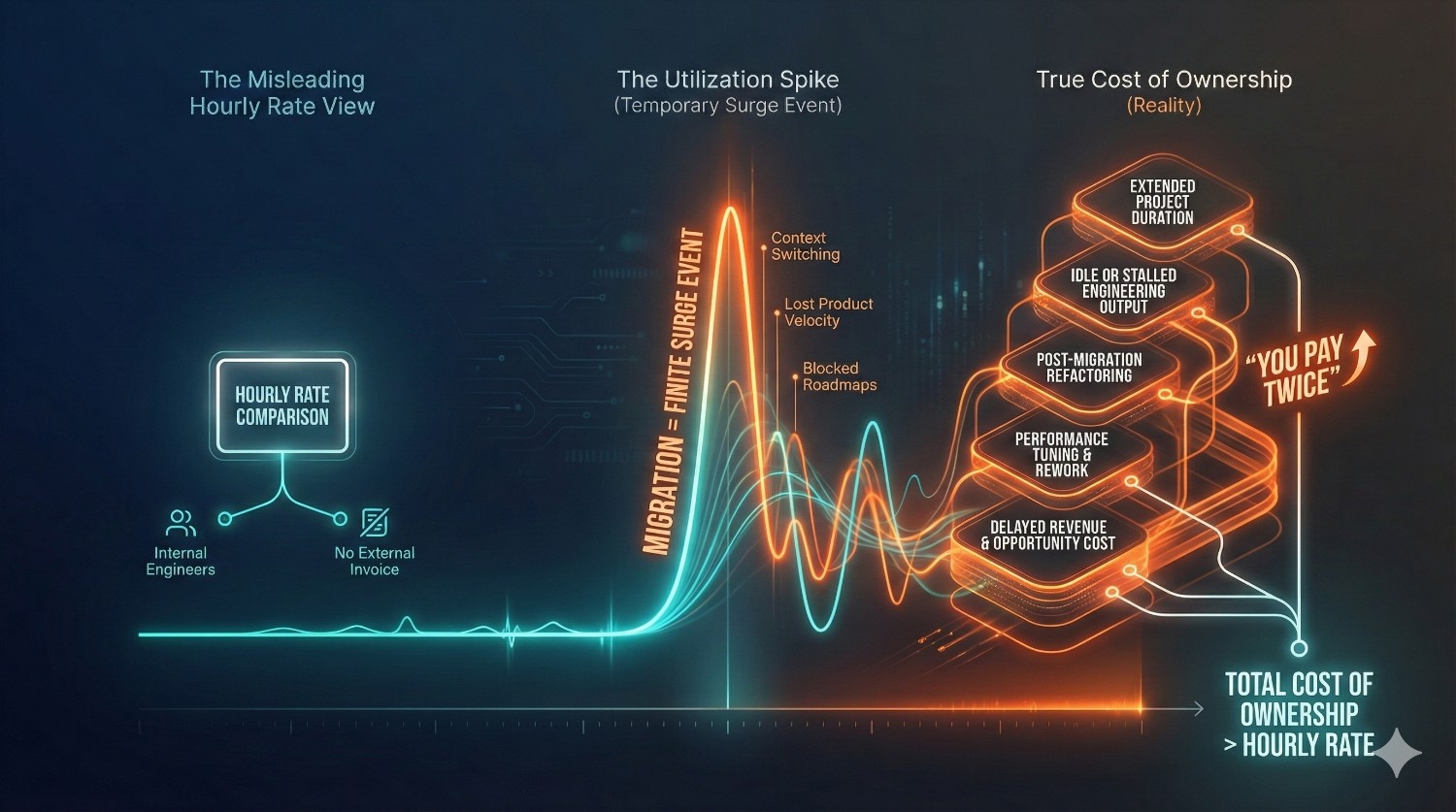
The true data migration consulting cost ROI becomes clear when you stop looking at hourly rates and start analyzing the total cost of ownership. The most expensive resource is a stalled engineering team that is not shipping value. When generalists are used for specialist work, you pay twice. You pay once in the prolonged project duration, and you pay again in the inevitable refactoring and performance tuning required post migration.
The Utilization Trap
The common argument for an internal project hinges on a simple hourly rate comparison. This math is fatally flawed because it treats a migration as a steady state activity. In reality, it is a temporary surge event. You are burning cash on a one-time problem.
The High Price of Internal Execution
Burning Cash on One time Problems
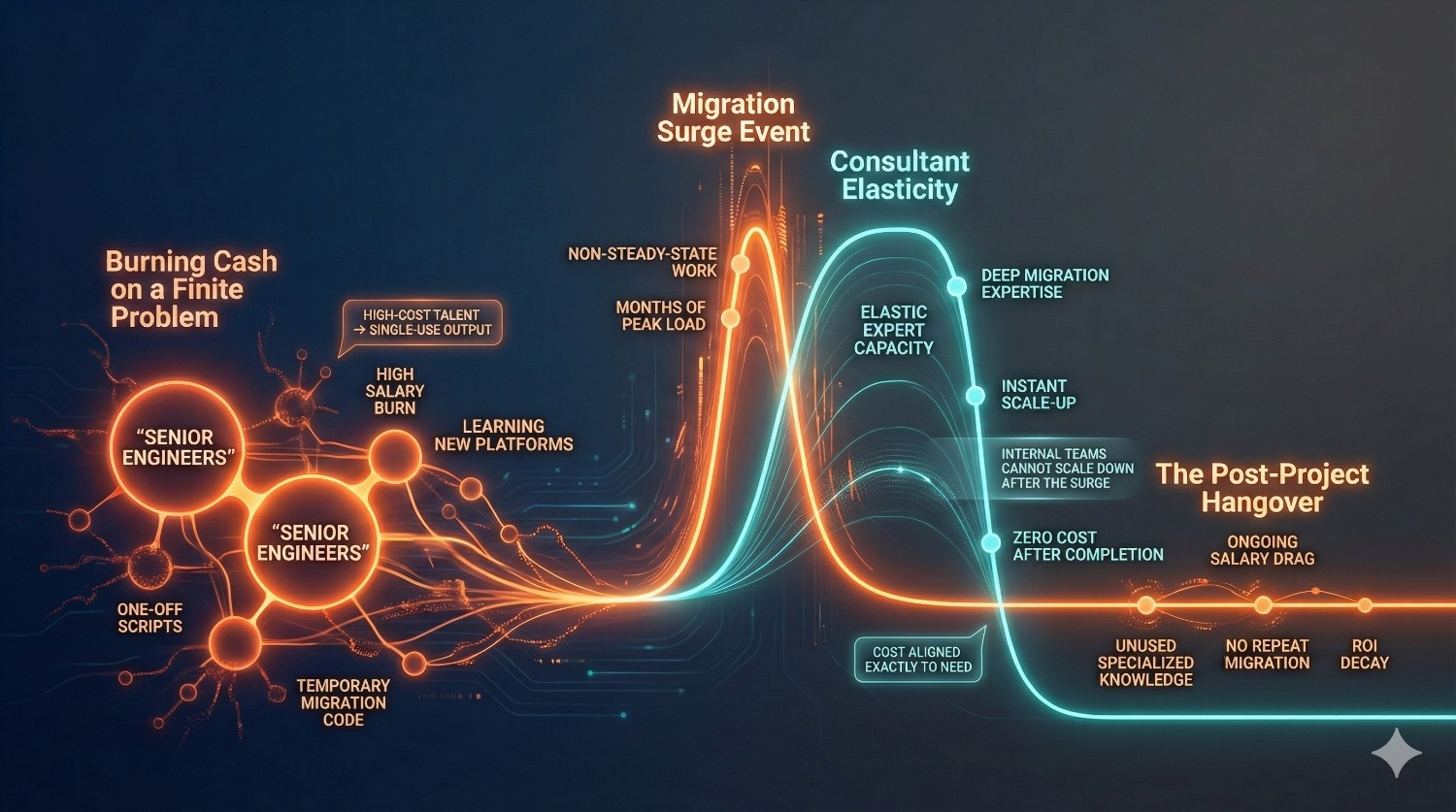
To migrate internally, you typically pull your top senior engineers off their core duties. They spend months learning new platforms and building disposable scripts code that is dead once the migration is complete. You are paying a premium for your most valuable talent to build single use tools that add no long term IP value.
The Surge Event Dynamics
A migration is a massive spike in workload. By engaging a consultant like Data Prism, you pay for elastic, expert capacity. You scale up deep expertise instantly for the surge and scale down to zero cost the day the project ends. This model aligns cost directly with need.
The Post Project Hangover
The hidden cost of the internal model manifests after project completion. You are left with high salaried engineers who are now experts in a process you will not repeat for years. You cannot scale down this cost, creating an ongoing drag on your data engineering ROI.
The Invisible Drain
The Opportunity Cost of Stalled Features
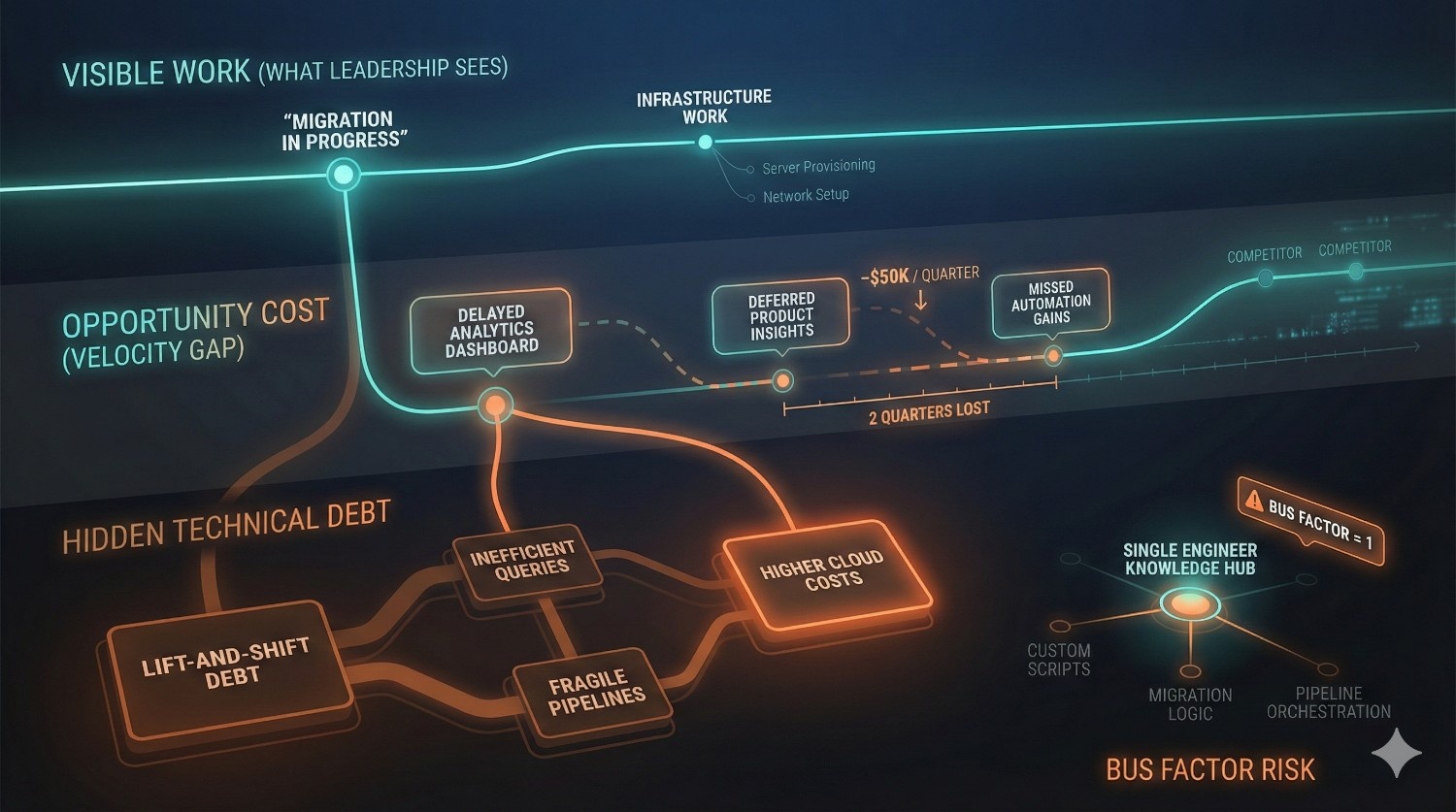
The most significant variable in the ROI calculation is often invisible on a balance sheet: Opportunity Cost. This represents the value of the roadmap features your team abandons while wrestling with infrastructure. If a new analytics dashboard projected to save $50,000 per quarter is delayed by two quarters, the migration has incurred a $100,000 hidden loss. While your team fights legacy databases, competitors are shipping new features, creating a velocity gap that is difficult to close.
The Hidden Risk of Technical Debt
A dangerous outcome of a DIY migration is a partial success that creates long term liability. Under time pressure, internal teams often choose a “lift and shift” approach, moving old technical debt into a new, expensive environment. This leads to inefficient queries, higher cloud costs, and fragile data pipelines.
The Bus Factor Risk
These projects often suffer from a high “bus factor.” If the one senior engineer who understands the custom migration scripts leaves, your new data infrastructure becomes a fragile black box, incurring massive future risk and remediation cost.
The Data Prism Advantage
Outcome Ownership, Not Time Billing
Most consulting engagements sell hours. Data Prism sells accountability.
We operate on an outcome-driven engagement model with clearly defined success criteria, delivery milestones, and risk boundaries. This structure aligns incentives correctly: we are motivated to finish faster, cleaner, and with fewer surprises. The risk of overruns, delays, and rework does not sit with your organization, it sits with us.
This model eliminates the utilization trap entirely. You are not managing headcount or utilization rates; you are purchasing a finished, validated migration.
Surge Expertise Without Long-Term Cost
A migration is a temporary surge problem, not a permanent staffing requirement. Data Prism provides immediate access to senior-level migration expertise without forcing you to hire, retrain, or retain specialists you will not need once the project is complete.
When the migration ends, the cost ends. There is no post-project payroll drag, no underutilized specialists, and no incentive to “find work” to justify headcount.
Architecture and Cost Discipline from Day One
Many migrations fail not during data movement, but in what they leave behind: inefficient schemas, expensive queries, and fragile pipelines. Data Prism approaches migrations as architectural transformations, not mechanical copy exercises.
We design target environments that are optimized for performance, governance, and long-term cost control. This prevents the common post-migration reality of ballooning cloud bills and months of corrective re-engineering.
Risk Reduction as a First-Class Deliverable
Every Data Prism engagement is structured around risk containment. We plan for validation, rollback, parallel execution, and controlled cutover before migration work begins. This reduces operational risk, protects business continuity, and gives stakeholders confidence throughout the process.
For executives, this risk reduction is not theoretical. It translates directly into fewer escalations, fewer emergency interventions, and fewer unpleasant surprises in board-level reporting.
Presenting the Business Case
Calculating the True ROI for the CFO
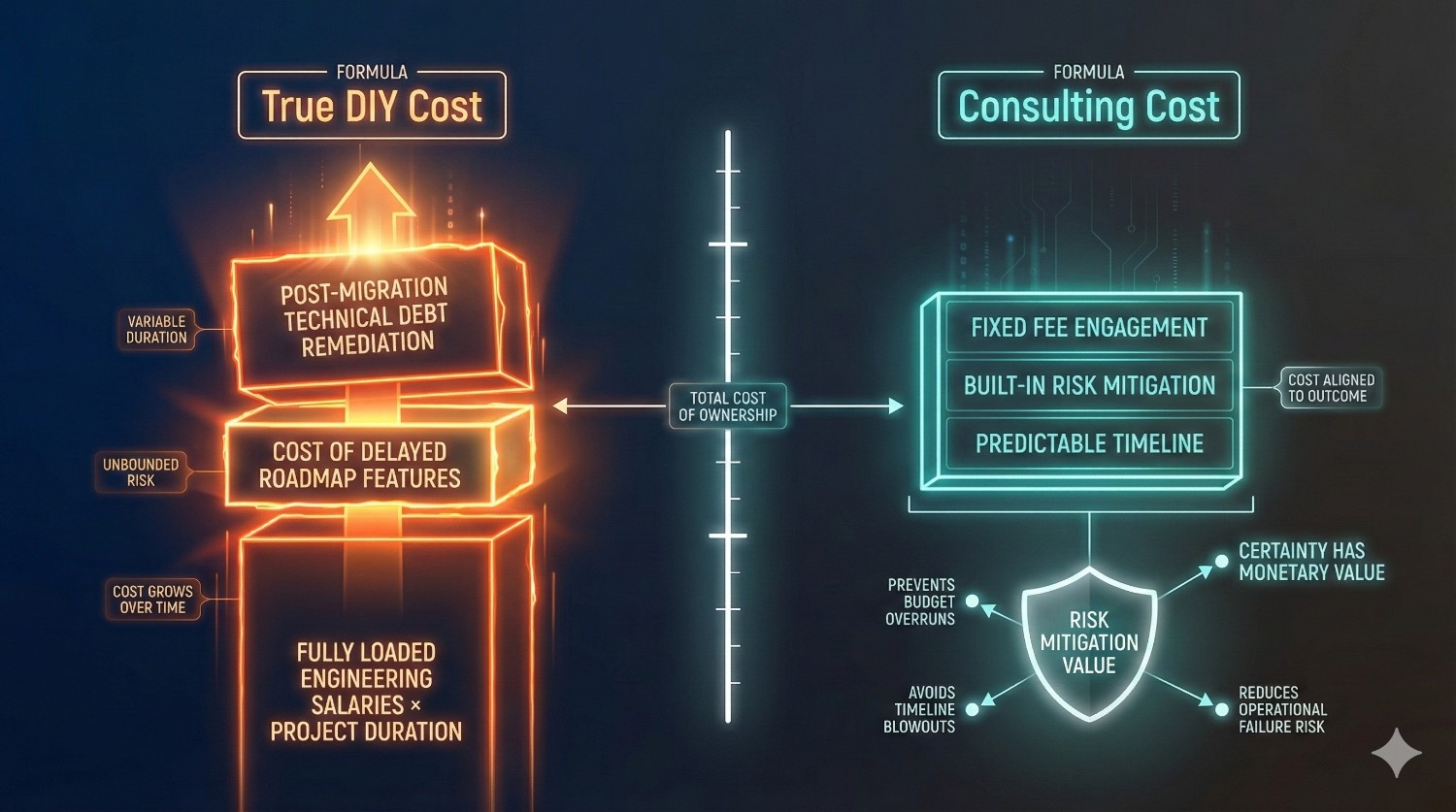
To secure a budget, you need a quantifiable formula. Compare the total cost of ownership of both paths.
True DIY Cost = (Fully Loaded Engineering Salaries x Project Duration) + Cost of Delayed Roadmap Features + Post Migration Technical Debt Remediation
Versus
Consulting Cost = Fixed Fee Risk Mitigation Value
Defining the Variables
Factor in the fully loaded cost of your engineers (salary, equity, benefits), then calculate the Cost of Delay from stalled projects.
Risk Mitigation Value
Finally, assign a value to risk mitigation. With industry failure rates high, partnering with Data Prism is an insurance policy against budget overruns, timeline blowouts, and operational failure. The value of this certainty is a critical line item in your ROI calculation.

Conclusion
In 2026, competitive advantage belongs to agile organizations. Tying up your most valuable engineering talent on infrastructure plumbing is a strategic misstep. The true winner is the leader who allocates resources effectively.
You must buy the outcome, not the hours. By leveraging specialized consulting from Data Prism, you purchase a guaranteed result, risk reduction, and the freedom for your team to focus on building your product’s future. You eliminate the learning curve, prevent team burnout, and ensure your data foundation is built on proven best practices.
Do not let hidden costs destroy your budget. Ready to calculate your migration ROI? Contact Data Prism today to see how our accelerator toolkit can cut your migration timeline by 40 percent and secure your data future.
Frequently Asked Questions (FAQ)
Our fixed fee covers the total cost of the specialized surge. When you use internal staff, you incur massive hidden costs: the opportunity cost of delayed product features, the cost of the learning curve, the long term cost of technical debt, and the ongoing cost of retaining specialized skills you no longer need. Our model eliminates these by providing concentrated expertise and IP, delivering the project faster and with a higher quality outcome, freeing your team to work on revenue generating activities.
Quite the opposite. Our methodology is built on collaboration and transparency. We use your team for domain knowledge while we provide migration expertise. We document everything meticulously and knowledge transfer is a core phase of our engagement. You gain the institutional knowledge of how to properly run a migration, rather than the one off knowledge of how your team painfully figured it out. This raises your team’s overall maturity.
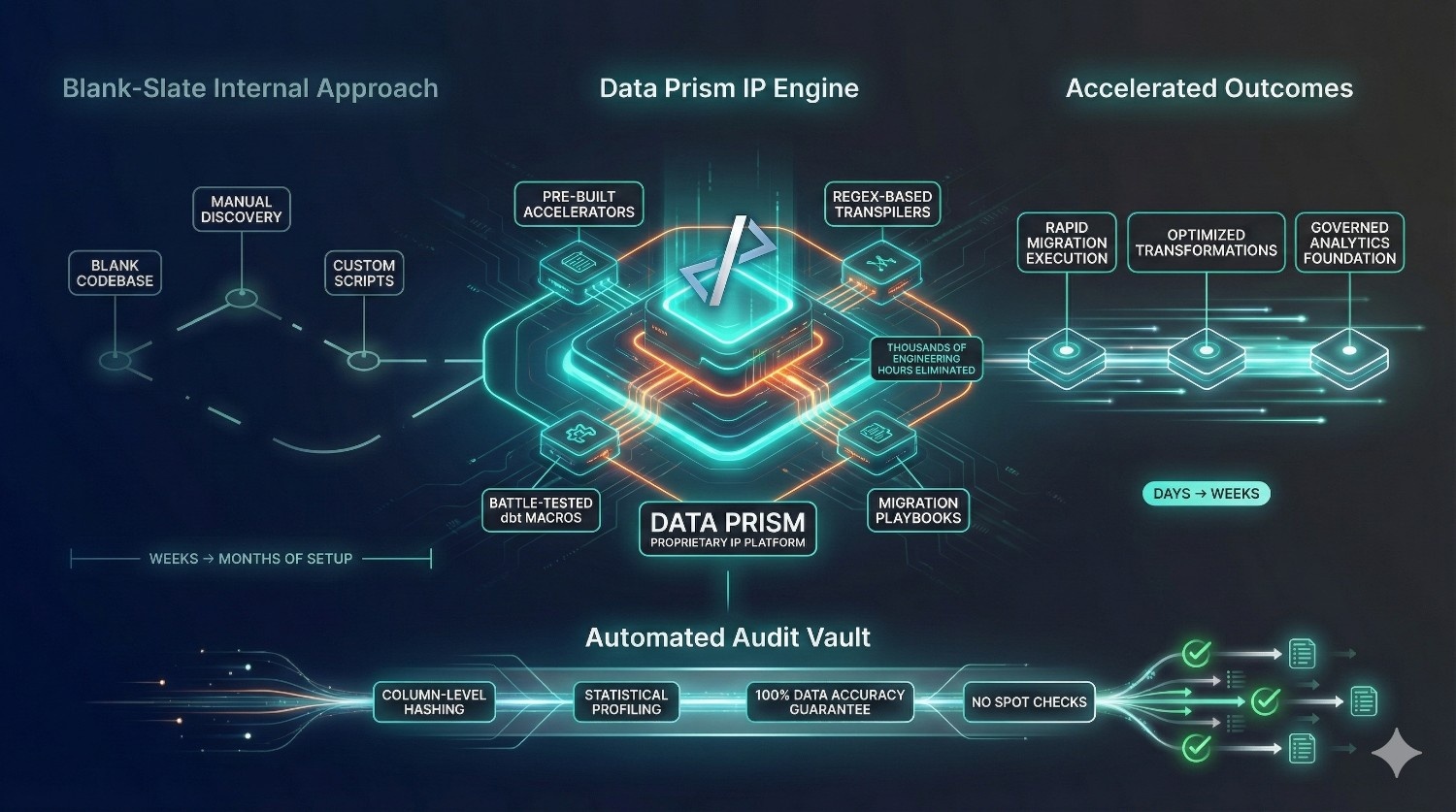
We move beyond simple row counts. Our proprietary Audit Vault tool provides automated, column by column validation using cryptographic hashing and statistical profiling. This gives us, and you, a mathematical guarantee of data integrity. For downtime, we employ proven cutover strategies, including parallel run periods and rollback scripts, to ensure business continuity is maintained.
Our engagement includes a formal handoff and support period. We ensure your team is confident in operating and maintaining the new environment. Furthermore, the architecture and code we deliver are built for the long term using modern, maintainable frameworks like dbt, setting you up for sustained success, not a post migration hangover.
Contact us for a dedicated ROI workshop. We will help you identify all the variables for your specific situation, your fully loaded engineering costs, the revenue impact of your current roadmap, and the risks specific to your data landscape. We will provide a clear, side by side financial comparison to inform your decision with hard numbers.