
Table of Contents

Introduction
For a long time, data migrations were treated as a background engineering task.Important, yes, but largely invisible to the business unless something went wrong.
That assumption no longer holds.
Today, data platforms sit directly on the critical path of revenue reporting, customer trust, regulatory compliance, AI initiatives, and operational decision-making. A failed migration is no longer just a technical inconvenience — it can become a platform-level risk with executive consequences.
This is why Data Migration Consulting has moved firmly into the CTO’s domain.
Modern migrations can affect:
- Financial reporting accuracy
- Customer-facing dashboards and SLAs
- Regulatory audits and data lineage
- Cost controls at the warehouse and infrastructure layer
- Trust in analytics, ML models, and downstream applications
When a migration goes wrong, the blast radius can be wide. Finance questions numbers. Product teams lose confidence in metrics. Engineering loses weeks firefighting regressions. Leadership loses predictability.
At the same time, data migrations themselves have become harder.
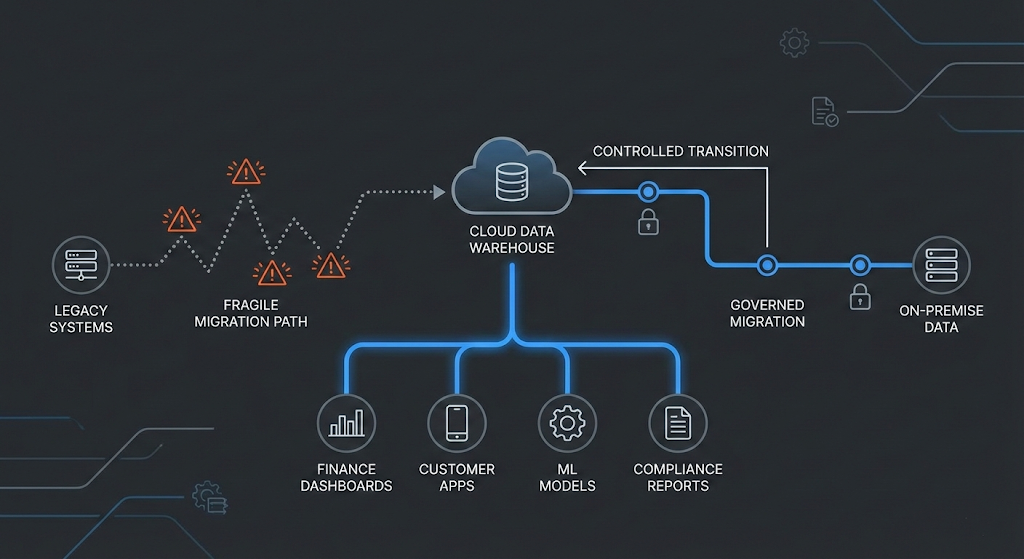
Data volumes are larger. Pipelines are more interconnected. Teams rely on dozens of upstream and downstream dependencies — BI tools, reverse ETL, ML pipelines, activation layers, third-party integrations. Even a “simple” platform change now touches far more surface area than it did five years ago.
This is why many organizations discover — often too late — that strong internal engineering teams still struggle with migrations.
Not because they lack skill.
But because large-scale migrations often require a fundamentally different operating model.
This guide is written for CTOs and Heads of Data who need to understand:
- Why migrations fail even with capable teams
- What Data Migration Consulting actually does differently
- How to evaluate consulting partners beyond credentials
- What outcomes you should demand, technically and organizationally
- How to de-risk migrations without slowing the business
The goal is not to convince you to outsource blindly.
The goal is to help you make migration decisions with clarity, leverage, and control.
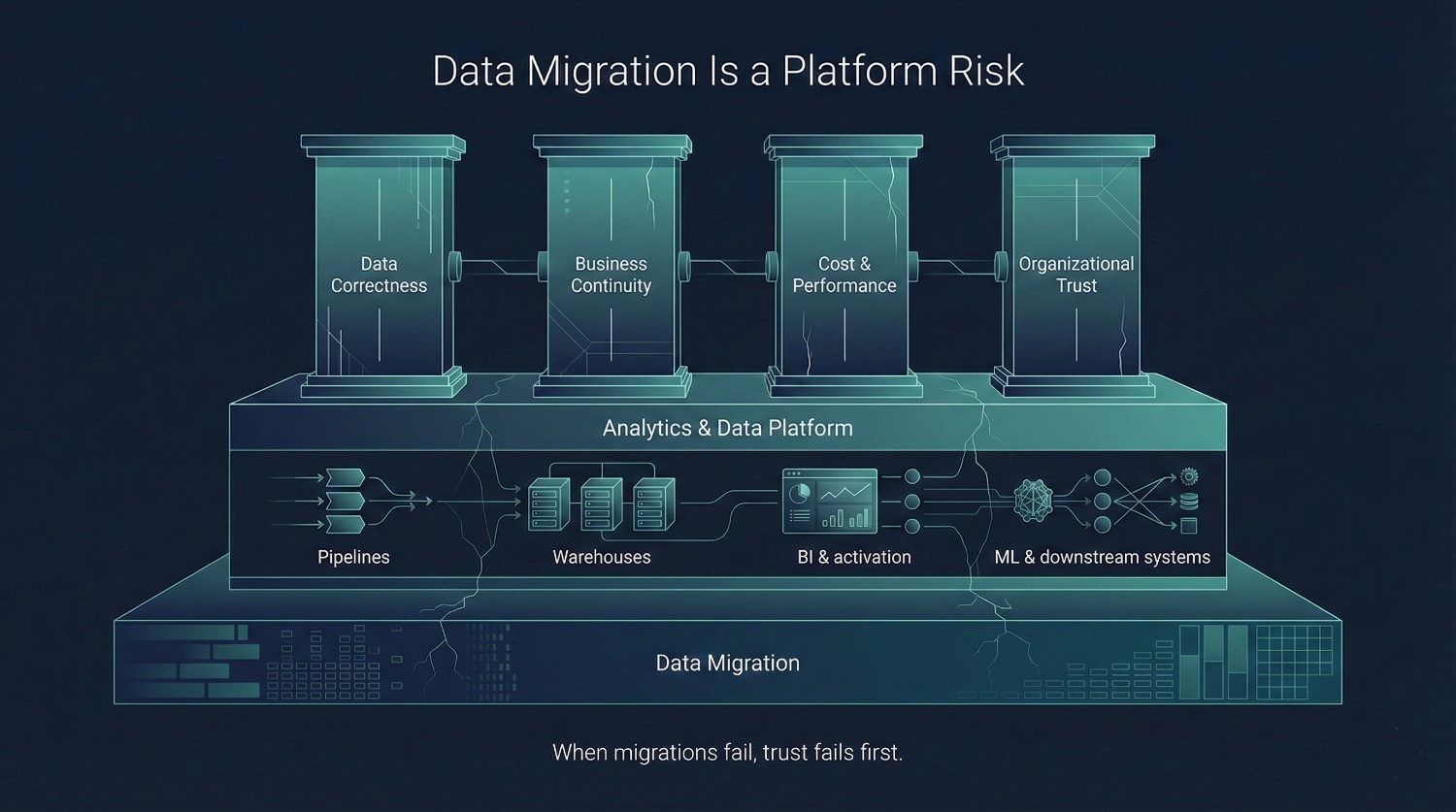
Data Migration Is No Longer Just a Technical Task, It’s a Platform Risk
One of the most common mistakes organizations make is framing data migration as a tooling exercise.
- “We’re moving warehouses.”
- “We’re upgrading the data stack.”
- “We’re refactoring pipelines.”
Those descriptions are technically accurate — but strategically misleading.
In reality, a migration can touch four layers simultaneously:
- Data correctness
- Business continuity
- Cost and performance
- Organizational trust
Data correctness is table-stakes, but not sufficient for success
Most migrations aim for functional parity:
- Tables load
- Queries run
- Dashboards render
But correctness is not binary.
Small discrepancies compound:
- Late-arriving data behaves differently
- Null handling changes
- Incremental logic drifts
- Historical backfills behave inconsistently
These issues often do not trigger alarms. They surface weeks later as “why does this number feel off?”
By then, the migration is “done,” and the cost of investigation is much higher.
Business continuity is fragile during migration windows
Even well-planned migrations introduce risk windows:
- Dual-write periods
- Partial cutovers
- Feature freezes
- Backfills overlapping with live usage
If these are not explicitly managed, teams end up choosing between:
- Shipping product features
- Stabilizing the migration
That tradeoff should not be implicit.
Cost behavior often changes silently
Different platforms — and even different configurations of the same platform — can have materially different cost profiles.
Without intentional cost modeling:
- Incremental jobs become full scans
- Ad-hoc BI usage explodes spend
- Retry loops amplify warehouse costs
- “Temporary” duplication becomes permanent
Finance notices. Engineering scrambles. Trust erodes.
Organizational trust is the hardest thing to rebuild
When data becomes unreliable, teams respond rationally:
- They export data to spreadsheets
- They create shadow pipelines
- They duplicate logic “just in case”
This fragmentation persists long after the migration ends.
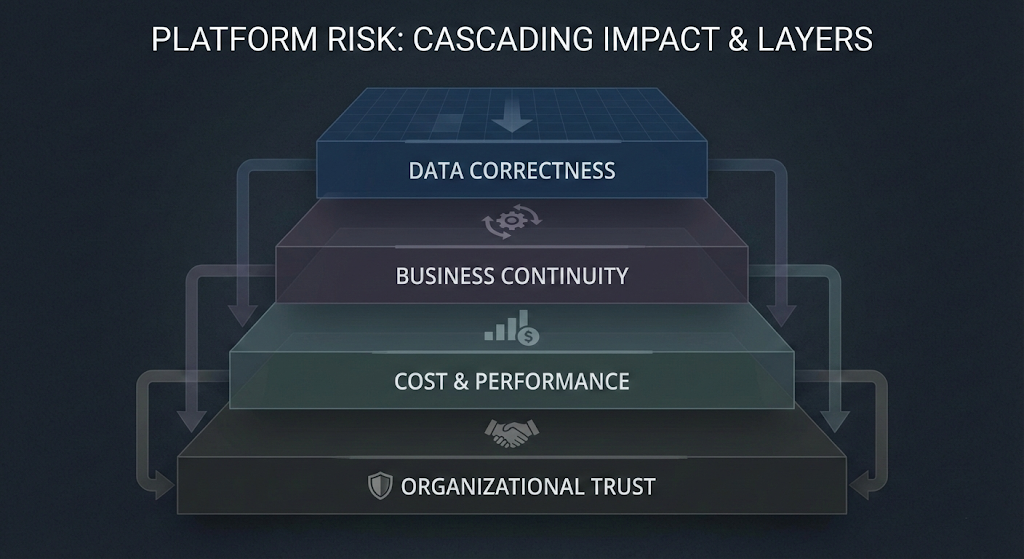
Data Migration Consulting often exists primarily to prevent this trust erosion — not just to move data.
Why Strong Internal Teams Still Struggle With Migrations
CTOs often ask a fair question:
“If we have senior data engineers, why do we need Data Migration Consulting?”
The answer is usually not capability — it’s incentives, context, and structure, which is where CTOs often get migration consulting wrong.
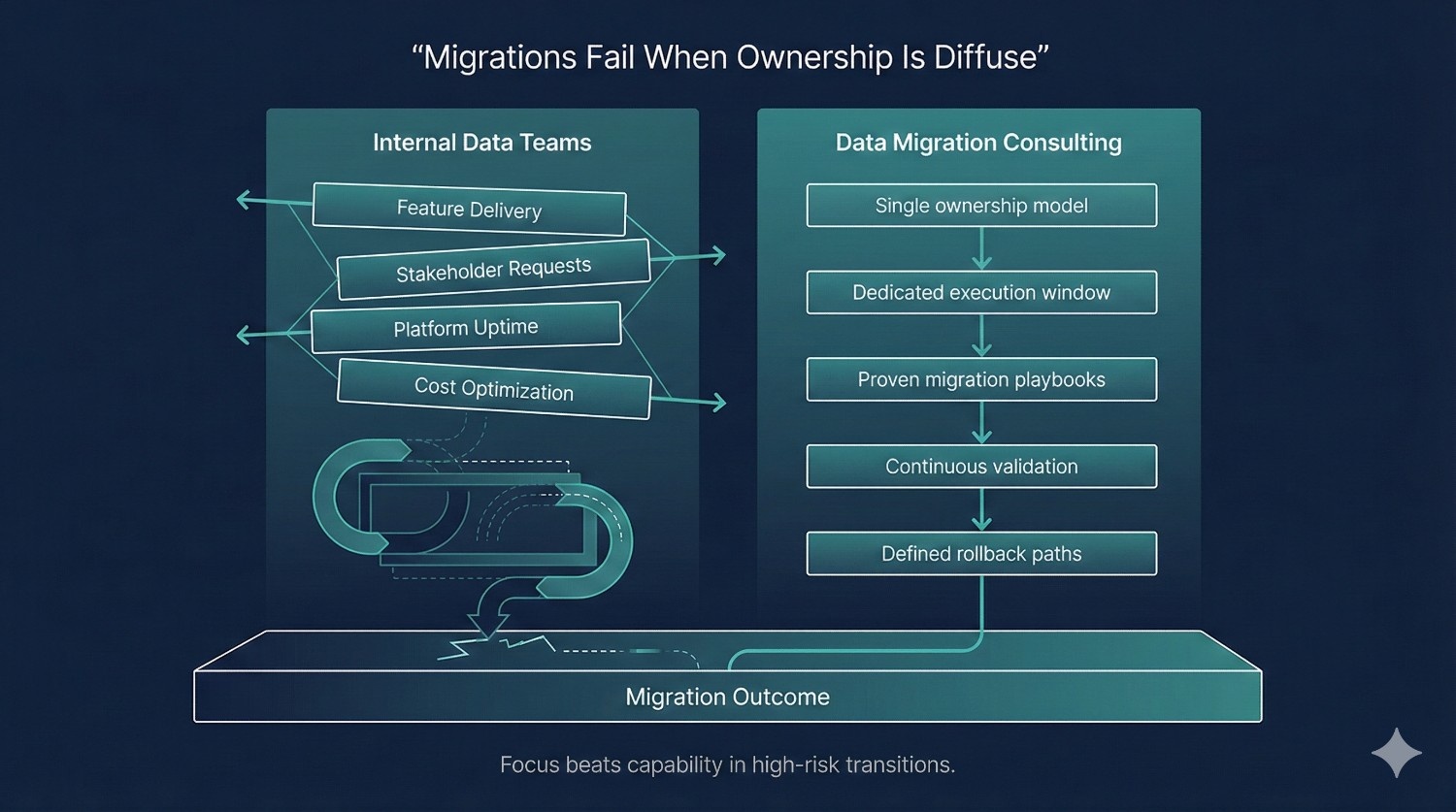
Internal teams optimize for delivery, not disruption
Most data teams are measured on:
- Feature velocity
- Stakeholder responsiveness
- Platform uptime
- Cost efficiency
Migrations often work against all four.
They introduce risk. They slow feature delivery. They require coordination across teams that don’t usually operate together.
Even highly capable engineers may naturally try to “minimize” migration work to protect delivery metrics.
Migrations lack a clear owner internally
In many organizations, migrations fall into an ownership gap:
- Platform team owns infrastructure
- Analytics team owns models
- Product teams own dashboards
- Finance owns reporting accuracy
When something breaks, no single team owns the outcome.
Consulting engagements force explicit ownership models that internal structures lack.
Engineers underestimate the long tail
Internal teams often plan for:
- Schema migration
- Pipeline refactors
- Dashboard updates
They underestimate:
- Backfill validation
- Edge-case queries
- Historical discrepancies
- Behavioral differences under load
- Post-cutover support
The long tail is where migrations often fail quietly.
Context switching kills migration momentum
Migrations require sustained focus.
Internal teams often struggle to get it.
Urgent bugs, stakeholder requests, roadmap pressure — all interrupt migration work. The result is prolonged dual-running states that increase risk instead of reducing it.
Data Migration Consulting introduces a dedicated execution lane that internal teams often cannot protect.
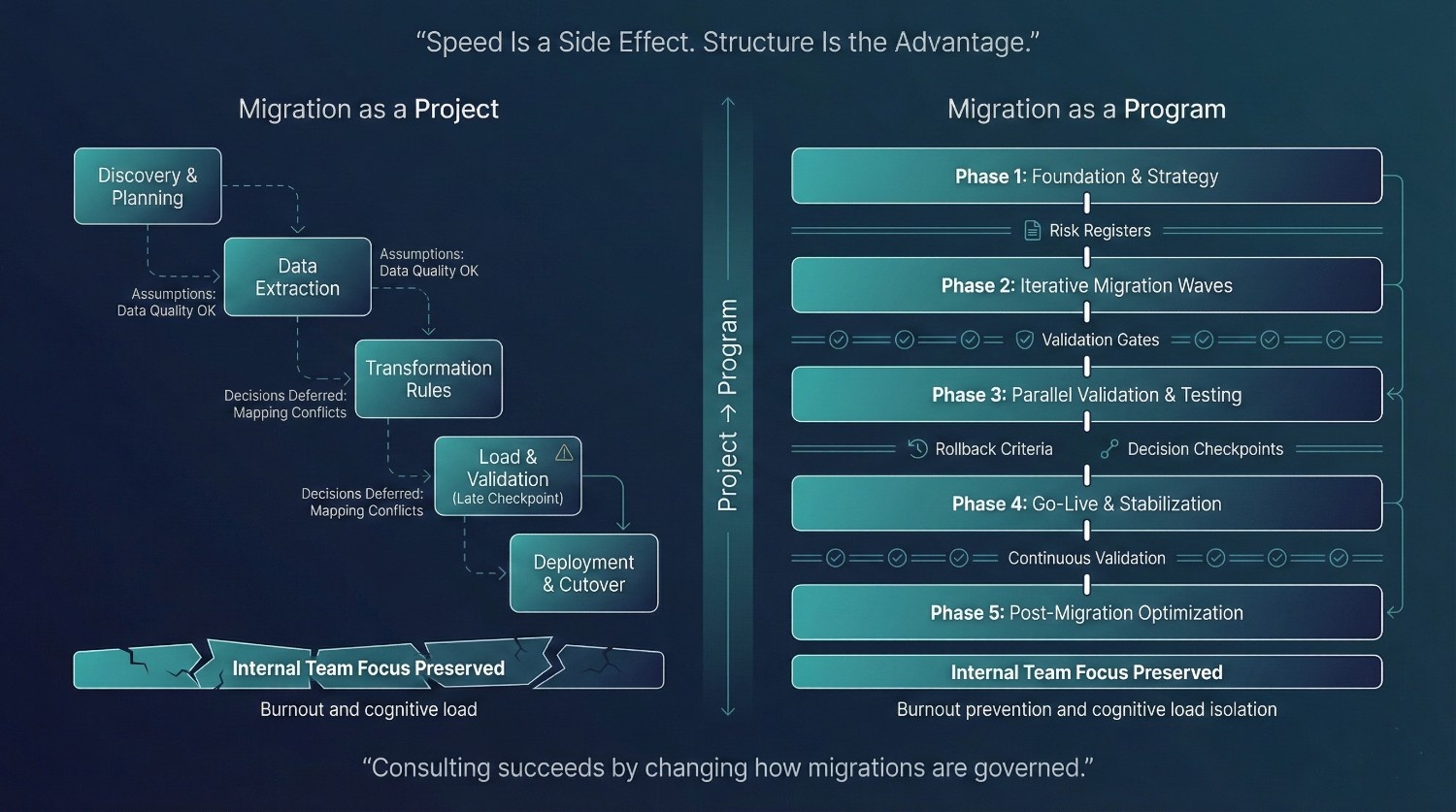
What Data Migration Consulting Actually Changes
There is a misconception that consultants simply “do the work faster.”
In practice, Data Migration Consulting changes the operating model of the migration itself.
It reframes the migration as a program, not a project
Projects have tasks.
Programs have:
- Phases
- Risk registers
- Validation gates
- Rollback criteria
- Executive visibility
Consulting-led migrations are typically designed as programs with explicit control points.
It introduces independent validation
Internal teams are often validating their own work under time pressure.
Consultants provide:
- Parallel validation paths
- Independent reconciliation
- Assumption challenges
- Failure-mode analysis
This separation significantly reduces blind spots that frequently explain why cloud data migrations fail even with great engineers.
It enforces explicit decision-making
During migrations, many decisions get deferred:
- “We’ll clean that later”
- “We’ll optimize after cutover”
- “This edge case is rare”
Consulting frameworks encourage decisions to be made explicitly — and documented — so risks are owned, not forgotten.
It protects internal teams from burnout
Migrations are mentally expensive.
Consultants absorb:
- Migration-specific cognitive load
- Cross-team coordination
- Repetitive validation work
This allows internal teams to stay focused on business delivery while still contributing strategically.
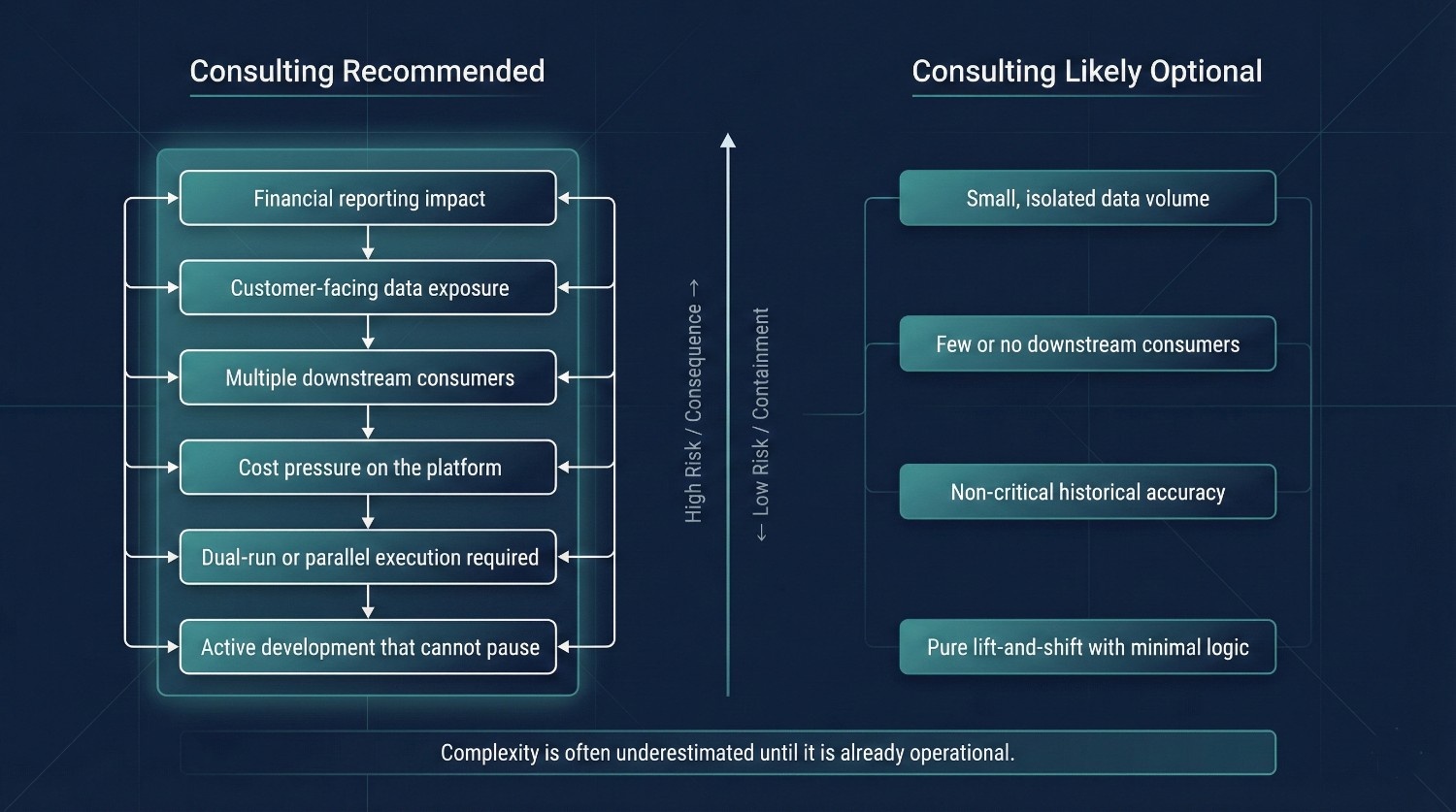
Not every migration needs external consulting.
But many organizations wait until it’s too late to ask for help.
Data Migration Consulting is strongly recommended when one or more of the following apply:
- The migration impacts financial reporting
- Downtime or incorrect data affects customers
- Multiple teams depend on the same datasets
- The platform is already under cost pressure
- You need to dual-run systems safely for a sustained period
- You cannot freeze development for weeks
It may be unnecessary when:
- Data volume is small and isolated
- There are few downstream consumers
- Historical accuracy is not business-critical
- The migration is a true lift-and-shift with minimal transformation logic
The mistake is not hiring consultants unnecessarily.
The mistake is assuming complexity is lower than it is — and discovering otherwise mid-migration.
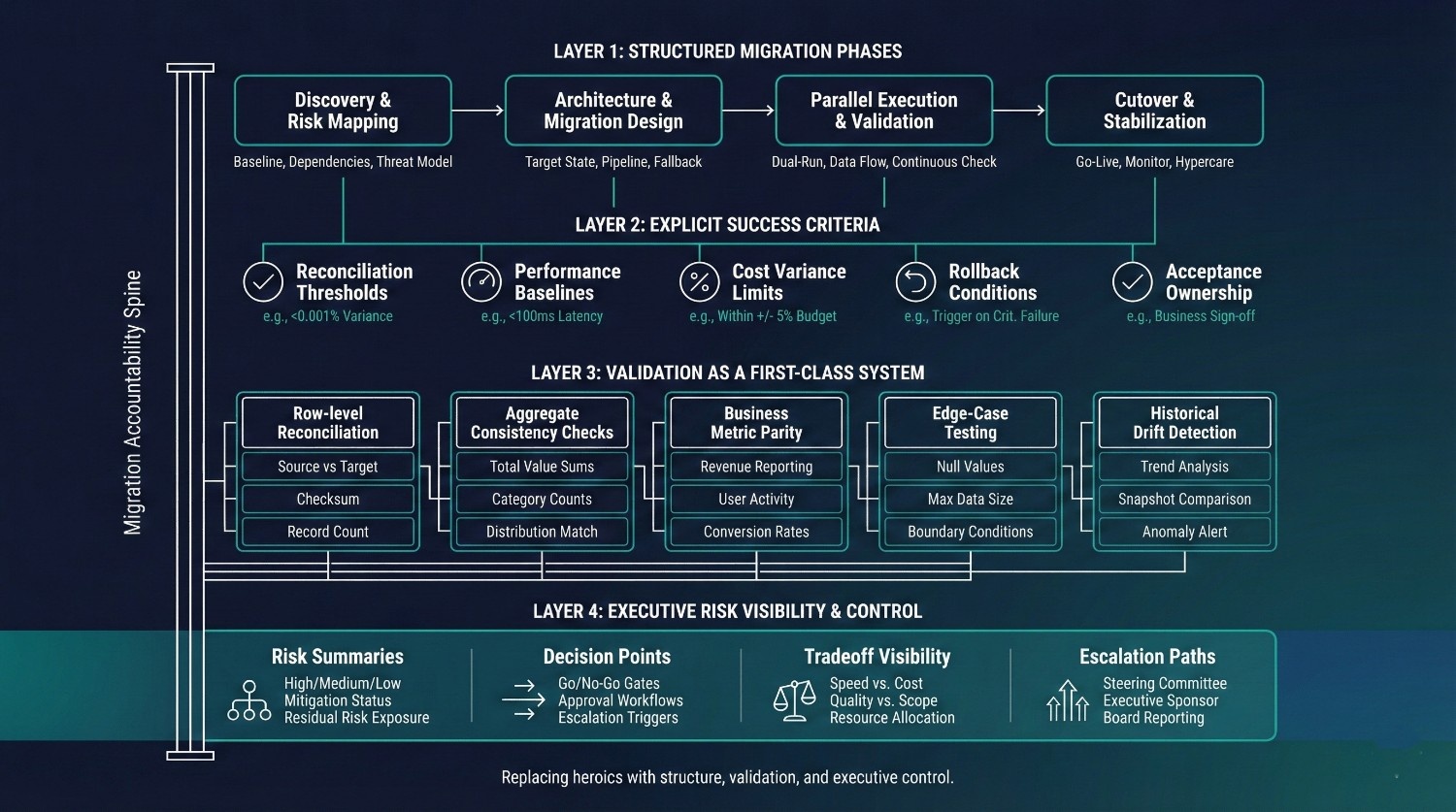
What to Expect From High-Quality Data Migration Consulting
Not all consulting engagements are equal.
CTOs should expect structure, transparency, and accountability — not heroics.
Clear migration phases
A credible consulting engagement defines phases such as:
- Discovery and risk mapping
- Architecture and migration design
- Parallel execution and validation
- Cutover planning
- Post-migration stabilization
Each phase has deliverables, not just activities.
Explicit success criteria
You should never hear “it depends” as the final answer when asking how success is measured.
Expect criteria like:
- Data reconciliation thresholds
- Performance baselines
- Cost variance limits
- Rollback conditions
- Acceptance sign-off owners
Validation as a first-class concern
Validation should not be an afterthought.
Strong Data Migration Consulting typically includes:
- Row-level reconciliation
- Aggregate checks
- Business metric parity
- Edge-case scenario testing
- Historical drift analysis
Risk visibility at the executive level
CTOs should receive:
- Clear risk summaries
- Decision points
- Tradeoff explanations
- Escalation paths
If risks are buried in engineering tickets, the engagement is mis-structured.
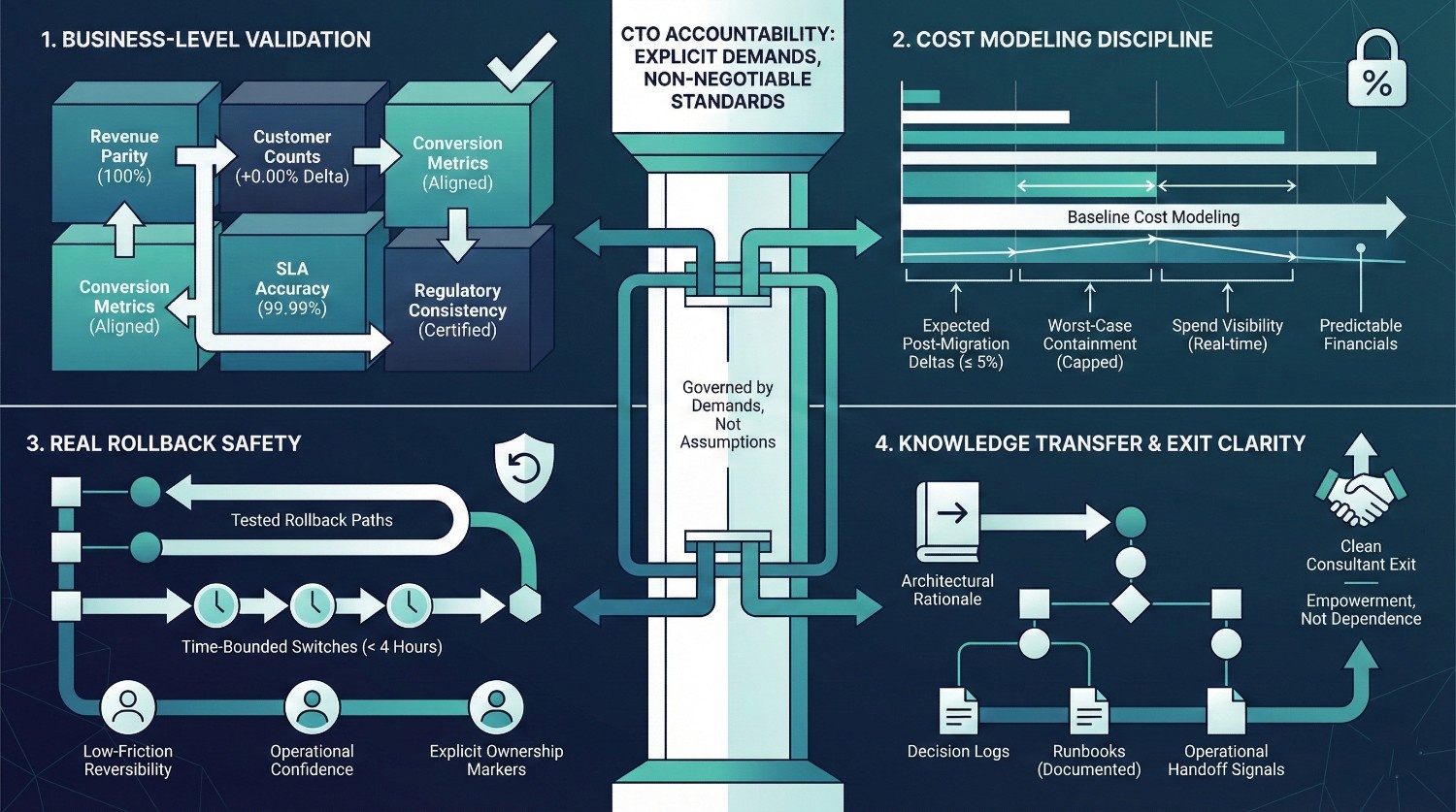
What CTOs Should Demand (and Not Settle For)
Many migrations fail not because consultants are incompetent — but because expectations were never clearly set.
Here is what CTOs should explicitly demand.
Demand: Business-level validation, not just technical checks
Technical correctness is insufficient.
You should see validation framed in terms of:
- Revenue numbers
- Customer counts
- Conversion metrics
- SLA calculations
- Regulatory reports
If consultants only talk about tables and schemas, they are missing the point.
Demand: Cost modeling before and after migration
You should not accept “we’ll optimize later.”
Demand:
- Baseline cost analysis
- Expected cost deltas
- Worst-case scenarios
- Guardrails for post-migration spend
Cost surprises undermine trust in the analytics platform.
Demand: A rollback strategy that actually works
Rollback plans should be:
- Tested, not theoretical
- Time-bound
- Clearly owned
If rollback requires heroic effort under expected failure scenarios, it is not a real rollback.
Demand: Knowledge transfer, not dependency
A successful engagement leaves your team stronger.
Expect:
- Clear documentation
- Architectural rationale
- Decision logs
- Operational runbooks
Consultants should exit cleanly — not embed themselves permanently.
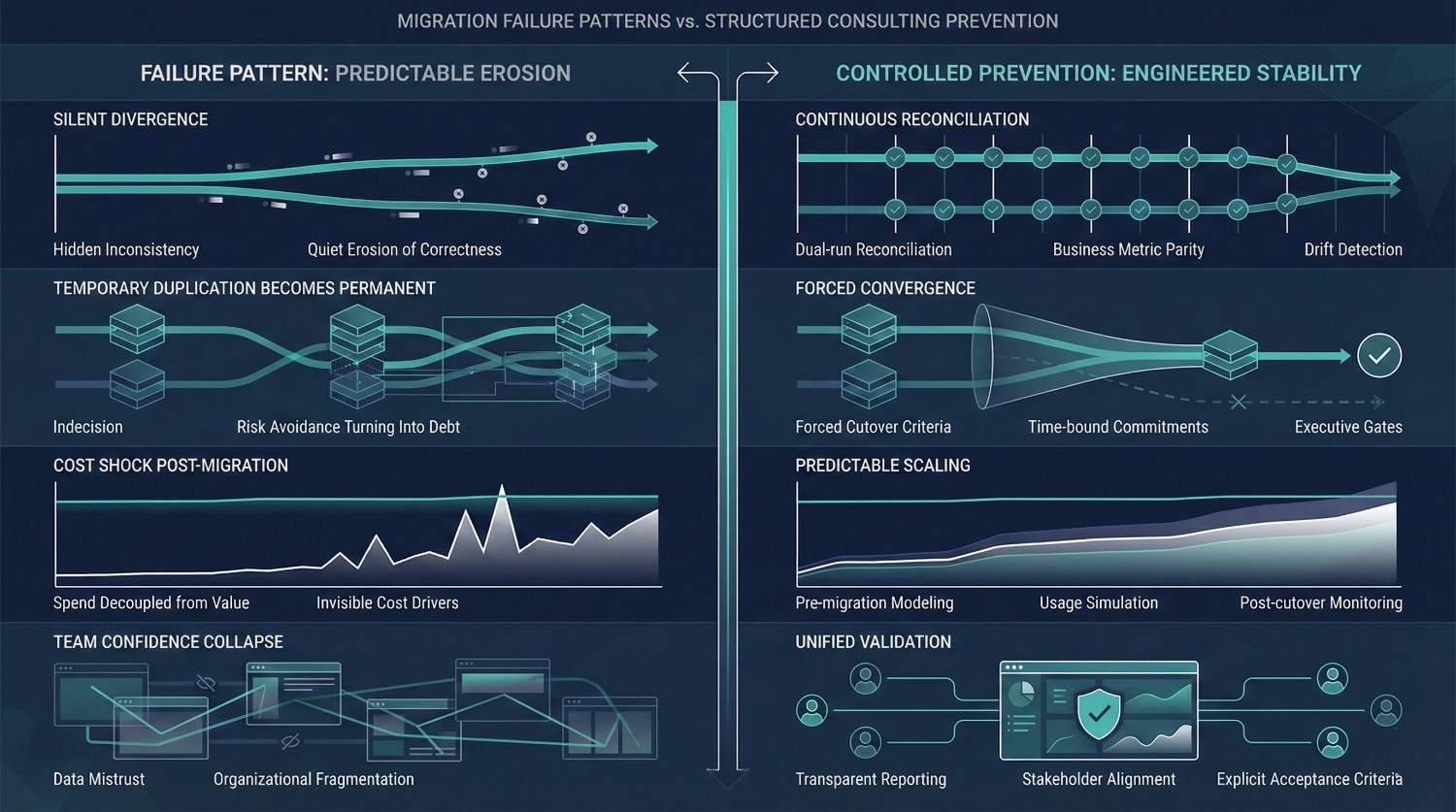
Common Failure Patterns in Data Migrations (and How Consulting Prevents Them)
Understanding failure patterns helps CTOs evaluate whether risks are being addressed — a core part of how CTOs should think about risk in cloud data migration.”
Failure Pattern: “Silent divergence”
Systems appear to work — but numbers slowly drift.
Cause:
- Different incremental logic
- Late data handling changes
- Timezone mismatches
Prevention:
- Continuous reconciliation during dual-run
- Business metric comparisons
- Automated drift detection when feasible
Failure Pattern: “Temporary duplication becomes permanent”
Data is duplicated “just for safety.”
Months later, both systems are still live.
Cause:
- No forced cutover criteria
- Fear of rollback complexity
Prevention:
- Explicit decommission timelines
- Explicit cutover commitments
- Executive sign-off gates
Failure Pattern: “Cost shock post-migration”
Performance improves — but costs increase unexpectedly.
Cause:
- New query patterns
- Different pricing models
- Lack of workload isolation
Prevention:
- Pre-migration cost modeling
- Usage simulations
- Post-cutover cost monitoring
Failure Pattern: “Team confidence collapse”
Even correct data is no longer trusted.
Cause:
- Poor communication
- Unclear validation
- Inconsistent messaging
Prevention:
- Transparent validation reporting
- Stakeholder communication plans
- Shared acceptance criteria
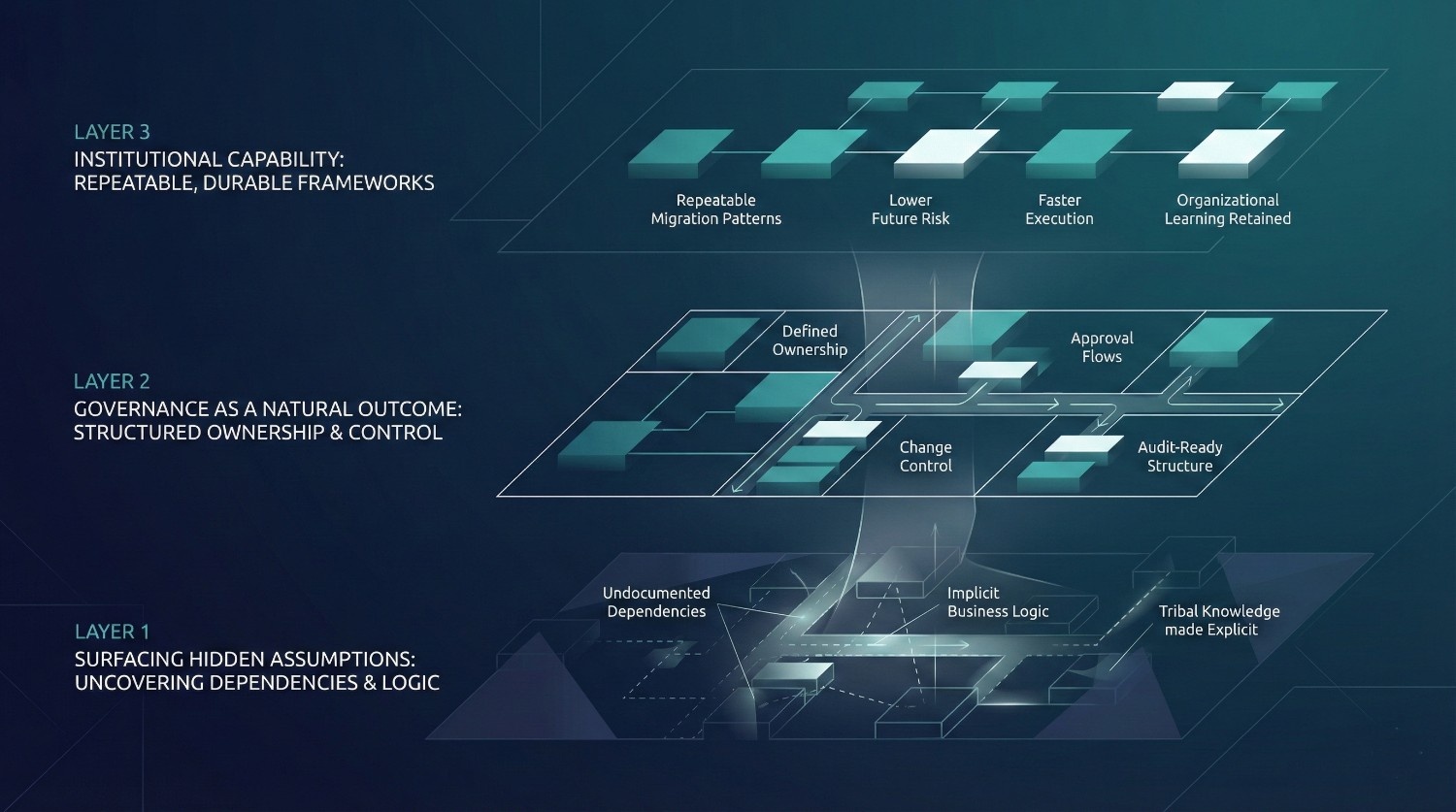
The Hidden Value of Data Migration Consulting
One under-appreciated benefit of Data Migration Consulting is the organizational maturity it can force.
Migrations surface undocumented assumptions
During migrations, teams discover:
- Hidden dependencies
- Implicit business rules
- Unowned pipelines
- Tribal knowledge
Consultants help make these explicit — sometimes for the first time.
Governance improves as a side-effect
Well-run migrations require controls typically formalized in a strong data migration testing strategy:
- Ownership models
- Approval workflows
- Change management
- Audit trails
These practices often persist after the migration, strengthening the platform overall.
Teams learn how to migrate safely in the future
A good consulting engagement is not just execution — it’s a blueprint.
Future migrations become:
- Faster
- Less risky
- More predictable
That institutional knowledge can be as valuable as the migration itself.
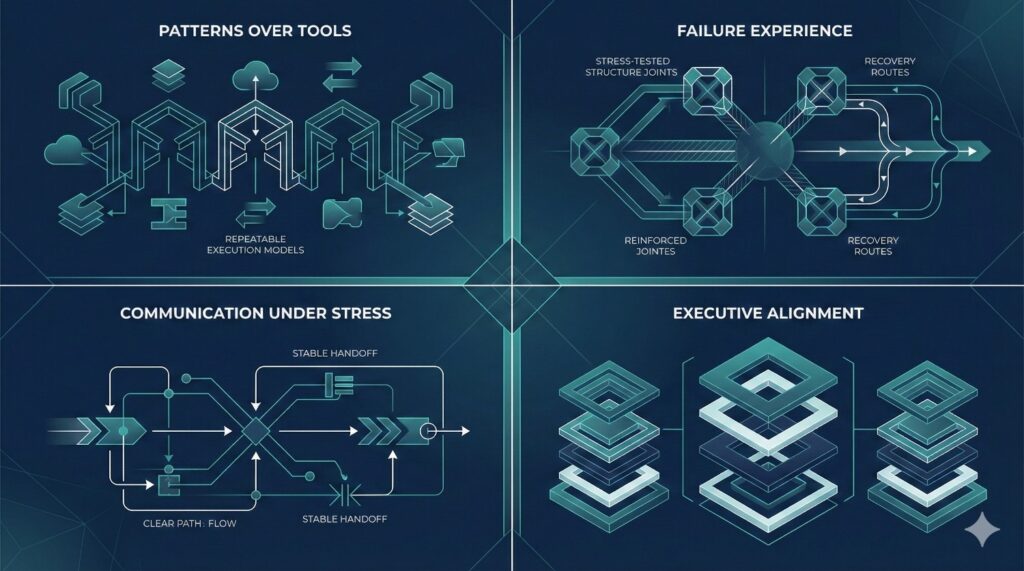
How CTOs Should Evaluate Data Migration Consulting Partners
Selecting a consulting partner is a risk decision.
Here’s how CTOs should think about evaluation.
Look for migration patterns, not tool expertise
Tool expertise is table-stakes for credible migration work.
Ask about:
- Migration frameworks
- Validation strategies
- Risk management approaches
- Failure recovery stories
Ask about the worst migration they’ve handled
Success stories are easy.
Failures reveal:
- How consultants think under pressure?
- How transparent they are?
- Whether they learn from mistakes?
Evaluate communication, not just delivery
You will be working with this team under stress.
Assess:
- Clarity of explanations
- Willingness to say “no”
- Ability to translate technical risk into business terms
Ensure executive alignment
Consultants should be comfortable speaking to:
- CTOs
- Finance leaders
- Product heads
If they only communicate at the engineer level, risks will be missed.
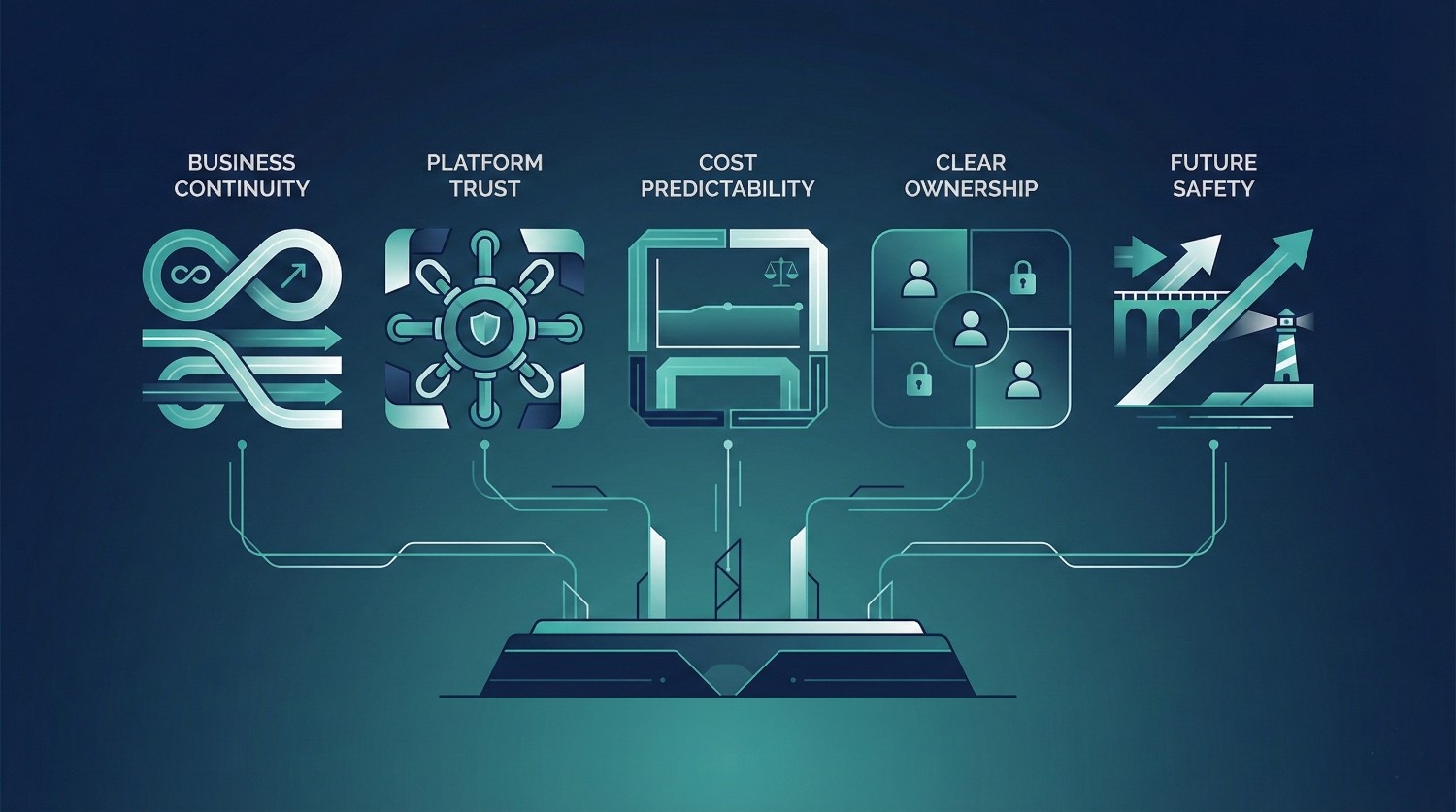
Outcomes That Signal a Successful Migration
A migration is successful when:
- The business barely noticed it operationally
- Internal teams trust the platform more than before
- Costs are predictable
- Ownership is clearer
- Future changes feel safer
Technically correct migrations that erode trust are failures — even if no incidents were logged.
Data Migration Consulting, at its best, delivers confidence — not just data movement.
Conclusion
For modern CTOs, data migrations are unavoidable.
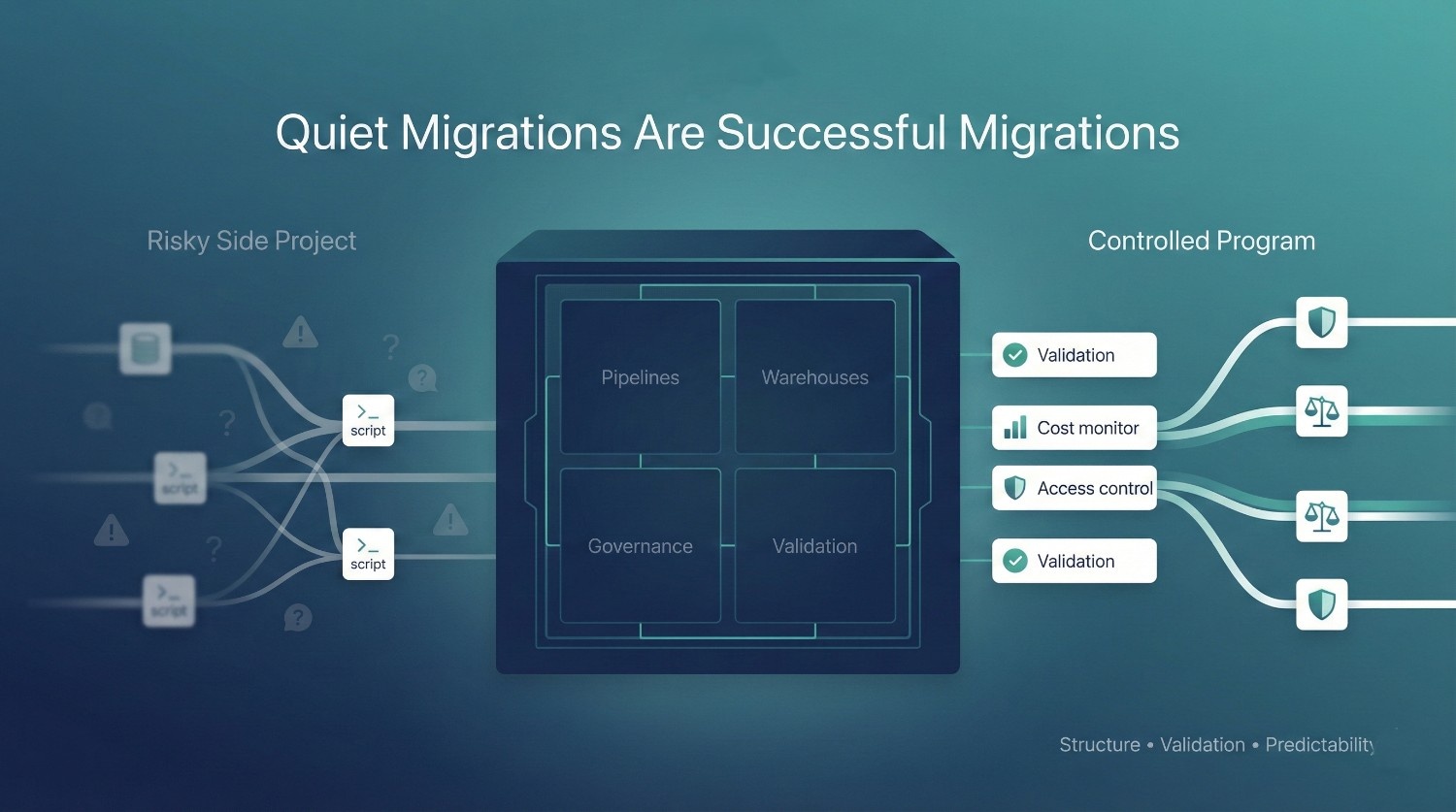
What is optional is whether they are treated as:
- A risky side project
- Or a controlled, well-governed program
Data Migration Consulting is not about outsourcing responsibility.
It is about introducing:
- Structure where chaos is likely
- Validation where assumptions hide
- Predictability where risk accumulates
The best consulting engagements are quiet.
They don’t generate hero stories.
They don’t require emergency escalations.
They simply work — and leave the platform stronger than before.
For CTOs and Heads of Data, that is the real return on investment.
Frequently Asked Questions (FAQ)
No.
Staff augmentation adds capacity. Data Migration Consulting changes the operating model of the migration.
Consulting engagements introduce:
- Explicit risk ownership
- Independent validation
- Structured cutover and rollback planning
- Executive-level visibility
If the goal is simply “more hands,” consulting is unnecessary. If the goal is predictable outcomes under risk, consulting fills a different role entirely.
Yes — in the right conditions.
Internal teams are most likely to succeed when:
- Data volumes are modest
- Downstream dependencies are limited
- Historical accuracy is not business-critical
- The migration is isolated from revenue and compliance workflows
Problems arise when migrations intersect with financial reporting, customer trust, or platform stability. In those cases, capability is often not the primary issue — structure and incentives are.
Ideally, before execution begins.
The highest leverage points are:
- During discovery and risk mapping
- While defining validation and reconciliation strategies
- When designing dual-run and cutover plans
Bringing consultants in after issues surface often turns a prevention exercise into damage control — which is slower, more expensive, and more disruptive.
Short-term velocity may appear slower.
Long-term delivery becomes faster and safer.
Consulting reduces:
- Rework from silent data issues
- Prolonged dual-run periods
- Emergency firefighting post-cutover
The net effect is fewer interruptions to product delivery — even if the migration itself is more deliberate.
High-quality engagements define success before work begins.
Typical success criteria include:
- Business metric parity within agreed thresholds
- Performance baselines met or exceeded
- Cost variance within predefined limits
- Clean cutover with tested rollback readiness
- Clear ownership and operational handoff
If success cannot be articulated upfront, risk is being deferred — not managed.
The CTO should not manage tasks — but must own risk decisions.
Effective CTO involvement includes:
- Approving risk tradeoffs explicitly
- Ensuring executive alignment across Finance, Product, and Engineering
- Holding the engagement accountable to business-level outcomes
Migrations fail most often when leadership engagement is implicit rather than structured.
There is no universal timeline.
Duration depends on:
- Data volume and history depth
- Number of dependent systems
- Validation rigor required
- Dual-run and stabilization expectations
What consulting improves is not speed — but predictability. You should know why the migration takes as long as it does, and what risks are being retired at each stage.
They should do the opposite.
A successful Data Migration Consulting engagement:
- Documents assumptions and decisions
- Transfers architectural context
- Leaves behind validation frameworks and runbooks
If your team feels weaker or more dependent after the engagement, the consulting model was flawed.
No — but it is only justified where risk concentration is high.
Mid-sized organizations often benefit the most because:
- They lack redundancy to absorb failures
- Trust erosion spreads faster
- Cost overruns are felt immediately
Consulting is not about company size — it’s about blast radius.
Underestimating the long tail.
Most failures do not happen during cutover.
They happen weeks later through:
- Quiet data drift
- Cost regressions
- Loss of stakeholder trust
Data Migration Consulting often exists to manage what happens after the migration is declared “done.”
Be cautious if a partner:
- Focuses primarily on tools rather than migration patterns
- Cannot clearly explain validation and rollback strategies
- Avoids discussing past failures
- Measures success only in technical terms
Migration consulting is a risk discipline. If risk is not central to the conversation, it is being ignored.