
Table of Contents

Introduction
Many leaders think they know what data warehouse consulting is.
Ask ten leaders, and you’ll hear confident answers:
- “It’s setting up Snowflake or BigQuery.”
- “It’s building ETL pipelines.”
- “It’s creating dashboards for the business.”
These answers sound reasonable at a surface level.
They are also incomplete—and frequently misleading.
The Shallow Definition Problem
Many organizations reduce data warehouse consulting to a bundle of visible outputs:
- Tool setup and configuration
- ETL or ELT pipelines
- Reporting tables and dashboards
These are artifacts. They are outputs, not the work itself.
When data warehouse consulting is framed this way, it becomes indistinguishable from:
- Staff augmentation
- One-off implementation projects
- Tool-specific contracting
That framing sets everyone up to fail.
Why This Misunderstanding Is So Costly
When leaders misunderstand what data warehouse consulting actually involves, several well-documented problems follow.
Failed Engagements
Consultants deliver what was asked for—pipelines, schemas, dashboards—but leadership often feels underwhelmed because the organization’s real problems remain unsolved. The technical delivery may be correct, but decision-making behavior remains unchanged—revealing a gap between implementation success and organizational impact.
Mismatched Expectations
Executives expect clarity, alignment, and decision confidence.
Consultants are measured on delivery speed and technical completeness.
Both sides may believe the other “missed the point.”
Distrust Between Consultants and Leadership
Leadership feels they paid for transformation and got infrastructure.
Consultants feel they delivered exactly what was scoped.
The breakdown usually isn’t malicious. It’s conceptual.
The Root Cause
Data warehouse consulting is not primarily about building things.
It is about making the organization capable of using data reliably at scale over time.
That includes:
- Deciding what data means
- Defining ownership and accountability
- Designing systems that reflect business reality
- Reducing friction between data producers and data consumers
- Making data trustworthy enough to be used in real decisions
Pipelines and dashboards are necessary, but they are means, not the purpose. Major cloud data platform vendors increasingly frame data warehousing as an operating capability, not an implementation task—emphasizing governance, ownership, and semantic consistency as prerequisites for value, not add-ons, a shift that aligns with dbt Fusion’s semantic layer and governance model.
What This Article Will Do
This article is written to reframe the conversation.
Specifically, it will:
- Define what data warehouse consulting actually is
Beyond tools, beyond pipelines, beyond diagrams. - Clarify what it is not
So leaders stop hiring for the wrong thing and being disappointed by predictable outcomes. - Help leaders decide whether they need it at all right now
Because in some cases, they don’t—and pretending they do only creates more confusion.
If you’ve ever felt that a “successful” data warehouse engagement failed to change how decisions are made, this article will explain why.
And more importantly, it will show what real data warehouse consulting looks like when it’s done correctly—and why it feels very different from what most people expect.
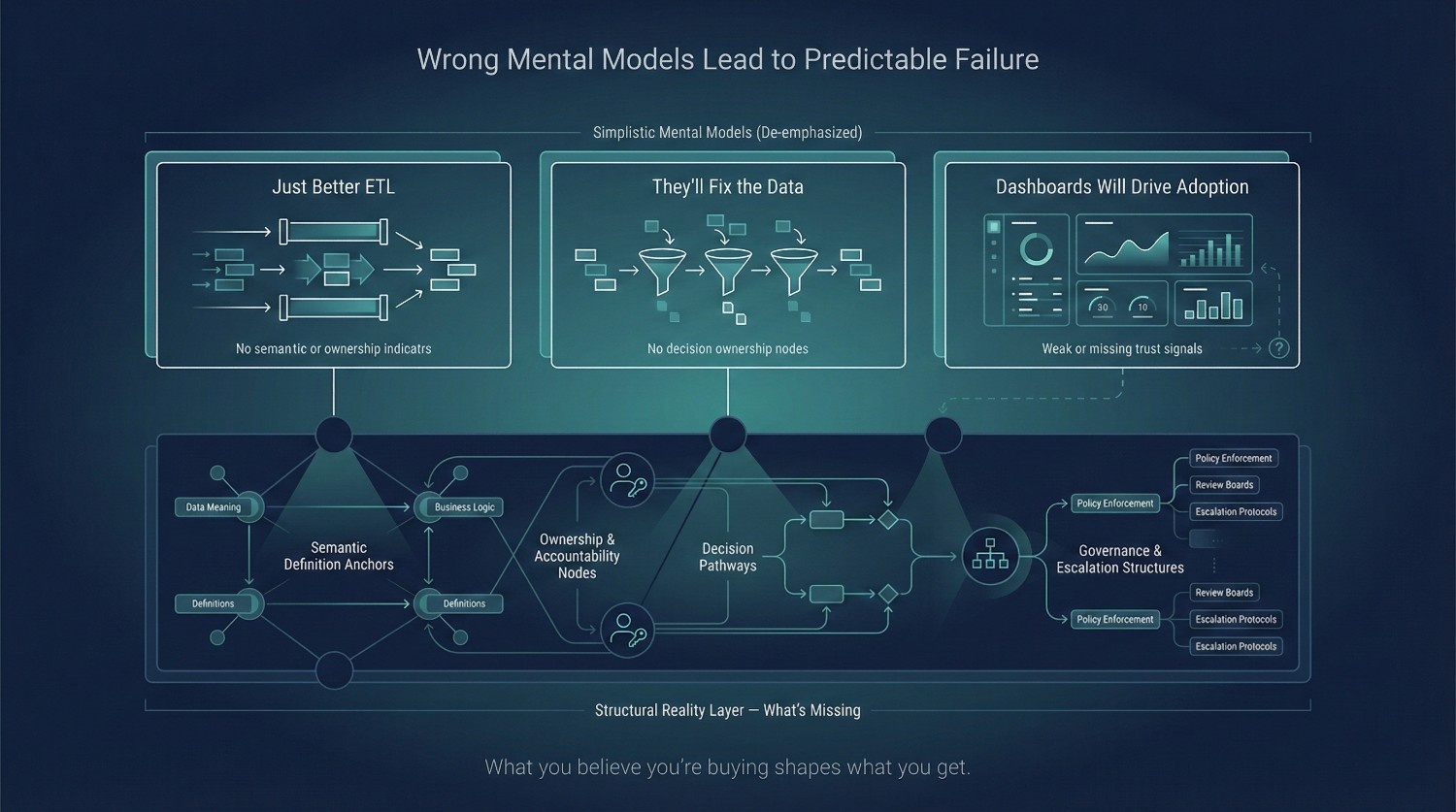
The Common (and Wrong) Mental Models
Many failed data warehouse consulting engagements don’t fail during delivery.
They fail before the contract is signed, because the mental model is misaligned.
Leadership believes they are buying one thing.
Consultants are hired to deliver another.
The gap between the two is often where disappointment grows.
Let’s break down the three most common—and most damaging—misconceptions.
“It’s Just ETL With Better Tools”
This is the one of the most widespread misunderstanding.
The assumption is simple:
“We already move data. We just need better pipelines and a modern warehouse.”
Why Pipelines Alone Don’t Create Value
ETL (or ELT) pipelines primarily answer one question:
How does data move from A to B?
They do not answer:
- What the data means
- Who owns it
- How it should be interpreted
- Which version is correct when conflicts arise
A warehouse full of well-orchestrated pipelines can still produce:
- Conflicting reports
- Unclear metrics
- Endless reconciliation
- Distrust from the business
Because movement without meaning becomes noise at scale.
ETL Without Modeling Often Produces Faster Chaos
When consulting engagements focus heavily on pipelines but lightly on modeling, the result is predictable:
- Raw data is centralized quickly
- Transformations multiply inconsistently
- Business logic spreads across reports
- Definitions diverge silently
Everything runs faster.Nothing becomes clearer.This pattern shows up repeatedly in large enterprises: pipeline velocity increases, but semantic debt accumulates. The organization moves faster while understanding less—until trust collapses under its own complexity.
This is not sustainable progress, it’s accelerated confusion.
Effective data warehouse consulting treats pipelines as infrastructure, not the product. The real work begins after data lands.
“They’ll Fix Our Data”
This belief sounds optimistic.
It is also a red flag.
“Once the consultants rebuild everything, the data will finally be clean.”
Data Quality Is an Organizational Outcome
In mature data organizations, data quality is treated as a governance and incentive problem first, and an engineering problem second. Technical fixes without behavioral change rarely persist.
Messy data is rarely caused solely by bad engineers.
It usually exists because:
- No one owned definitions long-term
- Exceptions were allowed without review
- Speed was rewarded over correctness
- Fixes were applied locally instead of systemically
Those are organizational behaviors—not purely technical defects.
Consultants can:
- Surface data quality issues clearly
- Show where inconsistencies originate
- Propose cleanup strategies and guardrails
They cannot decide:
- Which historical data should change
- Which inconsistencies are acceptable
- Which edge cases matter to the business
- Who absorbs the impact of “fixing” numbers
Without ownership, “cleanup” often becomes arbitrary—and trust erodes.
Why “Cleanup” Without Ownership Almost Always Fails
When data quality decisions have no internal owner:
- Cleanup is partial and inconsistent
- Logic becomes defensive and complex
- Exceptions are encoded instead of resolved
- Business teams lose confidence when numbers shift unpredictably
The consultant leaves.
The mess slowly returns.
Because the behaviors that created the mess never changed.
Real data warehouse consulting doesn’t promise permanent clean data.
It creates the conditions under which clean data can exist.
“They’ll Build Dashboards the Business Will Love”
This is often the most emotionally charged misconception.
Leadership often hopes:
“If the dashboards look good enough, adoption will follow.”
Dashboards Are Symptoms, Not Solutions
Executives often discover this too late: dashboards fail not because they are poorly designed, but because no one is willing to stand behind the numbers when they are challenged. Dashboards reflect the health of the underlying system.
If:
- Definitions are unclear
- Ownership is missing
- Numbers change unexpectedly
- Trust is fragile
then no amount of visual polish will fix adoption.
You don’t solve trust problems primarily with charts.
Why Adoption Can’t Be Outsourced
Business adoption depends on:
- Predictable behavior over time
- Confidence that numbers won’t embarrass users
- Clear answers when questions arise
- Visible ownership of truth
Consultants can design dashboards.
They cannot make the business feel safe using them.
When adoption fails, the dashboards are blamed—but the root cause is almost always deeper:
- Semantic drift
- Unresolved ambiguity
- Missing leadership backing
- No one standing behind the numbers
Dashboards don’t create trust on their own.
They reveal whether trust exists.
The Pattern Behind All Three Misconceptions
Each of these mental models tends to assume the same thing:
“Data warehouse consulting is about building things for us.”
In reality, it is about helping the organization decide, align, and operate differently around data.
Pipelines, cleanup, and dashboards are tools—not outcomes.
Until that distinction is clear, even well-funded, well-executed engagements often feel disappointing.All three misconceptions share a common flaw: they treat data warehouse consulting as a delivery function, rather than an operating model change.
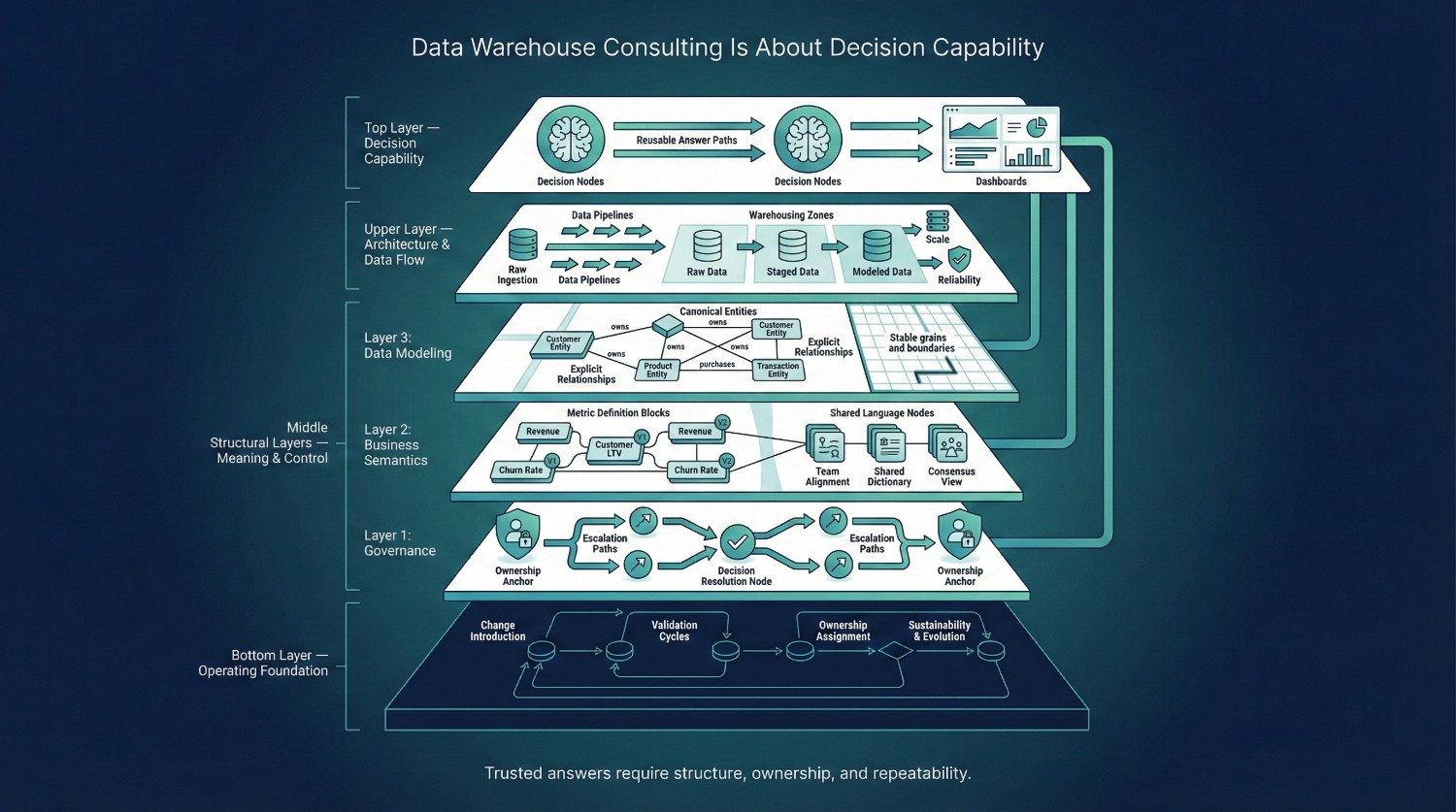
What Data Warehouse Consulting Actually Is
To understand why many engagements disappoint, we need a precise definition—one that goes beyond tools, diagrams, and deliverables.
A Precise Definition
Data Warehouse Consulting is the practice of designing, validating, and operationalizing how an organization turns raw data into trusted, decision-grade information.
That definition is intentionally dense, because the work itself is. Enterprise data platform guidance increasingly emphasizes that value emerges not from data availability, but from repeatable interpretation—when the same question yields the same answer regardless of who asks it or when.
It is not primarily about moving data.
It is not primarily about standing up infrastructure.
It is not primarily about producing dashboards on demand.
It is about ensuring that when a leader asks a question, the answer:
- Is understood the same way across teams
- Can be explained without caveats
- Holds up under scrutiny
- Can be reused tomorrow without reinterpretation
That outcome does not happen accidentally by default.
Where Data Warehouse Consulting Actually Lives
Effective data warehouse consulting sits at the intersection of several disciplines that are usually treated separately—and poorly coordinated.
Architecture
This is the part most people recognize.
Architecture typically defines:
- How data flows from source systems into the warehouse
- How environments are separated (raw, staged, modeled)
- How scale, cost, and reliability are managed
- How change is introduced without breaking consumers
But architecture alone only answers where data lives and how it moves—not what it means.This is why many technically sound warehouses still fail to change decision-making: the plumbing works, but the meaning layer is left implicit.
Data Modeling
Modeling is where meaning begins to stabilize over time.
Effective data warehouse consulting usually focuses heavily on:
- Canonical entities (customers, orders, products, events)
- Grain and cardinality decisions
- Explicit relationships instead of implicit joins
- Separation of raw data from business logic
This is not about academic modeling purity alone.
It is about creating structures that prevent accidental reinterpretation.
When modeling is weak, downstream reports often become a new definition.
Governance
Governance is not bureaucracy—it is decision hygiene.
In practice, governance answers:
- Who owns each critical metric
- How definitions are changed
- How conflicts are resolved
- What happens when data is wrong
Consulting that ignores governance often creates warehouses that look modern but behave like legacy systems—dependent on tribal knowledge and informal fixes.
Good consultants design governance that is intentionally:
- Lightweight
- Explicit
- Enforced through structure, not meetings
Business Semantics
This is where many engagements quietly fail.
Business semantics translate:
- Technical fields into business concepts
- Events into outcomes
- Records into narratives leadership can rely on
This includes:
- Clear metric definitions
- Explicit assumptions
- Versioned meaning when things change
- Shared language between data and business teams
Without semantic clarity, data may be accurate—but it is unlikely to be trusted. In large organizations, trust rarely breaks because numbers are wrong. It breaks because no one can explain why they changed—or who approved the change.
Operating Processes
Finally, data warehouse consulting concerns how the system is operated, not just built.
That includes:
- How new metrics are introduced
- How validation is performed
- How incidents are handled
- How adoption is monitored
- How legacy logic is retired
A warehouse without operating processes behaves like a one-time project.
A warehouse with them becomes an organizational capability. At this point, the warehouse stops being a project artifact and starts functioning as shared infrastructure for decision-making—owned, governed, and evolved like any other critical system.
Why This Feels Different Than Expected
When data warehouse consulting is done well:
- There are more conversations about meaning than tools
- Decisions are slowed early to prevent confusion later
- Progress is measured in clarity, not just delivery
- Leadership is involved more than expected
- Engineers spend less time reconciling and more time building forward
This can feel uncomfortable to organizations expecting speed through implementation.
But the alternative is familiar:
- Fast delivery
- Slow trust
- Endless clarification
- Quiet abandonment
Data warehouse consulting is not only about making data available.
It is about making data usable without negotiation.
Everything else—pipelines, tools, dashboards—exists to support that goal, not replace it.
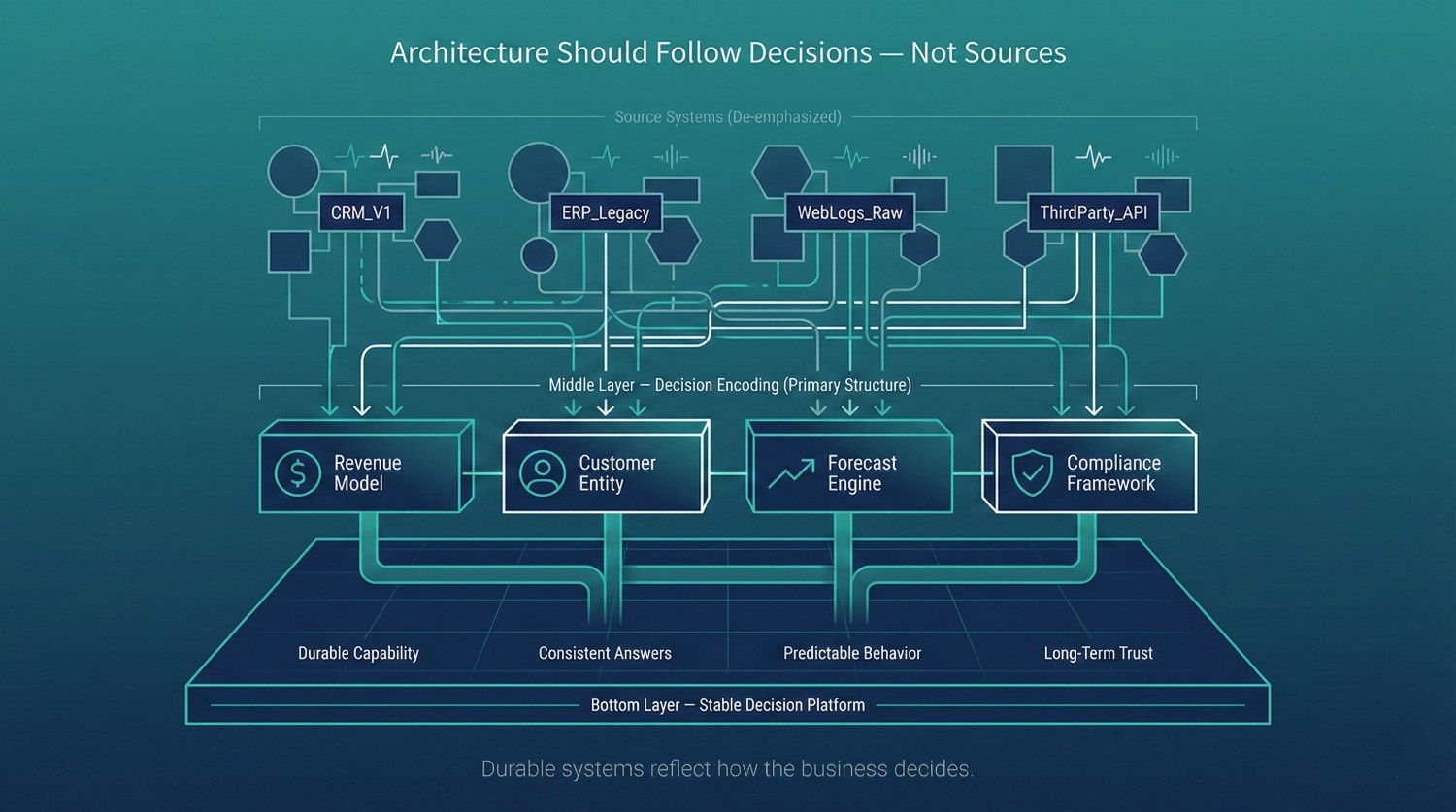
Core Pillar #1: Decision-Driven Architecture
One of the clearest signals that data warehouse consulting is being done effectively is this:
Architecture decisions are driven by business decisions—not by source systems.
Many failed warehouses are technically impressive and strategically misaligned. They reflect how data is produced, not how it is used.
Architecture Designed Around Decisions, Not Sources
In large organizations, the most expensive architectural mistakes are not technical—they are conceptual. Systems optimized around source structure tend to entrench existing silos rather than enable cross-functional decisions.
A source-driven architecture answers questions like:
- Where did this data come from?
- How often does it update?
- What format is it in?
A decision-driven architecture asks different questions:
- Which decisions does this data support?
- How often do those decisions need to be made?
- What level of accuracy and freshness do they require?
- Who is accountable for the outcome?
Effective data warehouse consulting typically starts with the second set.
When architecture mirrors source systems, every report often must reconstruct meaning. When architecture mirrors decisions, meaning is already encoded.
Why “Just Ingest Everything” Often Fails
The instinct to ingest all available data is understandable.
It feels:
- Comprehensive
- Future-proof
- Low-risk
In practice, it creates:
- Unbounded schemas
- Unclear ownership
- Rising cost without corresponding value
- Data that exists but is never used
More importantly, it avoids the hardest question:
Which data actually matters?
This question is uncomfortable because it forces prioritization. Avoiding it pushes cost, complexity, and ambiguity downstream—where they are far more expensive to unwind.Without that decision, warehouses become storage systems, not decision systems.
Effective data warehouse consulting is opinionated about what belongs in the core model—and what does not.
Aligning Structure With Real Needs
A decision-driven architecture is explicitly aligned with how the business operates.
Reporting Needs
Reports that leadership relies on regularly should be:
- Built on stable, versioned models
- Protected from upstream volatility
- Easy to explain and defend
Ad-hoc analysis should not reshape core tables.
Forecasting
Forecasts require:
- Consistent historical definitions
- Clear treatment of revisions
- Explicit handling of late-arriving data
Architecture must preserve comparability over time, not just reflect the latest state.
Regulatory Requirements
Compliance-driven data demands:
- Auditability
- Lineage
- Reproducibility
These needs should influence model design early—not be bolted on after the fact.
Long-Term Maintainability vs. Short-Term Delivery
Source-driven architectures often optimize for speed:
- Fast ingestion
- Minimal upfront decisions
- Early delivery of raw access
Decision-driven architectures tend to optimize for durability:
- Fewer breaking changes
- Clear ownership boundaries
- Predictable behavior over time
Good data warehouse consulting does not ignore delivery pressure.
It balances it.
Short-term speed is preserved by:
- Staging layers that absorb change
- Clear contracts between layers
- Explicit trade-offs documented early
Long-term maintainability is protected by:
- Stable canonical models
- Controlled evolution
- Fewer places where meaning can drift
Decision-driven architecture is not about building less data.
It is about building the right data in the right structure, so decisions can be made without negotiation or re-interpretation.
This pillar sets the foundation. The next pillars focus on how meaning, ownership, and trust are preserved as the warehouse grows.
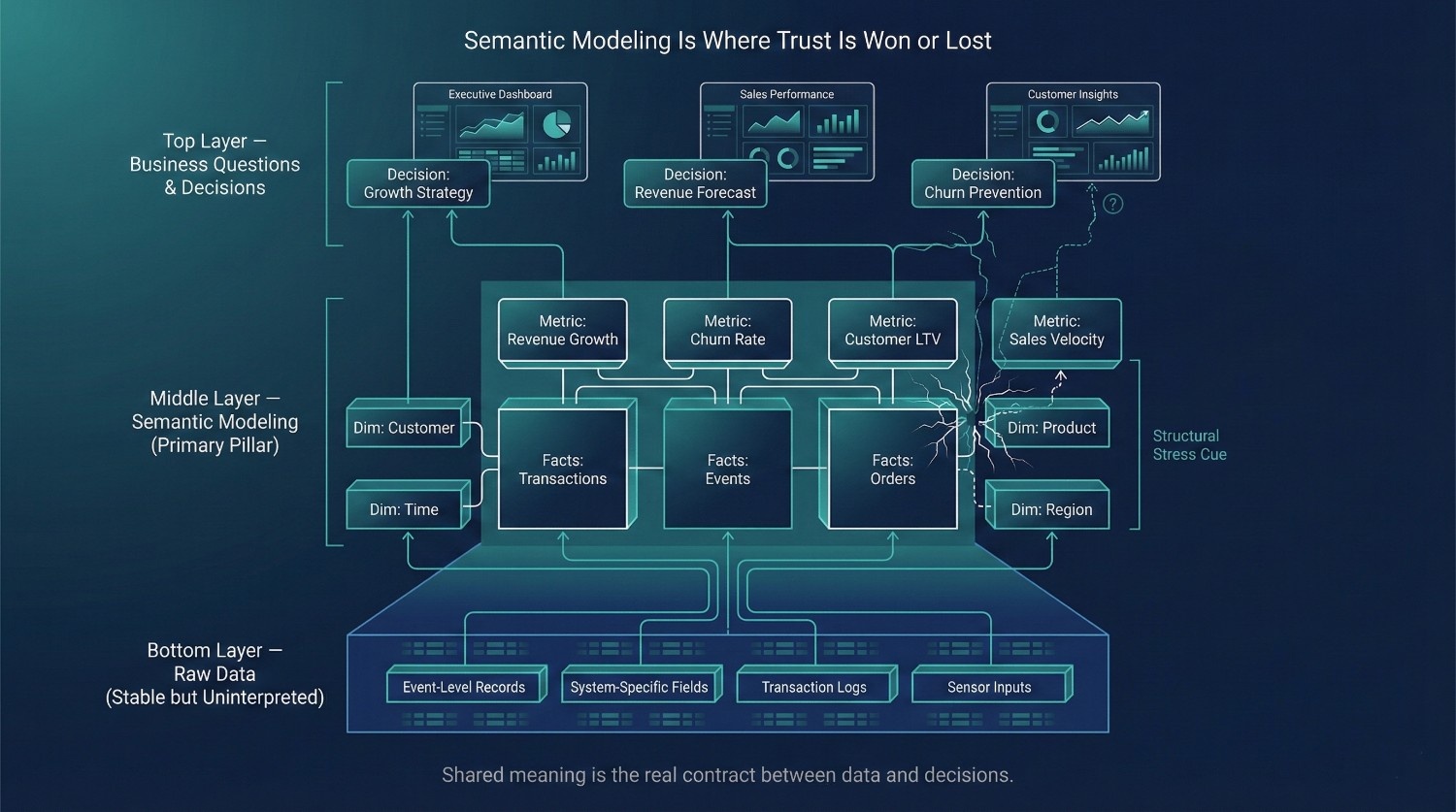
Core Pillar #2: Semantic Modeling (Where Most Efforts Break)
If there is one place where data warehouse efforts most frequently commonly fail, it is here.
Not in ingestion.
Not in tooling.
But in semantic modeling—the layer where raw data is turned into shared business meaning.
Many organizations underestimate this work. Others skip it entirely. Both outcomes often lead to the same result: persistent confusion and lost trust.
The Gap Between Raw Data and Business Meaning
Raw data answers questions like:
- What event occurred?
- What value was recorded?
- When did a system update?
Business users ask different questions:
- How many customers do we have?
- What is our revenue this quarter?
- Are we growing or shrinking—and why?
Semantic modeling is the bridge between these worlds.
It translates:
- Events into outcomes
- Records into entities
- System fields into business concepts
Without this layer, every report often becomes interpretations—and interpretations drift.
Facts, Dimensions, and Metrics as Contracts
In effective data warehouse consulting, semantic models are treated as contracts, not conveniences.
That means:
- Facts clearly define what happened and at what grain
(e.g., one row per transaction, per order, per event) - Dimensions define how data can be grouped and filtered
(e.g., customer, product, time, region) - Metrics define how performance is measured
(e.g., revenue, active users, churn)
These are not meant to be flexible suggestions.
They are shared agreements.
When facts and dimensions are stable, metrics behave predictably. When they are not, teams lose confidence not because the numbers are wrong, but because they are fragile—small changes produce large, unexplained effects.
Why Poor Semantic Layers Erode Trust
When semantic modeling is weak or inconsistent:
- The same metric returns different numbers in different tools
- Small changes produce unexpected shifts
- Historical trends stop lining up
- Explanations become conditional and defensive
Business teams stop asking:
“What does the data say?”
And start asking:
“Which version should I believe today?”
That shift often marks the collapse of trust.
No amount of pipeline reliability can compensate for semantics that change depending on who is querying the data.
The Cost of Letting Every Team Define Metrics Independently
In the absence of a strong semantic layer, teams fill the gap themselves.
This leads to:
- Marketing redefining “conversion”
- Finance redefining “revenue”
- Product redefining “active user”
- Operations redefining “retention”
Each definition is locally rational.
Collectively, they are disastrous.
The organization pays for this fragmentation through:
- Endless reconciliation meetings
- Conflicting narratives in leadership reviews
- Slower decision-making
- Reduced confidence in analytics as a whole
Data warehouse consulting that avoids semantic modeling may deliver faster in the short term. But it almost always guarantees long-term friction.
Semantic modeling is not optional overhead.
It is the mechanism that makes data reusable without reinterpretation.
When this pillar is strong, trust compounds.
When it is weak, every new question resets the conversation.
Organizations rarely abandon analytics because they lack data. They abandon it because they cannot defend the answers it produces under pressure.
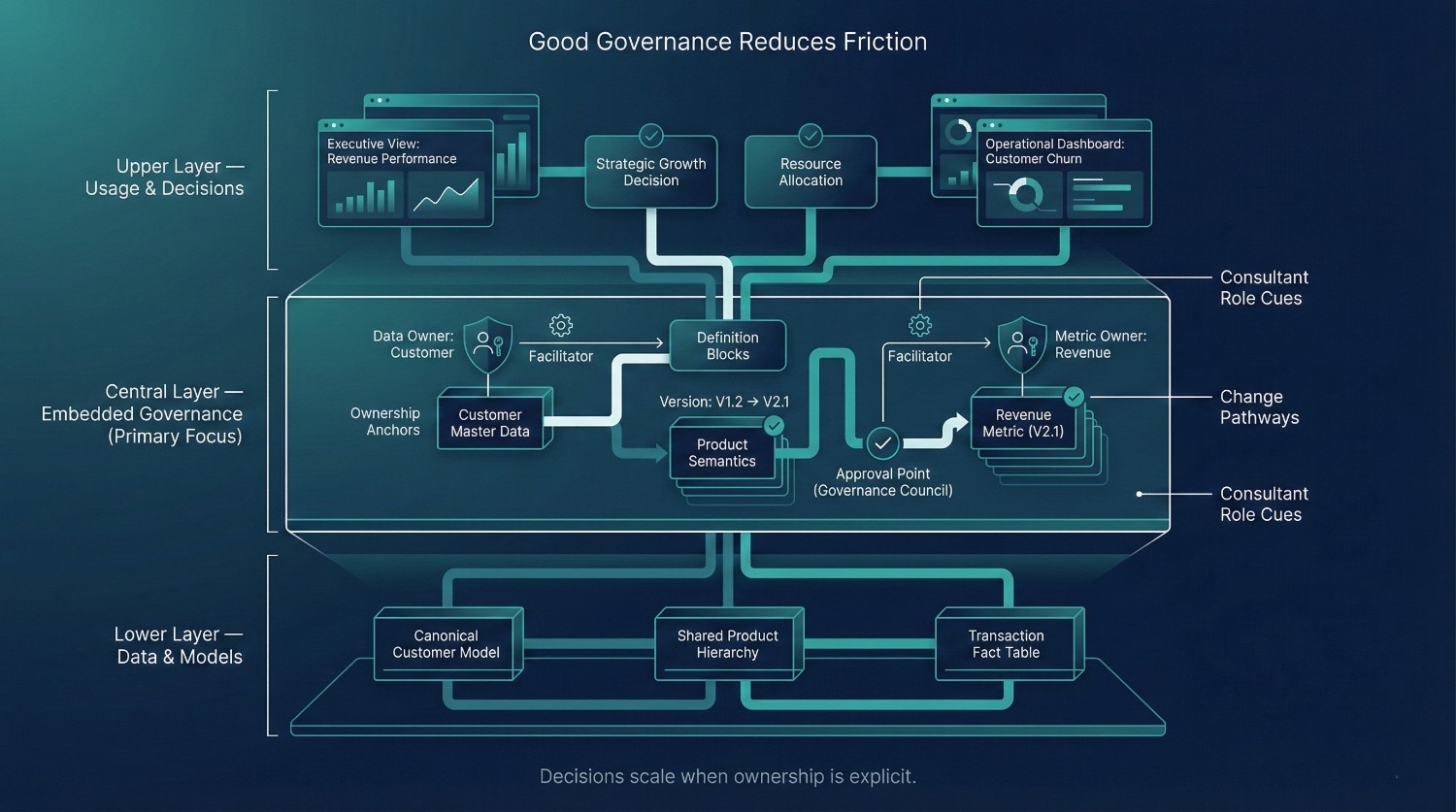
Core Pillar #3: Data Governance That Actually Works
Few terms are more misunderstood—or more poorly executed—than data governance in practice.
When leaders hear it, they imagine:
- Committees
- Approval queues
- Slowed delivery
- Process for the sake of process
That reaction is understandable. Governance often fails because it is designed as bureaucracy.
Real data warehouse consulting treats governance very differently.
Governance vs. Bureaucracy
Bureaucracy primarily exists to control people.
Governance exists to make decisions repeatable.
In mature data organizations, governance is treated as a product decision: it exists to reduce uncertainty, not to enforce compliance for its own sake.
Bad governance adds layers:
- More meetings
- More approvals
- More documents no one reads
Good governance removes friction by answering questions before they become disputes.
The goal is not to slow change.
It is to make change safe, explainable, and non-chaotic.
What Practical Governance Actually Looks Like
Effective governance in a data warehouse is surprisingly simple—but very explicit.
Ownership
Every critical dataset and metric has:
- A clearly named owner
- A defined responsibility (accuracy, meaning, availability)
- Authority to approve or reject changes
Ownership is about accountability, not control. Without it, issues often become group discussions that never resolve.
Definitions
Definitions are:
- Written down
- Versioned
- Visible to everyone who uses the data
This includes:
- Metric definitions
- Inclusion and exclusion rules
- Known limitations
- Intended use cases
When definitions are explicit, disagreements become solvable instead of emotional.
Change Control
Change control does not mean “no changes.”
It means:
- Changes are intentional
- Impact is assessed before release
- Historical continuity is protected or explicitly broken
Practical change control answers:
- What is changing?
- Why is it changing?
- Who is affected?
- When does it take effect?
Without this, trust erodes every time numbers shift.
Why Governance Must Be Embedded, Not Added Later
Many organizations treat governance as a phase that comes after the warehouse is built.
That approach fails in most organizations.
When governance is layered on later:
- Bad semantics are already entrenched
- Ownership disputes are politicized
- Workarounds are normalized
- Business teams have often already lost trust
Effective data warehouse consulting embeds governance directly into:
- Modeling decisions
- Naming conventions
- Deployment workflows
- Documentation practices
Governance becomes part of how work is done—not an extra step people try to avoid. Once governance is embedded, teams stop debating whether a decision is valid and start focusing on what to do next.
Consultants as Facilitators, Not Gatekeepers
A critical distinction: consultants should enable governance, not enforce it.
Good consultants:
- Help identify owners
- Facilitate definition alignment
- Design lightweight change processes
- Make governance visible through structure
They do not:
- Act as permanent approval authorities
- Own definitions themselves
- Become bottlenecks for progress
If governance only works while consultants are present, it is not governance—it is dependency.
Data governance that works is not loud, heavy, or ceremonial.
It is quiet, embedded, and decisive.
When governance is done right, most people barely notice it—because decisions stop being debated over and over again.
And that stability is exactly what allows a data warehouse to scale without losing trust.
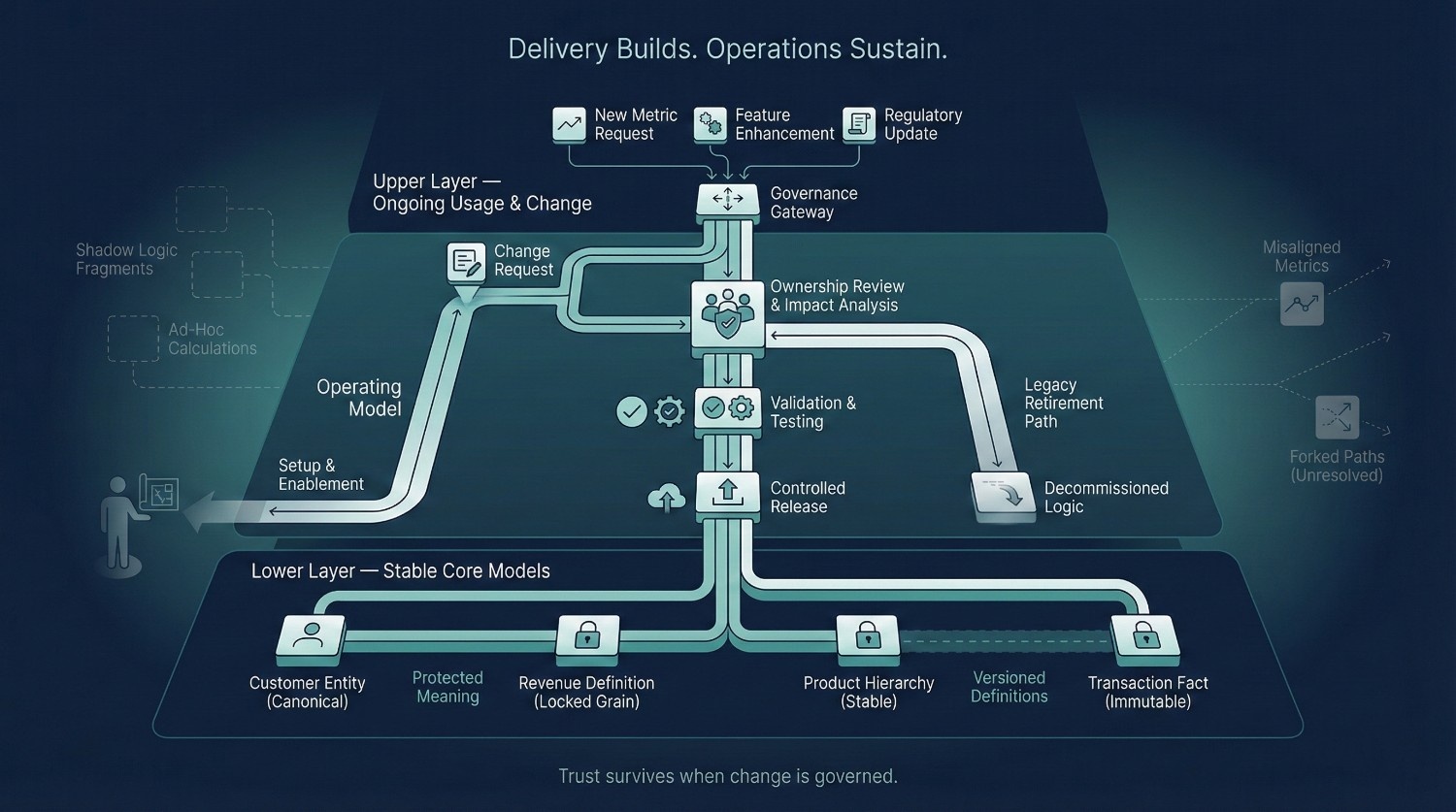
Core Pillar #4: Operating Models, Not Just Delivery
One of the clearest signals that data warehouse consulting has been misunderstood is this question appearing after delivery:
“So… who owns this now?”
If that question is unanswered, the warehouse is already on a slow path to decay.
Who Owns the Warehouse After Consultants Leave?
Consultants eventually exit. Complexity does not.
A sustainable warehouse requires clarity on:
- Who owns core models
- Who approves semantic changes
- Who is accountable when numbers are questioned
- Who decides what gets added—and what does not
Without explicit ownership:
- Engineers hesitate to change anything
- Analysts create workarounds
- Business teams rebuild logic downstream
- Trust often erodes quietly
Real data warehouse consulting plans for ownership from day one, not as a handoff checklist at the end. Ownership defined late is ownership defined under pressure—and pressure amplifies politics rather than clarity.
How Changes Are Requested, Reviewed, and Shipped
Warehouses evolve continuously. The question is not whether change happens, but how it happens.
A functional operating model defines:
- How new metrics are proposed
- Who reviews semantic impact
- How changes are validated with the business
- When changes become official
- How old logic is retired
When this flow is unclear:
- Every request feels urgent
- Changes bypass review
- Definitions drift
- Stability disappears
Good operating models create predictability—even when change is frequent.
Preventing the Slow Erosion of Trust
Many warehouse failures don’t come from big mistakes. They emerge from dozens of small, reasonable exceptions that were never reconciled into a coherent operating system.
Metric Sprawl
Without guardrails:
- Similar metrics proliferate
- Slight variations coexist
- Teams argue over which one is “right”
An operating model limits this by enforcing shared definitions and clear ownership.
Shadow Models
When core models feel slow or risky to change:
- Teams recreate logic downstream
- Business rules fragment
- The warehouse loses authority
A good operating model makes the right path the easy path.
Uncontrolled Access
When everyone can build anything:
- Raw data leaks into reports
- Semantics are bypassed
- Inconsistencies multiply
Access control is not about restriction—it is about protecting meaning.
Why Operating Models Matter More Than Tools
Tools change.
Operating models endure.
A modern warehouse built on weak operating foundations often will:
- Accumulate debt
- Lose trust
- Require re-platforming sooner than expected
A modest warehouse with a strong operating model will:
- Scale gradually
- Absorb change without chaos
- Maintain clarity as usage grows
This is why real data warehouse consulting spends significant time on:
- Roles and responsibilities
- Change workflows
- Ownership boundaries
- Long-term stewardship
Delivery builds a warehouse.
Operating models keep it usable.
Without them, even well-designed systems slowly collapse under their own flexibility.
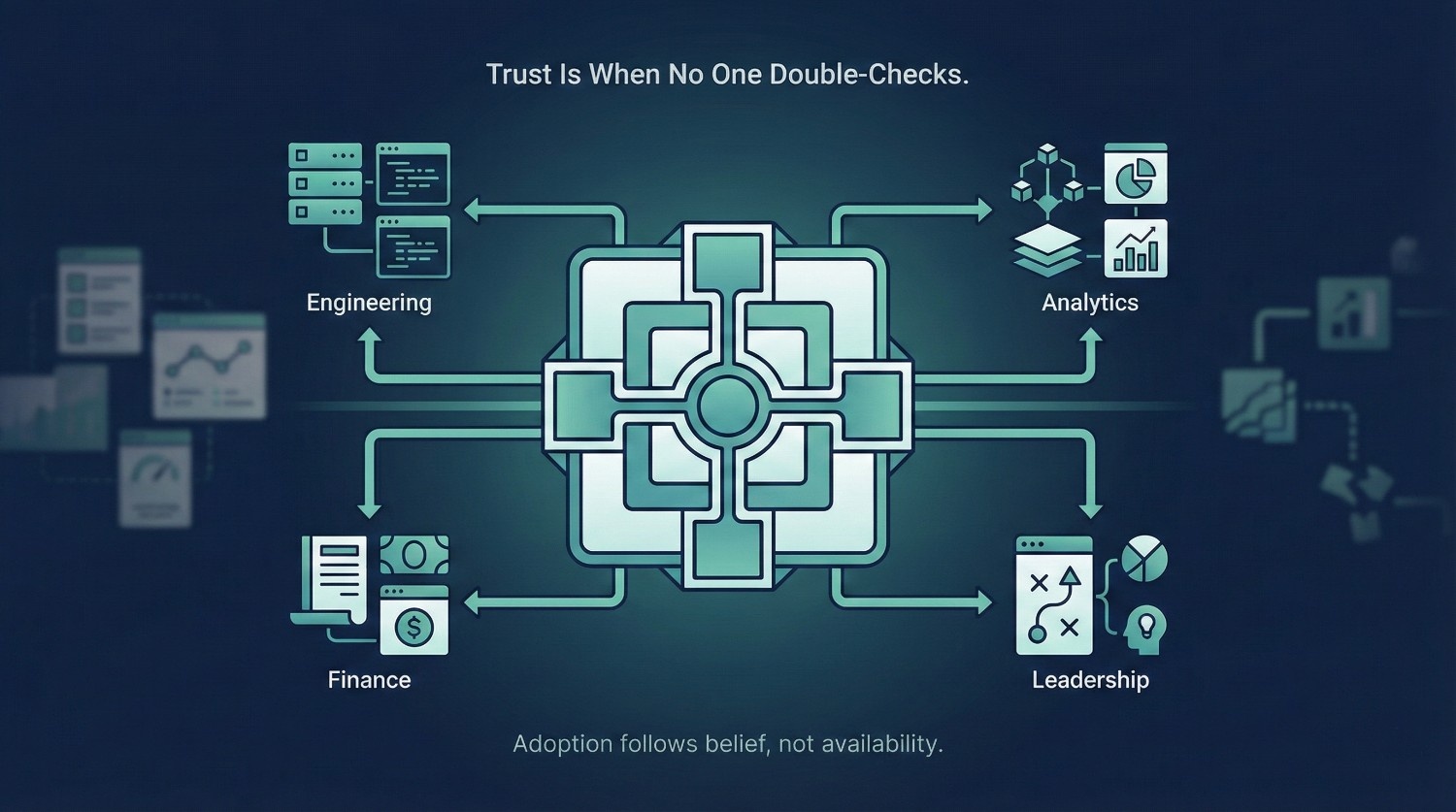
Core Pillar #5: Trust, Adoption, and Organizational Alignment
The final—and often most underestimated—pillar of data warehouse consulting is not technical at all.
It is trust.
A warehouse that is fast, scalable, and well-modeled can still fail if the organization does not believe in it. And once belief is lost, no amount of optimization restores it quickly.
Trust as a Deliverable
In practice, executives experience trust as a reduction in cognitive load: fewer caveats, fewer reconciliations, and fewer meetings spent arguing about numbers instead of decisions.
That means asking questions like:
- Do business teams rely on this data without cross-checking?
- Are numbers used confidently in executive meetings?
- Do people stop asking “where did this come from?” after rollout?
If the answer is no, the warehouse has not fully succeeded—regardless of technical quality.
Trust must be designed, earned, and maintained.
Why Technically Correct Data Still Fails
Technical correctness is necessary. It is not sufficient. Many failed analytics platforms are technically sound. What they lack is behavioral reliability—users cannot predict how numbers will behave when questioned.
Data often fails in the business when:
- Numbers change without explanation
- Definitions shift silently
- Different teams get different answers to the same question
- No one can say which metric is authoritative
From a business perspective, this feels unsafe.
People don’t avoid the warehouse because it’s wrong.
They avoid it because using it feels risky.
Data that requires disclaimers is not decision-grade.
Aligning the Organization Around Data
Trust emerges when the warehouse aligns how different parts of the organization think and operate around data.
Engineering
Engineering needs:
- Clear contracts for meaning
- Stable models to build against
- Fewer late-stage “what does this actually mean?” surprises
Without alignment, engineers often end up encoding ambiguity into systems.
Analytics
Analytics teams need:
- Canonical definitions they don’t have to reinvent
- Predictable data behavior over time
- Confidence that their work won’t be undermined by upstream changes
Without alignment, analytics becomes reconciliation instead of insight.
Finance
Finance needs:
- Reproducibility
- Historical consistency
- Clear ownership of revenue and cost definitions
Without alignment, finance often trusts its own spreadsheets more than the warehouse.
Leadership
Leadership needs:
- One version of the truth
- Clear explanations when numbers change
- Confidence that decisions won’t be reversed by data disputes
Without alignment, leadership may gradually disengage from analytics altogether. When alignment exists, disagreements shift from “whose numbers are right” to “what should we do about what the numbers show.” That shift is the real indicator of success.
Making Data Usable, Not Just Available
Availability is easy.
Usability is hard.
Usable data is:
- Stable enough to rely on
- Clear enough to explain
- Governed enough to trust
- Flexible enough to answer new questions without redefining old ones
This is where real data warehouse consulting earns its value.
It doesn’t just centralize data.
It aligns the organization around shared meaning.
Trust is not built solely by dashboards.
Adoption is not driven primarily by tooling.
Alignment does not emerge automatically.
When data warehouse consulting succeeds, it does so because the warehouse becomes a shared mental model—not just a shared storage layer.
That is the difference between a warehouse that exists and one that actually changes how an organization operates.
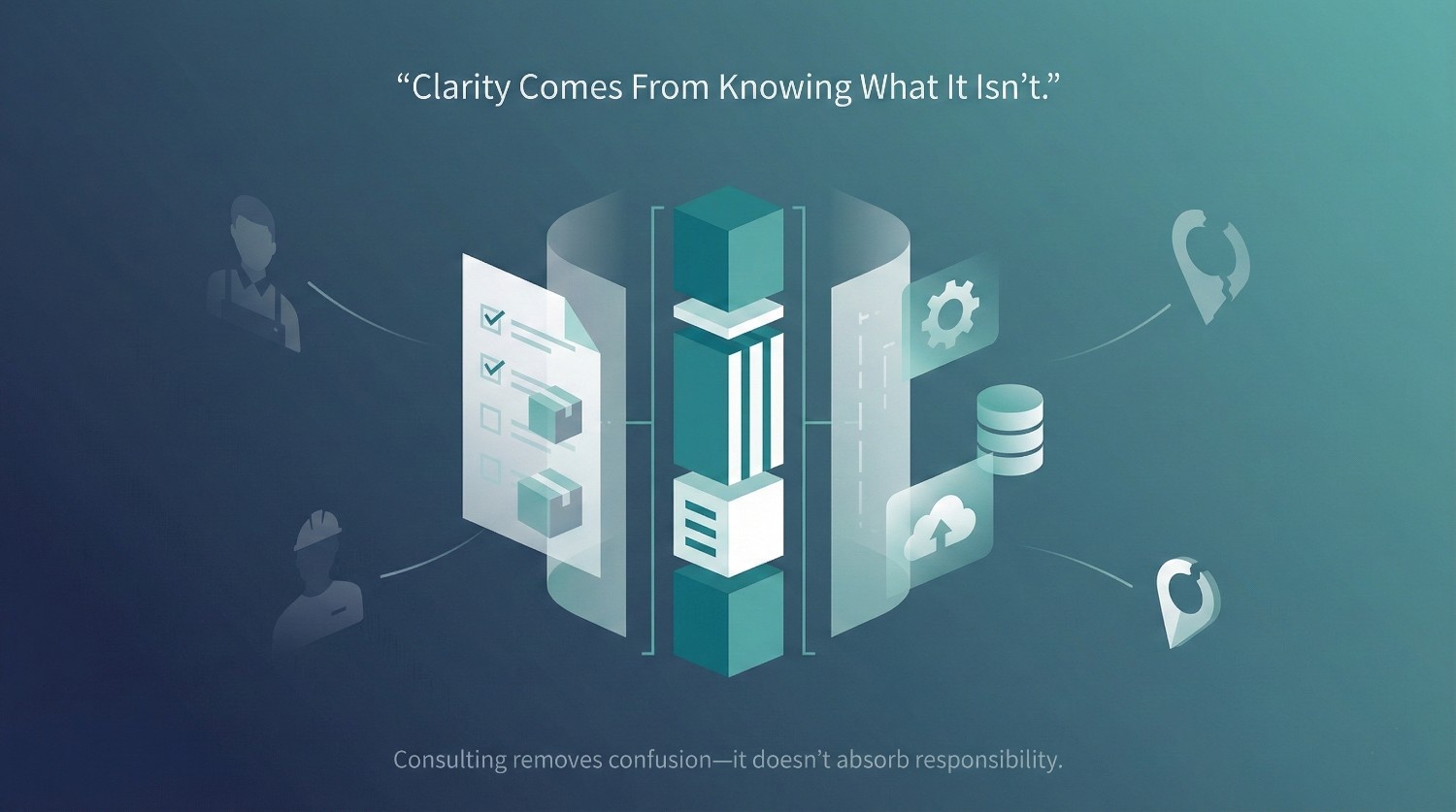
What Data Warehouse Consulting Is Not
Clarity often comes faster by defining boundaries.
Many disappointing engagements happen not because data warehouse consulting was done poorly—but because it was expected to be something it fundamentally is not.
This section draws those lines clearly.
Not Staff Augmentation
Hiring data warehouse consultants is not the same as renting extra engineers. Staff augmentation increases capacity. Consulting changes trajectory. Confusing the two leads organizations to optimize for speed when they actually need clarity.
Staff augmentation focuses on:
- Filling short-term capacity gaps
- Increasing delivery throughput
- Executing pre-defined tasks
Data warehouse consulting focuses on:
- Designing durable systems
- Establishing shared meaning
- Creating operating discipline
Reducing long-term friction
Why “More Hands” ≠ Better Outcomes
Adding more engineers to an unclear system:
- Accelerates inconsistent logic
- Multiplies definitions
- Increases coordination cost
- Makes ownership harder to identify
If the core problems are ambiguity, trust, and governance, more hands often make those problems happen faster.
Consulting adds value by reducing degrees of freedom, not by maximizing output.
Not a One-Time Build
Warehouses are not static assets.
They are living systems. Treating a warehouse as a project assumes the business will stop changing. It never does.
They change when:
- The business evolves
- New products launch
- Pricing models shift
- Regulations change
- New data sources appear
Why “Project Complete” Is a Dangerous Phrase
Declaring a warehouse “done” often creates false confidence.
It suggests:
- Definitions are final
- Ownership is settled
- No new governance is required
- Adoption will take care of itself
In reality, this is when the most important work begins:
- Maintaining semantic stability
- Managing controlled change
- Preventing drift and sprawl
- Reinforcing trust over time
Good data warehouse consulting designs for continuity, not completion.
Not Tool-First Implementation
Tools matter—but they are rarely the starting point.
When engagements begin with:
- “We chose Snowflake”
- “We want dbt models”
- “We need dashboards fast”
Without first addressing:
- What decisions matter
- What definitions must be stable
- Who owns what
- How change is governed
The tools often simply amplify existing confusion.
Tools Amplify Decisions—They Don’t Replace Them
Modern platforms are powerful precisely because they are flexible.
That flexibility becomes dangerous without:
- Clear semantics
- Strong ownership
- Explicit constraints
Data warehouse consulting uses tools to encode decisions, not avoid them.
Not Ownership Transfer
Perhaps the most critical misconception of all:
Consultants cannot own your data truth.
They can:
- Help define it
- Make it explicit
- Document it
- Design systems to protect it
They cannot:
- Be accountable when numbers are questioned
- Absorb political fallout from metric changes
- Decide which definition wins long-term
- Stand behind data in executive forums
Accountability without authority is unsustainable—and authority without accountability erodes trust just as quickly. Ownership of data truth must remain internal.
When organizations try to outsource ownership:
- Accountability diffuses
- Trust weakens
- Consultants become scapegoats
- The warehouse loses authority
The Common Thread
Each misunderstanding assumes the same thing:
“Data warehouse consulting is something we buy so we don’t have to do the hard parts ourselves.”
In reality, it exists to force the hard parts to be done explicitly, early, and correctly.
When leaders understand what data warehouse consulting is not, they stop being disappointed by it—and start using it for what it actually does best.
Why Companies Think They Need Data Warehouse Consulting (But Often Don’t)
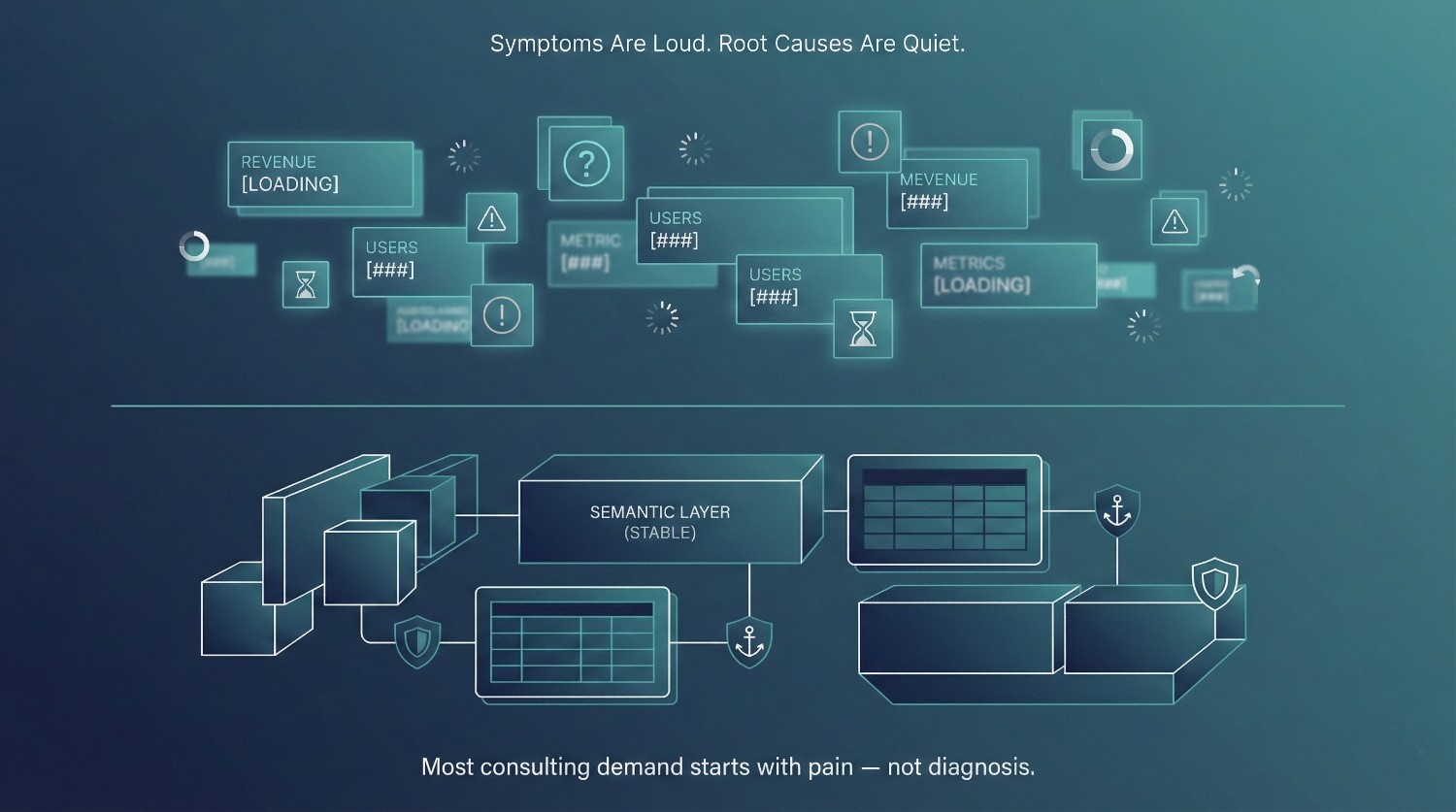
Many organizations seek out data warehouse consulting for reasons that sound compelling—but are often symptoms, not root causes.
This distinction matters, because treating symptoms with infrastructure work is how companies spend heavily and still feel stuck.
Let’s look at the most common triggers.
“We Need Faster Dashboards”
This is one of the most frequent justifications—and often one of the most misleading.
What leaders experience:
- Dashboards load slowly
- Queries time out
- Analysts complain about performance
What they assume:
“Our warehouse architecture must be wrong.”
What is often actually happening:
- Business logic is duplicated across layers
- Metrics are recomputed inconsistently
- Poor semantic modeling forces expensive joins
- Ad-hoc fixes accumulate over time
In these cases, performance is not the problem—it is the signal. Performance bottlenecks often reveal where meaning has been deferred to query time instead of being resolved in models—turning analytics into an interpretive workload rather than a retrieval one.
Speed issues surface because the system is doing too much interpretive work at query time. Adding more compute or rewriting pipelines may help temporarily, but it does not address the underlying lack of structure.
If dashboards are slow because meaning is unstable, data warehouse consulting focused only on optimization will disappoint.
“Our Warehouse Is Slow”
This sounds technical. It often isn’t.
When teams say this, they often mean:
- “It’s unpredictable”
- “We don’t know what will break”
- “Small changes have big effects”
- “We’re afraid to touch core models”
Slowness here is psychological as much as computational. Systems feel slow when teams hesitate to act on results. That hesitation is rarely about milliseconds—it’s about confidence.
A warehouse with:
- Clear semantic layers
- Stable contracts
- Explicit ownership
- Controlled change processes
often feels fast—even if raw performance is unchanged.
By contrast, a warehouse with ambiguous meaning feels slow because every change requires negotiation and revalidation.
If the system is slow because people don’t trust it, consulting that focuses on tuning rather than structure misses the mark.
“Leadership Doesn’t Trust the Numbers”
This is the most dangerous symptom—because it is often misdiagnosed as a tooling issue.
Leadership distrust usually does not mean:
- The data is wrong
- The warehouse is broken
- The tools are insufficient
It usually means:
- Definitions changed without explanation
- Numbers differ across reports
- No one can say which version is authoritative
- Historical narratives no longer line up
In these cases, the problem is not data availability, it is stability. Trust breaks when leaders cannot predict how numbers will behave under scrutiny—or who is responsible when they don’t.
No amount of new dashboards, faster pipelines, or modern tooling will reliably fix trust if:
- Semantics are unclear
- Ownership is missing
- Decision authority is diffused
Companies that hire data warehouse consultants to “fix trust” without addressing these foundations often end up more frustrated than before.
The Pattern Behind These Requests
Each of these statements often points to a deeper issue:
Symptom | Likely Root Cause |
|---|---|
Slow dashboards |
Unstable or duplicated business logic |
Slow warehouse |
Fear of change due to unclear contracts |
Leadership distrust |
Semantic drift and missing ownership |
The pattern is consistent across industries: performance complaints, instability, and distrust are rarely isolated problems. They are downstream effects of unresolved decisions about meaning, ownership, and change.
If the real problem is:
- Misaligned incentives
- Lack of governance
- Unclear definitions
- Weak operating models
Then consulting focused purely on delivery will treat symptoms and leave root causes unresolved.
When Consulting Is the Wrong Tool
External execution cannot substitute for internal commitment. When leadership avoids decisions, consultants are left optimizing around ambiguity rather than resolving it.
Companies often don’t need data warehouse consulting when:
- They lack basic agreement on definitions
- Leadership is unwilling to own decisions
- Teams expect consultants to “fix” behavior
- Adoption issues are cultural, not structural
In these cases, the right first step is internal alignment, not external execution.
Consulting becomes valuable after the organization is ready to:
- Decide what data means
- Assign ownership
- Treat trust as a deliverable
- Operate the warehouse deliberately
These conditions are not technical prerequisites—they are leadership ones. Without them, even the best consulting engagement will optimize delivery while failing to change outcomes.
Data warehouse consulting is not a cure-all.
When used to address symptoms, it disappoints.
When used to resolve root causes, it transforms how data actually works inside the organization.
When Data Warehouse Consulting Is the Right Move
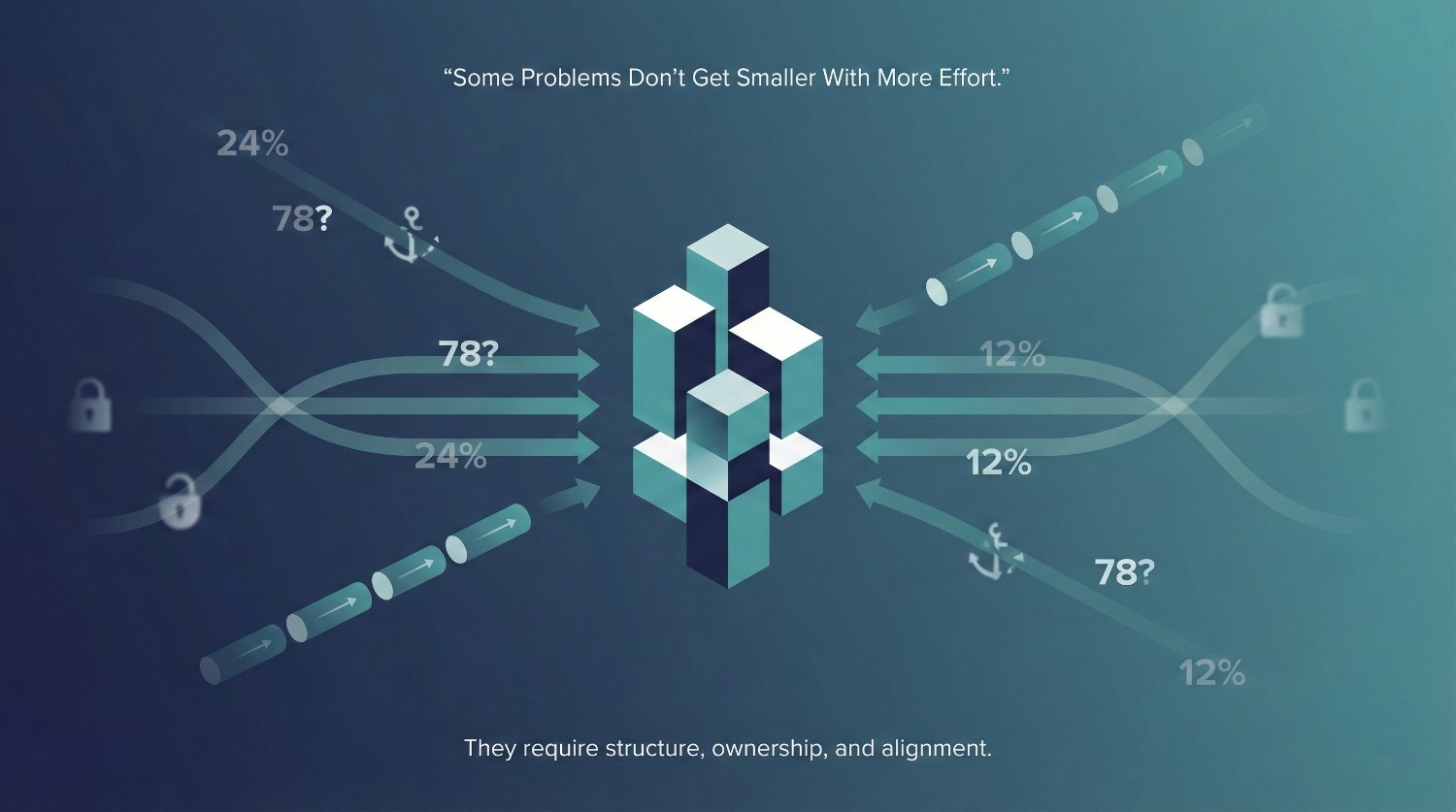
Data warehouse consulting delivers the most value only when it is applied to the right problems at the right moment.
Below are strong signals that an organization is no longer dealing with isolated technical issues—and that external consulting can help create clarity, alignment, and momentum.These signals typically emerge only after internal fixes have been attempted and failed—indicating that the problem has moved beyond isolated execution gaps and into systemic design.
Multiple Teams Arguing Over Numbers
This is one of the clearest indicators.
When:
- Finance and Product report different revenue
- Analytics and Engineering disagree on user counts
- Leadership meetings stall over “whose numbers are right”
The issue is no longer primarily tooling or performance.
It signals:
- Missing semantic contracts
- Undefined ownership of metrics
- Business logic scattered across systems
Data warehouse consulting is valuable here because it focuses on aligning meaning, not just rebuilding pipelines.
No Clear Data Ownership
If no one can confidently answer:
- Who owns revenue definitions?
- Who approves changes to core metrics?
- Who is accountable when numbers are questioned?
Then the warehouse is operating on informal authority.
In these environments:
- Engineers hesitate to make changes
- Analysts create parallel logic
- Trust erodes quietly
Consulting helps by forcing ownership to be named, documented, and operationalized—something internal teams often struggle to do alone due to politics or inertia.
Growing Data Cost With Declining Trust
This combination is especially dangerous.
You see:
- Increasing cloud spend
- More pipelines, models, and dashboards
- Slower decision-making
- Less confidence in reports
This often means the system is scaling activity, not value.
Data warehouse consulting helps here by:
- Identifying duplicated logic
- Reducing unnecessary transformations
- Aligning spend with decision-critical data
- Designing architectures that control growth instead of amplifying chaos
Cost problems without trust problems are technical.
Cost problems with trust problems are structural.
Migrations Stalled or Half-Finished
If the organization is stuck in:
- Endless dual-runs
- “Temporary” legacy dependencies
- Partial cutovers that never complete
The issue is rarely execution capability alone.
It is usually when decisions are deferred long enough, the system begins to reflect indecision as architecture—making progress feel risky rather than incremental.
Data warehouse consulting adds value by structuring decisions, defining exit criteria, and helping leadership move forward deliberately instead of drifting.
Leadership Asking for ROI From Data Investments
When executives start asking:
- “What are we actually getting from this warehouse?”
- “Why are we spending more but trusting it less?”
- “How does this improve decisions?”
The organization has crossed a threshold.
This is no longer an engineering question.
It is a strategic one.
Data warehouse consulting is effective here because it reframes the conversation around:
- Business outcomes
- Decision enablement
- Adoption and trust
- Measurable value, not just delivery
The Common Thread
In all of these cases, the organization is not missing effort—it is missing structure.
Data warehouse consulting is the right move when:
- Problems are systemic, not isolated
- Ambiguity is blocking progress
- Internal alignment is hard to achieve alone
- Leadership is ready to engage, not delegate
When those conditions are present, consulting does not replace internal teams—it helps them converge. The difference is subtle but decisive: builders deliver systems, while effective consultants help organizations converge on how those systems should behave under pressure.
And that convergence is what turns a warehouse from a cost center into a decision-making asset.
How to Evaluate a Data Warehouse Consulting Partner
Choosing a data warehouse consulting partner is less about credentials and more about how they think.
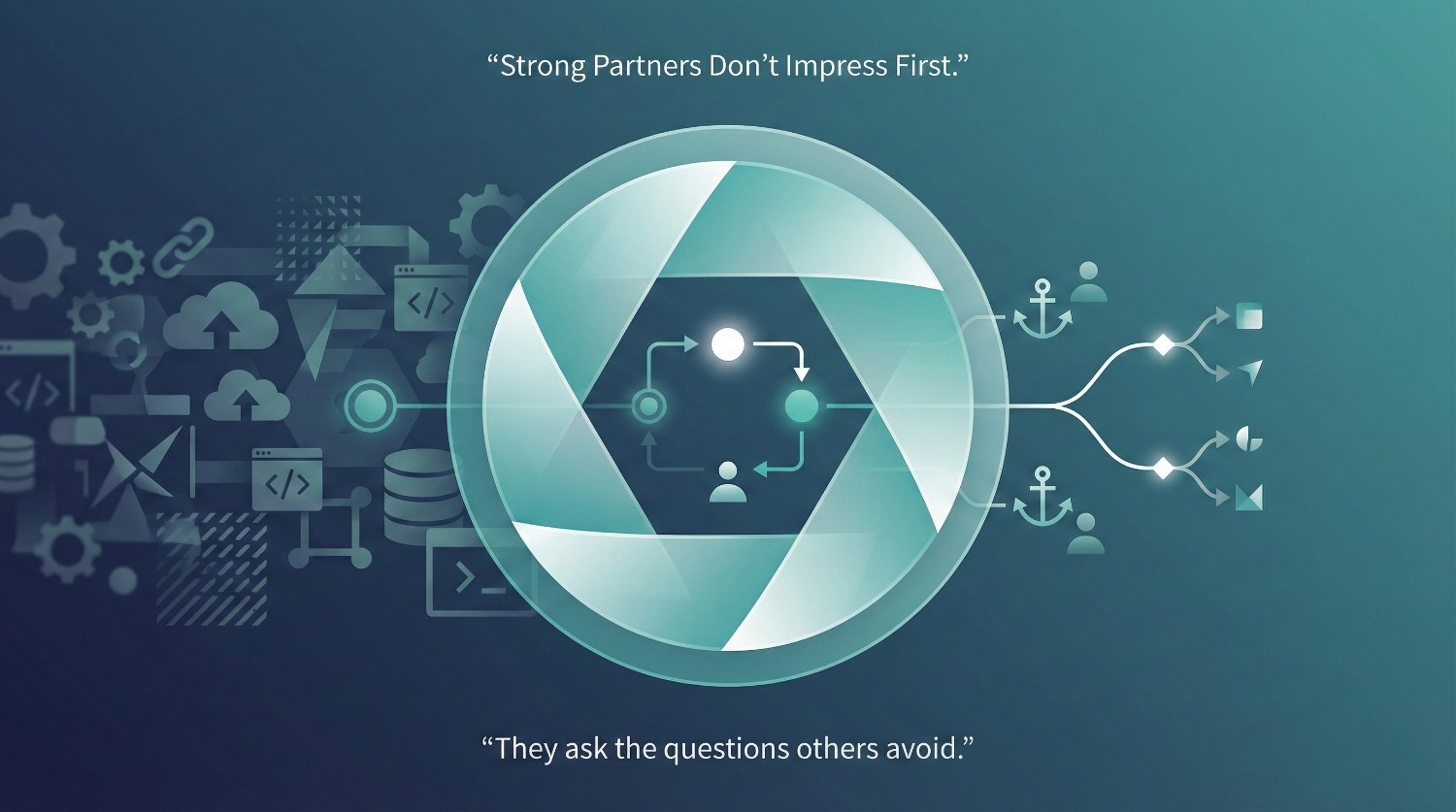
Strong partners don’t start by showing architectures or tool stacks.
They start by asking questions that make the room slightly uncomfortable.
That discomfort is a signal—not a problem. In practice, productive discomfort usually means assumptions are being surfaced early—before they harden into models, dashboards, and executive reporting.
What to Look For
These behaviors often separate effective consulting partners from expensive disappointments.
Do They Ask Business Questions Early?
Good consultants ask questions like:
- What decisions does leadership struggle to make today?
- Which numbers cause the most debate?
- Where does trust break down?
- What happens when metrics disagree?
They are trying to understand decision pressure, not just data flow.
If conversations stay technical for too long without tying back to business decisions and definitions, the engagement is often already drifting.
Do They Surface Uncomfortable Decisions?
Effective consultants don’t smooth over ambiguity—they expose it.
Look for partners who:
- Point out conflicting definitions
- Call out missing ownership
- Highlight trade-offs instead of hiding them
- Say “this requires leadership input” explicitly
Consultants who avoid tension often encode ambiguity into systems—and leave the organizations to deal with the fallout later.
Do They Talk About Ownership and Exit Plans?
Strong partners plan for independence from the beginning.
They should be able to explain:
- Who owns what after they’re gone
- How decisions are made without them
- How governance continues internally
- What success looks like when the engagement ends
If ownership only works while consultants are present, the engagement is risk of creating dependency, not capability.
Can They Explain Trade-Offs Clearly?
Every data warehouse decision has consequences.
Good consultants:
- Explain why one option helps and what it sacrifices
- Make assumptions explicit
- Avoid “best practice” absolutes
- Help leadership choose intentionally
If everything is framed as “the right way,” nuance is being lost—and risk may be being hidden.
What to Be Cautious Of
These are early warning signs that often precede disappointing outcomes.
Tool Obsession
Be cautious if conversations focus heavily on:
- Specific platforms
- Framework preferences
- Technical elegance without business context
Tools should support decisions—not replace them.
Over-Promising Speed
Mature partners usually talk about sequencing: early wins for confidence, followed by deeper semantic consolidation.Statements like:
- “We can do this very fast”
- “We’ve done this many times before”
- “We’ll clean everything during migration”
Often signal that complexity is being underestimated—or ignored.
Speed without alignment often leads to rework and trust loss.
Avoiding Governance Conversations
If a partner:
- Downplays governance
- Treats ownership as “out of scope”
- Avoids discussions about metric authority
They are postponing the hardest problems, not solving them.
Governance avoided early usually always returns later—louder and more expensive.
The Evaluation Mindset That Works
The best data warehouse consulting partners behave less like builders and more like architects of alignment.
They:
- Ask about meaning before mechanics
- Make trade-offs visible
- Insist on ownership
- Design for independence, not reliance
When you evaluate partners through this lens, the difference becomes clear.
You’re not hiring someone to build a warehouse.
You’re hiring someone to help your organization decide how data works—and keep it working after they leave.
The Engagement Model That Actually Works
Many failed data warehouse consulting engagements fail not because of capability—but because of how the engagement is structured.
The model matters as much as the expertise.
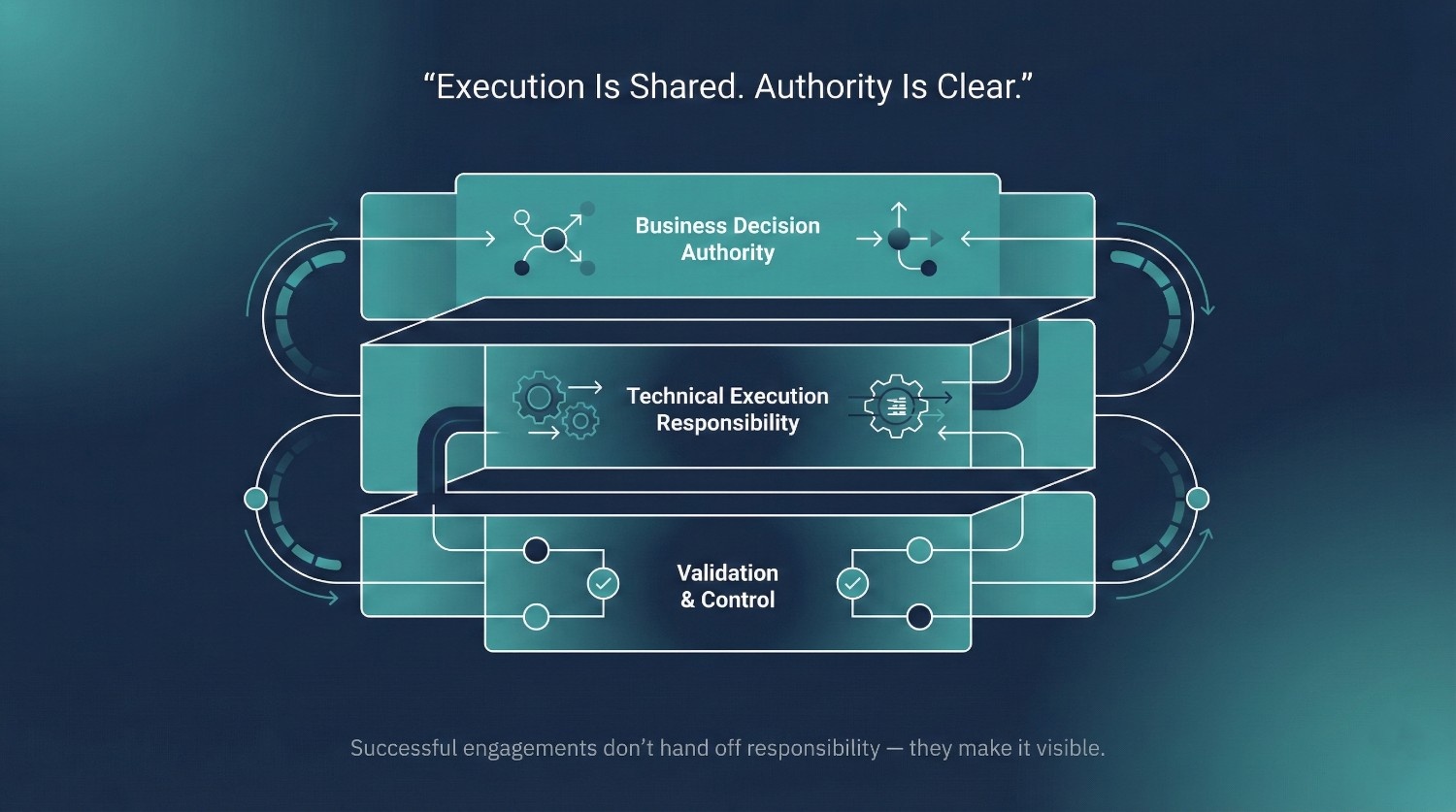
Engagements that succeed tend to share a very pattern: shared responsibility, explicit authority, and deliberate visibility.
Consulting as Co-Ownership, Not Handoff
The most effective engagements treat consulting as a co-ownership period, not a delegation.
That means:
- Consultants are accountable for execution quality
- Internal leaders remain accountable for decisions
- Success is shared, and accountability remains explicit
Work is done with the organization, not for it.
When consulting is treated as a handoff:
- Ambiguity gets buried in implementation
- Decisions are deferred instead of resolved
- Consultants become de facto owners without authority
- Internal teams often disengage
Co-ownership keeps responsibility visible—and prevents quiet failure.
Clear Internal Decision Makers
Nearly every successful engagement has one thing in common: named decision-makers.
Not committees.
Not Slack channels.
Not “we’ll align later.”
There should be:
- A business owner for core metrics
- A technical owner for architecture
- A clear escalation path when definitions conflict
- Explicit authority to decide and move forward
Consultants can structure choices.
Only internal leaders can close them.
Without decision-makers, progress looks busy—but often doesn’t converge.
Time-Boxed Validation Loops
Validation is necessary. Endless validation is a common failure mode.
Effective engagements use:
- Clearly defined validation windows
- Pre-agreed acceptance criteria
- Explicit exit conditions
This prevents:
- Permanent dual-runs
- Reopened decisions
- “Almost matching” paralysis
Time-boxed validation helps the organization to decide what “good enough” actually means—and move forward.
Business-Visible Milestones
Milestones should be visible to the business—not just engineering.
Strong engagements define milestones in terms of:
- Questions the business can now answer
- Reports leadership can rely on
- Decisions that no longer require reconciliation
This reframes progress from:
“We built another model”
to:
“This decision is now supported confidently”
Visibility tends to build trust. Silence often erodes it.
Knowledge Transfer as a First-Class Goal
If the organization cannot operate the warehouse confidently after consultants leave, the engagement has not met its core objective regardless of delivery quality.
Effective consulting treats knowledge transfer as a core deliverable:
- Decision rationale is documented
- Trade-offs are explained, not hidden
- Governance processes are internalized
- Ownership transitions are explicit
The goal is independence, not dependency.
The Pattern That Holds It All Together
Engagements that work share the same structure:
- Shared responsibility
- Explicit authority
- Bounded validation
- Visible outcomes
- Intentional handover
This model does not remove complexity.
It helps contain it.
And when data warehouse consulting is structured this way, it stops feeling like an expensive project—and starts functioning as what it should be: a catalyst for durable, organization-wide clarity around data.
Measuring Success in Data Warehouse Consulting
One of the reasons data warehouse consulting feels disappointing—even when work is delivered—is that success is measured incorrectly.
Most organizations track what is easy to count, not what actually matters.
Real success becomes visible when measurement extends beyond technical completion into business behavior and organizational health.
Technical Metrics (Necessary, Not Sufficient)
Technical metrics matter. They are table stakes.
They answer questions like:
- Does the system run reliably?
- Is performance acceptable?
- Are pipelines stable?
- Are costs predictable?
Common technical indicators include:
- Pipeline success rates and failure recovery time
- Query performance and concurrency behavior
- Data freshness and latency
- Cost per query or per workload
- Incident frequency and resolution time
These metrics confirm that the warehouse functions.
They do not, on their own, confirm that it works for the organization.
A technically sound warehouse can still be ignored, distrusted, or bypassed.
Business Metrics
Business metrics reveal whether the warehouse has changed how decisions are made.
Adoption
Adoption is not about logins or dashboard views alone.
Look for:
- Reduction in spreadsheet-based reconciliation
- Fewer parallel “backup” reports
- Business teams defaulting to warehouse-backed data
- Executives referencing warehouse metrics without caveats
Adoption means people increasingly choose the warehouse because it feels safer, not because they are told to use it.
Decision Latency
Decision latency measures how long it takes to go from question to confident answer.
Healthy signals include:
- Faster turnaround on leadership questions
- Fewer follow-up clarifications
- Reduced time spent validating numbers
- More decisions made in-meeting instead of deferred
When decision latency drops, the warehouse is likely doing its job—even if dashboards look unchanged.
Trust
Trust is subtle, but observable.
You can see it when:
- Numbers are defended instead of apologized for
- Metric changes are discussed calmly, not reactively
- Business teams ask “why did this change?” instead of “is this wrong?”
- Leadership stops asking for alternative versions “just in case”
Trust is among the hardest outcomes to build—and among the most valuable once earned.
Organizational Metrics
The most durable benefits of data warehouse consulting appear at the organizational level.
These metrics are rarely tracked—but they determine long-term ROI.
Reduced Rework
Look for:
- Fewer last-minute report fixes
- Less duplicated logic across teams
- Fewer emergency reconciliations before reviews
- Reduced need to rebuild the same metrics repeatedly
Reduced rework usually indicates the system is absorbing complexity instead of exporting it.
Clear Ownership
Success shows up when:
- Metric owners are known and accepted
- Escalations go to the right people quickly
- Decisions don’t stall due to authority gaps
- Engineers are no longer forced to arbitrate meaning
Ownership clarity reduces friction even when disagreements exist.
Fewer Escalations
Healthy warehouses tend to reduce escalation frequency—not because problems disappear, but because:
- Issues are resolved closer to the source
- Definitions are explicit
- Change processes are understood
- Surprises are rare
When fewer issues reach executive level, the system is stable.
The Measurement Shift That Matters
Weak success measurement asks:
“Did we build what we planned?”
Strong success measurement asks:
“Did the organization change how it uses data?”
Data warehouse consulting succeeds when, over time:
- Decisions become easier
- Trust increasingly becomes default
- Ownership becomes clear
- Rework declines
Technical delivery enables this—but it does not guarantee it.
If success is only measured in pipelines, models, and dashboards, disappointment is almost guaranteed.
When success is measured in confidence, clarity, and organizational behavior, the value of data warehouse consulting becomes visible—and defensible—to leadership.
Final Thoughts
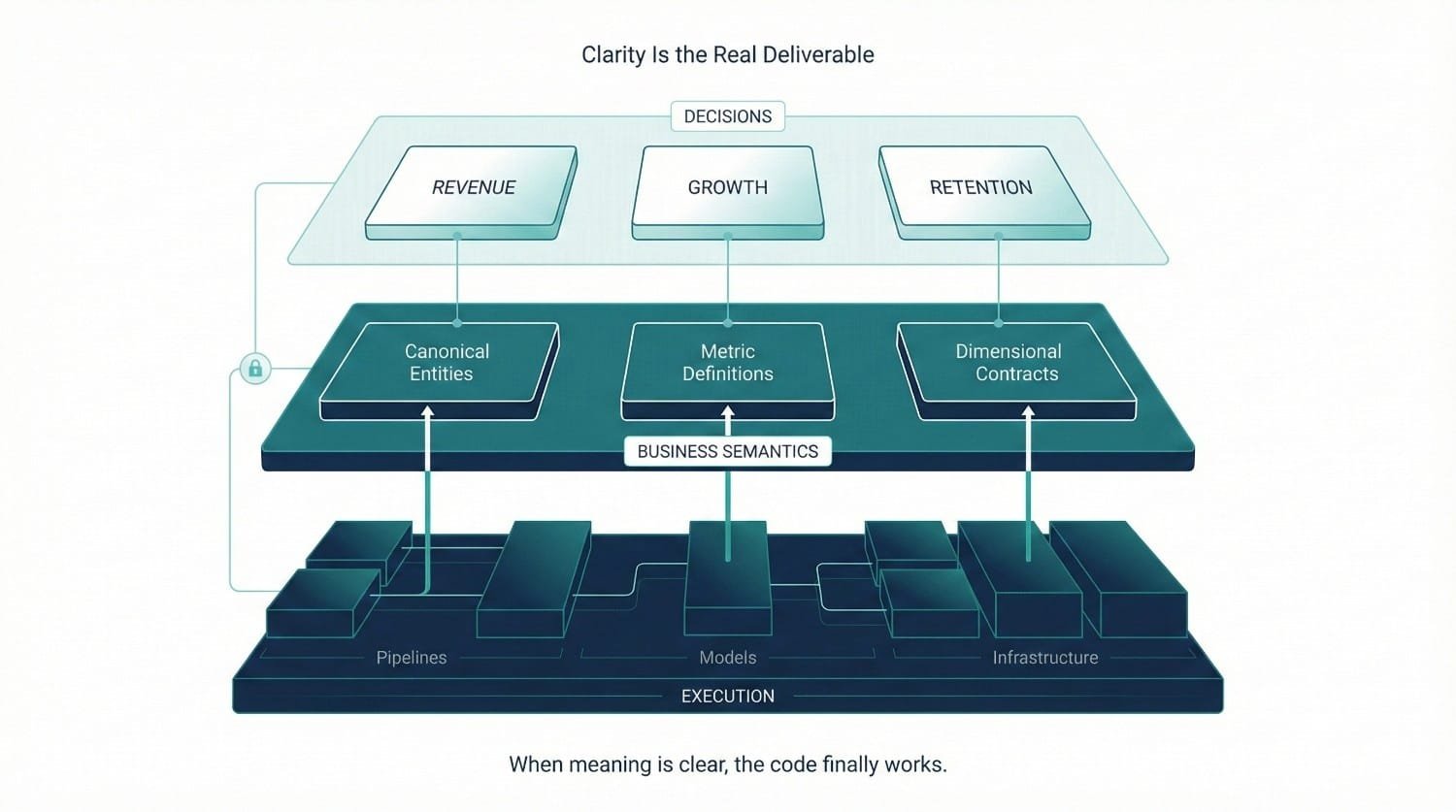
By the time an organization hires data warehouse consultants, code is rarely the primary problem.
Most teams already have:
- Skilled engineers
- Modern tools
- Working pipelines
- Dashboards that technically function
What they lack is clarity. Large-scale post-migration reviews at organizations such as Google and Meta have repeatedly shown that delivery issues attributed to “data complexity” were more often rooted in unresolved semantic decisions and unclear ownership than in platform or pipeline limitations.
Code Is Often the Easy Part
Code responds to instructions.
If definitions are clear, ownership is assigned, and decisions are explicit, engineers can implement almost anything reliably.
When code fails, it is often because it was asked to compensate for:
- Ambiguous meaning
- Deferred decisions
- Political uncertainty
- Missing ownership
In those situations, even excellent code produces unstable outcomes.
Clarity Is Often the Hard Part
Clarity requires:
- Choosing one definition when multiple feel reasonable
- Naming owners who are accountable when numbers are questioned
- Accepting that some changes will alter historical narratives
- Making trade-offs visible instead of hiding them in implementation
These are leadership challenges—not technical ones.
Data warehouse consulting exists to help force these questions into the open, early, and in a structured way. The value is not confrontation for its own sake, but resolution: surfacing ambiguity while there is still time to choose deliberately, rather than encoding uncertainty permanently into systems.
When Data Warehouse Consulting Succeeds
It succeeds when it:
- Makes decisions explicit
Assumptions are documented. Trade-offs are discussed. Nothing important is left implied. - Assigns ownership
Every critical metric and model has a clear owner with authority and responsibility. - Builds systems people trust
Data behaves predictably. Changes are explained. Confidence compounds instead of resetting.
Pipelines, tools, and dashboards support these outcomes—but they do not create them. Once trust stabilizes, organizations consistently report second-order benefits: faster onboarding of analysts, fewer bespoke data requests, and a measurable reduction in executive escalations tied to reporting disputes.
Final Takeaway
Executives often evaluate data initiatives based on delivery artifacts. The more reliable signal of success is whether leadership discussions shift from debating numbers to debating decisions.If your data warehouse consulting engagement avoids:
- Hard conversations
- Ownership decisions
- Semantic alignment
- Governance design
Then it is not meaningfully reducing risk—it is postponing it.
Data warehouse consulting is not about writing more code.
It is about making the organization clear enough that the code can finally work.
That clarity is what turns data from a source of friction into a source of confidence—and it is the true measure of a successful engagement.
Frequently Asked Questions (FAQ)
Data warehouse consulting helps an organization turn raw data into trusted, decision-grade information. It focuses on clarity—definitions, ownership, operating models, and trust—not just pipelines, tools, or dashboards.
Data engineering focuses on building and maintaining data systems.
Data warehouse consulting focuses on deciding how data should work inside the organization—what metrics mean, who owns them, how change happens, and how trust is maintained. Engineering implements those decisions; consulting helps create them.
Possibly—but tools alone don’t solve:
- Conflicting metric definitions
- Ownership gaps
- Trust issues
- Governance failures
- Slow or risky decision-making
If those problems exist, modern tools may actually amplify them. Consulting is valuable when the issue is structure and alignment, not technology.
They can surface data quality issues and design ways to manage them.
They cannot decide:
- Which historical data should change
- Which discrepancies are acceptable
- Who absorbs the impact of corrections
Data quality improves only when ownership and decision authority are clear.
Because business teams trust predictability and clarity, not correctness alone.
If numbers change unexpectedly, definitions aren’t explicit, or ownership is unclear, dashboards feel unsafe—even if they’re accurate.
No. Warehouses are living systems.
Good consulting designs:
- Operating models
- Change processes
- Ownership structures
So the organization can evolve the warehouse after consultants leave.
If you hear things like:
- “Which number is right?”
- “This used to match last quarter”
- “I’ll double-check in my spreadsheet”
- “We’re afraid to change anything”
The problem is organizational—not technical.
Success shows up when:
- Teams stop rebuilding the same metrics
- Leadership trusts numbers without caveats
- Decisions happen faster
- Escalations decrease
- Ownership is clear
Pipelines and dashboards are outputs—not success indicators.
It depends on organizational readiness, not data size.
Most value comes early from:
- Clarifying definitions
- Naming owners
- Structuring decisions
Longer engagements are justified when operating models and governance need to be built—not just systems.
Partners who:
- Focus only on tools
- Avoid governance discussions
- Promise speed without trade-offs
- Don’t ask business questions early
These signals usually mean hard problems will be deferred—not solved.
If leadership is unwilling to:
- Own definitions
- Make decisions
- Accept visible trade-offs
- Stay engaged
In that case, consulting will deliver artifacts—but not outcomes.
Data warehouse consulting is not about code.
It is about making decisions explicitly, assigning ownership, and building systems people trust.
If an engagement avoids those conversations, it isn’t simplifying your data—it’s quietly making it more expensive to understand.