
Table of Contents
Introduction
The Pressure Is Real. Every organization is under the same squeeze right now:
- More data sources, many mid-to-large enterprises manage dozens to hundreds of disconnected systems, and the number grows every quarter
- Higher expectations, leadership wants unified analytics, real-time insights, and AI-ready data
- Tighter budgets, do more with less, deliver faster, prove ROI sooner
- Less patience, tolerance for 18-month integration projects without incremental value has significantly declined
The result: a constant search for the fastest, most cost-effective way to get data integrated and working. And that search almost always leads to the same fork in the road.
The Two Paths
When organizations decide to tackle data integration, they typically gravitate toward one of two options:
Path 1: Buy an iPaaS Tool
“Let’s get MuleSoft / Boomi / Workato / Celigo. It’ll handle our integration needs. The vendor says it does everything.”
Path 2: Engage Data Integration Consulting
“Let’s bring in experts who’ve done this before. They’ll assess our situation and build the right solution.”
Both paths are valid. Both have real strengths. And both have real limitations that vendors and consulting firms don’t always advertise.
The False Dichotomy
Here’s where most organizations go wrong: they frame this as an either/or decision.
- “Should we buy a tool or hire a consultant?”
- “Should we invest in a platform or invest in services?”
- “Should we build internal capability with software or outsource it to experts?”
The framing itself is the problem.
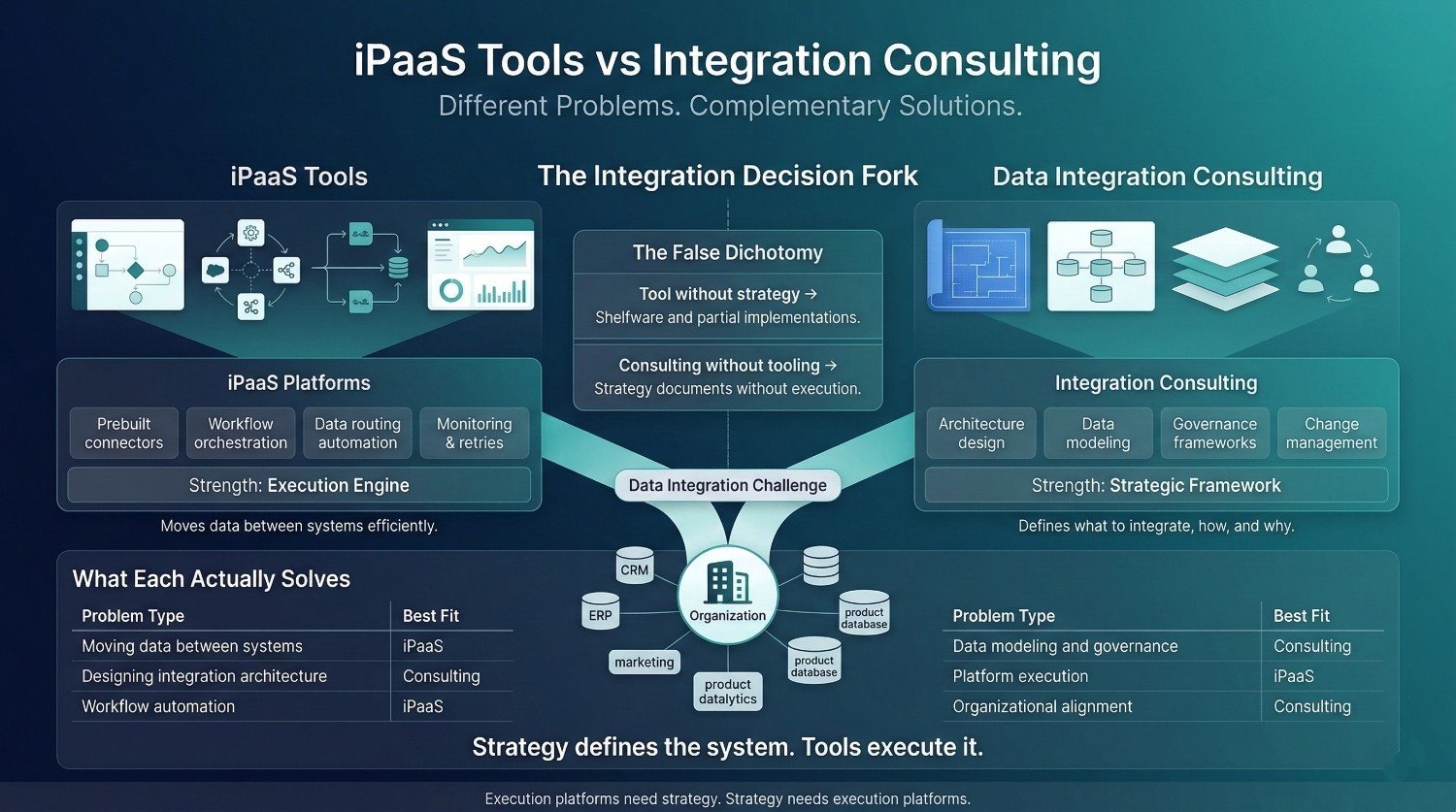
iPaaS tools and data integration consulting solve fundamentally different problems:
Questions | iPaaS Tools | Data Integration Consulting |
|---|---|---|
What they solve |
The mechanics of connecting systems and moving data |
The strategy, architecture, and organizational challenges of making data usable |
What they provide |
Pre-built connectors, workflow builders, monitoring dashboards |
Assessment, architecture design, data modeling, governance, change management |
Where they excel |
Execution, moving and routing data between systems efficiently |
Planning, defining what to move, how to transform it, and why it matters |
Where they fall short |
They don't tell you what your integration strategy should be |
They don't replace the need for a platform to execute that strategy |
Treating this as either/or leads to predictable failure modes:
- Tool without strategy → Shelfware. The iPaaS is purchased, partially configured, and never fully leveraged because nobody defined the architecture, data model, or governance framework it should operate within.
- Consulting without tooling → A beautiful strategy document that can’t be executed because there’s no platform to implement it on.
- The right tool for the wrong problem → An iPaaS solving application integration when the real need is data warehouse consolidation. Or consulting engaged for a simple connector setup that didn’t need it.
The Real Question
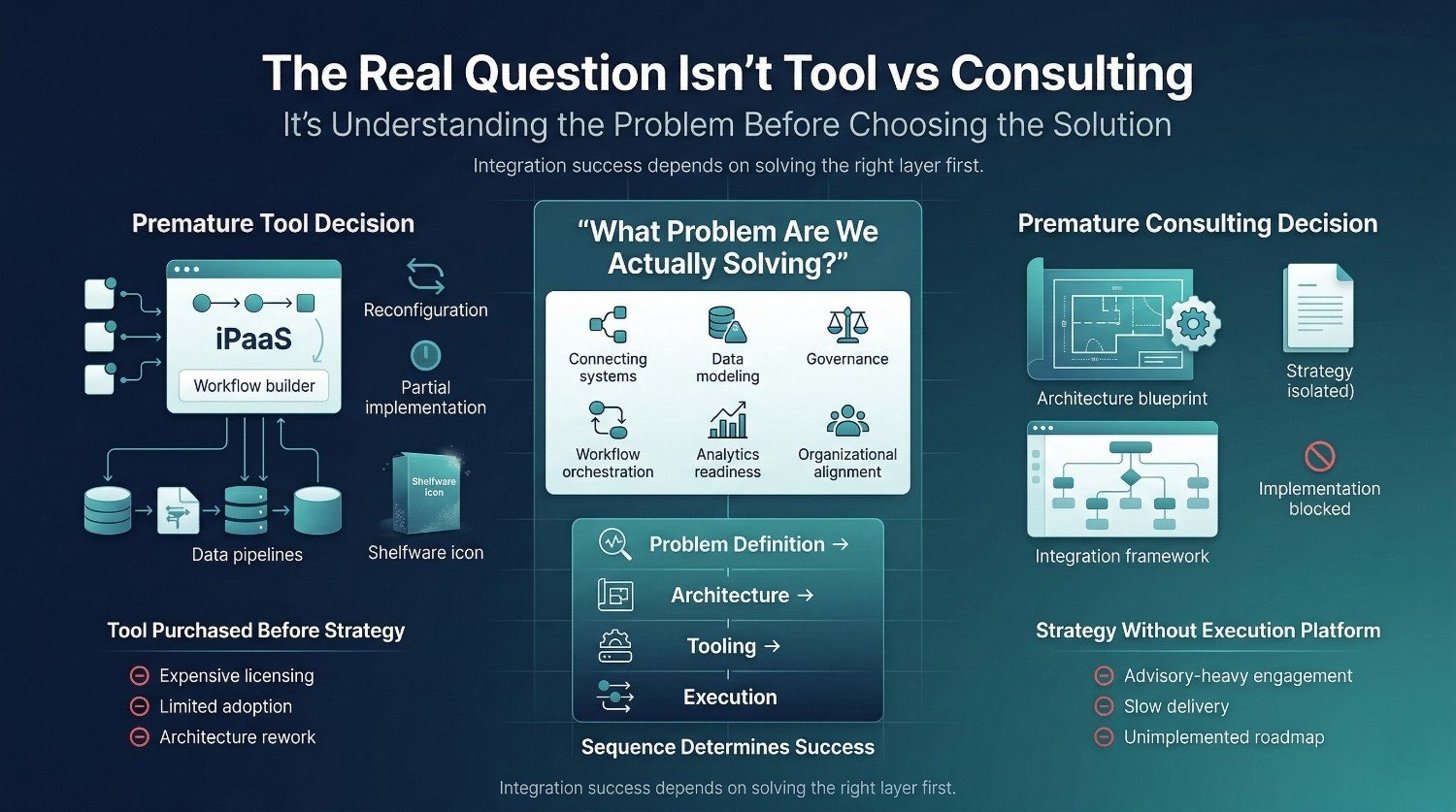
The question isn’t “iPaaS or consulting?” The question is:
“What problem am I actually trying to solve, and which combination of tooling and expertise will solve it most effectively?”
That requires understanding:
- What iPaaS tools actually do, and what they don’t
- What data integration consulting actually delivers, and where it’s overkill
- Where the two overlap, where they complement each other, and where one is clearly the right choice over the other
The Cost of Getting It Wrong
This isn’t an abstract decision. Getting it wrong has concrete consequences:
- Buying an enterprise iPaaS without a defined strategy can result in six-figure licensing commitments with limited realized value
- Engaging consulting when you just needed a tool → Months of advisory work and a roadmap for a problem that a $30K/year connector platform could have solved in two weeks
- Buying both but in the wrong sequence → The tool is configured before the strategy is defined, then has to be reconfigured after consulting reveals the architecture should have been different
The most expensive integration mistake isn’t choosing the wrong tool or the wrong consultant. It’s not understanding which problem you’re solving before you start spending.
The Thesis
iPaaS tools and data integration consulting solve fundamentally different layers of the integration challenge. Understanding which layer your organization needs to address, and in what sequence, is the single most important decision you’ll make before investing a dollar.
This isn’t about one being better than the other. It’s about using each for what it’s actually good at, and knowing when you need one, the other, or both.
What You'll Walk Away With
By the end of this post, you’ll have:
- A clear understanding of what iPaaS tools actually do, their strengths, their limits, and where they stop being useful
- An equally clear picture of what data integration consulting delivers, and where it’s essential vs. unnecessary
- A practical framework for deciding which one you need, when, and in what combination
- Concrete guidance on how to avoid the most common mistakes organizations make when choosing between them
- The confidence to make this decision based on your actual problem, not vendor marketing or consulting sales pitches
Let’s break it down.
What Is iPaaS? A Clear Definition
Before comparing iPaaS tools to data integration consulting, let’s make sure the definition is precise, because the term gets stretched to cover a lot of things that aren’t really iPaaS, and the actual capabilities vary enormously across platforms.
Defining iPaaS (Integration Platform as a Service)
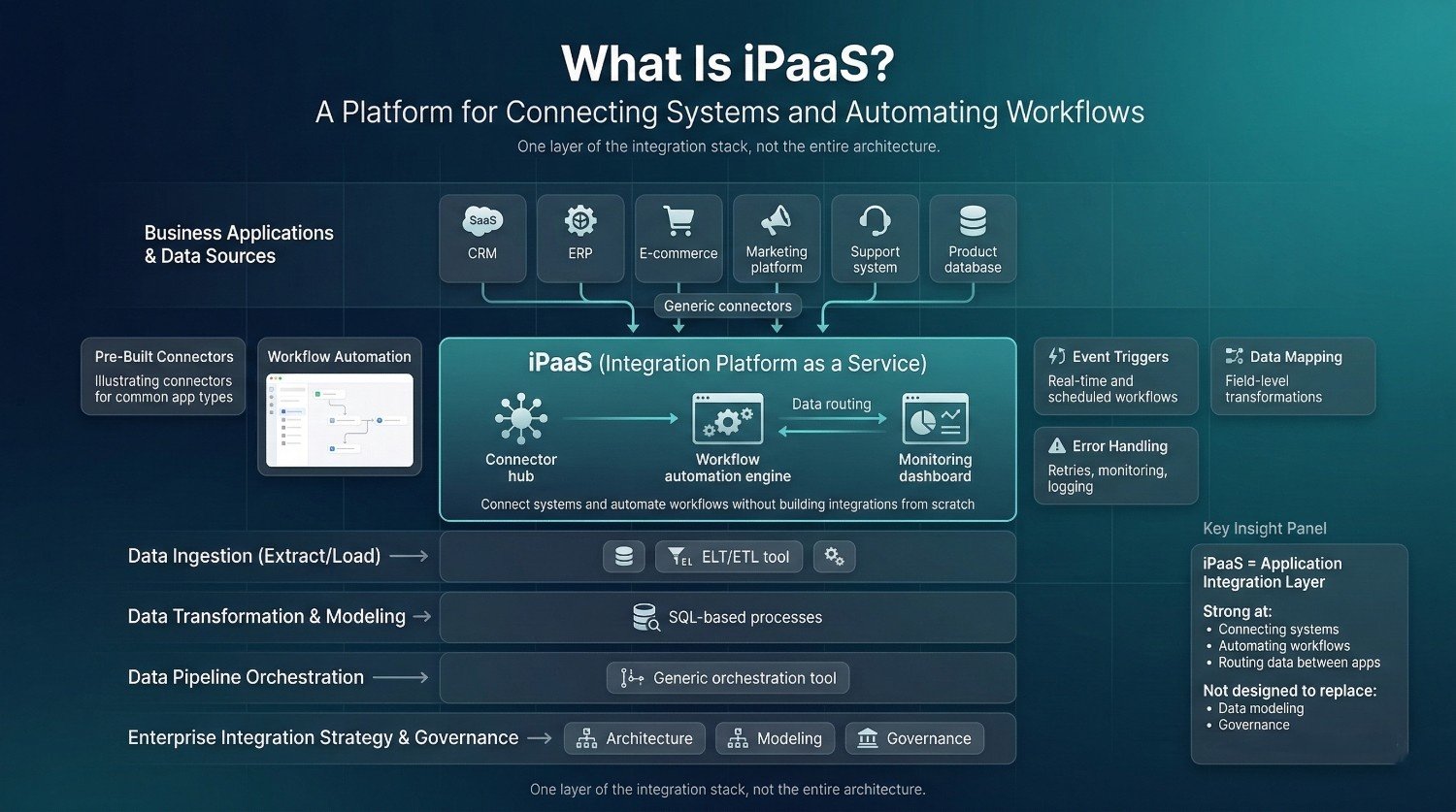
iPaaS is a cloud-based platform that provides pre-built connectors, workflow automation, and integration capabilities as a managed service. The core promise:
“Don’t build integrations from scratch. Use our platform, we’ve already built the connectors, the infrastructure, and the workflow engine. You just configure the logic.”
In practical terms, iPaaS platforms give you:
- A library of pre-built connectors to popular applications and data sources
- A workflow builder (usually visual/low-code) for designing integration flows
- Managed infrastructure, no servers to provision, patch, or scale
- Monitoring and error handling, built into the platform
Where iPaaS Fits in the Integration Landscape
iPaaS sits at a specific layer of the integration technology stack:
Layer | What It Covers | Example Tools |
|---|---|---|
Data Movement / Ingestion |
Extracting and loading raw data from sources to targets |
Fivetran, Airbyte, Stitch, Meltano |
iPaaS |
Application-to-application integration, workflow automation, data routing between systems |
MuleSoft, Boomi, Workato, Celigo |
Data Transformation |
Modeling, cleaning, and structuring data inside a warehouse or lakehouse |
dbt, SQLMesh, Coalesce |
Data Integration (full scope) |
End-to-end unification, strategy, architecture, modeling, quality, governance, transformation |
Informatica, Talend, custom architectures + consulting |
Orchestration |
Coordinating and scheduling workflows across all layers |
Airflow, Dagster, Prefect |
iPaaS overlaps with several of these layers but typically does not fully replace specialized tools in each category. It’s strongest at the application integration layer, connecting SaaS tools and automating workflows between them.
What iPaaS Platforms Typically Offer
Pre-Built Connectors
- Hundreds or thousands of connectors to popular applications, Salesforce, HubSpot, NetSuite, Snowflake, Shopify, ServiceNow, Workday, and many more
- Handle authentication, API versioning, pagination, and rate limiting out of the box
- New connectors added regularly as the ecosystem grows
- This is a primary value proposition, what used to take weeks of custom API development now takes hours of configuration
Visual Workflow Builders
- Drag-and-drop interfaces for designing integration flows
- Low-code or no-code, accessible to business analysts and operations teams, not just engineers
- Define triggers, data mappings, conditional logic, and routing without writing code
- Generally lowers the barrier to entry for common integration patterns
Data Mapping and Basic Transformation
- Field-level mapping between source and target systems
- Simple data type conversions (string to integer, date format changes)
- Filtering, conditional routing, and basic enrichment
- Important consideration: these are typically lightweight transformations, not the complex business logic, entity resolution, or cross-system reconciliation that full data integration requires
Event Triggers and Scheduling
- Real-time triggers, fire an integration when an event occurs (new record created, status changed, webhook received)
- Scheduled execution, run integrations on a defined cadence (hourly, daily, weekly)
- Webhooks, listen for events from external systems and trigger workflows
- Enables both real-time and batch integration patterns
Error Handling and Logging
- Built-in retry logic for failed API calls
- Error queues and alerting when flows fail
- Execution logs for debugging and auditing
- Some platforms offer automatic error resolution for common failure patterns
API Management
- Some enterprise iPaaS platforms (especially MuleSoft) include API creation and lifecycle management
- Publish APIs for internal or external consumers
- Version management, access control, and usage monitoring
- Not universal, many mid-market iPaaS platforms don’t include this capability
Pre-Built Templates and Recipes
- Common integration patterns available out of the box:
- “Sync Salesforce contacts to HubSpot”
- “Create NetSuite invoices from Shopify orders”
- “Push Zendesk tickets to Slack channels”
- Accelerates deployment for standard use cases
- Useful starting points, but almost always require customization for real-world scenarios
Leading iPaaS Platforms
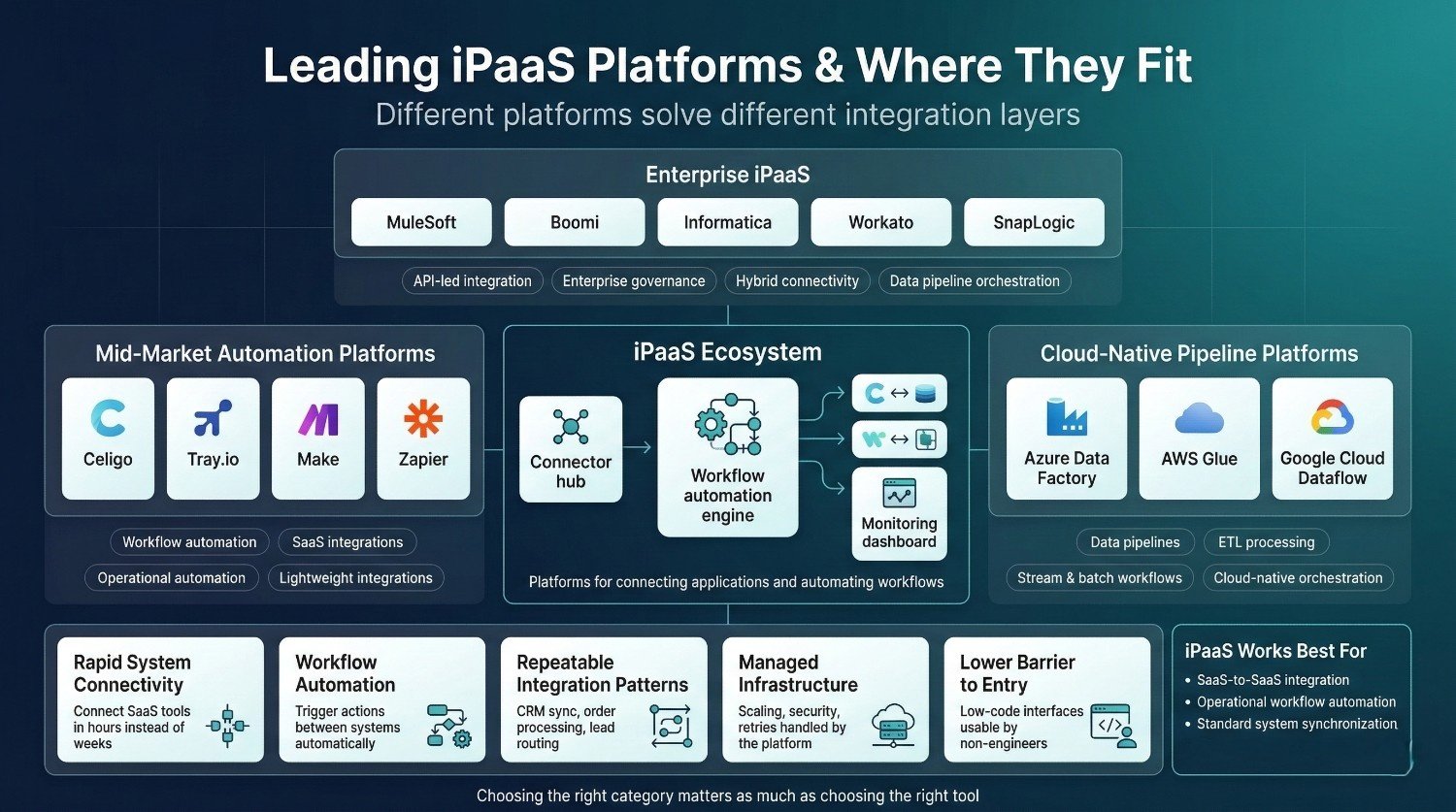
The iPaaS market is crowded and segmented. Different platforms target different audiences and solve different integration problems.
Enterprise-Grade
Platform | Key Strengths | Ecosystem Fit |
|---|---|---|
MuleSoft |
API-led connectivity, enterprise governance, Salesforce-native integration |
Large enterprises, Salesforce-heavy environments, API strategy initiatives |
Boomi |
Broad connector library, strong MDM capabilities, hybrid deployment |
Mid-to-large enterprises, hybrid cloud environments |
Informatica IDMC |
Deep data integration and quality capabilities, AI-assisted mapping |
Data-centric enterprises with complex transformation needs |
Workato |
Business-user friendly, strong workflow automation, growing enterprise adoption |
Organizations wanting both integration and business process automation |
SnapLogic |
AI-powered integration, strong data engineering focus |
Enterprises with significant data pipeline requirements |
Mid-Market / SMB
Platform | Key Strengths | Ecosystem Fit |
|---|---|---|
Celigo |
NetSuite-native, strong e-commerce integrations, error management |
E-commerce and mid-market companies running NetSuite |
Tray.io |
Flexible workflow builder, developer-friendly, strong automation |
Tech-forward mid-market companies with complex workflows |
Make (formerly Integromat) |
Visual builder, affordable, large template library |
Small teams and SMBs automating operational workflows |
Zapier |
Simplest entry point, massive connector library, no-code |
Very lightweight automation, not enterprise data integration |
Cloud-Native / Data-Focused
Platform | Key Strengths | Ecosystem Fit |
|---|---|---|
Azure Data Factory |
Deep Azure integration, hybrid data movement, visual pipeline builder |
Organizations committed to the Microsoft/Azure ecosystem |
AWS Glue |
Serverless ETL, Spark-based, tight AWS integration |
AWS-native data engineering teams |
Google Cloud Dataflow |
Stream and batch processing, Apache Beam-based |
GCP-native teams with real-time data processing needs |
The Important Nuance
These platforms often address different integration layers and organizational needs:
- MuleSoft and Boomi emphasize application integration, connecting apps and automating business processes
- Informatica and SnapLogic lean more toward data integration, transformation, quality, and data pipeline management
- Azure Data Factory and AWS Glue are data engineering tools that overlap with iPaaS but are really cloud-native pipeline builders
- Zapier and Make are task automation tools, useful for lightweight workflows but not enterprise data integration
Choosing the wrong category of iPaaS for your problem is just as wasteful as choosing no iPaaS at all. This is one of the first things data integration consulting can help clarify.
What iPaaS Does Well
Let’s give iPaaS platforms their full credit. When used for the right problems, they deliver real, measurable value:
Dramatically Reduces Time to Basic Connectivity
- Historically, connecting enterprise SaaS systems required substantial custom API development
- With iPaaS, it’s configured in hours, authentication, field mapping, scheduling, error handling all included
- For standard SaaS-to-SaaS or SaaS-to-warehouse patterns, this speed advantage is significant
Lowers the Barrier to Entry
- Visual workflow builders mean you don’t need a team of senior data engineers to build basic integrations
- Business analysts, ops teams, and junior developers can create and manage integration flows
- Democratizes integration for organizations that don’t have (or can’t hire) deep integration expertise
Handles High-Volume, Repeatable Patterns Efficiently
- Standard integration patterns, CRM sync, order processing, lead routing, are well-served by iPaaS
- Once configured, these flows run reliably at scale with minimal maintenance
- The managed infrastructure handles scaling, failover, and security automatically
Managed Infrastructure
- No servers to provision, patch, or maintain
- Automatic scaling, handles volume spikes without manual intervention
- Built-in security, encryption, and compliance certifications (SOC 2, HIPAA, etc.)
- Significantly reduces the operational burden on internal teams
Accelerates Standard Use Cases
iPaaS shines brightest with well-defined, repeatable integration patterns:
- CRM-to-ERP sync, orders, contacts, accounts flowing between sales and finance systems
- Marketing automation data flows, leads and engagement data moving between marketing platforms and CRM
- SaaS-to-warehouse ingestion, operational data replicated to a data warehouse for analytics
- Cross-application workflow automation, when X happens in System A, trigger Y in System B
- Employee onboarding flows, HR system triggers account creation across IT, payroll, and access management
For these use cases, iPaaS is often the fastest, most cost-effective solution available, and data integration consulting may not be needed at all.
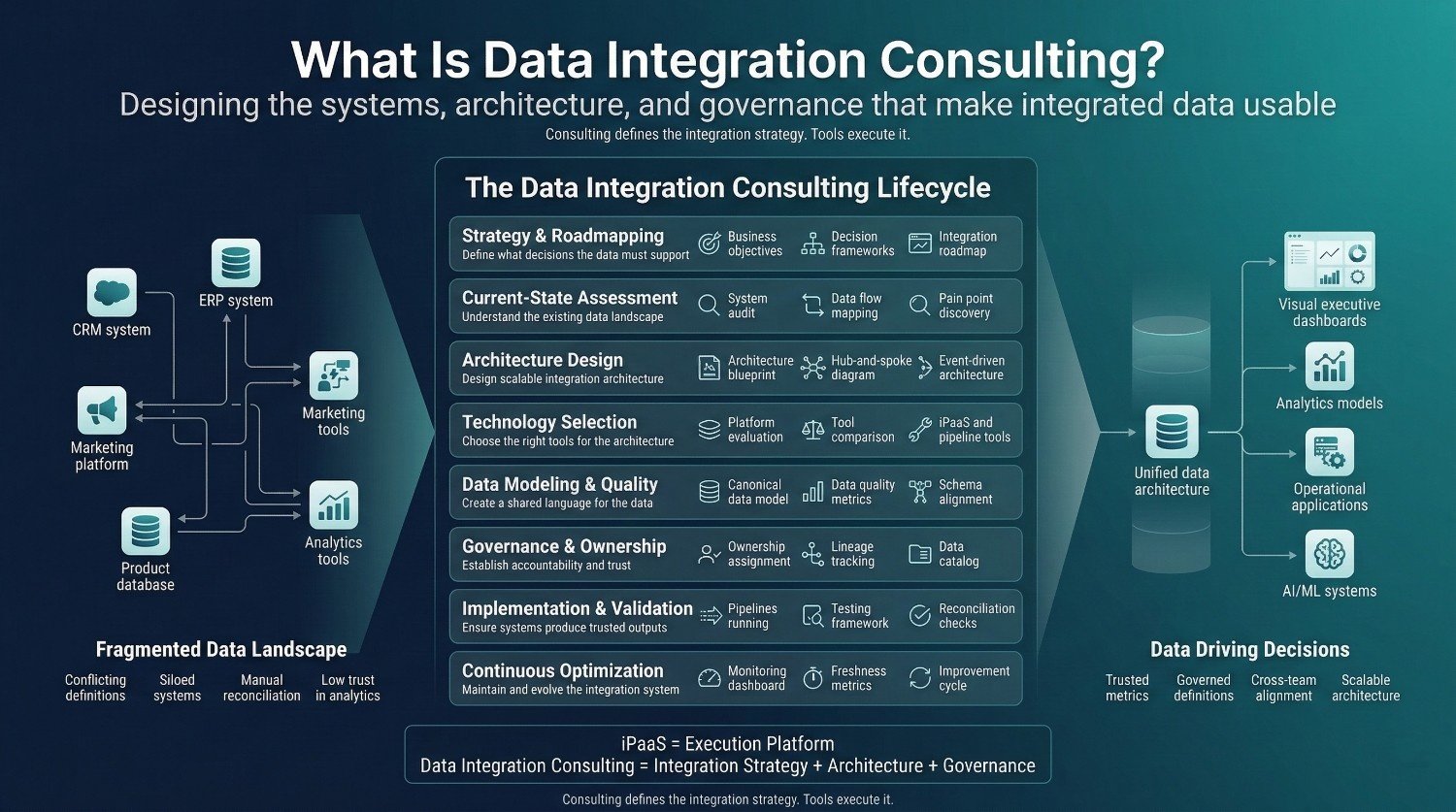
What Is Data Integration Consulting? A Clear Definition
Now let’s give data integration consulting the same treatment, a precise definition, a clear scope, and an honest assessment of where it delivers value.
Defining Data Integration Consulting
Data integration consulting typically involves expert-led services that help organizations plan, design, implement, and optimize their broader data integration approach, from business objectives through architecture through ongoing operations.
The key distinction from iPaaS:
iPaaS is a platform you configure. Data integration consulting is an expertise you engage. One gives you the tools to execute. The other helps you figure out what to execute, why, in what order, and how to make it stick.
What It's Not
- It’s not just “setting up connectors”, that’s implementation services
- It’s not just “building pipelines”, that’s data engineering
- It’s not just “writing a strategy doc”, that’s advisory without delivery
Comprehensive data integration consulting engagements typically span the full lifecycle:
From | To |
|---|---|
"We have data in systems" |
"Our data drives business decisions" |
Fragmented, untrusted data |
Unified, governed, trusted data |
Tool-first thinking |
Outcome-first architecture |
Departmental silos |
Cross-functional alignment |
One-time project |
Sustainable, evolving program |
The primary focus isn’t merely on connecting systems. It’s on solving business problems through data, with connectivity as one component of a much larger solution.
What Data Integration Consulting Typically Covers
Here’s the full scope, layer by layer. This is what separates consulting from tool configuration.
Strategy and Roadmapping
- Defining integration goals aligned with measurable business outcomes, not just technical deliverables
- Building a phased roadmap that delivers value incrementally
- Prioritizing initiatives based on business impact, technical feasibility, and organizational readiness
- Answering the question every initiative should start with: “What decisions will this data enable?”
Current-State Assessment
- Auditing the existing data landscape:
- What systems exist and what data they hold
- How data flows between systems today, including manual processes and workarounds
- Known pain points, quality issues, and technical debt
- Previous integration attempts, what worked, what didn’t, and why
- This assessment often reveals problems the organization didn’t know it had, which is often the intent of a structured assessment
Architecture Design
- Designing a scalable, maintainable integration architecture tailored to the organization’s specific needs
- Evaluating architectural patterns:
Pattern | When It Fits |
|---|---|
Hub-and-spoke |
Centralized integration through a single platform, good for organizations with a strong central data team |
Event-driven |
Real-time integration triggered by events, good for operational use cases with low latency requirements |
Data mesh |
Decentralized, domain-owned data products, good for large organizations with mature domain teams |
Data fabric |
Metadata-driven, automated integration across distributed sources, good for complex, heterogeneous environments |
Hybrid |
Combination of patterns, the most common real-world approach |
- Designing for current requirements and anticipated growth
- Designing the architecture to support observability, maintainability, and governance from the outset
Technology Evaluation and Selection
This is where consulting and iPaaS directly intersect:
- Vendor-neutral assessment of which tools fit the organization’s actual requirements
- Evaluating iPaaS platforms, data movement tools, transformation engines, and orchestration frameworks
- Comparing build vs. buy for each layer of the integration stack
- Proof-of-concept testing with real data, not vendor demo datasets
A qualified data integration consulting partner may recommend an iPaaS platform as part of the solution. Or they might recommend against it. The recommendation is driven by your needs, not by a vendor partnership.
Data Modeling
- Building canonical data models that create a shared language across all source systems
- Defining how key entities, customer, product, order, employee, are represented in the integrated environment
- Mapping source schemas into the canonical model, resolving naming conflicts, structural differences, and granularity mismatches
- This is the work that makes disparate data meaningfully unified rather than simply co-located
Data Quality and Profiling
- Profiling every critical source system for completeness, accuracy, consistency, and freshness
- Quantifying quality issues, duplicate rates, null percentages, format inconsistencies
- Building remediation plans for critical quality issues that would undermine integration
- Establishing measurable quality baselines so improvement can be tracked over time
Governance Framework
- Establishing data ownership, who is accountable for the quality and accuracy of each data domain
- Defining data stewardship, who handles day-to-day quality issues and escalations
- Implementing lineage tracking, tracing every data point from source through transformation to consumption
- Building data catalogs, making integrated data discoverable and understandable
- Setting access controls, role-based permissions, data classification, and audit trails
Transformation and Business Logic
- Encoding complex business rules that no iPaaS can infer automatically:
- How revenue is calculated and which source is authoritative
- How customer segments are defined and which criteria apply
- How fiscal periods, territories, and hierarchies work
- How conflicting data from two systems gets resolved
- Handling the long tail of edge cases, the 20% of transformation logic that takes 80% of the effort
- Documenting every rule with rationale, approval, and source dependency
Change Management
- Stakeholder alignment, getting finance, marketing, operations, and engineering to agree on shared definitions
- Cross-team facilitation, navigating political dynamics that internal teams often can’t
- Training and enablement, ensuring people actually adopt the integrated data
- Communication, managing expectations about timelines, complexity, and iterative delivery
Testing and Validation
- Multi-layer testing that extends beyond verifying that the pipeline executed successfully:
- Data completeness, all expected records arrived
- Data accuracy, transformed values match business expectations
- Edge case coverage, nulls, special characters, timezone handling
- Business validation, stakeholders confirm the output matches their domain knowledge
- Source-to-target reconciliation on every pipeline
- Parallel testing with real users before go-live
Ongoing Optimization
- Monitoring frameworks, pipeline health, data quality scores, freshness SLAs
- Maintenance planning, handling source system changes, schema evolution, API deprecations
- Evolution roadmap, new sources, new requirements, new regulations
- Regular governance reviews to ensure the framework remains aligned with evolving business needs
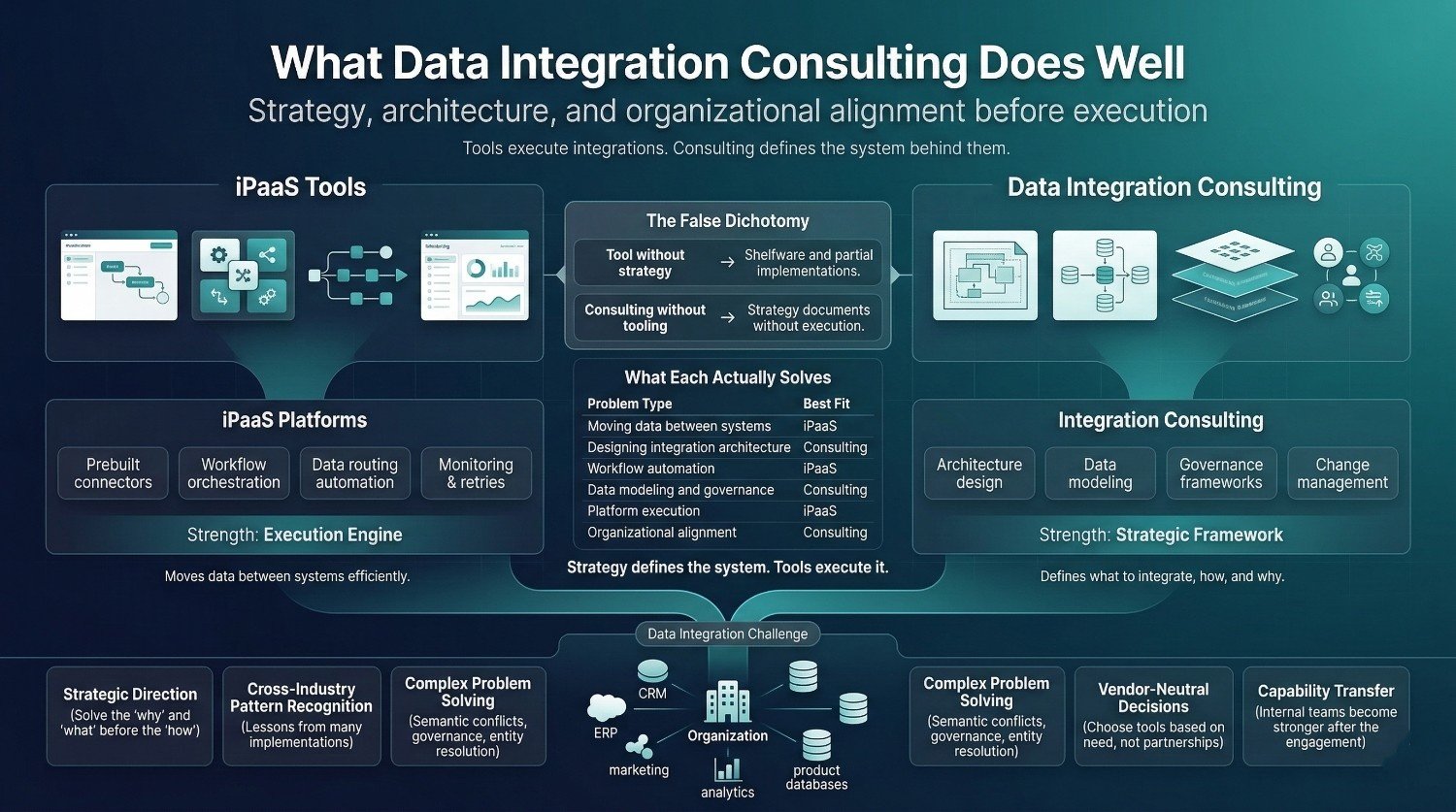
What Data Integration Consulting Does Well
Solves the "Why" and "What" Before the "How"
iPaaS answers: “How do we connect these systems?”
Data integration consulting answers:
- “Why are we integrating this data?”
- “What business outcome should it enable?”
- “What does ‘done’ look like, in business terms?”
- “What’s the right architecture, sequence, and approach?”
Then, and only then, “How do we build it?”
The “why” and “what” are where most projects succeed or fail. The “how” is execution, important, but only valuable when the direction is right.
Brings Cross-Industry Pattern Recognition
- A consulting team that’s done integration across retail, healthcare, finance, and SaaS has seen your problem before, probably dozens of times
- They have experience identifying which approaches tend to work and which tend to introduce risk
- Your team doesn’t have to learn these lessons the hard way at the project’s expense
Handles Complexity That Tools Can't Address
Some integration challenges aren’t tool problems at all:
- Semantic conflicts, “revenue” means different things in different departments. No iPaaS resolves that independently.
- Organizational politics, two departments fighting over whose system is the source of truth. No tool mediates that effectively without human facilitation.
- Regulatory requirements, proving data provenance and lineage to an auditor. No connector handles that without supporting governance and architecture.
- Entity resolution, determining that three records across three systems all refer to the same real-world customer. No visual workflow builder solves that automatically.
These are the challenges where data integration consulting delivers its highest value, because they require human judgment, domain expertise, and organizational facilitation.
Provides Vendor-Neutral Objectivity
- Not tied to any specific platform or vendor
- Will recommend an iPaaS when it’s the right fit, and recommend against it when it’s not
- Evaluates your entire stack holistically, not just the layer their product operates on
- The recommendation serves your business, not a partnership agreement
Accelerates by Avoiding Pitfalls
- Projects that take 12–18 months internally get compressed to 6–9 months, not by cutting corners, but by avoiding the rework cycles that come from inexperience
- Architecture is more likely to be designed appropriately the first time
- Quality issues get caught before they cascade
- Stakeholder misalignment gets resolved in workshops, not in production
Builds Internal Capability
Good consulting doesn’t create dependency. It creates capability:
- Your engineers learn patterns they hadn’t encountered
- Your analysts understand the data model and governance framework
- Your stewards have operational runbooks and procedures
- When the engagement ends, your team is stronger and more self-sufficient
This is the fundamental value proposition of data integration consulting, not just delivering a solution, but building your organization’s ability to sustain and evolve it.
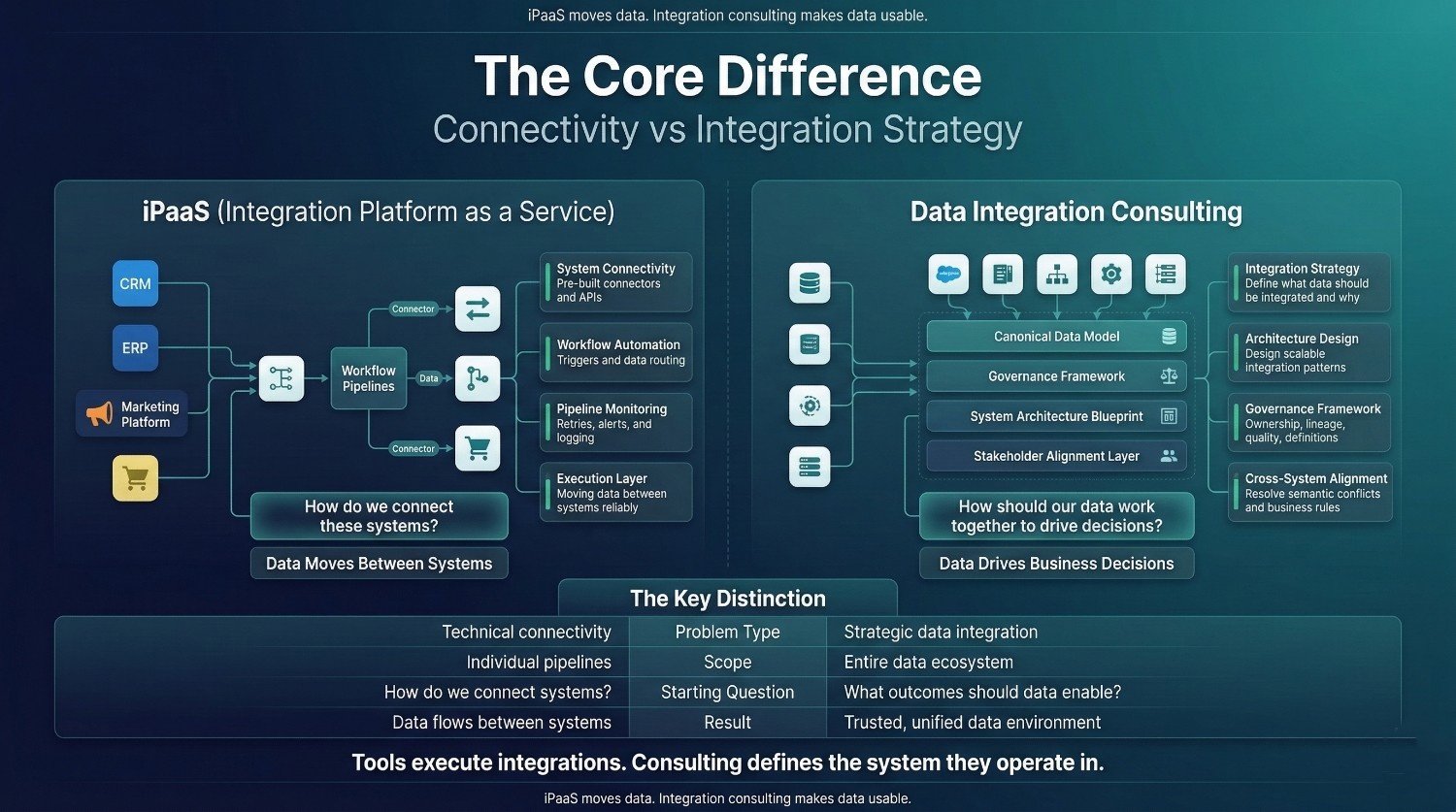
The Core Differences: A Deep Comparison
This is the section that puts iPaaS and data integration consulting side by side, honestly, dimension by dimension, so you can see exactly where each delivers value and where each falls short.
What They Solve
This is the most fundamental difference. Everything else flows from it.
iPaaS Solves the Connectivity and Automation Problem
“How do we move data between systems efficiently?”
- Establishing connections between applications
- Automating data flows and business process triggers
- Handling API communication, authentication, scheduling, and error handling
- Making it possible for data to get from System A to System B reliably
This is a technology problem. And iPaaS solves it well.
Data Integration Consulting Solves the Strategy and Complexity Problem
“How do we make all our data work together to drive business outcomes?”
- Defining what data needs to be integrated, why, and for whom
- Designing an architecture that unifies data across dozens of systems
- Reconciling conflicting definitions, schemas, and business rules
- Building governance, quality, and organizational alignment
- Ensuring the integrated data is trusted, usable, and sustainable
This is a business and organizational problem that involves technology. iPaaS is one tool in the solution. Consulting helps define the broader solution.
The Distinction
iPaaS | Data Integration Consulting | |
|---|---|---|
Problem type |
Technical, connectivity and automation |
Strategic, architecture, governance, and business alignment |
Starting question |
"How do we connect these two systems?" |
"What business outcome should our integrated data enable?" |
End result |
Data moves between systems |
Data works together to drive decisions |
Scope of Impact
iPaaS Operates at the Pipeline Level
- Individual flows, connections, and automations
- Source A → Target B with mapping, transformation, and error handling
- Each flow is configured, monitored, and maintained independently
- Impact is localized, each integration solves a specific connectivity need
Consulting Operates at the Ecosystem Level
- The entire data landscape, every source, every consumer, every dependency
- Architecture that defines how all systems relate and how data flows across the organization
- Governance that ensures consistency, quality, and trust across every integrated dataset
- Organizational readiness, stakeholder alignment, change management, and capability building
- Impact is systemic, decisions affect every downstream consumer and use case
The Distinction
An iPaaS tool is a component in the integration solution. Consulting defines the overall solution that components fit into. It is possible to configure numerous iPaaS flows without establishing a cohesive integration strategy. You can’t build an integration strategy without eventually using tools to execute it.
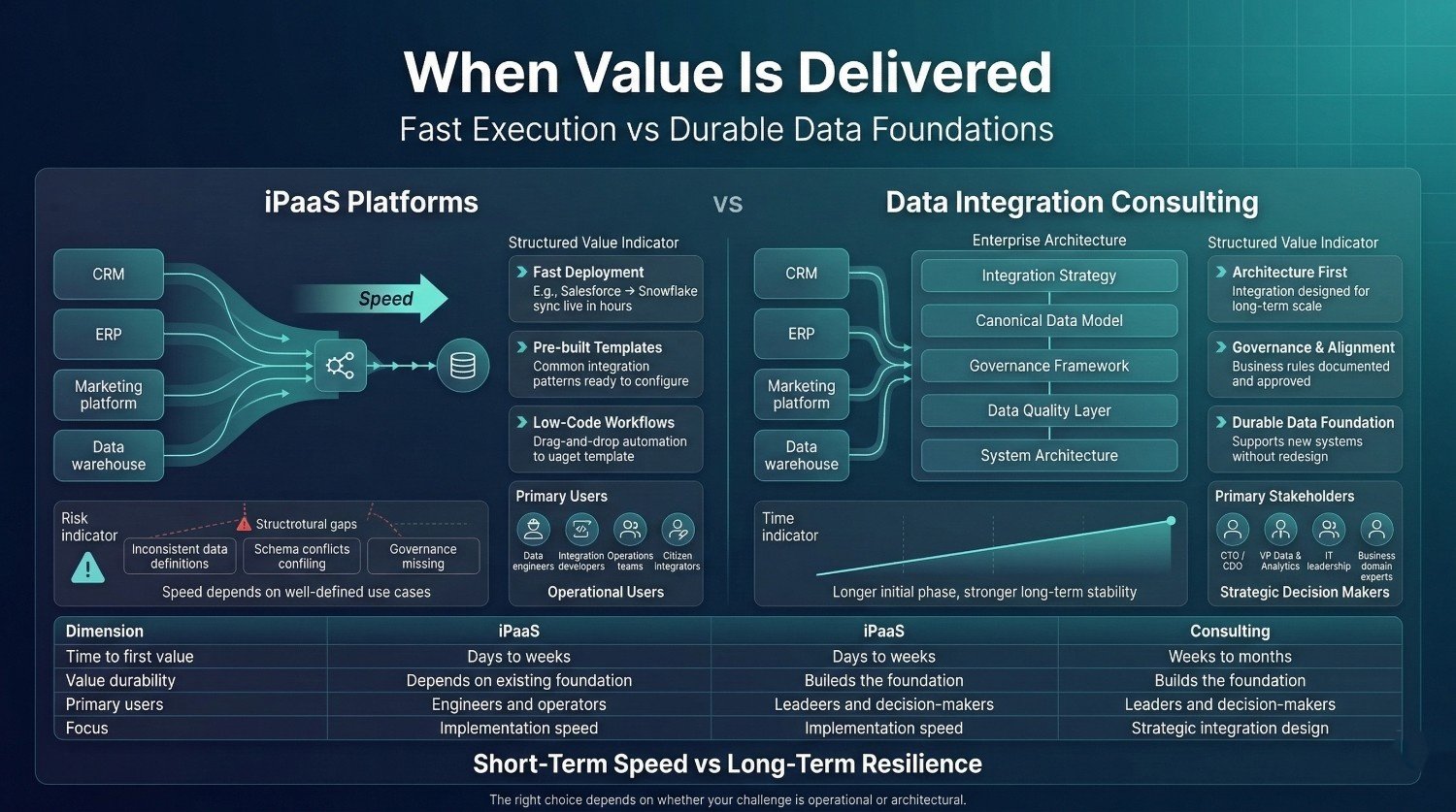
When Value Is Delivered
iPaaS: Fast Value for Known Problems
- A Salesforce-to-Snowflake sync can often be live within hours for standard use cases
- A standard CRM-to-ERP workflow can be running within days
- Pre-built templates accelerate common patterns
- Speed to value is the core selling point, and it’s real for well-defined use cases
But there’s a catch:
- Speed depends on the use case being well-defined and standard
- When schemas conflict, business rules are ambiguous, or data quality is poor, iPaaS speed stalls because the platform can’t resolve those problems
Consulting: Sustained Value Through Foundation
- Discovery and assessment take weeks, not hours
- Architecture design takes deliberation, not drag-and-drop
- Governance and alignment take facilitation, not configuration
- Time to first visible output is longer
But what you get is fundamentally different:
- An architecture less likely to require significant redesign when additional sources are introduced
- Business rules that are documented, approved, and auditable
- Governance that prevents the quality erosion that makes iPaaS flows unreliable
- A foundation designed to provide durable value over time, not just the first sprint
The Distinction
iPaaS | Data Integration Consulting | |
|---|---|---|
Time to first value |
Days to weeks |
Weeks to months |
Value durability |
Depends on whether the foundation exists |
Builds the foundation that makes everything durable |
Risk profile |
Fast start, potential rework later if strategy is missing |
Slower initial phase, typically with reduced rework over time |
Short-term speed vs. long-term resilience. Both matter. The question is which one your situation demands more urgently.
Who Uses It
iPaaS Users
- Data engineers, configuring and maintaining integration flows
- Integration developers, building more complex workflows and custom connectors
- Business technologists / citizen integrators, operations, marketing, and finance teams using low-code interfaces to build their own automations
- DevOps, managing the platform infrastructure and monitoring
These are operational users, people executing integration day to day.
Consulting Clients
- CDOs and CTOs, setting data strategy and making architecture decisions
- VPs of Data and Analytics, defining integration priorities and measuring business impact
- IT leadership, evaluating technology investments and managing organizational change
- Business stakeholders, contributing domain knowledge and approving business rules
- Compliance and legal, ensuring regulatory requirements are met by design
These are typically strategic stakeholders and decision-makers, people defining what integration should achieve, not just how it runs.
The Distinction
iPaaS | Data Integration Consulting | |
|---|---|---|
Primary audience |
Engineers and operators who build and maintain flows |
Leaders and stakeholders who define strategy and make investment decisions |
Interaction mode |
Configure, monitor, troubleshoot |
Assess, design, advise, facilitate, build |
Decision level |
How to implement a specific integration |
What to integrate, why, and in what architecture |
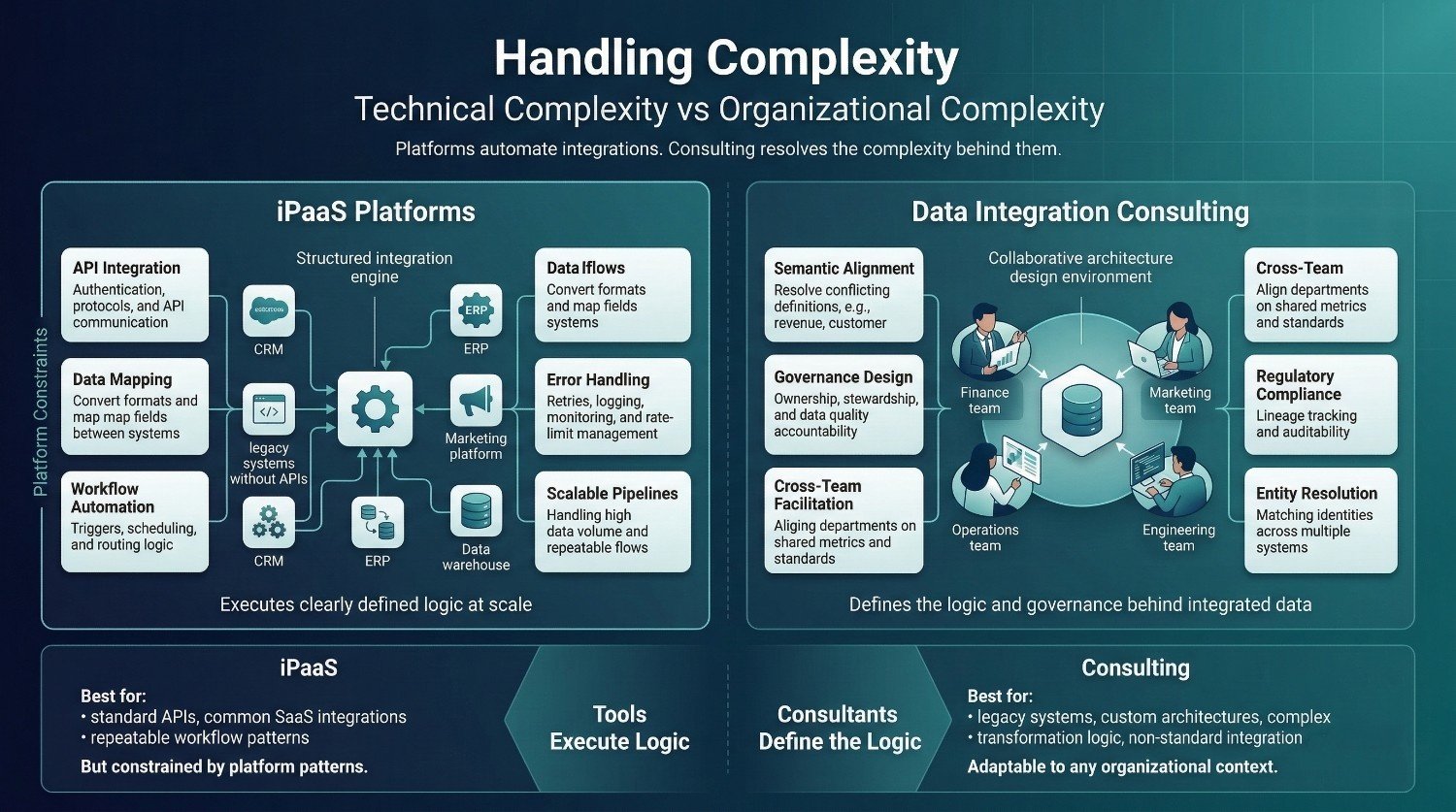
Handling Complexity
This is where the difference becomes starkest.
iPaaS Handles Technical Complexity
- API formats, protocols, and authentication methods
- Data type mapping and basic format conversion
- Scheduling, retry logic, and error handling
- Rate limiting, pagination, and API versioning
- Scaling to handle high data volumes
iPaaS platforms are well-suited to executing clearly defined logic. Give them clear rules and they’ll follow them reliably at scale.
Consulting Handles Business and Organizational Complexity
- Conflicting definitions, “revenue” means different things in sales and finance. Someone has to decide which definition the integrated data uses, and get both departments to agree.
- Governance gaps, nobody owns the customer data. Nobody is accountable for its accuracy. No golden record rules exist. These are organizational design problems, not configuration problems.
- Cross-departmental alignment, getting marketing, finance, operations, and product to agree on shared metrics and data standards. This requires facilitation, not software.
- Regulatory requirements, proving data lineage and provenance to an auditor. This requires architecture and governance, not more connectors.
- Entity resolution, determining that “John Smith” in Salesforce, “J. Smith” in NetSuite, and “jsmith@company.com” in HubSpot are the same person. This requires probabilistic matching logic and human validation, not field mapping.
The Distinction
Tools execute logic. Consultants define the logic. You can’t configure your way out of a governance gap. You can’t drag-and-drop your way through a cross-departmental metric disagreement. You can’t automate entity resolution with a pre-built template.
These are the problems where data integration consulting delivers its highest value, and where iPaaS platforms, regardless of capability, are not primarily designed to address.
Flexibility and Customization
iPaaS: Powerful Within Boundaries
iPaaS platforms work best within their supported ecosystem:
- Pre-built connectors for popular applications
- Standard data formats and API patterns
- Common integration patterns (sync, trigger, batch)
Where iPaaS hits limits:
- Custom or legacy systems without standard APIs, requires custom connector development, often complex and poorly supported
- Unusual data formats, proprietary file formats, binary data, deeply nested JSON structures
- Highly complex business rules, multi-step transformations with conditional logic, cross-system lookups, and exception handling that exceeds the visual builder’s capabilities
- Unique architectural requirements, when your integration needs don’t fit the platform’s assumed patterns
When pushed beyond these boundaries, iPaaS may shift from accelerating delivery to introducing constraints.
Consulting: Adapts to Your Context
- No two consulting engagements are identical, the approach is shaped by your systems, your data, your organization, and your goals
- Handles legacy systems, custom platforms, and non-standard data sources without being limited by a connector library
- Designs architectures that fit your reality, not a platform’s preferred pattern
- Encodes business logic of any complexity, because the transformation is designed by humans, not constrained by a visual builder
The Distinction
iPaaS gives you a platform with capabilities. Consulting gives you a solution designed for your situation. When your situation fits the platform’s sweet spot, iPaaS is faster and cheaper. When it doesn’t, forcing it can introduce more problems than it solves.
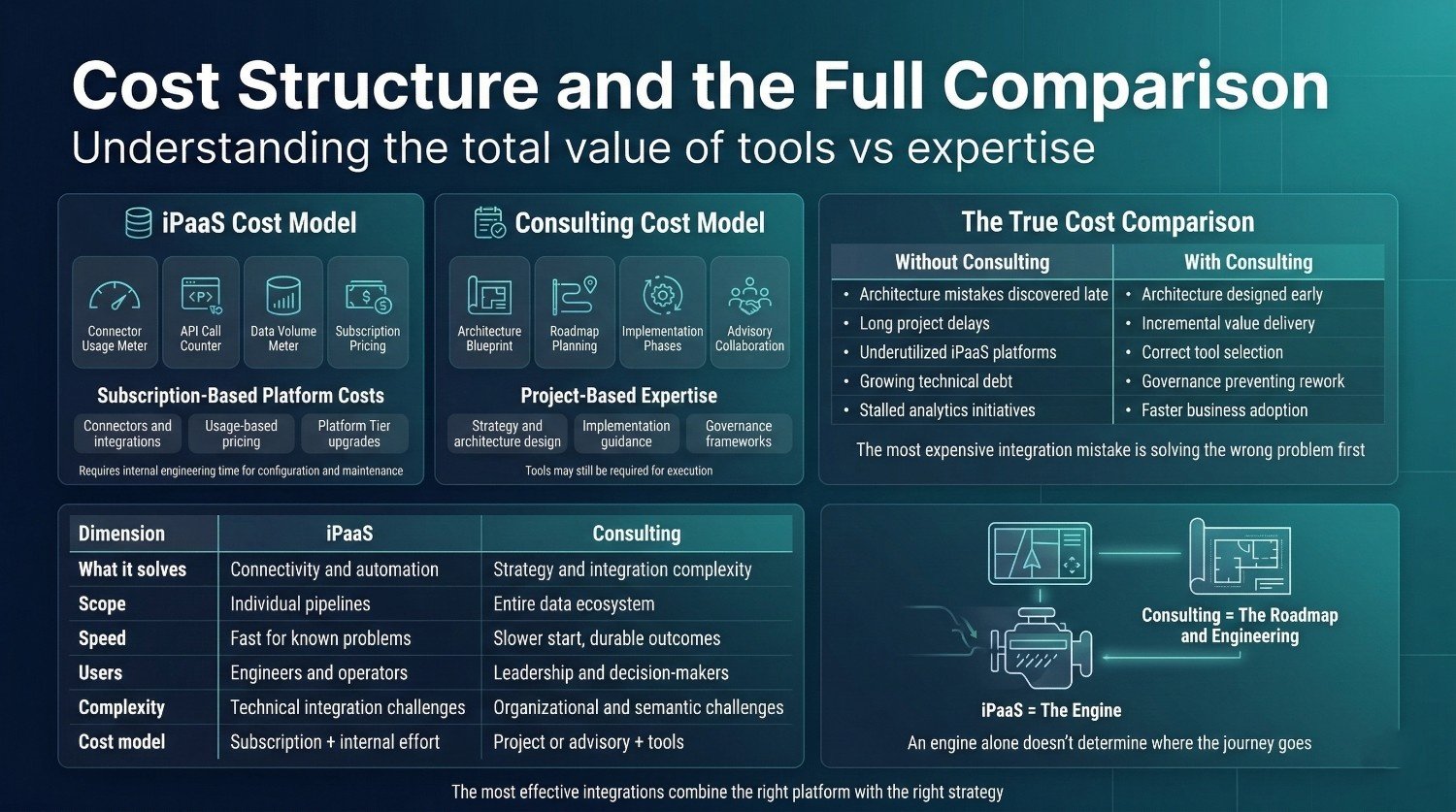
Cost Structure
iPaaS Costs
- Subscription fees, typically based on:
- Number of connectors or connections
- Data volume (rows, tasks, or API calls)
- Platform tier (features and support level)
- Range: $10K–$500K+/year depending on platform and scale
- Plus internal costs:
- Team time to configure, maintain, and troubleshoot flows
- Training and onboarding
- Custom connector development for unsupported systems
Consulting Costs
- Project-based fees, scoped engagements with defined deliverables and timelines
- Retainer fees, ongoing advisory or managed services
- Range: $50K–$1.5M+ depending on scope, complexity, and duration
- Plus tool costs, consulting may recommend iPaaS or other platforms as part of the solution (separate purchase)
The True Cost Comparison
The sticker prices above are misleading without context. The real comparison includes:
Hidden Cost | Without Consulting | With Consulting |
|---|---|---|
Internal team time for rework |
High, architecture mistakes discovered late, rebuilt from scratch |
Low, architecture more likely to be designed appropriately from the outset |
Opportunity cost of delays |
Months of stalled analytics, AI, and business initiatives |
Weeks, value delivered in early phases |
iPaaS underutilization |
Common, tool purchased before strategy defined, features unused |
Rare, tool selected after requirements are clear, fully leveraged |
Technical debt accumulation |
Rapid, workarounds become permanent fixtures |
Minimal, governance and documentation prevent debt |
Cost of failure |
Potentially project-ending, stalled projects, lost trust |
Dramatically reduced, proven methodology prevents common failure modes |
The most cost-effective integration isn’t necessarily the one with the lowest sticker price. It’s the one that delivers trusted, usable data to the business in the shortest time with the fewest false starts.
Comparison Table: The Full Picture
Dimension | iPaaS | Data Integration Consulting |
|---|---|---|
What It Solves |
Connectivity and automation, moving data between systems |
Strategy and complexity, making data work together for business outcomes |
Scope |
Pipeline level, individual flows and connections |
Ecosystem level, architecture, governance, quality, organizational readiness |
Speed to Value |
Fast for standard, well-defined use cases |
Longer initial timeline but builds a durable, scalable foundation |
Primary Users |
Data engineers, integration developers, citizen integrators |
CDOs, CTOs, VPs of Data, IT leadership, business stakeholders |
Complexity Handled |
Technical, APIs, authentication, scheduling, error handling |
Business and organizational, semantics, governance, politics, compliance, architecture |
Customization |
Powerful within platform boundaries; constrained outside them |
Designed to adapt to varied organizational contexts, systems, and requirements |
Cost Model |
Recurring subscription + internal team time |
Project-based or retainer + recommended tool costs |
Best For |
Well-defined integration patterns between supported systems |
Complex, multi-source, multi-stakeholder integration with strategic, governance, and quality requirements |
Limitation |
Doesn't define strategy, resolve semantic conflicts, or build governance |
Does not replace the need for a platform to execute the strategy |
The Key Takeaway
iPaaS is the engine. Data integration consulting is the engineering, the road map, and the driving strategy. You need an engine to go anywhere. But an engine without a plan, a route, and a maintenance strategy will eventually break down, no matter how powerful it is. The organizations that get integration right don’t choose between these two. They understand which problems each one solves and invest accordingly.
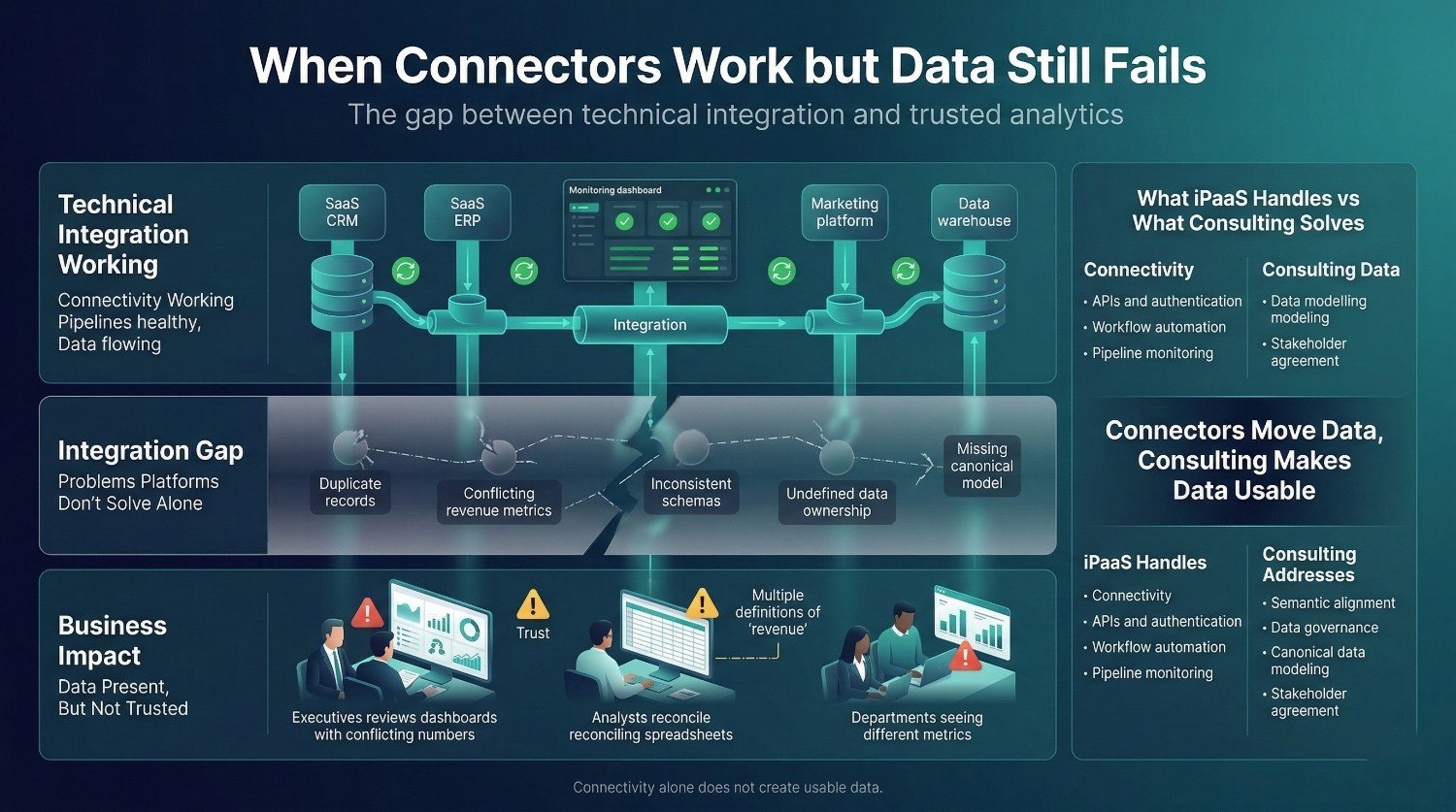
Where iPaaS Falls Short (And Consulting Fills the Gap)
iPaaS platforms are excellent at what they’re designed to do. But there’s a clearly defined boundary where their capabilities end, and a set of critical integration challenges that exist entirely beyond that boundary.
This section maps those gaps precisely. Not to argue against iPaaS, but to help you recognize when you’re facing a problem that a platform alone can’t solve.
The "Connectors Work But Nothing Else Does" Problem
This is the most common pattern, and we covered it in depth in our previous post, “Why Data Integration Projects Fail Even When Connectors Work.” The short version:
- Connectors are live. Data is flowing. Pipelines are green.
- Business users still can’t trust the reports.
- Different departments still get different numbers.
- Analysts still spend most of their time cleaning data.
Why iPaaS Can't Fix This
The problem isn’t connectivity. The problem is everything that happens after data lands:
What's Broken | Is This an iPaaS Problem? |
|---|---|
Data quality, duplicates, nulls, stale records |
iPaaS delivers what the source gives it |
Semantic conflicts, "revenue" means different things in different systems |
iPaaS maps fields, it doesn't reconcile meaning |
No governance, nobody owns the data, no golden record rules exist |
iPaaS monitors pipelines, not organizational accountability |
No canonical model, data from five systems sits in five incompatible structures |
iPaaS moves data, it doesn't design unified models |
Stakeholder misalignment, departments disagree on definitions |
iPaaS has no opinion on business semantics |
Data integration consulting addresses these layers directly. iPaaS platforms are not designed to address them independently, because they’re not tool problems.
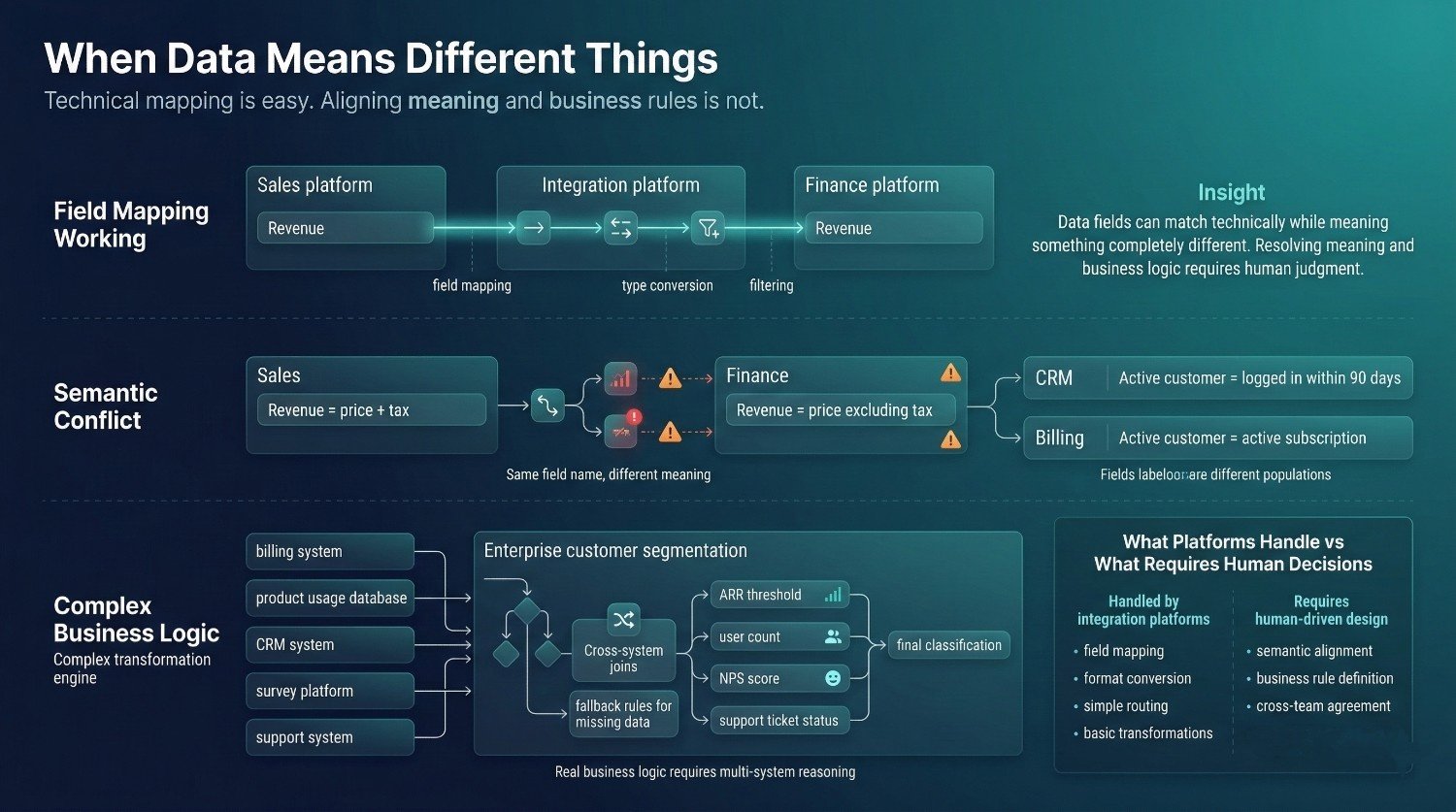
Schema and Semantic Conflicts
What iPaaS Can Do
- Map Field_A in System 1 to Field_B in System 2
- Convert data types, string to integer, date format changes
- Apply basic filtering and routing logic
This works perfectly when the fields actually mean the same thing.
What iPaaS Can't Do
Determine that revenue in Salesforce includes tax while revenue in NetSuite excludes it, and decide which definition the integrated dataset should use. Or that customer_status = “active” in the CRM means “has logged in within 90 days” while in the billing system it means “has a non-cancelled subscription.” Both are technically “active.” They refer to completely different populations.
Why This Requires Consulting
Resolving semantic conflicts demands:
- Business context, understanding what each field actually means in its source system, according to the people who use it
- Domain expertise, knowing that revenue recognition rules differ by industry, region, and accounting standard
- Cross-team negotiation, getting sales and finance to agree on a shared definition, with documented rationale
- Documentation, recording the decision so it’s auditable and maintainable
This is fundamentally a human-driven activity. It requires workshops, conversations, and decisions that no platform can automate. It’s one of the highest-value activities in any data integration consulting engagement, and one of the most commonly skipped steps that leads to failed integration.
Complex Transformation and Business Logic
What iPaaS Handles Well
- Field mapping and renaming
- Data type conversion
- Simple conditional routing, if X, send to Target A; if Y, send to Target B
- Basic aggregation and filtering
- Lookup values from reference tables
For straightforward transformations, iPaaS visual builders are fast and effective.
Where iPaaS Breaks Down
Real-world business logic is rarely straightforward:
Fiscal year calculations that vary by region:
- US fiscal year starts January 1. UK subsidiary starts April 1. Japan subsidiary starts April 1 but uses a different calendar system.
- Every date-based metric needs region-aware fiscal mapping. Most iPaaS field mapping tools cannot express this natively.
Customer segmentation combining data from five systems:
- Enterprise = ARR > $500K (from billing) + more than 100 users (from product database) + strategic account flag (from CRM) + NPS > 8 (from survey tool) + no open P1 tickets (from support system)
- This requires cross-system joins, conditional logic, and fallback rules for missing data. It exceeds what many visual workflow builders support natively.
Regulatory reporting transformations:
- SOX-compliant revenue recognition requires multi-step calculations with audit trails
- GDPR data subject access requests require tracing data across every system it’s been copied to
- These aren’t integration flows, they’re compliance architectures
What Happens When You Force It
When transformation complexity exceeds the tool’s capabilities, teams do one of two things:
- Build workarounds, custom scripts, external processing steps, manual interventions that create technical debt and break the iPaaS’s managed benefits
- Oversimplify the logic, implement a “close enough” version that introduces errors stakeholders eventually discover
Neither outcome is acceptable. Both are often avoidable with proper architectural design and consulting guidance that designs the transformation layer properly, using the right combination of tools for the right level of complexity.
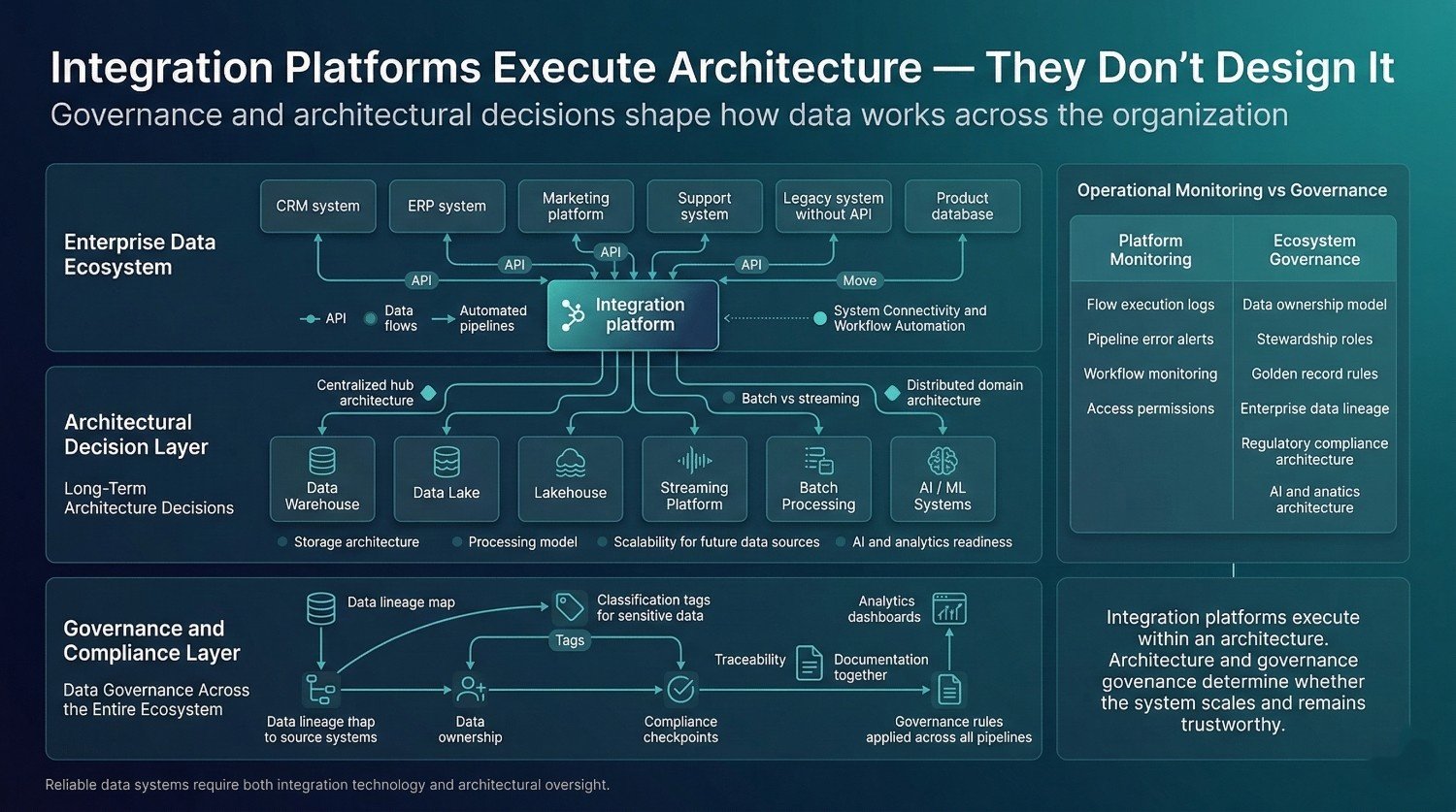
Architecture Decisions
What iPaaS Doesn't Tell You
An iPaaS platform answers: “How do we connect these systems?”
It doesn’t answer:
- Do we need a data warehouse, a data lake, a lakehouse, or a data mesh?
- Should we use batch processing or real-time streaming, or both?
- Should integration be centralized through one platform or distributed across domain teams?
- How do we handle legacy systems that don’t have APIs?
- What happens when we add 20 more data sources in the next 18 months?
- How does this integration architecture support our AI/ML roadmap?
These are architecture decisions, and they have consequences that last years. Getting them wrong can require rebuilding foundational components while the business runs on top of it.
Why Architecture Requires Experienced Judgment
Decision | Options | Wrong Choice Consequence |
|---|---|---|
Central vs. distributed |
Hub-and-spoke vs. data mesh |
Central approach that creates bottlenecks, or distributed approach that creates chaos |
Batch vs. real-time |
Scheduled loads vs. streaming |
Stale data when real-time was needed, or over-engineered streaming for a weekly report |
Storage architecture |
Warehouse vs. lake vs. lakehouse |
Wrong tool for the query patterns, costing 3-10x more in compute |
Integration platform |
iPaaS vs. custom vs. cloud-native |
Platform that fits today's 5 sources but can't handle tomorrow's 30 |
iPaaS platforms don’t make these decisions. They operate within whatever architecture you’ve chosen, for better or worse. Data integration consulting helps inform and guide these decisions, based on your specific systems, scale, team, budget, and future trajectory.
Governance and Compliance
What iPaaS Provides
Most enterprise iPaaS platforms offer:
- Execution logs, which flows ran, when, and whether they succeeded
- Error monitoring, alerts when flows fail
- Basic access controls, who can configure and manage flows
- Audit trails, within the platform’s own operations
This is useful operational monitoring. This is operational monitoring, not comprehensive governance.
What iPaaS Doesn't Provide
Governance Capability | iPaaS Coverage |
|---|---|
Data ownership model, who is accountable for each data domain |
Typically not addressed directly |
Stewardship roles, who handles day-to-day quality and escalation |
Typically not addressed directly |
Golden record logic, when systems disagree, which one wins |
Typically not addressed directly |
End-to-end lineage, tracing a data point from source through every transformation to final consumption |
Partial, within the platform only, not across the full ecosystem |
Data catalog, making data discoverable and understandable across the organization |
Typically not addressed directly (separate tooling needed) |
Classification and sensitivity labeling, PII, PHI, financial data, confidential |
Basic at best |
Cross-system compliance architecture, GDPR right-to-erasure across 15 systems, HIPAA audit trail across all PHI flows |
Typically not addressed directly |
Why This Matters
Regulators don’t audit individual iPaaS flows. They audit your organization’s ability to demonstrate data integrity, provenance, and control across the entire ecosystem.
If your answer to “Where did this number come from?” is “Let me check the Boomi logs”, that’s not enough. You need end-to-end lineage from source through every transformation, enrichment, and aggregation to final report. Across every system. With documentation. That’s a governance architecture, designed and implemented through data integration consulting, not configured in an iPaaS.
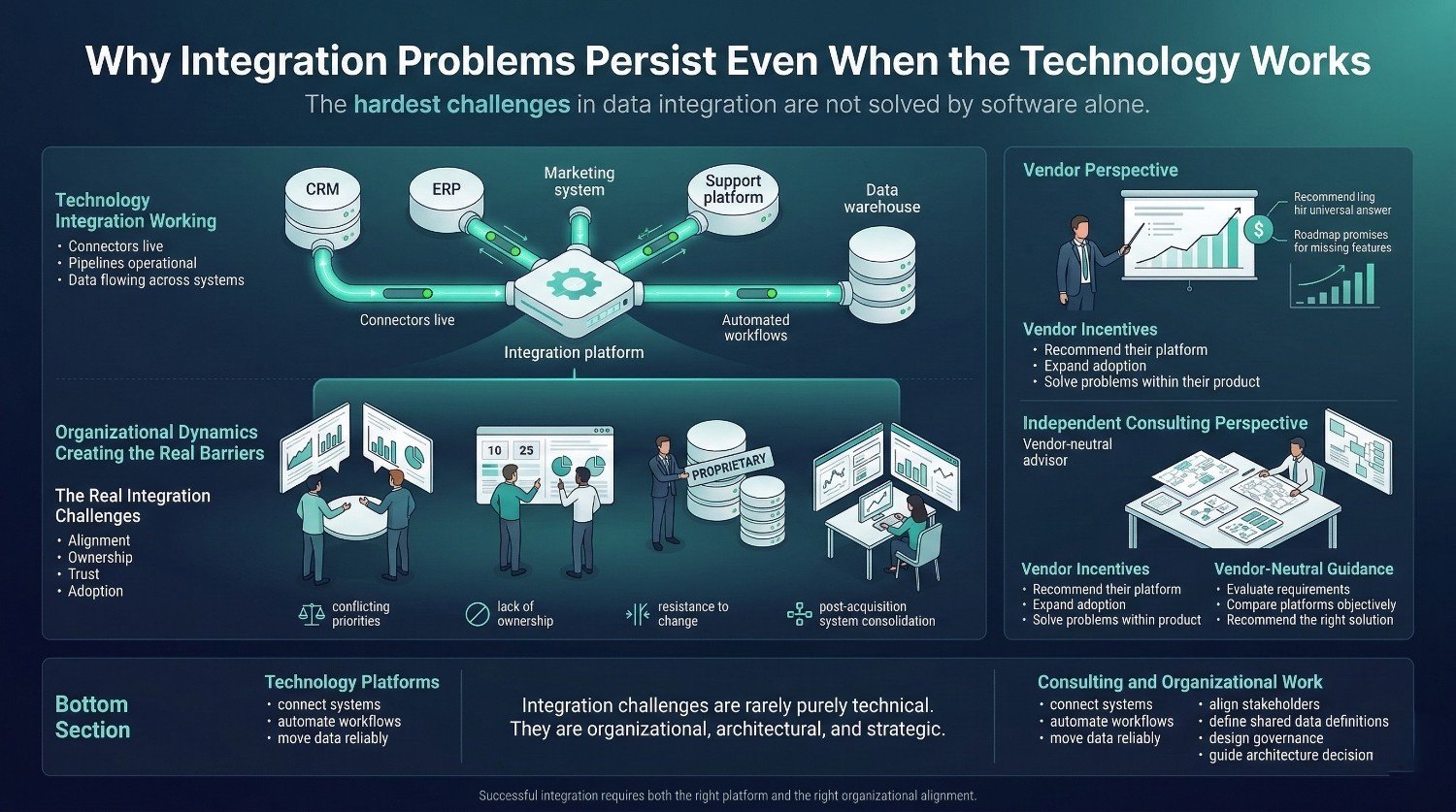
Organizational and Change Management
What No Platform Can Do
This is the gap that’s hardest to accept, because it means the problem isn’t solvable by buying something. iPaaS platforms cannot:
- Resolve turf wars between departments fighting over whose system is the source of truth
- Facilitate a workshop where sales and finance agree on a shared definition of “revenue”
- Convince a department head to share data they’ve historically guarded
- Train business users on a new integrated data model and get them to actually adopt it
- Manage the organizational anxiety that comes with changing how people access and trust data
- Navigate the political dynamics of post-acquisition consolidation
Why This Matters More Than Technology
Research consistently shows that integration projects fail more often due to organizational factors than technical ones:
- Lack of stakeholder alignment
- No executive sponsorship
- Conflicting departmental priorities
- Resistance to change
- Undefined ownership and accountability
These are people problems. They require facilitation, negotiation, communication, and trust-building, skills that exist in experienced data integration consulting teams, not in software platforms. The best iPaaS platform in the world, deployed into an organization that hasn’t aligned on shared definitions or established data ownership, will produce the same result as no platform at all: data that nobody trusts.
Vendor Lock-In and Objectivity
The Inherent Bias
When you ask an iPaaS vendor whether their platform is the right solution, there is a strong structural incentive toward one answer:
“Yes.”
This isn’t malice. It’s structural incentive. The vendor’s business depends on your adoption and expansion. Their sales team, their professional services, and their product roadmap are all aligned toward one outcome: you using more of their platform.
What This Means in Practice
- The vendor will recommend their platform for use cases it handles well and use cases it doesn’t handle well
- They won’t tell you that a different tool, or a simpler approach, would be more cost-effective
- They won’t recommend reducing your license scope, even if your actual needs are smaller than what you’ve purchased
- They’ll position every gap as a feature on the roadmap, “We’re adding that in Q3”
The Consulting Alternative
Independent data integration consulting, when genuinely vendor-neutral, provides something no vendor can:
- An objective assessment of whether an iPaaS is required for your specific use case
- Honest comparison of platforms based on your requirements, not partnership agreements
- Willingness to recommend a simpler, cheaper approach when it’s the right fit
- Architecture that isn’t coupled to a single vendor, protecting your flexibility as needs evolve
The Lock-In Risk
Choosing a platform that fits today but not tomorrow is one of the most expensive integration mistakes:
- Your data volumes double, the platform’s pricing model makes it cost-prohibitive
- You adopt systems outside the platform’s connector library, custom development negates the managed benefits
- Your integration needs shift from application integration to data integration, the platform wasn’t designed for your new requirements
- Migrating away from a deeply embedded iPaaS can become a significant effort depending on how tightly workflows are coupled to the platform
Data integration consulting helps you evaluate tools with eyes wide open, including the long-term lock-in risk that vendors have no incentive to discuss.
The Summary
Gap | Why iPaaS Can't Fill It | How Consulting Fills It |
|---|---|---|
Data quality and trust |
Delivers what the source gives it, garbage in, garbage out |
Profiles, assesses, and remediates quality before integration begins |
Semantic conflicts |
Maps fields, doesn't reconcile meaning |
Facilitates cross-team agreement on shared definitions |
Complex business logic |
Visual builders hit limits with multi-system, multi-step rules |
Designs and documents transformation logic of any complexity |
Architecture decisions |
Operates within an architecture, doesn't define one |
Designs the architecture based on requirements, scale, and future growth |
Governance and compliance |
Monitors pipelines, doesn't govern the ecosystem |
Builds ownership, lineage, cataloging, and compliance frameworks |
Organizational alignment |
Has no opinion on people, politics, or process |
Facilitates stakeholder agreement, change management, and adoption |
Vendor objectivity |
Inherently biased toward their own platform |
Vendor-neutral, recommends what fits your situation |
None of these gaps are iPaaS failures. They’re simply outside the platform’s design scope. Recognizing that scope, and knowing when you’ve exceeded it, is the difference between a successful integration investment and an expensive one.
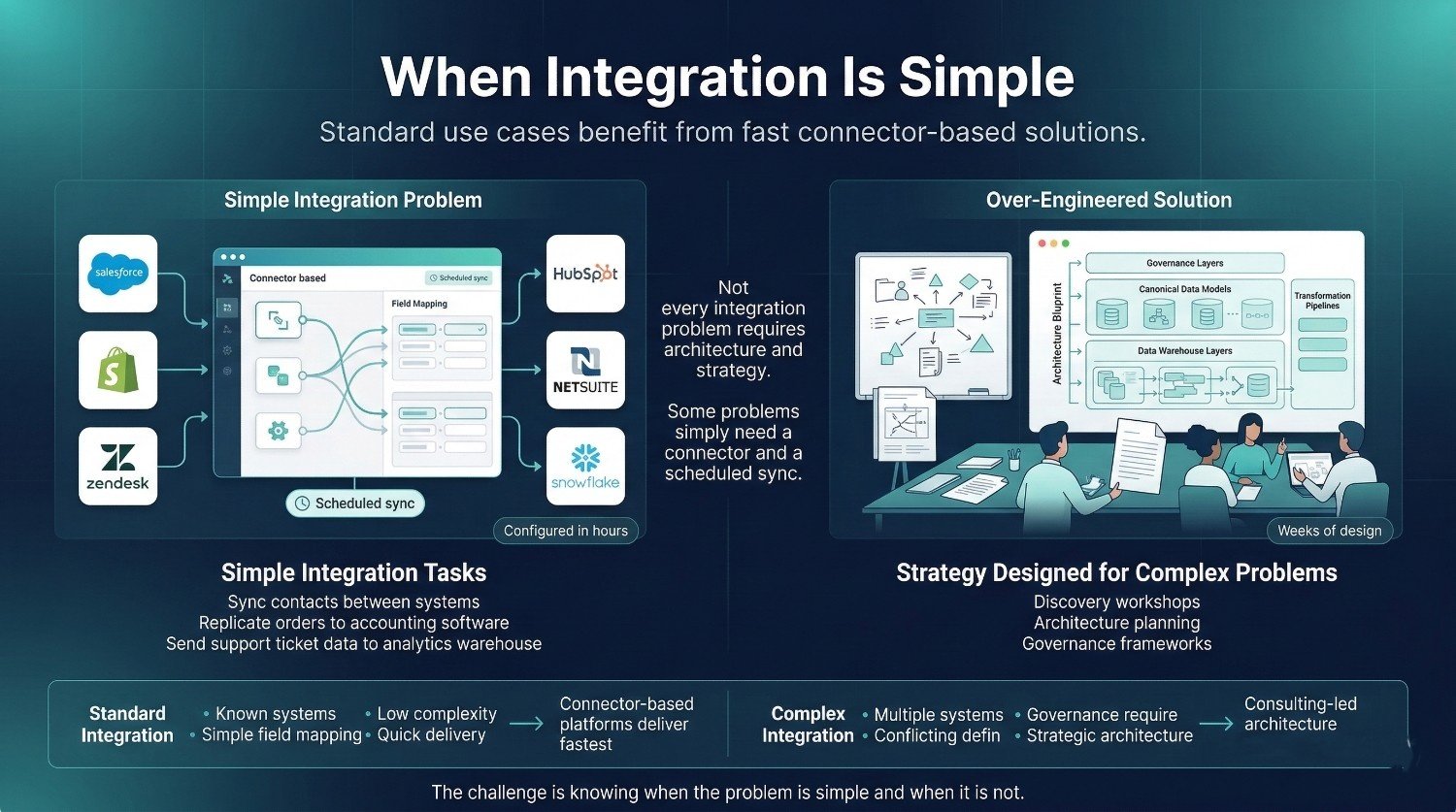
Where Data Integration Consulting Falls Short (And iPaaS Fills the Gap)
Fair is fair. If we’re going to be honest about where iPaaS falls short, we need to be equally honest about where data integration consulting has its own limitations, and where iPaaS fills gaps that consulting can’t.
Execution Speed for Standard Use Cases
The Reality
Data integration consulting is built for complexity. When the problem is complex, the investment in discovery, architecture, and strategy pays for itself many times over.
But not every problem is complex.
When Consulting Is Overkill
- You need to sync Salesforce contacts to HubSpot → iPaaS handles this in hours
- You need Shopify orders flowing into NetSuite → iPaaS has a pre-built template for this
- You need Zendesk tickets replicated to Snowflake for basic reporting → iPaaS connector, configured in an afternoon
For these use cases, engaging a consulting team means:
- Weeks of discovery for a problem that doesn’t need discovery
- An architecture review for a single point-to-point connection
- A governance framework for a three-table sync
That’s not strategic, it’s expensive.
The Honest Answer
Not every integration needs a strategy engagement. Some just need a connector, a few field mappings, and a schedule. iPaaS wins here, decisively. It usually delivers value for standard use cases faster and at lower cost than a full consulting engagement.
The skill is knowing which category your problem falls into. If you’re not sure, a quick scoping conversation with a data integration consulting partner (not a full engagement) can help you determine whether you actually need them or whether iPaaS alone will do.
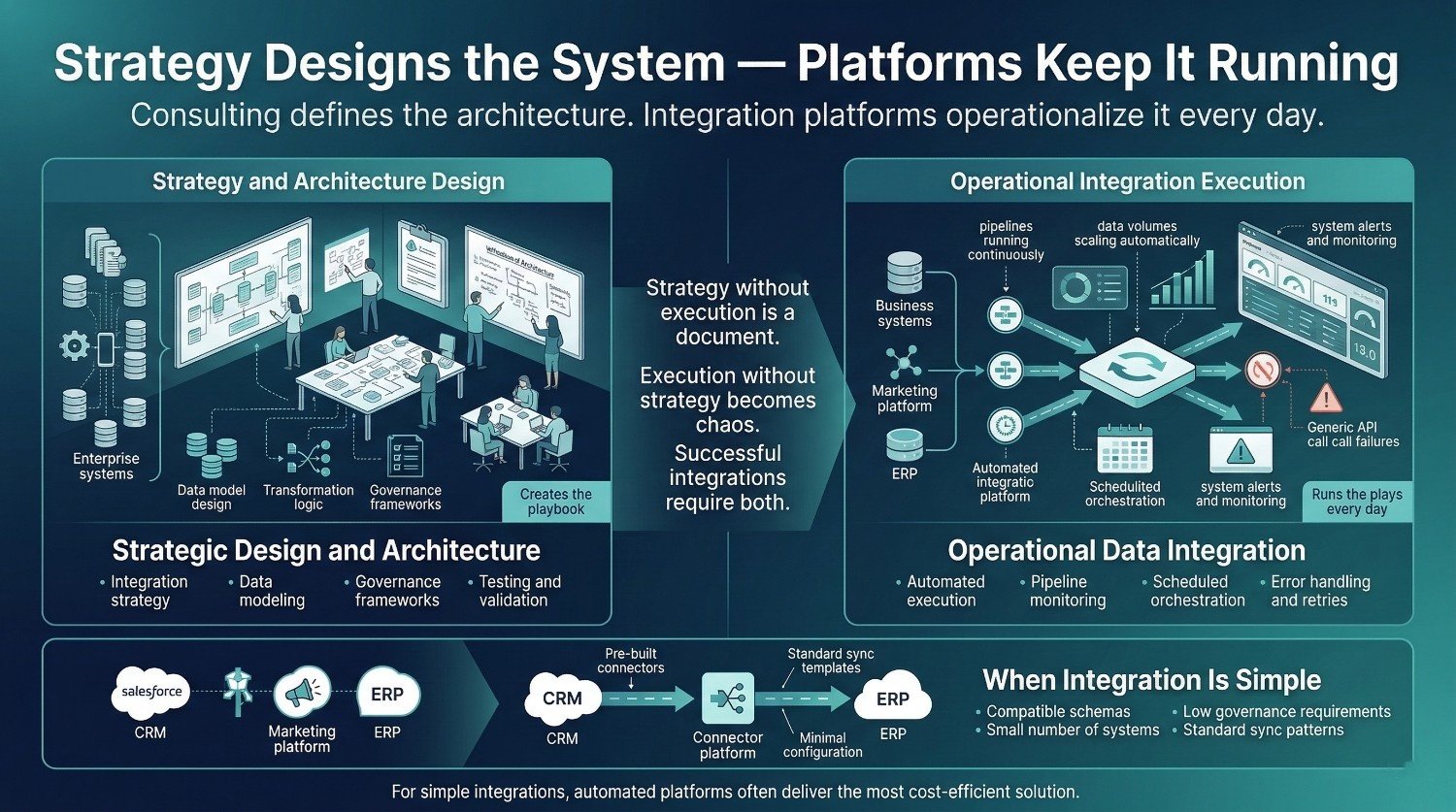
Ongoing Operational Execution
The Reality
Consulting engagements end. The consultants leave. But integrations need to keep running every day.
What Consulting Delivers
- The strategy and architecture
- The data model and transformation logic
- The governance framework and documentation
- The testing and validation approach
- Knowledge transfer to the internal team
What Consulting Doesn't Deliver
- A platform that executes integration flows 24/7
- Automatic retry when an API call fails at 3 AM
- Managed scaling when data volumes spike
- Real-time monitoring dashboards tracking pipeline health
- Scheduled orchestration of hundreds of concurrent flows
That is typically the role of an operational integration platform, and iPaaS platforms are designed for it.
The Honest Answer
Consultants are not intended to operate day-to-day integration flows indefinitely. You need a platform, iPaaS or otherwise, that operationalizes the strategy consulting defined.
Think of it this way:
Consulting | iPaaS | |
|---|---|---|
Designs the playbook |
Yes |
No |
Runs the plays every day |
No |
Yes |
The playbook without execution is a document. Execution without a playbook is chaos. You need both.
Cost Efficiency for Simple Scenarios
The Reality
Data integration consulting represents a significant investment, typically $50K minimum for even a scoped assessment. That investment makes sense when the problem is complex enough to justify it.
When it’s not, it’s wasted money.
Scenarios Where iPaaS Alone Is Sufficient
Scenario | Why Consulting Isn't Needed |
|---|---|
2–3 SaaS systems with compatible schemas |
No semantic conflicts to resolve |
Single team consuming the data |
No cross-departmental alignment required |
Standard sync patterns (CRM ↔ ERP, marketing ↔ warehouse) |
Pre-built templates handle the logic |
Clean source data with no significant quality issues |
No profiling or remediation needed |
No compliance or regulatory requirements |
No governance architecture needed |
Low business criticality |
Failure or delay doesn't impact revenue or operations |
For these scenarios, a $15K–$50K/year iPaaS subscription delivers everything you need. Spending $100K+ on consulting for the same outcome isn’t strategic, it’s wasteful.
The Honest Answer
Data integration consulting should be engaged when the complexity, risk, or stakes justify the investment. For simple, low-risk integrations between a handful of well-known systems, iPaaS alone is not just sufficient, it’s the smarter choice.
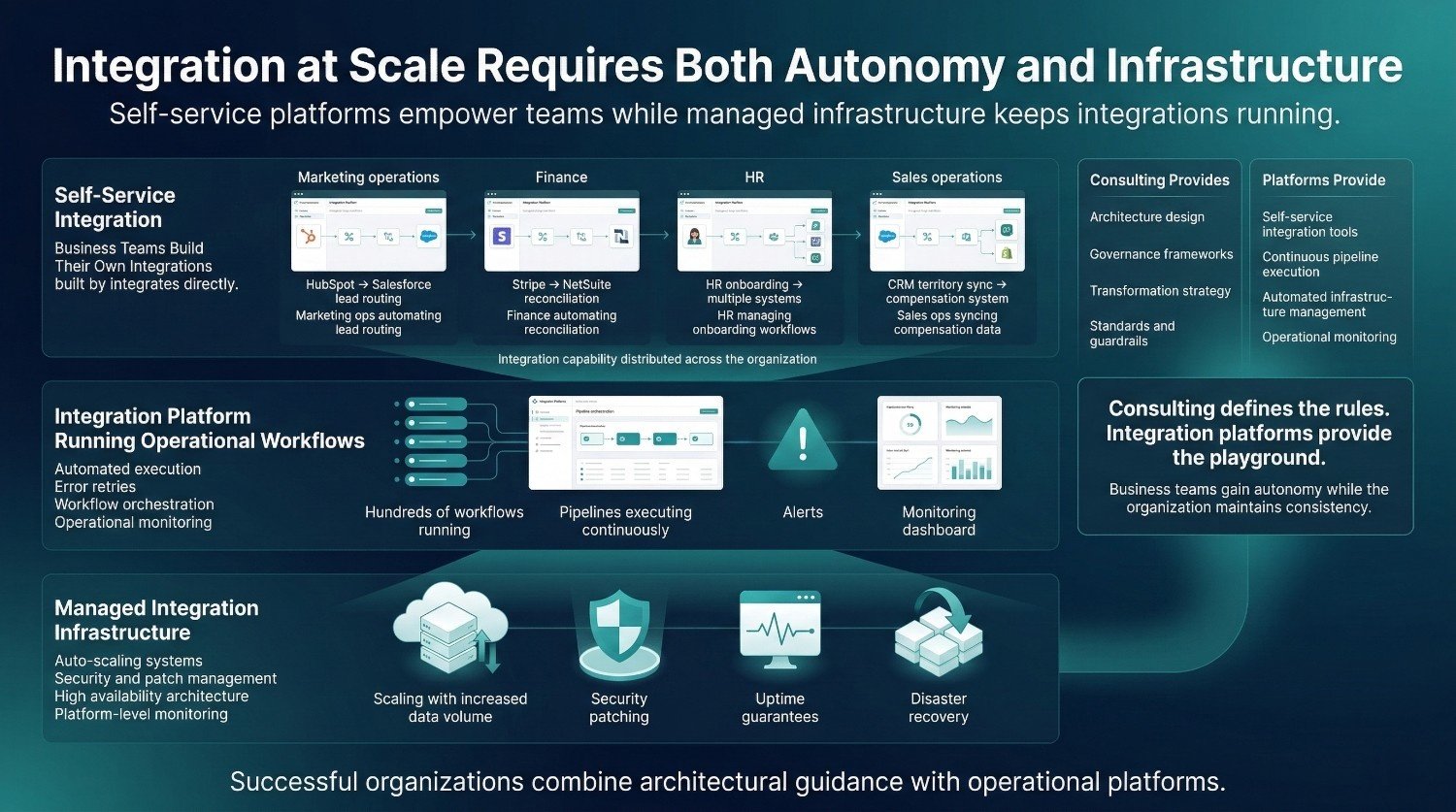
Self-Service and Citizen Integration
The Reality
One of the most powerful trends in enterprise technology is democratizing integration, enabling business users, operations teams, and analysts to build and manage their own integration flows without waiting for the central data team. iPaaS platforms are purpose-built for this.
What iPaaS Enables
- Marketing ops builds their own lead routing flow from HubSpot to Salesforce, without filing a ticket with engineering
- Finance creates an automated reconciliation between Stripe and NetSuite, configured in the iPaaS by a finance analyst
- HR sets up employee onboarding workflows that trigger account creation across IT, payroll, and access systems, managed by the HR team directly
- Sales ops syncs territory assignments between CRM and compensation tools, maintained by the revenue operations team
This reduces bottlenecks on the central data team and puts integration capability in the hands of the people closest to the business process.
What Consulting Can't Provide Here
- Consulting provides expertise and frameworks, not a self-service platform
- A consultant can design governance guardrails for citizen integration, but the platform itself has to enable the self-service
- Without a self-service integration platform, most integration requests must be routed through central engineering teams, creating a queue that grows faster than the team can deliver
The Honest Answer
Data integration consulting can design the governance framework, the standards, and the guardrails that make self-service integration safe and sustainable. But the self-service capability itself comes from the platform. The ideal scenario: consulting designs the rules, iPaaS provides the playground. Business users get autonomy. The organization gets consistency. Nobody gets chaos.
Managed Infrastructure
The Reality
Running integration infrastructure is real work:
- Servers need provisioning, patching, and monitoring
- Platforms need scaling as data volumes grow
- Security patches need applying
- Uptime needs guaranteeing
- Performance needs optimizing
iPaaS platforms are designed to handle most of this as a managed service within their scope. You configure the flows; they run the infrastructure.
What iPaaS Manages
Infrastructure Concern | iPaaS Handles It |
|---|---|
Server provisioning and management |
Vendor-managed within platform boundaries |
Auto-scaling |
Built-in |
Security and patching |
Vendor-managed |
Typically backed by vendor SLAs depending on contract tier |
Typically backed by vendor SLAs depending on contract tier |
Monitoring and alerting |
Built-in dashboards |
Disaster recovery |
Platform-level redundancy |
What Consulting Doesn't Typically Provide
- Consulting recommends architecture, including infrastructure decisions
- Consulting may help set up monitoring and observability frameworks
- But consulting doesn’t run your infrastructure long-term (unless you’re in a managed services engagement)
- Once the consulting engagement ends, the infrastructure needs to run on something, and iPaaS is often that something
The Honest Answer
Architecture is a consulting deliverable. Infrastructure is a platform deliverable. You need architecture to know what infrastructure to run. You need infrastructure to actually run it.
For most organizations, iPaaS provides the operational infrastructure layer that consulting’s architecture sits on top of. Trying to replace that operational layer with consulting alone is neither practical nor cost-effective.
The Summary
Gap in Consulting | How iPaaS Fills It |
|---|---|
Speed for simple use cases |
Pre-built connectors and templates deliver in hours, not weeks |
Ongoing execution |
Runs integration flows 24/7 with automatic retry, scheduling, and monitoring |
Cost for simple scenarios |
$15K–$50K/year subscription vs. $50K+ minimum consulting engagement |
Self-service capability |
Empowers business users to build and manage their own integrations |
Managed infrastructure |
Handles scaling, security, uptime, and maintenance as a service |
None of these gaps are consulting failures. They’re simply outside consulting’s design scope, just as governance, architecture, and organizational alignment are outside iPaaS’s scope. The point isn’t that one is better than the other. It’s that they cover different layers of the integration challenge, and the most successful organizations use both, strategically, for what each does best.
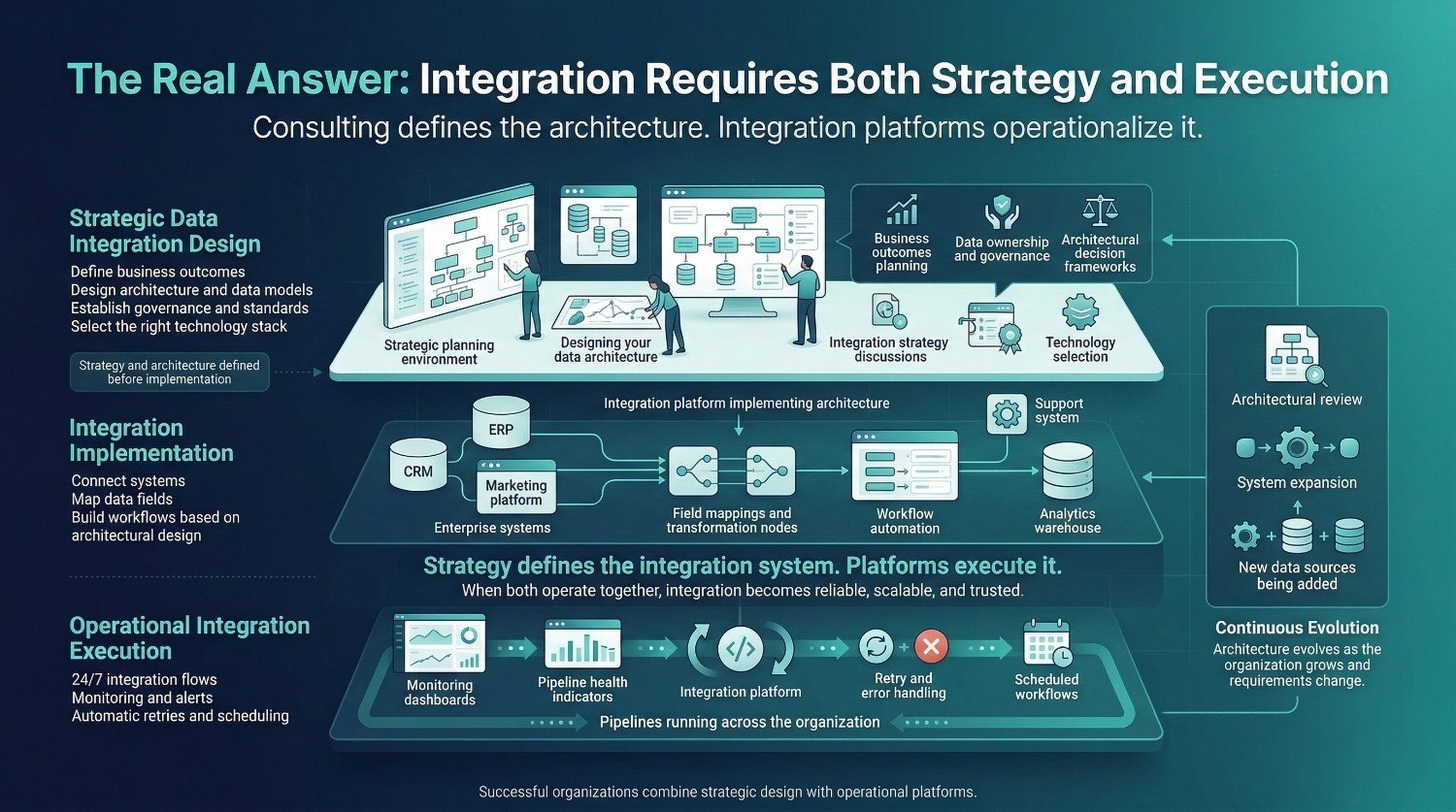
The Real Answer
This is the section that resolves the false dichotomy. The answer isn’t iPaaS or consulting. For most organizations facing real integration complexity, the answer is both, used in the right sequence and for the right purpose.
The Complementary Relationship
iPaaS and data integration consulting aren’t competitors. They operate at different layers of the same problem.
Layer | Who Handles It | What It Looks Like |
|---|---|---|
Strategy |
Consulting |
"What business outcomes should our integrated data enable?" |
Architecture |
Consulting |
"What's the right integration pattern, data model, and technology stack?" |
Governance |
Consulting |
"Who owns the data? What are the rules? How do we track lineage?" |
Tool selection |
Consulting (with iPaaS as a candidate) |
"Which platform fits our requirements, not which vendor has the best pitch?" |
Implementation |
iPaaS (guided by consulting's design) |
"Build the connectors, mappings, and workflows according to the architecture" |
Operations |
iPaaS |
"Run the integrations 24/7 with monitoring, retry, and alerting" |
Evolution |
Consulting (periodic) |
"How should the architecture adapt as the business changes?" |
The relationship works like this:
- Consulting defines the strategy → iPaaS executes it
- Consulting designs the architecture → iPaaS is a component within it
- Consulting establishes standards → iPaaS operates within them
- Consulting validates outcomes → iPaaS provides the operational data to measure against
When both are part of a coordinated approach, the result is integration that’s strategically sound, operationally reliable, and built to last. When either one is missing, you get predictable failures:
- Consulting without iPaaS results in a strong strategy with no execution platform. It never leaves the document stage.
iPaaS without consulting = Connectors running efficiently, replicating garbage into a system nobody trusts.
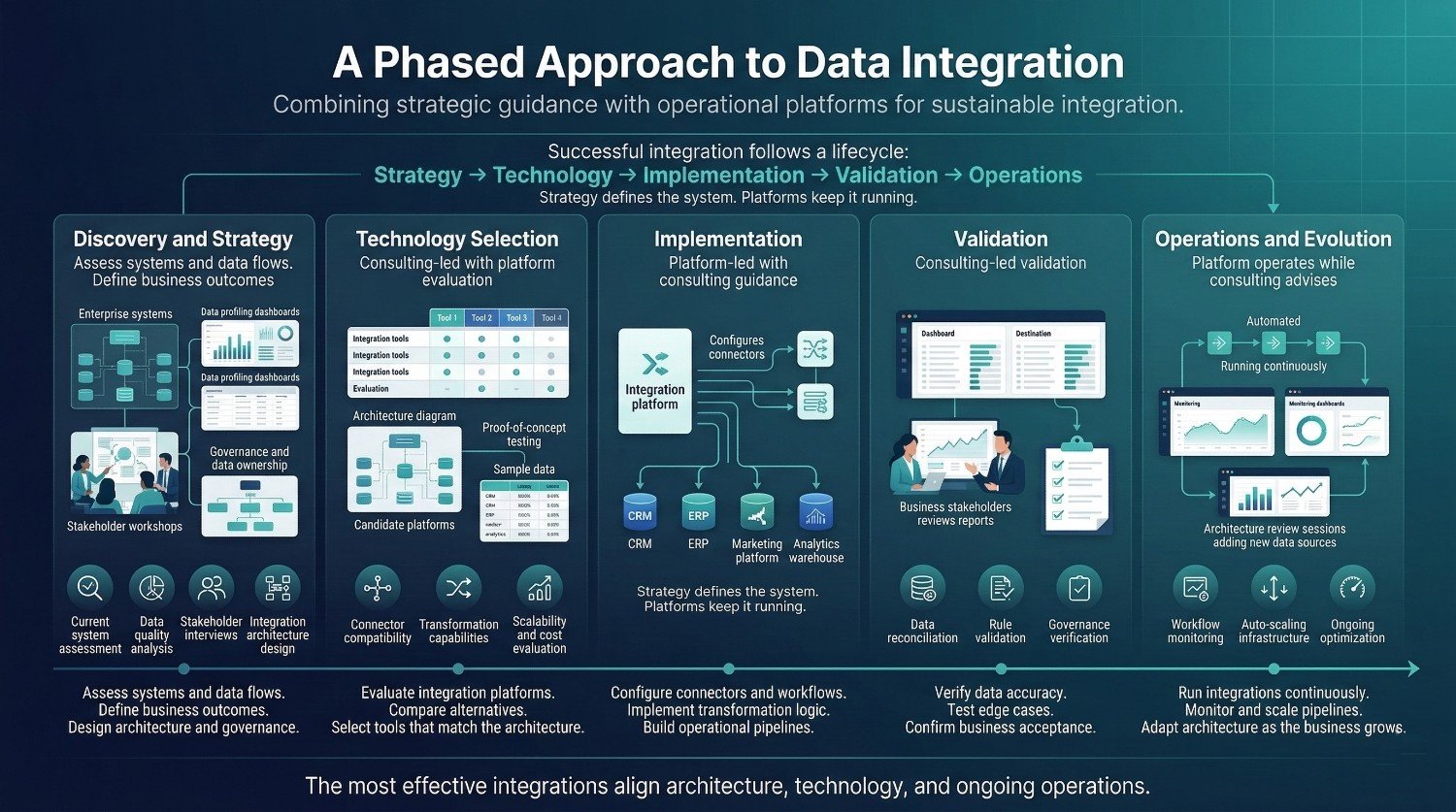
A Phased Approach in Practice
Here’s how the two work together in a well-sequenced engagement:
Phase 1: Discovery and Strategy (Consulting-Led)
Duration: 2–6 weeks
Activities:
- Current-state assessment, systems, data flows, pain points, technical debt
- Source data profiling, quality, completeness, consistency across every critical source
- Stakeholder interviews, understanding requirements, definitions, and priorities across departments
- Business outcome definition, what should the integrated data enable, measured how?
- Governance framework design, ownership, stewardship, golden record rules, lineage requirements
Deliverables:
- Data landscape map
- Quality assessment with risk prioritization
- Integration architecture design
- Governance framework
- Phased implementation roadmap
iPaaS involvement at this stage: None yet. This phase defines what the tool needs to do, before choosing which tool does it.
Phase 2: Technology Selection (Consulting-Led, iPaaS Evaluated)
Duration: 1–3 weeks
Activities:
- Defining tool requirements based on Phase 1 findings
- Evaluating iPaaS platforms against those requirements, connectors needed, transformation capabilities, scalability, cost model, governance features
- Comparing iPaaS options to alternatives, cloud-native tools, open-source frameworks, custom development
- Proof-of-concept testing with real data where appropriate
Deliverables:
- Tool evaluation matrix
- Platform recommendation with rationale
- Implementation plan for selected tool(s)
Critical principle: The tool is selected because it fits the architecture, not the other way around. This is the single most important sequencing decision in any integration initiative.
Phase 3: Implementation (iPaaS-Led, Consulting-Guided)
Duration: 4–16 weeks depending on complexity
Activities:
- Configuring iPaaS connectors to all source and target systems
- Implementing data mappings and transformation logic designed by consulting
- Building workflow automations, scheduling, and error handling
- Implementing data quality checks and monitoring within the platform
- Following the canonical data model and governance standards established in Phase 1
Deliverables:
- Working integration pipelines
- Configured monitoring and alerting
- Operational documentation
Consulting’s role at this stage: Review, validate, and guide, ensuring the implementation aligns with the architecture and doesn’t introduce shortcuts that create technical debt.
Phase 4: Validation (Consulting-Led, iPaaS Provides Data)
Duration: 2–4 weeks
Activities:
- Source-to-target data reconciliation across every pipeline
- Business rule validation, do transformed values match stakeholder expectations?
- Edge case testing, nulls, special characters, timezone handling, high-volume loads
- Business user sign-off, stakeholders confirm the output matches their domain knowledge
- Governance verification, lineage tracking, access controls, and documentation completeness
Deliverables:
- Validation report with results and any remediation actions
- Business sign-off documentation
- Go-live readiness confirmation
Why consulting leads this phase: Validation is not just confirming that the pipeline ran. It is confirming that the data is accurate, trusted, and ready for business use. That requires business context and domain expertise that iPaaS monitoring can’t provide.
Phase 5: Operations and Evolution (iPaaS Runs, Consulting Advises)
Duration: Ongoing
iPaaS handles:
- Day-to-day pipeline execution, scheduling, monitoring, retry, alerting
- Auto-scaling as data volumes grow
- Infrastructure management, security, uptime, maintenance
- Self-service integration for business teams (within governance guardrails)
Consulting provides (periodically):
- Quarterly architecture reviews, is the foundation still fit for purpose?
- New source onboarding guidance, how to integrate acquisitions, new tools, or new business lines
- Governance evolution, updating rules, ownership, and policies as the business changes
- Optimization recommendations, performance, cost, and maintainability improvements
The result: iPaaS keeps the engine running. Consulting ensures the engine is still pointed in the right direction.
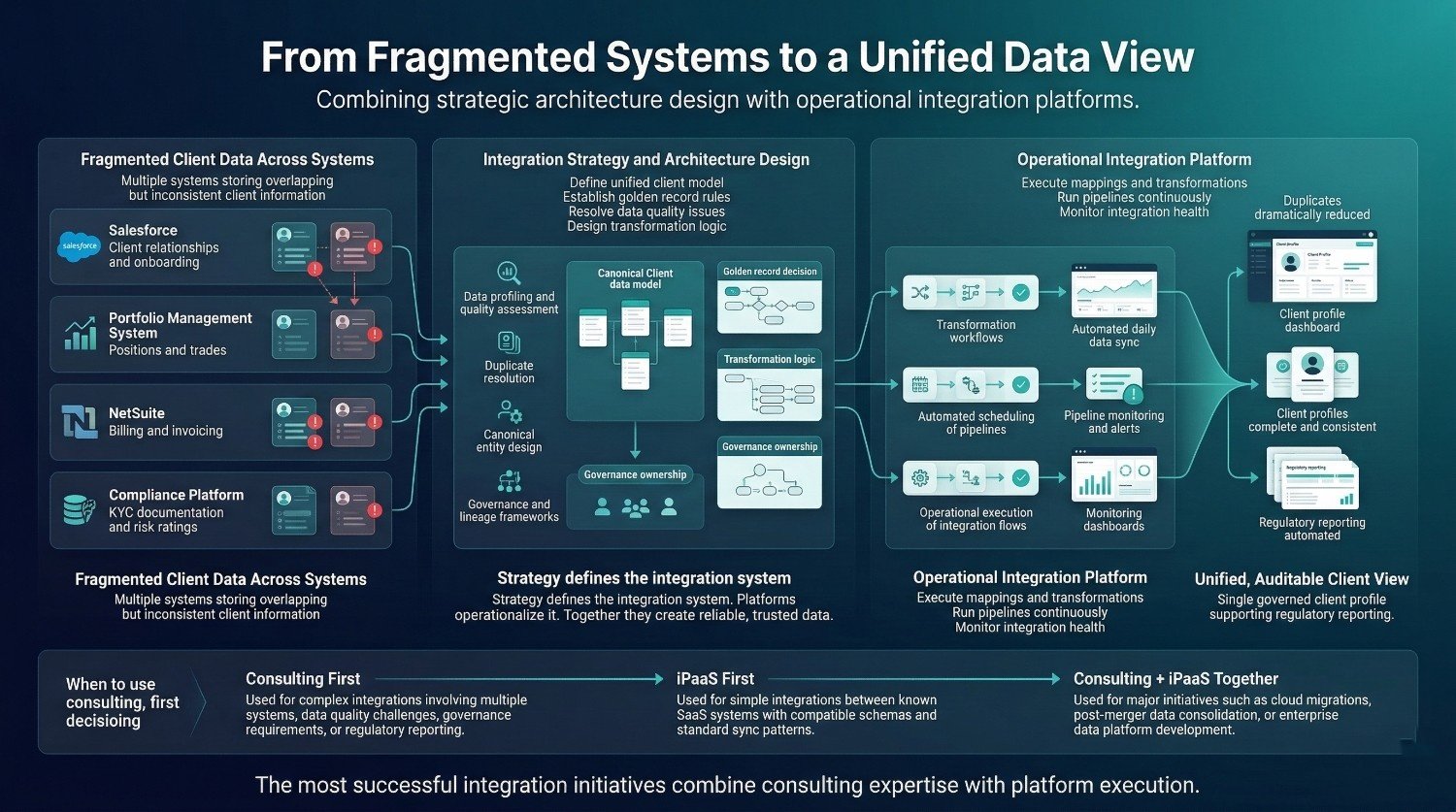
A Real-World Walkthrough
The Scenario
A mid-sized financial services company (400 employees, $200M AUM) needs to consolidate client data from four systems into a unified view for regulatory reporting.
Source systems:
- Salesforce (client relationships and onboarding)
- A proprietary portfolio management system (positions and trades)
- NetSuite (billing and invoicing)
- A compliance platform (KYC documentation and risk ratings)
The requirement: A single, auditable client profile that satisfies SEC and FINRA reporting requirements, with full lineage tracking.
What Consulting Contributed
Activity | Outcome |
|---|---|
Data landscape assessment |
Mapped all four systems, their schemas, and their data flows, including three undocumented manual processes |
Data quality profiling |
Discovered 40% duplicate client records across Salesforce and the portfolio management system |
Canonical client model |
Designed a unified client entity that all four systems map into, with documented field mappings and conflict resolution rules |
Golden record rules |
Defined which system is authoritative for each attribute, Salesforce for contact info, portfolio system for positions, compliance platform for KYC status |
Transformation logic |
Documented every business rule, AUM calculation methodology, client tier definitions, regulatory classification logic |
iPaaS selection |
Evaluated three platforms against requirements. Selected Boomi based on connector coverage, transformation capabilities, and compliance certifications |
Governance framework |
Established data ownership (compliance team owns KYC data, finance owns billing data), lineage tracking requirements, and access controls |
What iPaaS (Boomi) Contributed
Activity | Outcome |
|---|---|
Connector implementation |
Connected all four source systems with pre-built and custom connectors |
Transformation execution |
Implemented the mapping and business rules designed by consulting in Boomi's workflow engine |
Scheduling and automation |
Configured daily sync with incremental updates via CDC |
Monitoring and alerting |
Built dashboards tracking pipeline health, data freshness, and error rates |
Ongoing operations |
Runs the integration 24/7 with automatic retry and failure notification |
The Outcome
Metric | Result |
|---|---|
Duplicate client records |
Reduced from 40% to under 2% |
Regulatory reporting time |
From 3 weeks of manual assembly to 2 days of automated generation |
Audit readiness |
Full lineage from source to report, auditor questions answered in minutes |
Client profile completeness |
From fragmented across four systems to a single, governed view |
Why Neither Could Have Done It Alone
- Consulting without Boomi = A perfect strategy document, a canonical model, and golden record rules, with no platform to execute them. The client would still be assembling reports manually.
- Boomi without consulting = Four systems connected to a warehouse, replicating 40% duplicate records, with no canonical model, no quality remediation, and no governance. The regulatory report would have been wrong, and the SEC doesn’t accept “the connector worked” as an explanation.
Together: a unified, governed, auditable client view, built on sound architecture and running on reliable infrastructure.
When to Lead with Consulting
Start with data integration consulting when:
- You have high complexity, multiple sources, incompatible schemas, conflicting definitions
- Data quality is a known concern, duplicates, inconsistencies, missing values across systems
- Regulatory or compliance pressure is driving the initiative
- Organizational alignment is lacking, departments disagree on definitions, ownership, or priorities
- Previous integration attempts have failed and you need a fresh, objective assessment
- You don’t yet know what tools you need, the problem hasn’t been defined clearly enough to evaluate platforms
- The problem is strategic, architecture, governance, and business outcome alignment are the primary challenges
When to Lead with iPaaS
Start with iPaaS when:
- The use case is well-defined and low-complexity, known systems, compatible schemas, standard patterns
- Your team has strong internal expertise, they’ve done this before and know what they’re building
- You need speed on a specific, bounded integration, not an enterprise-wide initiative
- Business teams need self-service, operations, marketing, or finance building their own workflows
- Data quality isn’t a significant concern, source data is clean and consistent
- No regulatory or governance complexity, the integration doesn’t feed compliance-critical reporting
When You Need Both from Day One
Engage consulting and select iPaaS simultaneously when:
- Major cloud migration, architecture, governance, and tooling all need to be designed together
- Post-M&A consolidation, two data ecosystems need strategic unification with operational execution
- Building an enterprise data platform from scratch, warehouse, lakehouse, or CDP initiative where everything is being designed for the first time
- The stakes are extremely high, getting the foundation wrong would be catastrophic to fix later
In these scenarios, the cost of sequencing incorrectly, buying the tool before defining the strategy, or defining the strategy without considering the tool’s capabilities, is significant enough that parallel investment in both consulting and iPaaS is the most efficient path.
The consulting team designs the architecture with full knowledge of the platform’s capabilities. The platform team begins configuration as soon as architecture decisions are finalized. The result is faster delivery and significantly less rework caused by misalignment between strategy and tooling.
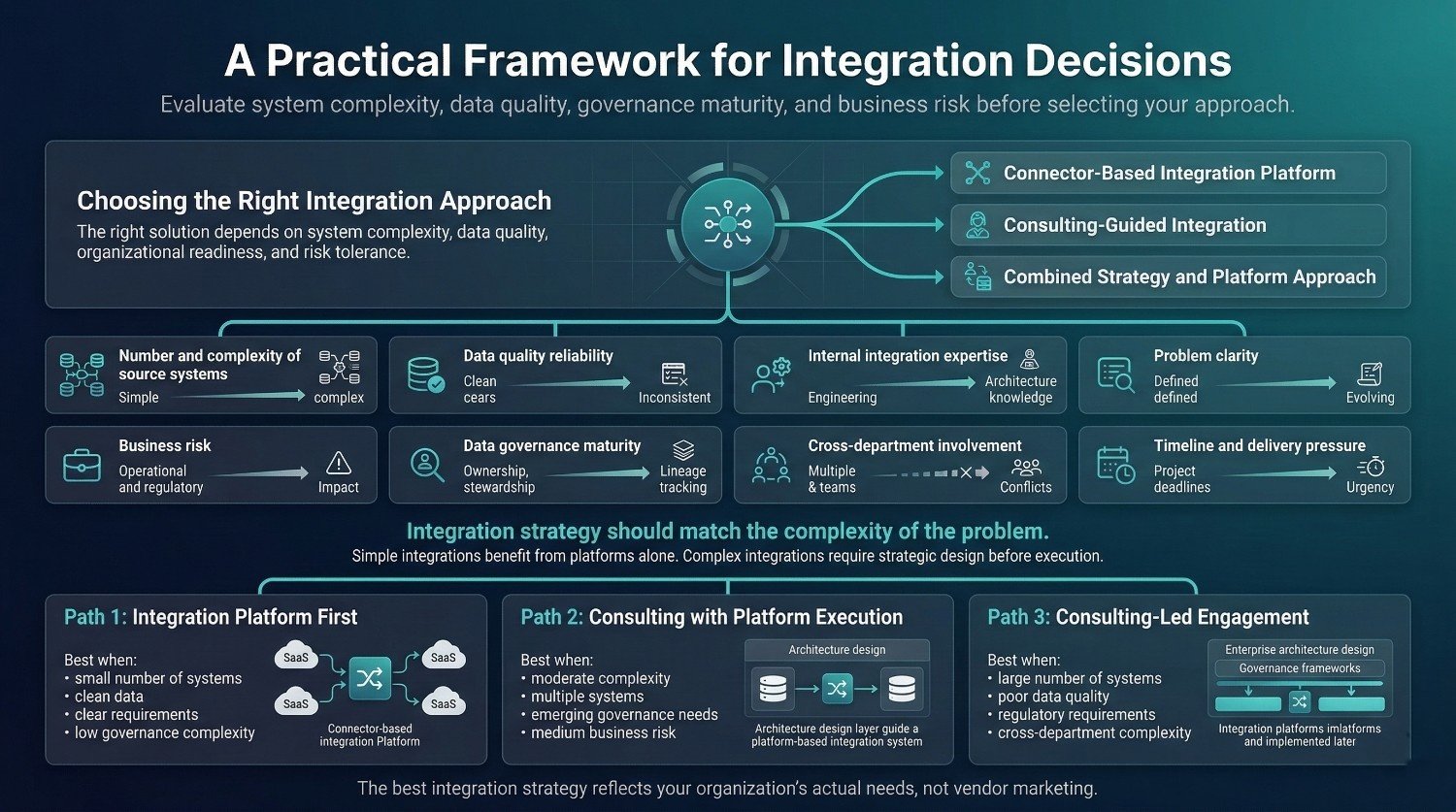
A Decision Framework
Enough comparison. Let’s give you a practical tool for making this decision, based on your actual situation, not vendor marketing or generalized advice.
Key Questions to Ask
Before choosing between iPaaS, data integration consulting, or both, answer these eight questions honestly.
Question 1: How many source systems are involved, and how complex are they?
Answer | Implication |
|---|---|
2–3 well-documented SaaS systems with standard APIs |
iPaaS is likely sufficient |
5–10 systems with mixed schemas and some legacy |
iPaaS + consulting advisory recommended |
10+ systems including legacy, custom, and inconsistent schemas |
Consulting-led engagement with iPaaS as execution layer |
Question 2: Is our data quality trustworthy?
Answer | Implication |
|---|---|
High, clean, consistent, minimal duplicates or gaps |
iPaaS can operate without major quality remediation when source data is already well-governed |
Moderate, some known issues but manageable |
iPaaS + data profiling (consulting can scope this quickly) |
Low, widespread duplicates, inconsistencies, missing values, conflicting records |
Consulting-led quality assessment before any tool is configured |
Question 3: Do we have experienced integration architects on our team?
Answer | Implication |
|---|---|
Yes, they've designed and delivered multi-source integration with governance |
Your team can lead with iPaaS and consulting only if complexity warrants |
Somewhat, strong engineers but no full integration lifecycle experience |
Consulting advisory for architecture and governance; team executes with iPaaS |
No, first time tackling integration at this scale |
Consulting-led engagement with significant knowledge transfer built in |
Question 4: Is this a well-defined use case or a complex, first-of-its-kind initiative?
Answer | Implication |
|---|---|
Well-defined, standard sync, known patterns, clear requirements |
iPaaS with pre-built templates and connectors |
Partially defined, general direction but requirements still emerging |
Consulting for discovery and scoping before tool selection |
Complex and novel, M&A consolidation, enterprise data platform, compliance-driven unification |
Consulting-led engagement covering strategy, architecture, governance, and structured implementation guidance |
Question 5: What's the business impact if we get this wrong?
Answer | Implication |
|---|---|
Low, exploratory analytics, non-critical reporting |
iPaaS is fine; failure is recoverable |
Moderate, feeds important decisions but not mission-critical |
iPaaS with consulting architecture review as insurance |
High, feeds executive decisions, customer-facing systems, regulatory reporting, or revenue operations |
Consulting-led to de-risk; iPaaS for execution after strategy is defined |
Question 6: Do we have clear data governance and ownership in place?
Answer | Implication |
|---|---|
Yes, data owners, stewards, golden record rules, lineage tracking all operational |
iPaaS can operate within existing governance framework |
Partially, some ownership defined but no formal governance framework |
Consulting to formalize governance alongside iPaaS implementation |
No, nobody owns the data, no shared definitions, no lineage |
Consulting to establish governance before iPaaS is configured, otherwise you're automating chaos |
Question 7: Are multiple departments involved with potentially conflicting needs?
Answer | Implication |
|---|---|
No, single team consuming the data |
iPaaS can be configured to meet their needs directly |
Some, two or three teams with mostly aligned requirements |
iPaaS with light consulting facilitation to align definitions |
Yes, multiple departments with conflicting definitions, competing priorities, and political dynamics |
Consulting is essential for cross-functional alignment, no tool resolves organizational conflict |
Question 8: What's our timeline, and how much risk can we absorb?
Answer | Implication |
|---|---|
Flexible, no hard deadline, room to iterate |
iPaaS and learn as you go; bring in consulting if you get stuck |
Moderate, business initiative dependent on this, but some buffer |
Consulting for upfront architecture to reduce rework risk; iPaaS for execution |
Tight, regulatory deadline, M&A milestone, or board commitment |
Consulting and iPaaS from day one, parallel investment to compress timeline without cutting corners |
Decision Matrix
Plot your answers against this matrix to determine the right investment.
The Two Axes
Integration Complexity, determined by your answers to Questions 1, 2, 4, 5, 6, and 7
Internal Capability, determined by your answers to Questions 3 and 8
The Four Quadrants
HIGH COMPLEXITY | |||
|---|---|---|---|
LOW CAPABILITY |
Full Consulting + iPaaS Together |
Consulting strategy + iPaaS Execution |
HIGH CAPABILITY |
iPaaS + Light Advisory |
iPaaS Only | ||
LOW COMPLEXITY | |||
What Each Quadrant Means
iPaaS Only (High Capability + Low Complexity)
- Your team knows what they’re doing. The problem is straightforward.
- Pick an iPaaS platform, configure the integrations, and move on.
- No consulting needed, save the budget for when complexity actually demands it.
iPaaS + Light Advisory (Low Capability + Low Complexity)
- The problem isn’t complex, but your team hasn’t done this before.
- iPaaS handles the execution. A scoped consulting advisory, architecture review, best practices, governance guardrails, ensures they build on the right foundation.
- Typical consulting investment: $30K–$75K for a 2–4 week advisory engagement alongside iPaaS deployment.
Consulting Strategy + iPaaS Execution (High Capability + High Complexity)
- Your team is strong, but the problem is genuinely hard, multiple sources, conflicting schemas, governance requirements, compliance pressure.
- Consulting leads strategy, architecture, and governance design. Your team implements using iPaaS, guided by consulting’s blueprint.
- Typical consulting investment: $100K–$300K for strategy and architecture, with iPaaS costs separate.
Full Consulting + iPaaS Together (Low Capability + High Complexity)
- The problem is hard and your team hasn’t navigated this before.
- Consulting leads end to end, strategy, architecture, governance, tool selection, implementation guidance, validation, and knowledge transfer. iPaaS is selected and configured as part of the consulting-designed solution.
- Typical consulting investment: $200K–$500K+ depending on scope, with iPaaS costs separate.
Where Organizations Misplace Themselves
The most common mistake: landing in “iPaaS Only” when you actually belong in “Consulting Strategy + iPaaS Execution.” This happens when teams:
- Overestimate their integration experience (building pipelines ≠ full integration)
- Underestimate the complexity (5 sources sounds manageable until the schema conflicts surface)
- Skip governance because it feels slow (it’s faster than rebuilding without it)
- Confuse connector count with integration maturity
Be ruthlessly honest about your quadrant. Misplacement can lead to rework, loss of stakeholder confidence, and avoidable technical debt.
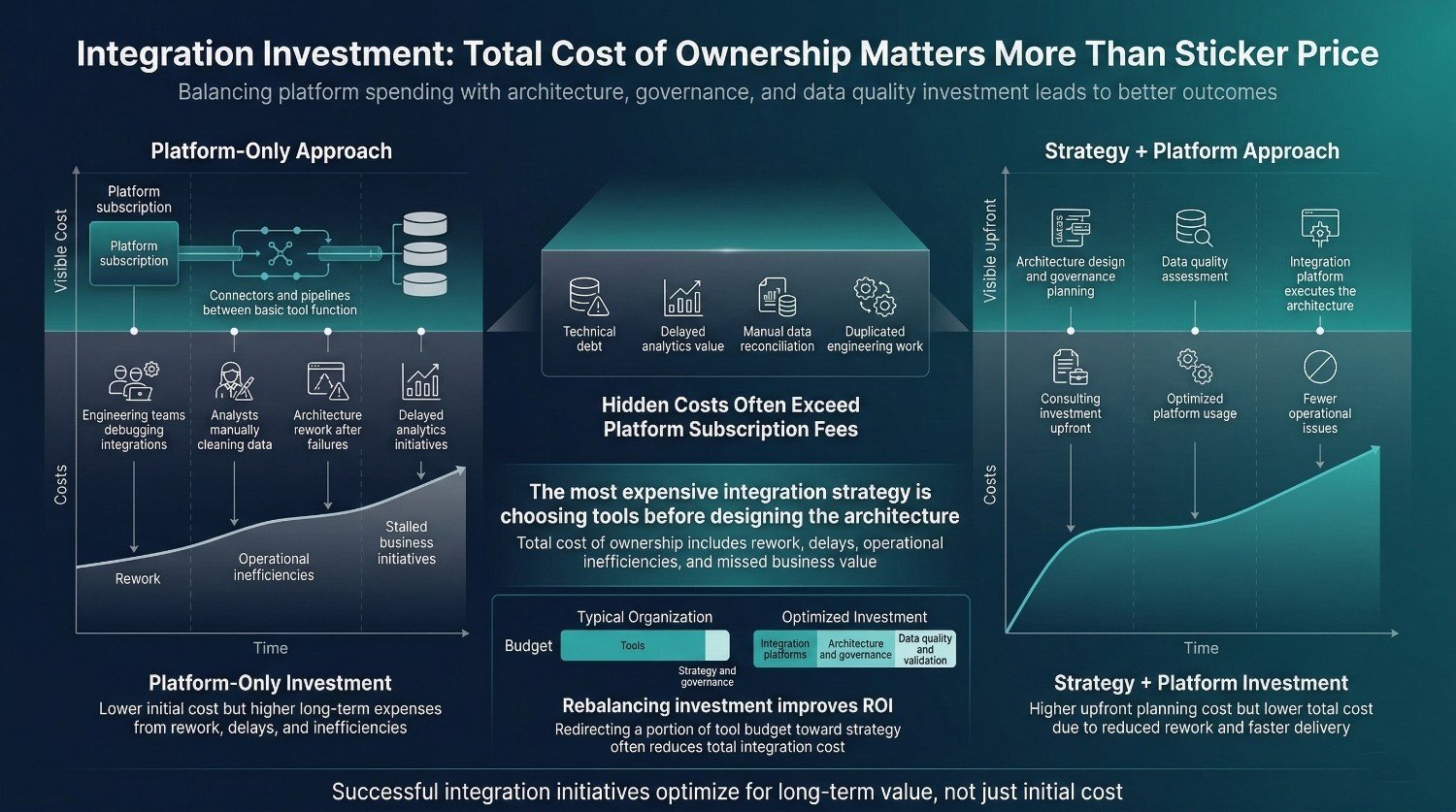
Budget Considerations
Think Total Cost of Ownership, Not Sticker Price
The decision between iPaaS and consulting is never just about comparing subscription fees to consulting rates. The real comparison includes everything:
Cost Component | iPaaS Only | iPaaS + Consulting |
|---|---|---|
iPaaS subscription |
$15K–$500K/year |
Same, consulting helps right-size the subscription |
Internal team time |
High, learning, building, debugging, rebuilding |
Moderate, guided by consulting, less rework |
Rework from architecture mistakes |
$50K–$200K+ (common without strategic guidance) |
Minimal, architecture designed right the first time |
Delayed business value |
6–12 months of stalled initiatives |
2–3 months, value often delivered in early phases |
Manual workarounds |
Ongoing, analysts cleaning data, teams reconciling numbers |
Eliminated or dramatically reduced |
Cost of failure |
Potentially project-ending, stalled, abandoned, restarted |
Dramatically reduced through methodology and risk mitigation |
Consulting fees |
$0 |
$50K–$500K+ depending on scope |
Total 3-year cost |
Can become higher due to rework, delays, and hidden inefficiencies if architecture is not well designed |
Often lower despite consulting fees, because the foundation is right |
In many complex initiatives, adding consulting to the budget can reduce total cost, because the savings from avoided rework, faster delivery, and eliminated workarounds exceed the consulting fees.
Where Organizations Typically Under-Invest
Area | Why It Gets Under-Funded | Cost of Under-Investment |
|---|---|---|
Governance |
Feels bureaucratic, hard to quantify ROI |
Shadow systems, conflicting metrics, compliance risk, eroded trust |
Testing and validation |
Pressure to launch quickly, testing seen as "nice to have" |
Wrong numbers reach stakeholders, trust destroyed on first use |
Change management |
Seen as soft, not technical |
Low adoption, teams revert to old processes, integrated data goes unused |
Data quality assessment |
"We'll fix quality issues as we find them" |
Issues discovered in production, cascading through every downstream system |
Where Organizations Typically Over-Invest
Area | Why It Gets Over-Funded | The Waste |
|---|---|---|
Tools and connectors |
Visible, demonstrable progress, green lights on a dashboard |
Tool capabilities unused because strategy, model, and governance don't exist |
Platform features |
Enterprise tier purchased "just in case" |
Paying for features the organization won't use for years, if ever |
Custom connector development |
Building connectors for every system before determining which ones matter |
Connectors built for sources that aren't in the integration roadmap's first three phases |
The Budget Rebalancing
For most organizations, the highest-ROI budget shift is:
Redirect 20–30% of planned tool spend toward consulting, specifically toward governance, architecture, and quality assessment.
That shift typically:
- Can reduce total project cost through avoided rework and earlier architectural alignment
- Accelerates time to value by 3–6 months
- Improves adoption and trust in the integrated data when paired with governance and change management
- Ensures the iPaaS investment is fully utilized, not sitting at 30% of capacity
This rebalancing is one of the first recommendations any honest data integration consulting partner will make, because an organization that overspends on tools and underspends on strategy will never get the ROI it expected from either.
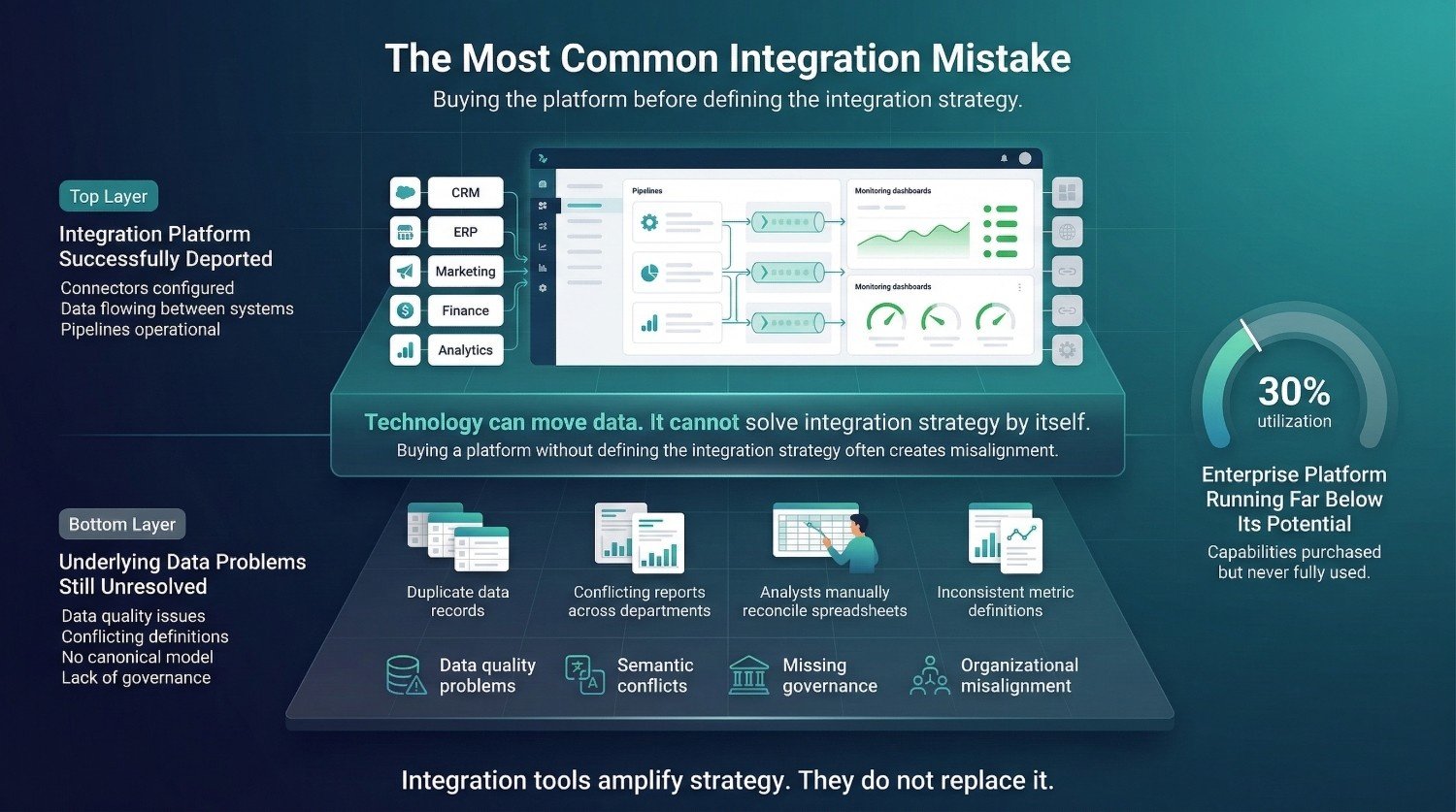
Common Mistakes When Choosing Between the Two
The iPaaS vs. consulting decision isn’t inherently difficult. But organizations make it difficult by repeating the same mistakes, mistakes that are entirely avoidable with the right awareness.
Here are the five that cause the most damage.
Buying an iPaaS and Assuming the Problem Is Solved
The Pattern
- Leadership mandates “we need to integrate our data”
- Someone evaluates iPaaS platforms, impressive demos, slick dashboards, hundreds of connectors
- A platform is purchased, $100K–$500K/year committed
- The team starts configuring connectors, data starts flowing
- Six months later, nobody trusts the data, reports still conflict, and the platform is running at 30% of its licensed capacity
Why This Happens
The iPaaS purchase feels like solving the problem. It’s a visible, concrete action. There’s a contract, a kickoff call, and an implementation timeline. Progress is measurable, connectors configured, flows live, data moving.
But the actual integration problem, data quality, semantic conflicts, governance, architecture, organizational alignment, hasn’t been touched. The tool is running. The problem is untouched.
The Shelfware Reality
This pattern is disturbingly common across enterprise software:
- Organizations purchase platform capabilities they never fully leverage
- Enterprise-tier licenses are bought “for future needs” that never materialize
- Connectors are configured for systems that aren’t part of any integration roadmap
- Features go unused because nobody designed the strategy that would require them
The iPaaS itself is not inherently the problem. Purchasing it before defining integration strategy often creates misalignment.
The Fix
Never purchase an integration platform before you’ve defined what integration means for your organization.
At minimum, answer these questions before signing a contract:
- What business outcomes should this platform support?
- What data sources are in scope, now and in the next 18 months?
- What transformation complexity will the platform need to handle?
- What governance and compliance requirements must it support?
- Who will configure, maintain, and evolve the integrations?
If you can’t answer these clearly, you need data integration consulting before you need an iPaaS.
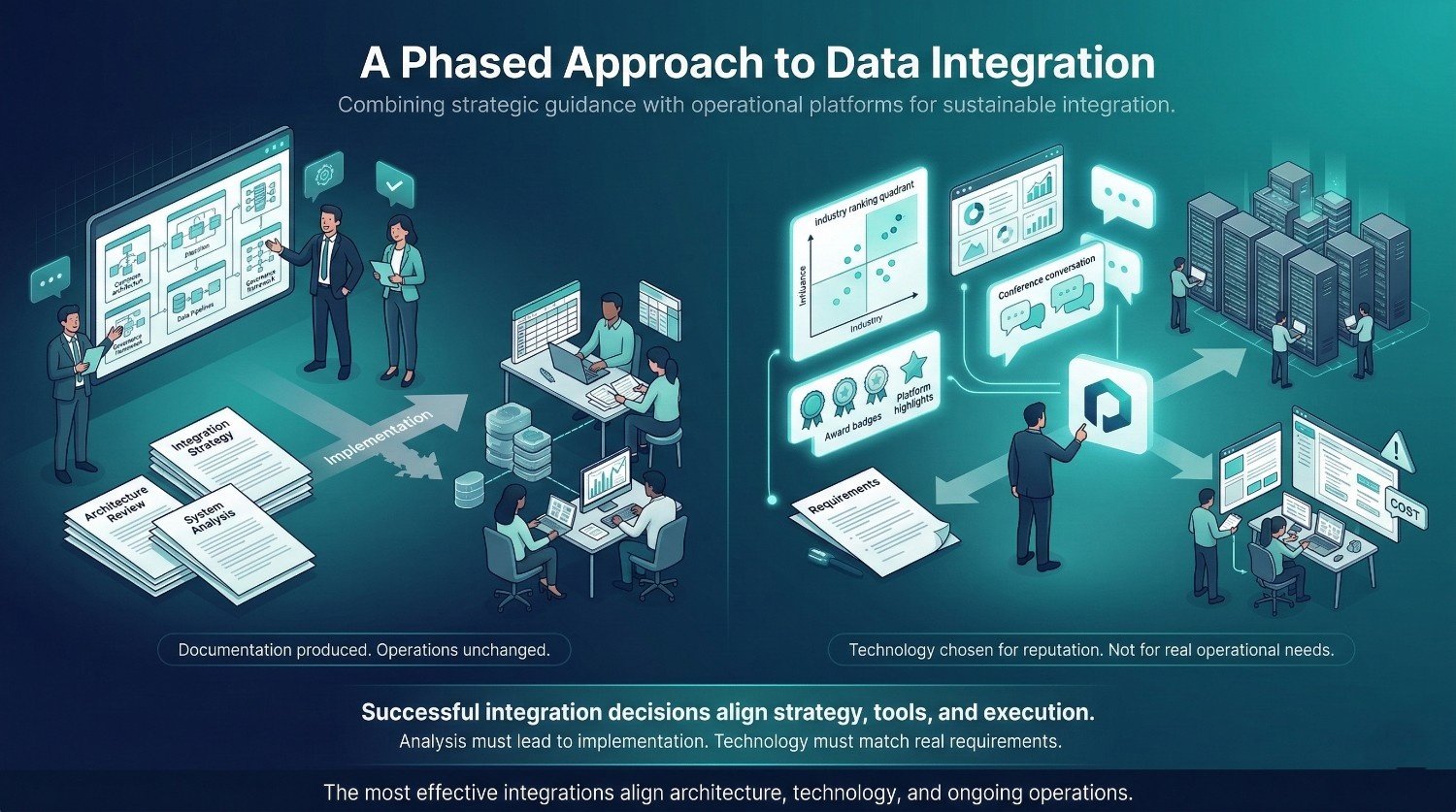
Engaging Consulting Without a Clear Scope or Goal
The Pattern
- Organization recognizes it has an integration problem
- A consulting firm is engaged, broad scope, vague objectives
- Weeks of discovery produce extensive documentation
- A comprehensive strategy deck is delivered, 80 pages, beautiful diagrams
- The deck sits on a shared drive. Nothing gets implemented. The team moves on to the next urgent request.
Why This Happens
- No defined deliverables, the engagement produces “findings” and “recommendations” but no executable plan
- No success criteria, nobody defined what “done” looks like, so the engagement never quite finishes
- No handoff plan, the strategy assumes an implementation phase that was never scoped or budgeted
- Analysis paralysis, the consulting team keeps discovering more complexity, the scope keeps expanding, and the project never transitions from planning to doing
The Fix
Every data integration consulting engagement should have, before it starts:
Requirement | What It Looks Like |
|---|---|
Defined scope |
Specific systems, data domains, and use cases, not "assess everything" |
Measurable deliverables |
Architecture document, data model, governance framework, implementation roadmap, not "strategic recommendations" |
Success criteria |
Clear conditions that define when the engagement has achieved its goal |
Implementation bridge |
Either the consulting engagement includes implementation, or there's an explicit plan for who implements the strategy and when |
Time boundaries |
Fixed duration with milestone checkpoints, not open-ended discovery |
The Litmus Test
If a consulting engagement can’t answer “What will be different in our organization 90 days after this engagement ends?”, the scope isn’t defined well enough. Strategy without execution delivers limited organizational value. Good data integration consulting always connects strategy to action.
Choosing Based on Vendor Marketing Instead of Actual Needs
The Pattern
- A Gartner Magic Quadrant places Platform X in the “Leaders” quadrant
- The team watches three impressive vendor demos
- A peer company mentions they use Platform Y at a conference
- The decision is made primarily based on analyst positioning, demo polish, and social proof, not requirements
Why This Is Dangerous
What works for a Fortune 500 with 200 data engineers may be completely wrong for a mid-market company with a team of three.
Factor | Fortune 500 Reality | Mid-Market Reality |
|---|---|---|
Team size |
Dedicated integration team of 10–50 |
2–5 engineers handling everything |
Budget |
$500K–$2M/year for integration tooling |
$30K–$150K/year total |
Complexity |
100+ source systems, global operations |
10–20 systems, single region |
Governance maturity |
Formal data governance organization |
Governance is informal or nonexistent |
Platform needs |
Enterprise-grade with advanced API management and MDM |
Reliable connectors with basic transformation |
Analyst quadrants evaluate platforms against enterprise-grade criteria. If you’re not an enterprise with enterprise-grade needs, the “Leader” may not be the optimal fit, too expensive, too complex, too much overhead for your situation.
The Fix
- Start with your requirements, not with a vendor shortlist
- Evaluate against your actual use cases, test with your data, your systems, your team
- Consider total cost of ownership, including internal team time, training, and maintenance
- Get independent advice, vendor-neutral data integration consulting that recommends based on your needs, not partnership agreements
- Ignore logos and social proof, what works for someone else’s architecture, team, and budget may not work for yours
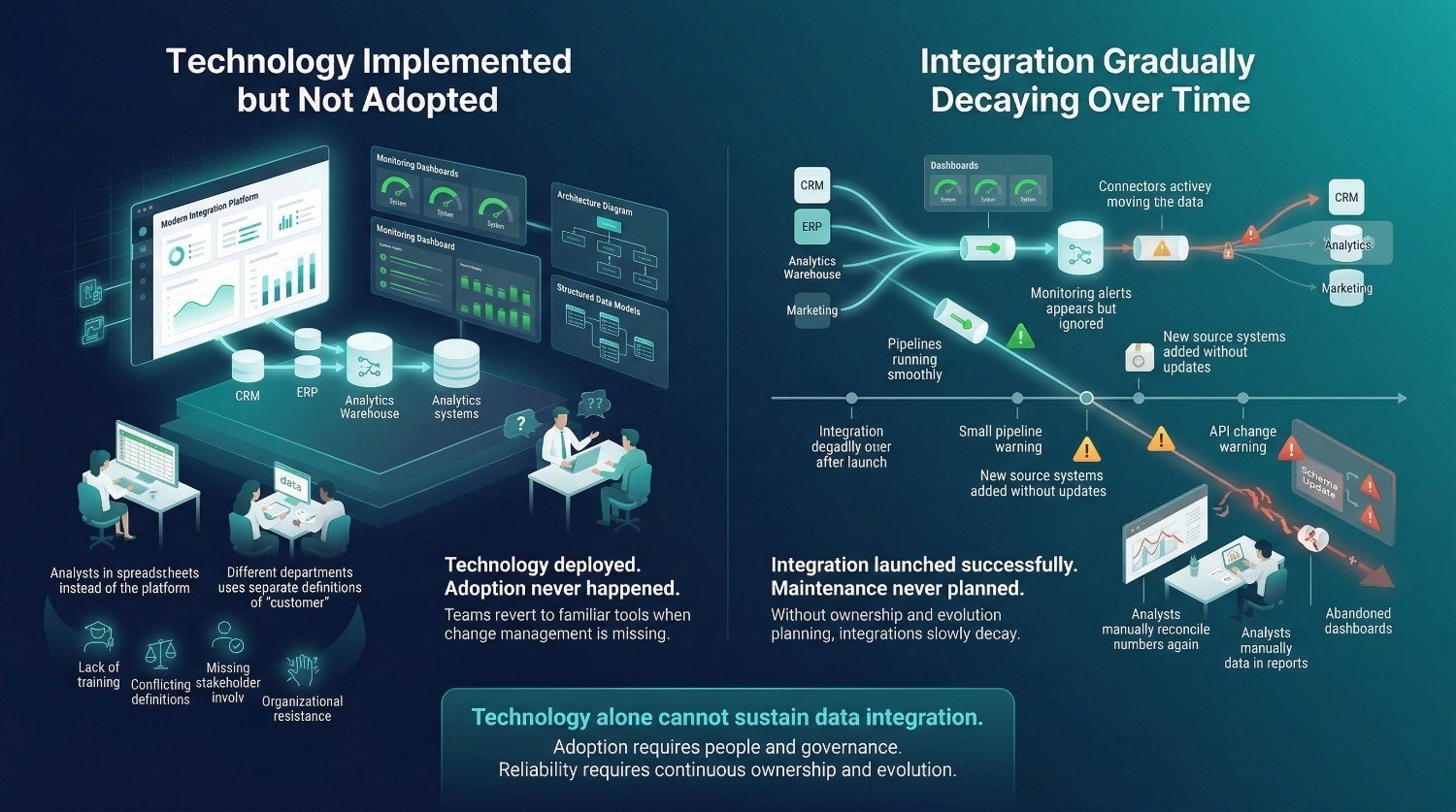
Ignoring the Human Element Entirely
The Pattern
- The best iPaaS platform is selected
- The most experienced consulting firm is engaged
- The architecture is sound, the data model is elegant, the pipelines are robust
- Go-live happens, and nobody uses it
Why This Happens
The integration is technically excellent but organizationally dead on arrival:
- Departments weren’t consulted during design, the integrated data doesn’t match their workflows
- Definitions weren’t agreed upon, marketing still uses their version of “customer” because nobody asked them to change
- Training never happened, users don’t know how to query the new model or where to find what they need
- Change resistance wasn’t addressed, teams revert to their spreadsheets because the old process is familiar and the new one isn’t
- No executive sponsorship, there’s no top-down mandate to adopt the integrated data
The Uncomfortable Truth
The most common reason integration projects fail isn’t bad technology or bad strategy. It’s that the organization didn’t change alongside the technology. Even the most capable iPaaS platform or consulting team cannot guarantee adoption. They can only create the conditions for it.
The Fix
- Involve stakeholders from day one, not at go-live. During discovery. During design. During testing.
- Invest in change management explicitly, budget for it, staff for it, track it
- Secure executive sponsorship, someone with organizational authority needs to mandate adoption and resolve conflicts
- Define shared vocabulary early, agreed-upon metrics and definitions published before the first pipeline runs
- Train relentlessly, not once. Continuously. With feedback loops and iteration.
Strong data integration consulting partners explicitly plan for the human element as a core workstream, not an afterthought. And they recommend iPaaS platforms that support adoption through usability, self-service, and accessible interfaces.
Not Planning for Post-Implementation
The Pattern
- Consulting engagement ends, strategy delivered, architecture built, knowledge transferred
- iPaaS is running, pipelines live, monitoring active, data flowing
- Everyone moves on to the next project
- Six months later:
- A source system updated its API, three pipelines silently broke
- The business added a new product line, the data model doesn’t account for it
- A new regulation requires additional lineage tracking, nobody planned for it
- Data quality has degraded, monitoring alerts were ignored because nobody owned them
- The integration that worked at launch is gradually degrading
Why This Happens
- Project mindset, the integration was treated as a project with a start and end date, not an ongoing program
- No operational ownership, when the consulting team left, nobody was assigned to maintain what was built
- Monitoring without response, alerts fire, but nobody has a documented process for responding
- No evolution plan, the integration was designed for today’s requirements with no plan for tomorrow’s changes
The Cost of Neglect
Integration decay is silent and compounding:
Month | What Happens |
|---|---|
Month 1–3 |
Everything works. The team moves on. |
Month 4–6 |
Minor issues emerge. Alerts fire. Nobody responds. "We'll fix it later." |
Month 7–9 |
Source system changes break two pipelines. Data quality degrades. Analysts start noticing discrepancies. |
Month 10–12 |
Stakeholders lose trust, again. Manual workarounds return. The integration is effectively abandoned. |
Month 13+ |
Someone proposes starting over. The cycle repeats. |
The Fix
Before the consulting engagement ends and before the iPaaS goes live, establish:
Operational Component | What It Includes |
|---|---|
Ownership assignment |
Named individuals responsible for every pipeline, every data domain, every governance policy |
Monitoring and response procedures |
Not just alerts, documented runbooks for what to do when alerts fire |
Source system change management |
A process for detecting and adapting to API changes, schema updates, and new fields |
Scheduled reviews |
Monthly pipeline health reviews, quarterly governance assessments, annual architecture fitness checks |
Evolution roadmap |
A plan for onboarding new sources, handling new requirements, and adapting to regulatory changes |
Sustainable integration success is measured beyond launch day. It’s the one that still works perfectly 18 months later. That requires planning for post-implementation before implementation starts, and it should be an explicit deliverable of a well-scoped data integration consulting engagement.
The Summary
Mistake | What Goes Wrong | How to Prevent It |
|---|---|---|
Buying iPaaS before defining strategy |
Tool underutilized, data untrusted, money wasted |
Define requirements and architecture before purchasing |
Engaging consulting without clear scope |
Expensive strategy document, no implementation |
Set defined deliverables, success criteria, and implementation bridge |
Choosing based on marketing |
Wrong platform for your size, complexity, and needs |
Evaluate against your actual requirements with vendor-neutral guidance |
Ignoring the human element |
Technically sound integration that nobody adopts |
Invest in change management, stakeholder involvement, and executive sponsorship |
No post-implementation plan |
Integration decays silently over 6–12 months |
Establish ownership, monitoring, and evolution planning before go-live |
Most of these mistakes are preventable with structured planning and governance. Every one of them is common. And every one of them costs significantly more to fix after the fact than to prevent upfront.
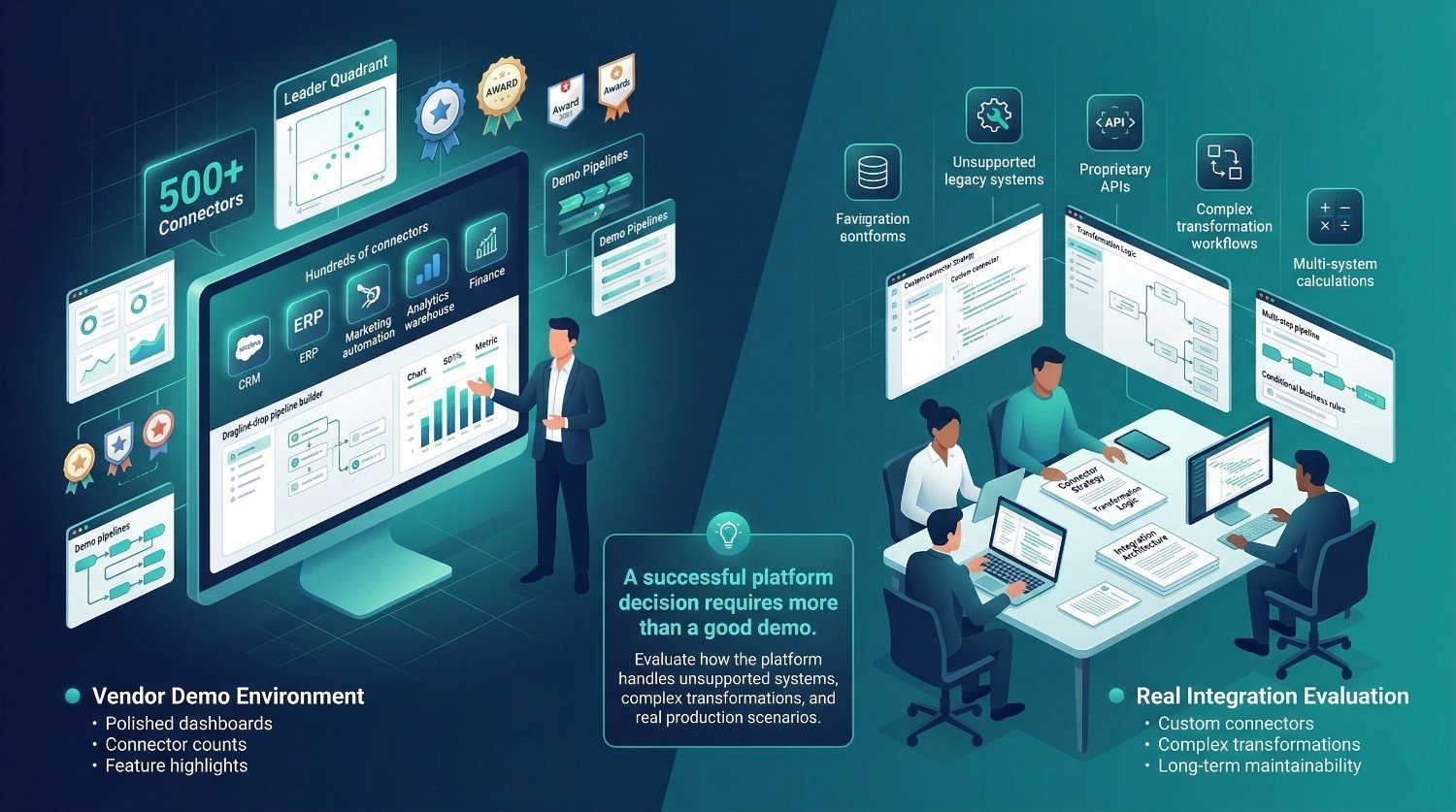
Questions to Ask iPaaS Vendors Before Buying
If after reading this post you’ve determined that an iPaaS platform is part of your solution, good. It probably is. But before you sign a contract, have a real conversation with every vendor on your shortlist. Not the demo conversation. Not the “let us show you our best features” conversation. The conversation that reveals whether this platform will actually work for your situation, 18 months from now, not just on day one.
These seven questions are designed to surface the gaps that vendor demos don’t show.
"What happens when we need a connector you don't support?"
Why This Matters
Many iPaaS vendors emphasize connector count, 300, 500, 1,000+. Impressive numbers. But the question isn’t how many connectors they have. It’s what happens when the one you need doesn’t exist.
Because it often happens in complex environments:
- A legacy system with a proprietary API
- A custom internal application with no standard interface
- A niche industry tool that’s not on any vendor’s roadmap
- A partner’s system that requires a non-standard integration pattern
What You Want to Hear
- A well-documented custom connector framework, SDK, API, or development toolkit
- Clear guidance on build time and effort for custom connectors
- Examples of customers who’ve built custom connectors successfully
- A connector request process with realistic timelines for new additions
Red Flag Answers
- “We support all major systems”, vague, doesn’t address the question
- “That’s on our roadmap for next quarter”, roadmap promises aren’t contracts
- “Our professional services team can build it for you”, at what cost, on what timeline?
- “You shouldn’t need any systems we don’t already support”, they don’t understand your environment
"How do you handle complex, multi-step transformation logic?"
Why This Matters
Basic field mapping and data type conversion are table stakes. The real test is whether the platform can handle the transformation logic your business actually requires:
- Multi-step calculations that reference data from multiple systems
- Conditional logic with exception handling and fallback rules
- Lookups against reference tables that change frequently
- Business rules that vary by region, product line, or customer segment
- Historical data transformations with schema versions that differ from current
What You Want to Hear
- Specific capabilities for complex transformations, scripting support, expression languages, custom functions
- Examples of customers running multi-system business logic within the platform
- Honest acknowledgment of where the visual builder hits its limits and what alternatives exist (custom code, external processing)
- Integration with external transformation tools (dbt, Spark) for logic that exceeds the platform’s native capabilities
Red Flag Answers
- “Our visual builder handles all transformation needs”, it doesn’t, for any platform
- “You can do anything with our expression language”, ask them to demonstrate your specific fiscal year calculation or segmentation logic
- “Most customers don’t need complex transformations”, most customers also don’t have your requirements
- Avoidance of the question or pivot to simpler use cases
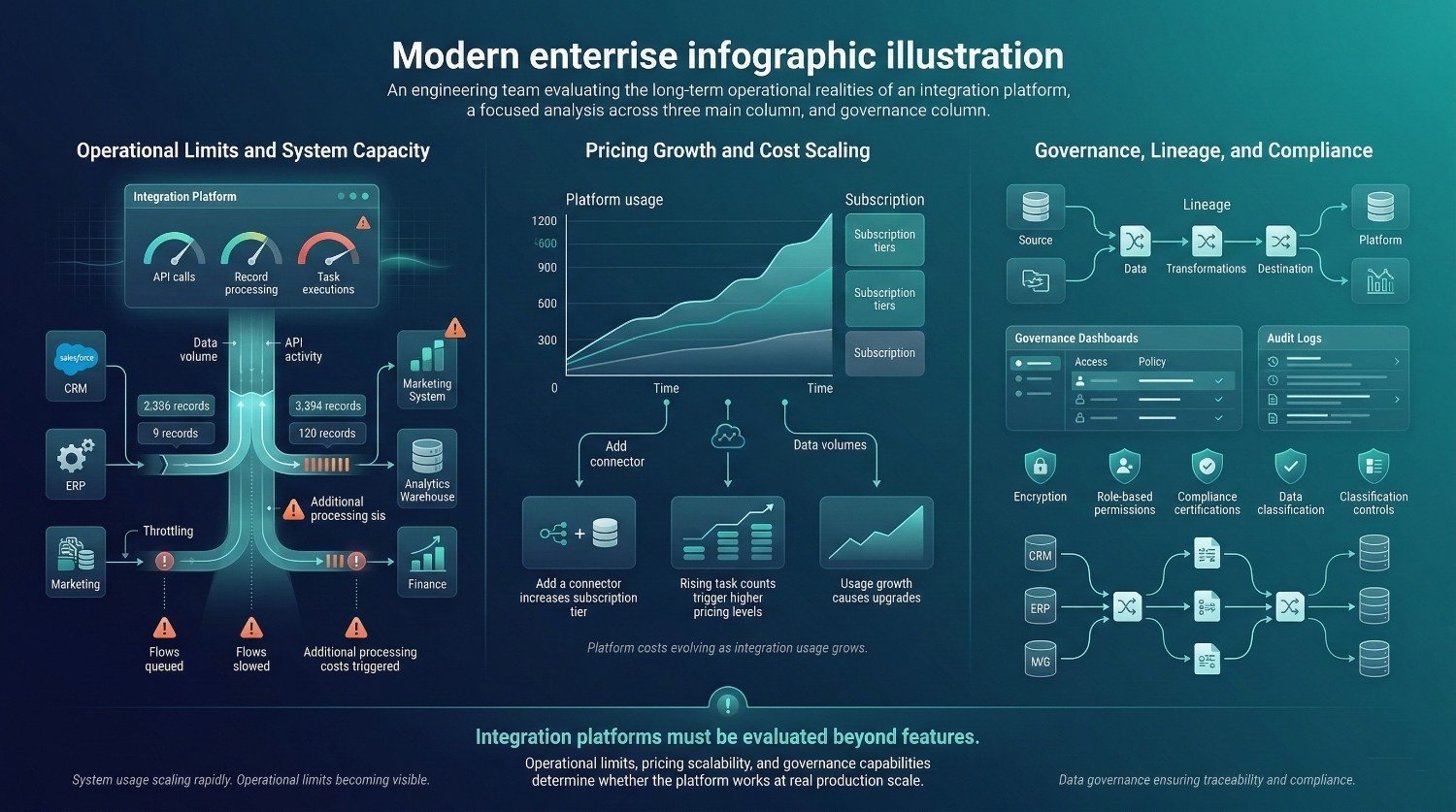
"What are the actual limits on data volume, API calls, and task execution?"
Why This Matters
iPaaS pricing and architecture are built around consumption limits. Understanding where those limits are, and what happens when you hit them, is critical for avoiding surprise costs and performance problems.
What You Want to Hear
- Explicit, documented limits, not buried in fine print:
- Maximum rows or records per sync
- API call limits per hour/day/month
- Task or operation count caps per billing cycle
- Concurrent flow execution limits
- Clear explanation of what happens when limits are hit:
- Flows throttled? Queued? Failed?
- Overage charges? Automatic tier upgrade?
- Performance degradation or hard cutoff?
- Real-world performance data, not just theoretical maximums, but actual throughput for customers with similar volumes
Red Flag Answers
- “Our platform scales automatically”, everything scales, at a cost. What cost?
- “You won’t hit our limits”, how do they know? Have they assessed your volume?
- Reluctance to provide specific numbers in writing
- “We can discuss limits during contract negotiation”, limits should be transparent before negotiation, not leverage during it
"How does pricing scale as our usage grows?"
Why This Matters
The iPaaS subscription that fits your budget today may not fit your budget in 18 months, especially if pricing scales with connectors, volume, or task counts in ways that aren’t immediately obvious.
What You Want to Hear
- A transparent pricing model with clear definitions:
- What counts as a “task,” “operation,” or “record”?
- How are connectors priced, per connector, per connection, or bundled?
- What triggers a tier upgrade?
- Modeled pricing scenarios for your growth trajectory:
- “At 2x your current volume, your annual cost would be approximately $X”
- “Adding 10 more connectors would move you to the Y tier at $Z/year”
- No hidden costs, are there charges for premium connectors, additional environments, support tiers, or API management features?
Red Flag Answers
- “We’ll work with you on pricing”, vague, unmodelable
- “Most customers stay within their tier”, your growth rate isn’t most customers’
- Pricing that lacks upfront transparency, transparency shouldn’t require commitment
- A model where costs scale faster than value, doubling your data volume shouldn’t triple your bill
"What governance, lineage, and compliance features are built in?"
Why This Matters
If your integration feeds regulatory reporting, handles PII, or needs to support audit requirements, the platform’s governance capabilities aren’t nice-to-haves. They’re requirements.
What You Want to Hear
- Lineage tracking, can you trace a data point from source through every transformation to destination? How granular is it? Does it cover the full ecosystem or just flows within the platform?
- Access controls, role-based permissions, data classification support, environment separation
- Audit trails, who changed what, when, and why? How long are logs retained?
- Compliance certifications, SOC 2, HIPAA, GDPR, ISO 27001, which are current, which are in progress?
- Data masking and encryption, at rest and in transit, with configurable policies for sensitive data
Red Flag Answers
- “We have full governance capabilities”, ask for specifics. “Full” means different things to different vendors.
- “Lineage is available in our enterprise tier”, governance capabilities should align with regulatory and operational needs, not only premium tiers
- Governance features that only cover within the platform, if your data flows through systems outside the iPaaS, platform-only lineage isn’t end-to-end
- No third-party compliance audit documentation available for review
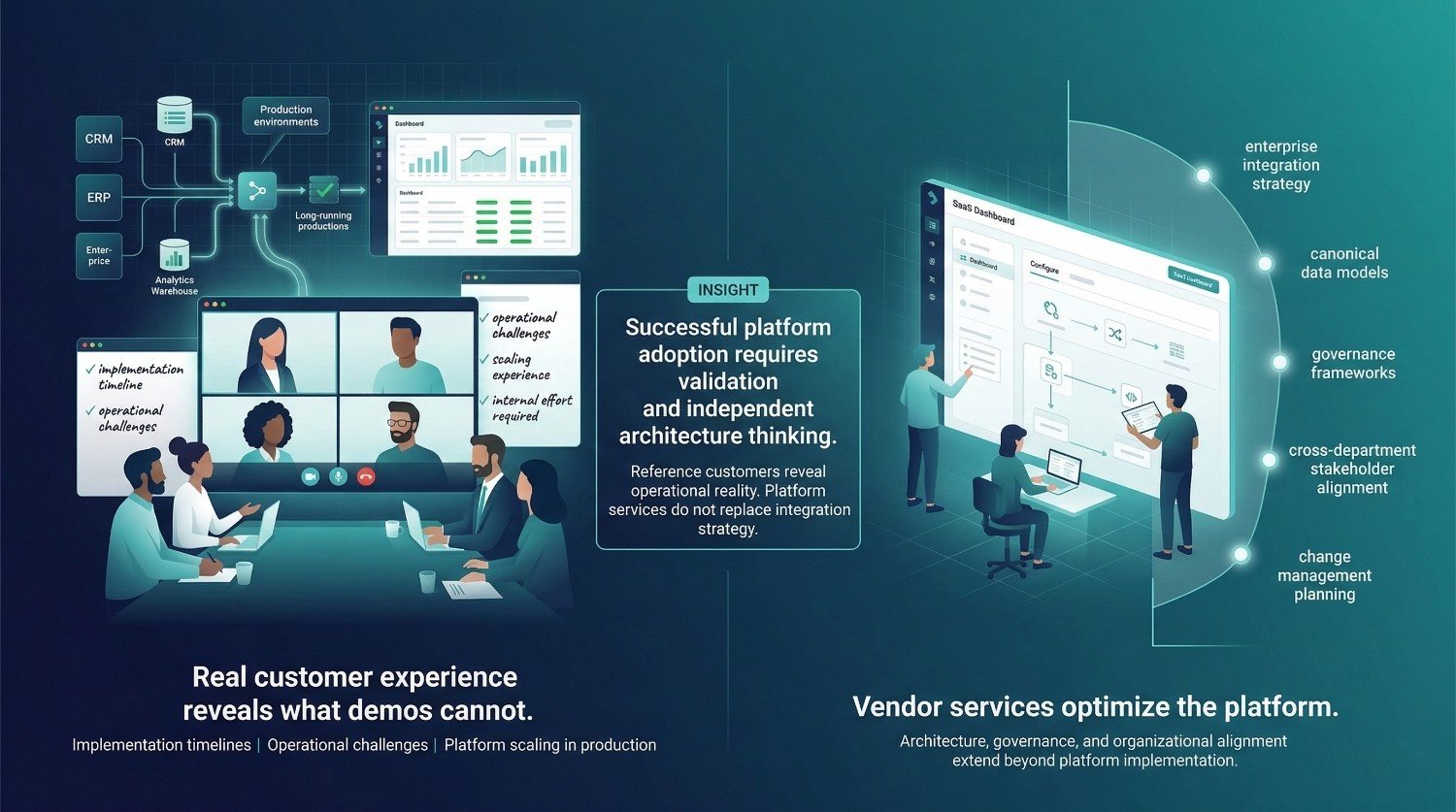
"Can we see a reference customer in our industry with similar complexity?"
Why This Matters
Demos are curated. Case studies are marketing. The only way to understand how a platform performs in a situation like yours is to talk to someone who’s been through it.
What You Want to Hear
- A named reference customer in your industry, or at least a similar industry with comparable complexity
- Willingness to arrange a direct conversation, not just a written testimonial
- A reference whose integration scope matches yours, similar number of systems, similar data volumes, similar compliance requirements
- Honest discussion of challenges encountered during implementation, not just success metrics
What to Ask the Reference
Question | Why It Matters |
|---|---|
How long did initial implementation take vs. what was estimated? |
Reveals whether timelines are realistic |
What didn't work as expected? |
Every implementation has surprises, what were theirs? |
How much internal effort was required beyond the platform? |
Reveals hidden costs the vendor may not mention |
Did you need external consulting alongside the iPaaS? |
Directly relevant to the iPaaS vs. consulting question |
How has the platform handled your growth over time? |
Tests the scaling claims |
What would you do differently? |
The most valuable question you can ask |
Red Flag Answers
- “We can’t share reference customers due to NDAs”, most established vendors can provide referenceable clients
- Only offering references from different industries or much simpler use cases
- “Our case studies cover this”, written case studies aren’t the same as live conversations
- Delays or deflection when you ask to speak directly with a customer
"What does your professional services team handle vs. what requires third-party consulting?"
Why This Matters
This question forces the vendor to be honest about where their platform, and their services, stop being sufficient.
What You Want to Hear
A clear, honest delineation:
Their PS Handles | Requires Third-Party / Your Team |
|---|---|
Platform setup and configuration |
Integration strategy and architecture |
Connector implementation |
Canonical data model design |
Basic workflow development |
Complex business rule definition |
Platform training |
Data quality assessment and remediation |
Technical troubleshooting |
Governance framework design |
Cross-departmental stakeholder alignment | |
Change management and adoption | |
Compliance architecture |
- Acknowledgment that their professional services optimize for their platform, not for your overall integration strategy
- Willingness to work alongside independent consultants without friction
- Honest assessment of where customers typically need additional help beyond what vendor PS provides
Red Flag Answers
- “Our professional services handle everything”, they don’t. No vendor PS team designs enterprise governance frameworks or facilitates cross-departmental alignment.
- “You won’t need outside consulting”, this is almost never true for complex integration scenarios
- Resistance to the idea of third-party consulting involvement, suggests they want full control of the engagement, not the best outcome for you
- “Our PS team can do the strategy work too”, vendor strategy is inherently biased toward their platform. That’s not independent data integration consulting, it’s sales engineering.
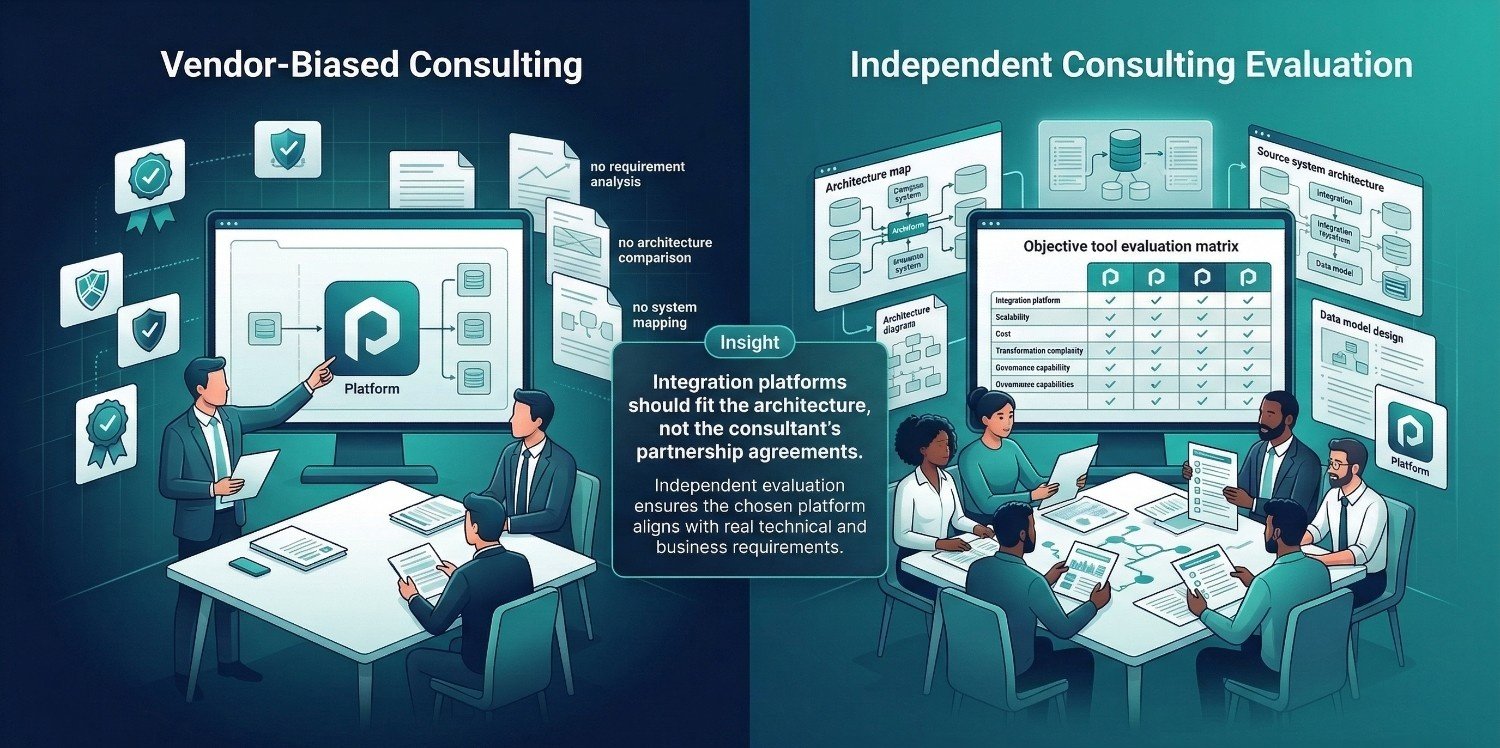
Questions to Ask Data Integration Consultants Before Engaging
Fair is fair. If we’re going to hold iPaaS vendors to tough questions, data integration consulting partners deserve the same scrutiny.
Not all consulting is created equal. The difference between a consulting engagement that transforms your data capabilities and one that produces expensive shelf documentation comes down to methodology, transparency, and accountability. These seven questions separate the two.
"Do you recommend tools based on our needs, or do you have preferred vendor partnerships?"
Why This Matters
A key value of independent consulting is objectivity. If a consultant recommends MuleSoft because they have a MuleSoft partnership, not because MuleSoft is the best fit for your situation, you’re paying consulting rates for a sales pitch.
What You Want to Hear
- “We’re vendor-neutral. Our recommendations are based entirely on your requirements, architecture, and budget.”
- A clear explanation of how they evaluate tools, what criteria they use, how they weight them, how they test
- Willingness to recommend simpler, cheaper tools when they’re the right fit, not just enterprise platforms with bigger margins
- Transparency about any partnerships, certifications, or resale agreements, these aren’t disqualifying, but they should be disclosed upfront
Red Flag Answers
- Immediate mention of a specific platform before understanding your requirements
- “We’re a certified [Vendor X] partner” with no acknowledgment of how that might influence recommendations
- A portfolio where every past engagement uses the same platform, suggests a one-tool mindset
- Reluctance to discuss alternatives or compare platforms objectively
The Test
Ask them to describe a situation where they recommended against a major platform, and what they recommended instead. If they can’t give a concrete example, their neutrality is theoretical.
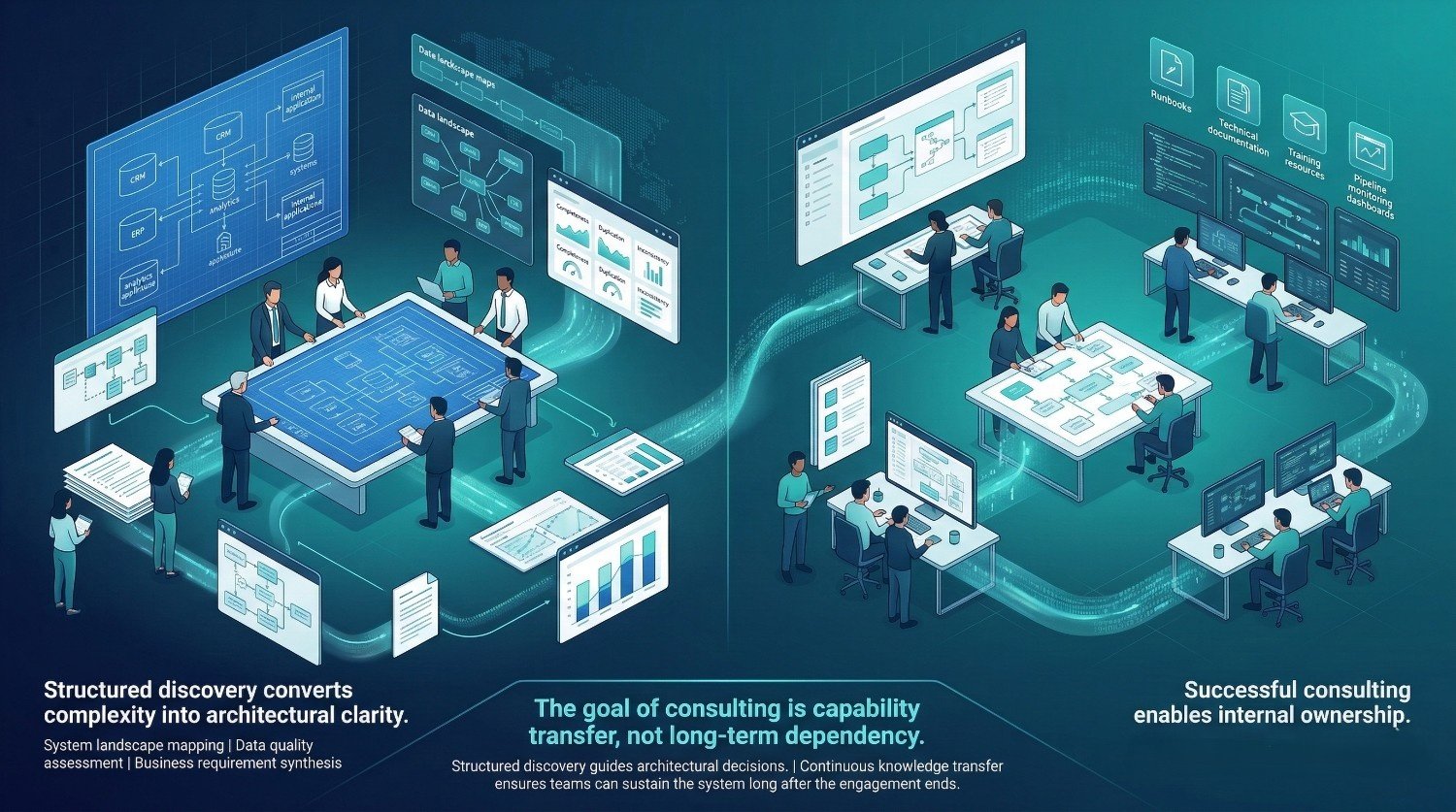
"What's your methodology for discovery and assessment?"
Why This Matters
Discovery is often where the engagement establishes its foundation. A consulting team without a structured methodology will burn your budget on open-ended exploration that never converges into actionable decisions.
What You Want to Hear
A clearly defined process with specific phases, activities, and deliverables:
Phase | What They Should Describe |
|---|---|
Stakeholder interviews |
Who they talk to, what they ask, how they synthesize across departments |
Data landscape mapping |
How they inventory systems, data flows, dependencies, and technical debt |
Data quality profiling |
Specific tools and methods for measuring completeness, accuracy, consistency, and duplication |
Requirements definition |
How they translate business needs into integration requirements, with stakeholder validation |
Gap analysis |
How they identify the distance between current state and desired outcomes |
Deliverable format |
What the assessment produces, architecture recommendations, quality report, prioritized roadmap |
- Time-bounded, discovery has a defined duration, not an open-ended runway
- Iterative, findings are shared and validated along the way, not hoarded until a final presentation
- Connected to action, the assessment directly informs the implementation plan
Red Flag Answers
- “We’ll figure out the approach once we understand your environment”, no methodology
- “Every engagement is different so we don’t have a standard process”, methodology should be adaptable, but it should exist
- Discovery phase with no defined end date or deliverables
- An approach that’s entirely interview-based with no quantitative data profiling, opinions without evidence
"How do you handle knowledge transfer to ensure we're not dependent on you?"
Why This Matters
This is the question that separates consulting partners from consulting dependencies. If the engagement ends and your team can’t operate, maintain, and evolve what was built, the engagement didn’t succeed. It created a subscription disguised as a project.
What You Want to Hear
- Knowledge transfer should be a defined deliverable, scoped, scheduled, and tracked
- Transfer happens throughout the engagement, not crammed into the last week:
When | Transfer Activity |
|---|---|
During architecture design |
Your architects review, discuss, and approve every decision, with rationale documented |
During implementation |
Your engineers pair with consultants, building alongside, not watching |
During testing |
Your team runs validation, with consulting guiding the process |
During go-live |
Your team operates the system, with consulting available for support |
Post-engagement |
Complete documentation, runbooks, and training materials delivered |
- A defined transition period, consulting support decreases gradually, not abruptly
- Independence as an explicit success metric, “Our goal is that your team operates this without us within [timeframe]”
Red Flag Answers
- “We’ll document everything at the end”, end-of-engagement documentation is always incomplete
- “We offer ongoing managed services”, fine as an option, but if it’s the primary answer to the dependency question, they’re designing for retention, not transfer
- No specific plan for pairing, training, or gradual handoff
- Knowledge transfer described as “a workshop”, a single workshop doesn’t build operational capability
The Test
Ask to speak with a past client whose internal team now operates the integration independently. If they can’t provide one, their knowledge transfer claims are unproven.
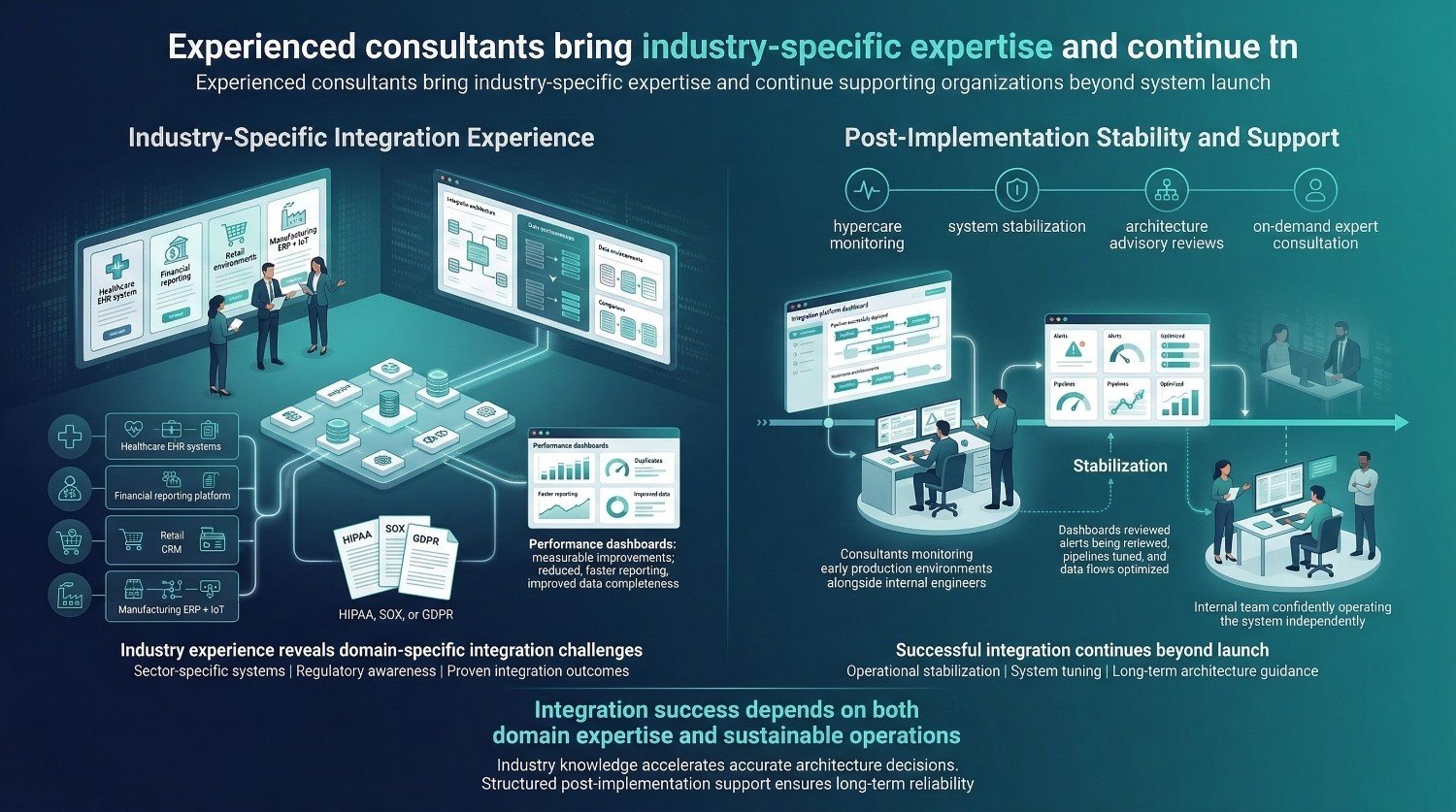
"Can you show us examples of similar projects in our industry?"
Why This Matters
Integration challenges vary significantly by industry. Healthcare entity resolution is different from retail customer deduplication. Financial regulatory reporting has constraints that SaaS analytics don’t. Manufacturing data integration involves IoT, ERP, and supply chain systems that other industries rarely touch.
A consulting team that’s done this in your industry will be faster, more accurate, and less likely to miss domain-specific pitfalls.
What You Want to Hear
- Specific case studies from your industry or an adjacent one, with concrete outcomes, not just descriptions of activities
- Familiarity with industry-specific systems, your EHR, your ERP, your regulatory platforms
- Understanding of industry-specific regulations, HIPAA, SOX, GDPR, PCI-DSS as they apply to your context
- Willingness to arrange a reference conversation with a client in your space
Red Flag Answers
- “Integration is the same across industries”, it’s not. Domain expertise matters.
- Only offering examples from completely different industries with no explanation of transferable patterns
- Case studies with no measurable outcomes, “we integrated their systems” is activity, not results
- “We can’t share details due to NDAs”, every firm has at least some referenceable work. If they can’t share anything, ask why.
The Nuance
Industry experience is valuable but not always mandatory. A consulting team with deep integration methodology across multiple industries may be better than one with narrow industry experience but weak methodology. The ideal is both. If you have to choose, prioritize methodology, but ask how they’ll bridge the domain knowledge gap.
"What does your involvement look like post-implementation?"
Why This Matters
The gap between go-live and steady-state operations is where many integration projects silently fail. Understanding what the consulting team offers, and doesn’t offer, after implementation is critical for planning.
What You Want to Hear
- A clearly defined post-implementation support model:
Support Type | What It Includes | Typical Duration |
|---|---|---|
Hypercare |
On-call support for critical issues during the first 2–4 weeks after go-live |
2–4 weeks |
Stabilization |
Monitoring, tuning, and addressing issues that surface with real production data |
1–3 months |
Periodic advisory |
Quarterly architecture reviews, governance assessments, evolution planning |
Ongoing as needed |
On-demand support |
Available for specific challenges, new source onboarding, regulatory changes, architecture questions |
As needed |
- Clear transition criteria, specific conditions that define when the engagement formally ends and your team takes full ownership
- Pricing transparency for post-implementation support, hourly, retainer, or project-based
- Willingness to step back when your team is ready, not manufacture reasons to stay engaged
Red Flag Answers
- “We’ll be available if you need us”, vague and unstructured
- “Our engagement ends at go-live”, no transition support is a significant risk
- Post-implementation support that’s only available as a large retainer commitment, not scalable to actual needs
- No defined criteria for when the transition is complete
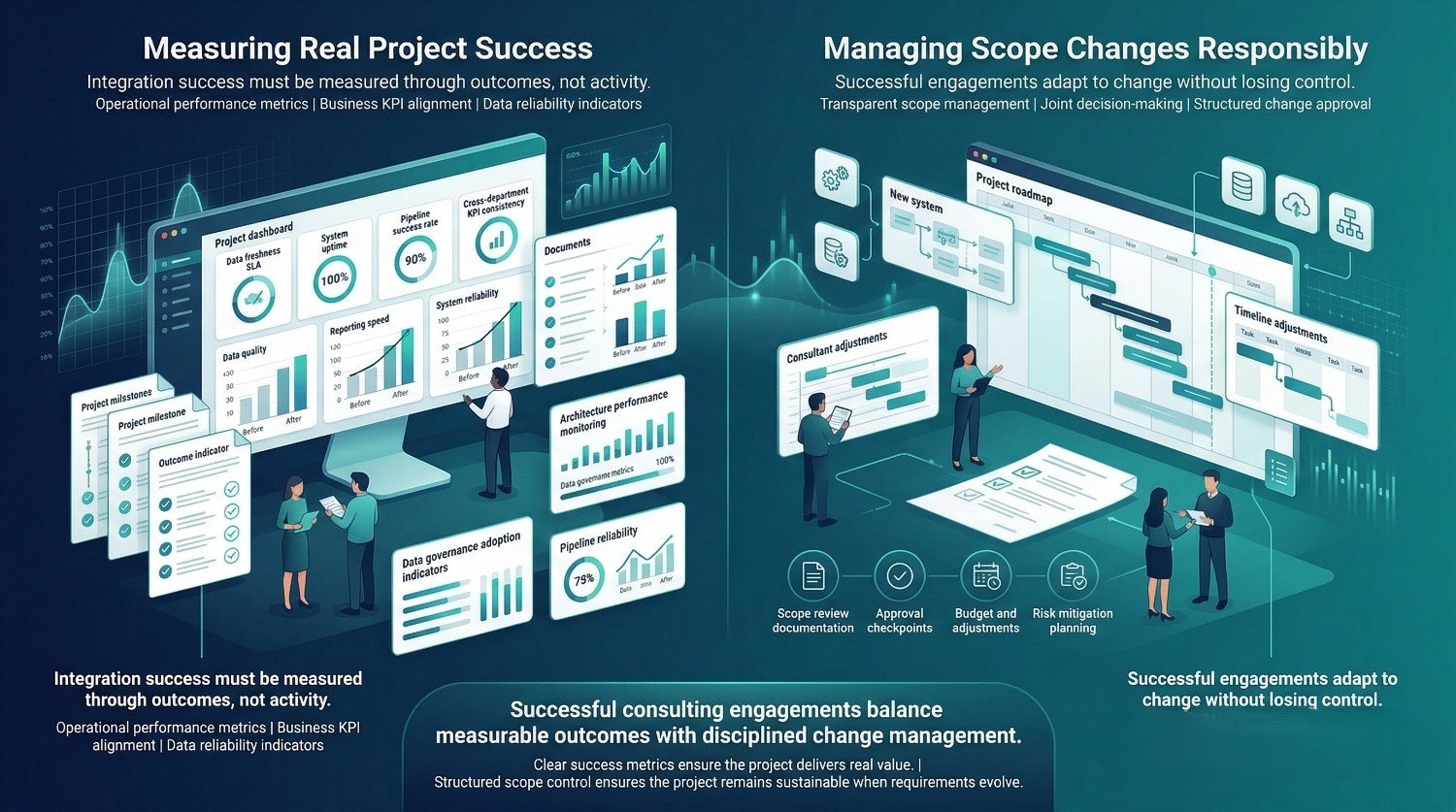
"How do you measure and report on project success?"
Why This Matters
If a consulting team can’t articulate how they measure success, they’re measuring activity, not outcomes. And activity-based measurement lets failing projects look like they’re on track right until they’re not.
What You Want to Hear
Success metrics tied to business outcomes, not just deliverables:
Deliverable Metric (Necessary) | Outcome Metric (Essential) |
|---|---|
Architecture document completed |
Architecture supports 2x source count without rework |
Data model deployed |
Your All departments report the same number for shared KPIspair with consultants, building alongside, not watching |
Governance framework documented |
Data ownership is operational with active stewards |
Pipelines in production |
Data freshness meets SLA 99%+ of the time |
Testing completed |
Zero critical data accuracy issues found post-launch |
- Regular progress reporting, not just a final report:
- Weekly status against milestones
- Risk and issue tracking with mitigation actions
- Budget tracking against plan
- Stakeholder feedback incorporated into delivery
- Post-engagement measurement, checking back at 90 and 180 days to confirm outcomes held
Red Flag Answers
- Success defined entirely by deliverables, “we delivered the architecture document” isn’t success if the architecture doesn’t work
- “We’ll report progress weekly”, progress on what? Against what criteria?
- No mention of business outcomes or stakeholder satisfaction
- No plan for post-engagement measurement, how do you know it worked if you never check?
"What happens if the project scope changes mid-engagement?"
Why This Matters
Scope will change. It always does.
- A new source system is discovered during assessment
- A stakeholder raises a requirement that wasn’t captured in discovery
- A regulatory change adds new compliance requirements
- Data quality is worse than expected and requires additional remediation
How the consulting team handles scope changes reveals whether they’re partners or vendors.
What You Want to Hear
- A defined change management process:
- How scope changes are identified and documented
- Who approves them, joint decision, not unilateral
- How they impact timeline, budget, and deliverables
- Transparent communication before any change is implemented
- Flexibility without exploitation:
- Willingness to adjust scope when the project genuinely requires it
- No padding original estimates to create buffer for upselling later
- Honest assessment of whether a scope change is necessary or optional
- Contractual clarity:
- Change order process documented in the agreement
- Fixed-price components vs. time-and-materials components clearly delineated
- No surprises, budget implications communicated before work begins
Red Flag Answers
- “We’re flexible, we’ll figure it out as we go”, no process means no protection
- “Scope changes are handled through additional work orders”, technically correct, but if every engagement requires multiple change orders, the original scoping was inadequate
- Resistance to discussing scope changes upfront, suggests they don’t want you thinking about it
- A contract with no change management clause, you have no protection if scope expands
The Test
Ask about a past engagement where scope changed significantly. How was it handled? What was the impact on timeline and budget? Was the client satisfied with the process? Their answer reveals more about how they’ll treat you than any proposal ever will.
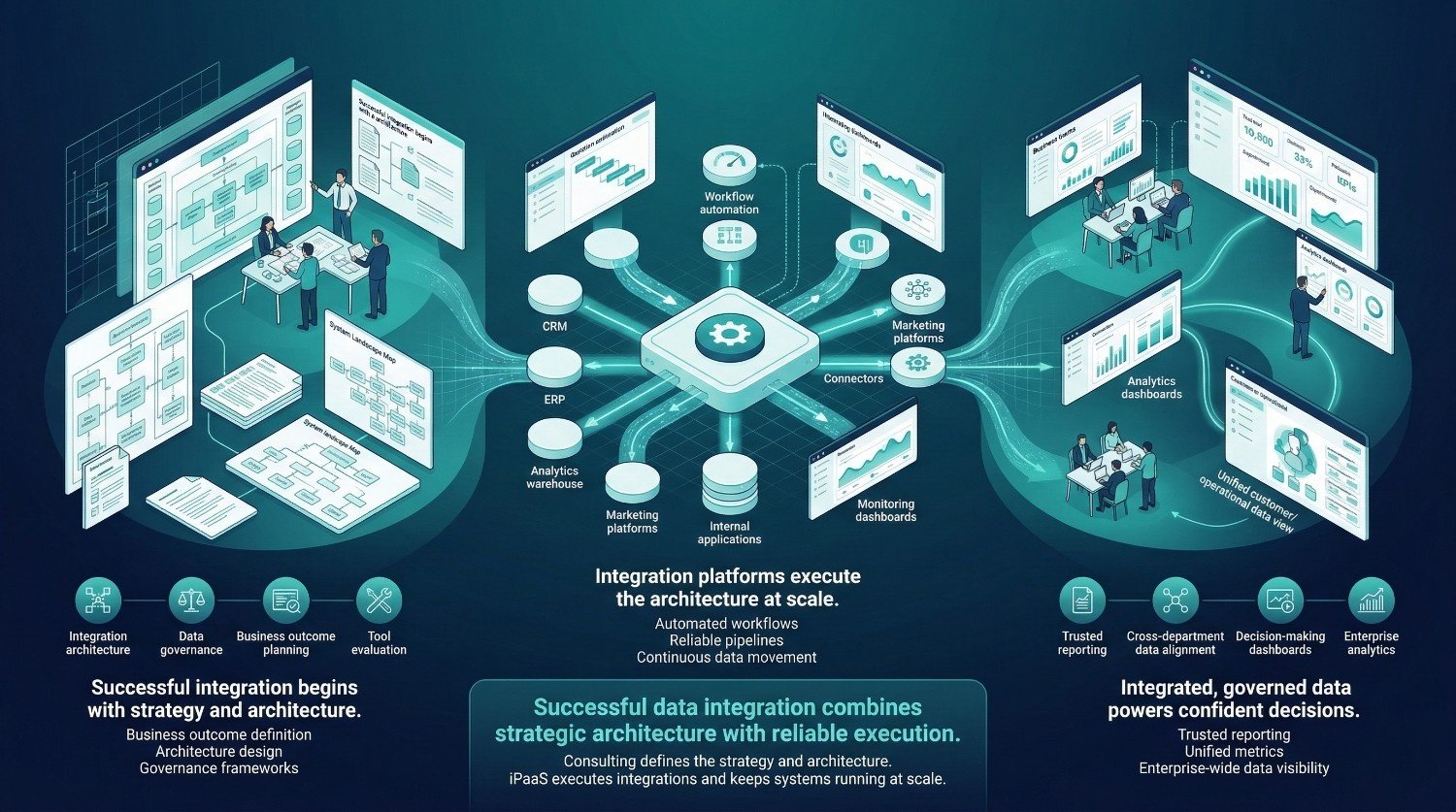
Final Thoughts
The Core Truth
iPaaS and data integration consulting address different layers of the integration challenge.
They solve different dimensions of the same challenge:
- iPaaS solves the execution problem, connecting systems, automating flows, running pipelines reliably at scale
- Data integration consulting solves the strategy problem, defining what to integrate, why, in what architecture, with what governance, and for what business outcome
Using only one approach can introduce predictable risk patterns:
- iPaaS without consulting → Connectors running efficiently, replicating garbage into systems nobody trusts
- Consulting without iPaaS → A brilliant strategy document with no platform to execute it
- Both, in the right sequence → Integrated, governed, trusted data that drives real business decisions
The Relationship, One Last Time
Layer | Who Handles It |
|---|---|
Why are we integrating this data? |
Consulting |
What should the integrated data enable? |
Consulting |
How should the architecture be designed? |
Consulting |
Which tools should execute within that architecture? |
Consulting (with iPaaS as a candidate) |
Build the connections, mappings, and workflows |
iPaaS |
Run the integrations 24/7 |
iPaaS |
Evolve the architecture as the business changes |
Consulting (periodically) |
The engine doesn’t choose the destination. The map doesn’t move the car. You need both, and you need them working together.
What the Most Successful Organizations Do Differently
After everything covered in this post, the pattern behind successful integration is remarkably consistent:
- They start with the problem, not the tool. They define business outcomes before evaluating platforms. They understand their data landscape before purchasing connectors.
- They invest in strategy before execution. Discovery, assessment, architecture, and governance come first. Tool selection and implementation follow, informed by the strategy, not driving it.
- They use consulting and iPaaS for what each does best. Consulting for the strategic, architectural, and organizational layers. iPaaS for the operational, execution, and infrastructure layers. No overlap. No gaps.
- They plan for the long term. Integration isn’t a project, it’s a program. They build for evolution, assign operational ownership, and schedule regular reviews.
- They don’t skip the human element. Stakeholder alignment, change management, shared definitions, and executive sponsorship aren’t afterthoughts. They’re core workstreams.
Organizations that follow this pattern don’t just have working integrations. They have data that the entire organization trusts, uses, and builds on, which is the entire point.
The One Takeaway
If you remember nothing else from this post, remember this:
Understand your problem before choosing your solution.
If your problem is straightforward connectivity between a few well-known systems, an iPaaS platform will serve you well. Buy it, configure it, move on. If your problem involves multiple sources, conflicting schemas, data quality issues, governance gaps, regulatory pressure, or organizational misalignment, you need data integration consulting to define the strategy before any tool can execute it effectively.
If your problem involves both, and most real-world problems do, invest in both, in the right sequence, with clear roles for each. One of the most expensive decisions is choosing a tool or consultant before defining the problem clearly. It’s choosing either one before understanding what you’re actually solving.
What to Do Next
Evaluate Your Current Approach Honestly
Ask yourself:
- Do we have a defined integration strategy, or are we just connecting systems as requests come in?
- Is our iPaaS platform fully leveraged, or is it running at 30% of capacity because the architecture was never defined?
- Do all departments trust the integrated data, or are shadow systems and spreadsheets still the real source of truth?
- Is our integration evolving with the business, or is it slowly decaying while everyone focuses on other priorities?
If the honest answers concern you, that’s not a problem. That’s clarity. And clarity is the first step toward fixing it.
Determine What You Actually Need
Use the decision framework from Section 8:
- Low complexity + strong team → iPaaS only
- Low complexity + limited expertise → iPaaS with light consulting advisory
- High complexity + strong team → Consulting for strategy + iPaaS for execution
- High complexity + limited expertise → Full consulting partnership with iPaaS selection included
Start the Conversation
Whether you need a scoped assessment, an architecture review, a tool evaluation, or a full integration strategy, the right starting point is a conversation about your specific situation. Not a demo. Not a proposal. A conversation that helps you understand where you stand and what the smartest next step is.
Reach out. We’d rather help you determine you don’t need consulting than watch you invest in the wrong solution.
Continue Reading
This post is part of a series on building smarter data integration strategies. If you found it valuable, the earlier posts in this series go deeper on related topics:
- The Difference Between Data Movement and Data Integration, understanding the foundational distinction that most organizations get wrong
- Why Data Integration Projects Fail Even When Connectors Work, the hidden layers of complexity that tools alone can’t solve
- When Do You Actually Need Data Integration Consulting?, the specific inflection points that signal it’s time for outside expertise
Subscribe to get the next post delivered directly. Share with a colleague navigating the iPaaS vs. consulting decision. And if your organization is somewhere in the middle of this journey, start with understanding the problem. The right solution will follow.
Frequently Asked Questions (FAQs)
iPaaS stands for Integration Platform as a Service. It’s a cloud-based platform that provides pre-built connectors, visual workflow builders, and managed infrastructure for connecting applications and moving data between systems. Think of it as a toolkit for building and running integration flows without having to code everything from scratch or manage your own servers.
Popular iPaaS platforms include MuleSoft, Boomi, Workato, Celigo, and SnapLogic at the enterprise and mid-market level, and Zapier and Make for lighter automation use cases.
Data integration consulting is expert-led services that help organizations plan, design, implement, and optimize their entire data integration strategy. It goes far beyond connecting systems, covering architecture design, data modeling, data quality assessment, governance frameworks, transformation logic, stakeholder alignment, change management, and ongoing optimization.
The focus is on solving business problems through data, not just establishing technical connectivity.
No. They solve fundamentally different problems. iPaaS solves the execution problem, how to connect systems and move data efficiently. Data integration consulting solves the strategy problem, what to integrate, why, in what architecture, with what governance, and for what business outcome.
You can have a perfectly running iPaaS platform and still have failed integration if nobody defined the data model, reconciled conflicting business definitions, established governance, or ensured data quality. Those are consulting problems, not tool problems.
Not for ongoing operations. Consulting defines the strategy, architecture, and governance, but it doesn’t provide a platform that runs integration flows 24/7 with automatic scheduling, retry logic, monitoring, and managed infrastructure. That’s what iPaaS does.
Consulting designs the playbook. iPaaS runs the plays every day. You need both for a complete solution.
When your situation is straightforward, specifically when you’re connecting a small number of well-documented SaaS systems with compatible schemas, your data quality is solid, your team has integration experience, there are no significant governance or compliance requirements, and the integration doesn’t feed business-critical decisions.
For standard patterns like CRM-to-ERP sync, marketing automation data flows, or SaaS-to-warehouse ingestion, iPaaS alone is often the fastest and most cost-effective solution.
Rarely, because most consulting engagements result in a recommendation that includes some form of integration tooling. However, a consulting-only engagement makes sense when you need a strategic assessment before making any tool investments. This might be a current-state audit, an architecture review, a tool evaluation, or a phased roadmap.
The consulting engagement defines what you need. The tool purchase comes after, informed by the strategy, not driving it.
Most organizations with real integration complexity need both. Specifically, you should invest in both when you’re dealing with multiple source systems with incompatible schemas, significant data quality issues, regulatory or compliance pressure, organizational misalignment across departments, a major cloud migration, post-acquisition data consolidation, or when you’re building an enterprise data platform from scratch.
In these scenarios, consulting defines the strategy and architecture while iPaaS provides the operational platform that executes within that architecture.
In complex scenarios, engaging in consulting before committing to a platform is often advisable, or at minimum, run a scoped assessment before committing to a platform.
A common and costly integration mistake is buying a tool before defining integration strategy. You end up with a platform that’s configured for the wrong architecture, used at a fraction of its capacity, and potentially the wrong fit for your actual requirements.
Consulting defines what you need. That definition informs which iPaaS platform, if any, is the right choice. Reversing this sequence leads to shelfware, rework, and wasted budget.
iPaaS subscriptions typically range from $15K to $500K+ per year depending on the platform, tier, and usage. Data integration consulting ranges from $50K for a scoped assessment to $500K+ for a full enterprise engagement.
But comparing sticker prices is misleading. The real cost comparison includes internal team time, rework from architecture mistakes, delayed business value, manual workarounds, and the cost of failure. Organizations that add consulting to their iPaaS investment often spend less in total over three years because they avoid the rework, delays, and waste that come from implementing tools without strategy.
Framing it as an either/or decision. The most common and costly mistake is buying an iPaaS platform and assuming the integration problem is solved. Connectors go live, data flows, and everyone celebrates, until reports don’t match, dashboards aren’t trusted, and analysts spend their days cleaning data instead of analyzing it.
The platform addressed connectivity, but strategy and governance may have remained unaddressed, data quality, governance, semantic reconciliation, or organizational alignment. Those are the layers where integration actually succeeds or fails.
Yes, if the use case is straightforward and your team has the right experience. For simple, well-defined integrations between a handful of supported systems, an internal team with iPaaS can deliver quickly and effectively.
Where internal teams typically struggle is when complexity increases, multiple sources with conflicting schemas, cross-departmental metric alignment, governance framework design, entity resolution, and compliance architecture. These challenges require specialized expertise that most teams encounter too infrequently to develop internally. That’s where data integration consulting fills the gap.
Ask yourself three questions. First, are the connectors working and data flowing reliably? If yes, the tool is doing its job. Second, is the data in the warehouse trusted, unified, and driving decisions? If no, the problem isn’t the tool, it’s everything that should have happened after the data landed. Third, do all departments report the same numbers for shared metrics? If no, you have a semantic, governance, and modeling problem, not a connectivity problem.
If connectivity works but business outcomes lag, strategy, governance, or data modeling may require attention.
Start with a scoped assessment. This is a lightweight consulting engagement, typically 2 to 4 weeks, that maps your current data landscape, profiles data quality, identifies gaps, and produces a prioritized roadmap.
The assessment tells you exactly where you stand, what you actually need, and whether that’s iPaaS, consulting, both, or neither. It’s the cheapest insurance against making the wrong investment, and it’s the most common starting point for organizations navigating this decision for the first time.
This post is part of an ongoing series on data integration strategy. Related posts include “The Difference Between Data Movement and Data Integration” which covers the foundational concepts, “Why Data Integration Projects Fail Even When Connectors Work” which explores the hidden failure modes beyond connectivity, and “When Do You Actually Need Data Integration Consulting?” which provides a framework for recognizing the inflection points that signal it’s time for outside expertise.
Subscribe to get the next post in the series delivered directly.