
Table of Contents

If your dashboards are refreshing every few minutes (even without new data), you’re paying for unnecessary compute and it should be optimized. Very small intervals between refreshes can also affect the performance and may result in slower response times.
Implementing a sensible refresh rate, using materialized views, and caching repetitive results can save a lot of money. The following table can serve as an ideal example to understand their importance.
Introduction
The Term Everyone Uses and Nobody Defines
Data architecture consulting is one of those terms that sounds self-explanatory until you ask three people what it means and get four different answers.
Ask a database administrator and they’ll tell you it’s about designing schemas and optimizing storage. Ask a data engineer and they’ll describe pipeline design and tool selection. Ask a cloud consultant and they’ll talk about infrastructure configuration. Ask a vendor and they’ll explain why their platform is the architecture you need.
None of them are entirely wrong. None of them captures the full scope either. The term gets used so loosely, attached to everything from database design to tool implementation to cloud migration, that its actual meaning has been diluted to the point of confusion. And that confusion can have real operational and financial consequences.
Why the Confusion Matters
When organizations don’t understand what data architecture consulting actually is, predictable problems follow:
Mismatched expectations. Leadership expects a strategic blueprint for their entire data ecosystem. The consulting partner delivers a database schema and a tool recommendation. Both parties think they delivered or received “architecture consulting.” Neither is satisfied.
Poorly scoped engagements. The organization hires for architecture but scopes for engineering, or hires for engineering but expects architecture. The engagement delivers work that’s technically competent but strategically misaligned. Budget is spent. The fundamental problem remains.
Missed opportunities. The organization has a genuine architecture problem, fragmented systems, no governance, technical debt, scaling failures, but doesn’t recognize it as architectural. They keep buying tools and hiring engineers to solve a problem that exists at a layer neither tools nor engineering can reach.
Wasted investment. The architecture engagement produces beautiful diagrams and comprehensive documents, but they don’t connect to business outcomes, don’t account for organizational reality, and don’t get implemented. Expensive shelf decoration.
Many of these failures can be traced back to a misunderstanding of what data architecture consulting actually involves.
What This Post Is For
This post exists to clear the fog. Not to sell you on architecture consulting. Not to convince you that you need it right now. Simply to give you a precise, honest, plain-language understanding of what this discipline actually is, so that if and when you do engage it, you know exactly what you’re buying, what you should expect, and how to evaluate whether you’re getting the real thing.
The Stakes
This clarity matters because architecture is one of the highest-leverage decision layers in the data ecosystem. Every other data investment, tools, pipelines, analytics, AI, governance, operates on top of architecture. When the architecture is sound, those investments deliver their full value. When the architecture is flawed, those investments underperform, regardless of how well they’re executed individually.
A perfectly built pipeline running within a poorly designed architecture produces unreliable results. A world-class BI tool querying a badly modeled warehouse produces dashboards nobody trusts. A sophisticated AI model trained on data from a fragmented, ungoverned ecosystem produces predictions that are technically impressive and practically useless.
Architecture is the multiplier. It amplifies everything above it, for better or worse.
The Thesis
Data architecture consulting is a distinct, strategic discipline that goes far beyond technology selection or diagram creation. It’s the practice of designing the complete structural foundation for how an organization’s data is collected, stored, organized, integrated, governed, and consumed, aligned to business outcomes and built to evolve. Understanding what it truly is, and equally, what it isn’t, is essential before investing in it.
What You'll Walk Away With
By the end of this post, you’ll have:
- A clear, demystified definition of what data architecture consulting actually involves, in plain language, not jargon
- A detailed look at every component of a real architecture engagement, from assessment through design through knowledge transfer
- An honest explanation of what it isn’t, the common misconceptions that lead to mismatched expectations
- Understanding of how it creates value, the specific mechanisms through which architecture translates to business impact
- The ability to evaluate whether a consulting partner is delivering genuine architecture work or something else wearing the label
- The confidence to engage data architecture consulting with clear expectations and the ability to hold your partner accountable for delivering real architectural value
Let’s start with what we’re actually talking about.
The Problem
Before defining what data architecture consulting actually is, we need to understand why the confusion exists in the first place. The misunderstanding isn’t accidental, it’s the predictable result of a term that means different things to different people, a market that uses it loosely, and a discipline whose best work is invisible.
The Term Means Different Things to Different People
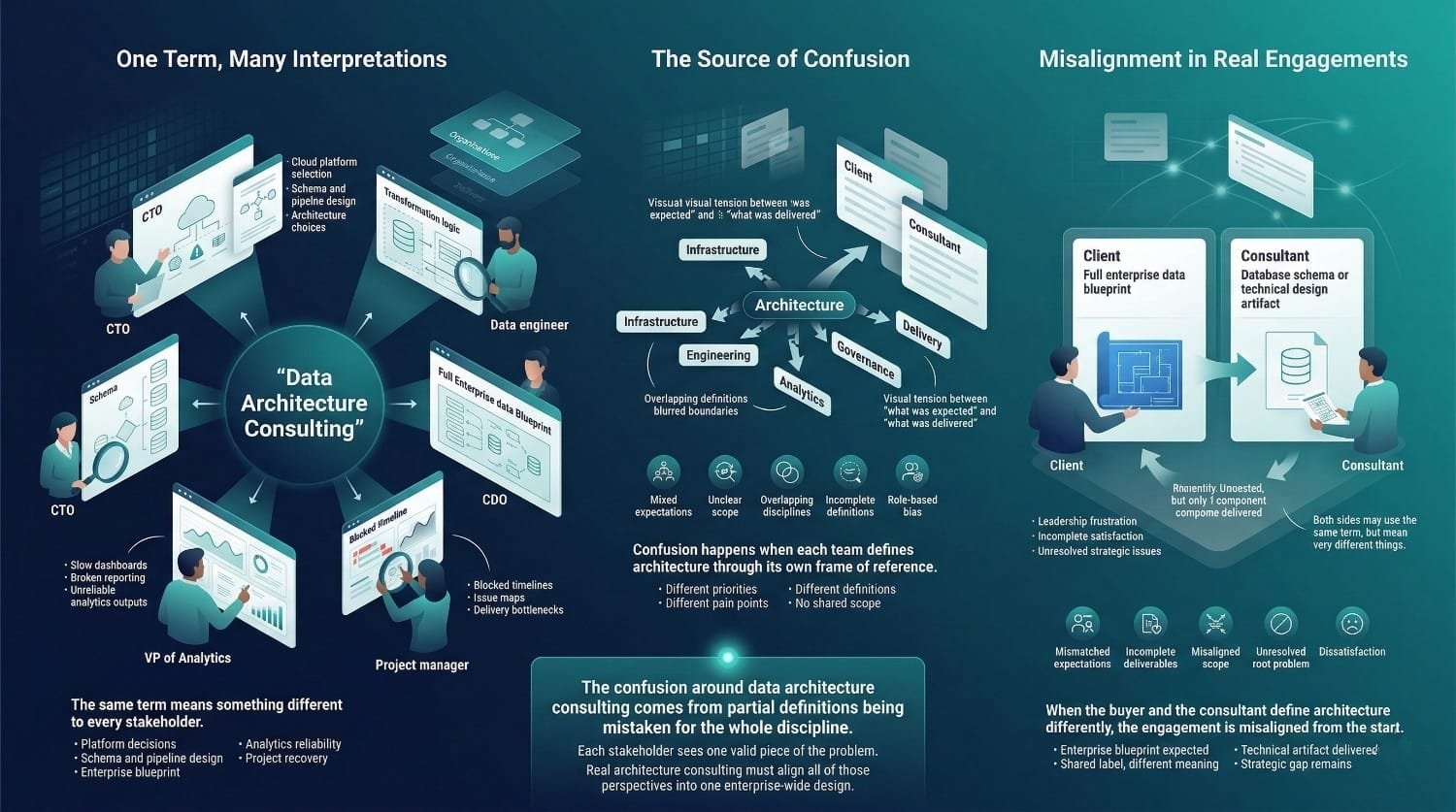
Ask five stakeholders in the same organization what “data architecture consulting” means and you’ll get five different answers, each shaped by their own role, their own pain points, and their own frame of reference.
The CTO hears: “Help us pick the right cloud platform and design our infrastructure.” Their world is technology decisions. Architecture, to them, means platform selection, Snowflake vs. Databricks, AWS vs. Azure, streaming vs. batch. They want a consultant who can evaluate options and make a recommendation.
The data engineer hears: “Design our database schemas and pipeline patterns.” Their world is implementation. Architecture means the technical blueprints they build against, table structures, indexing strategies, transformation patterns, and naming conventions.
The CDO hears: “Create a blueprint for our entire data ecosystem.” Their world is enterprise data management. Architecture means the complete structural design, every system, every flow, every governance policy, every standard, and how it all serves the business strategy.
The VP of Analytics hears: “Fix whatever is making our dashboards slow and unreliable.” Their world is data consumption. Architecture means whatever structural changes are needed to make analytics actually work.
The project manager hears: “Tell us why our data project is stuck and what to do about it.” Their world is delivery. Architecture means the root cause analysis that explains why things aren’t working and the plan that gets them unstuck. Every one of these perspectives captures a piece of what data architecture consulting involves. None captures the full enterprise scope of data architecture. And when an organization engages consulting with one perspective while the consultant operates from another, the engagement risks misaligned before it begins.
The CDO expects an enterprise blueprint. The consultant delivers a database schema. Both call it “architecture consulting.” Neither is satisfied.
Vendor and Consulting Firm Confusion
The market makes the confusion worse, significantly worse.
Vendors Relabeling Implementation as Architecture
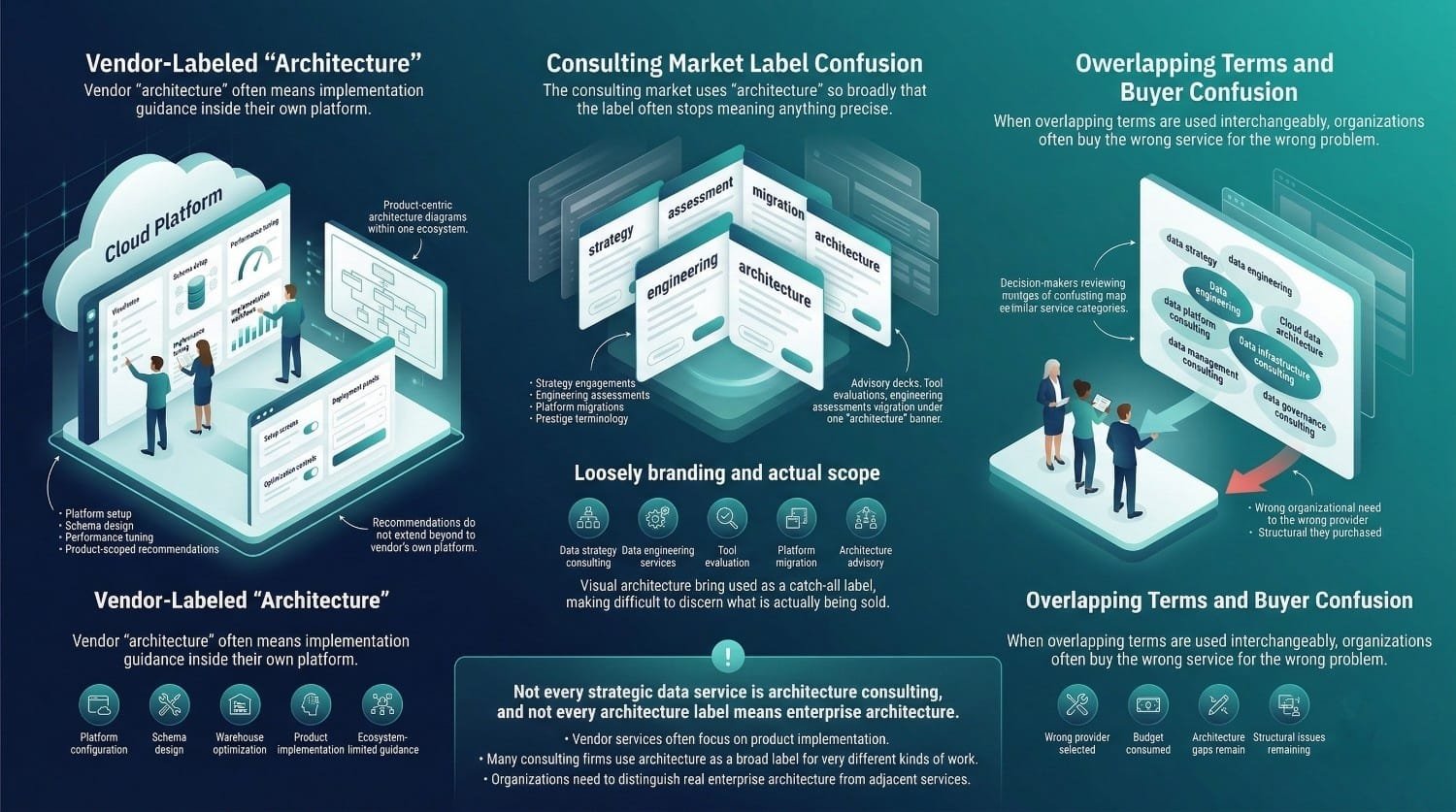
When a cloud platform vendor offers “data architecture consulting,” what they typically provide is guidance on how to implement their platform, how to configure their warehouse, how to design schemas within their tool, how to optimize performance on their infrastructure.
This is valuable work. However, it is typically scoped to product implementation rather than enterprise-wide architecture design. It’s product implementation services wearing an architecture label. The distinction matters because vendor-provided “architecture” will always be scoped to their product. Their recommendations will generally be constrained to their own platform ecosystem. They won’t design the components of your architecture that exist outside their ecosystem. They won’t evaluate whether their tool should be part of your architecture at all.
Consulting Firms Using Architecture as a Catch-All
On the consulting side, “architecture” has become a prestige term attached to almost any strategic data work. Data strategy engagements get called architecture. Data engineering assessments get called architecture. Tool evaluations get called architecture. Platform migrations get called architecture.
Some of these overlap with genuine architecture work. Many don’t. The result is a market where the “architecture consulting” label is applied to engagements ranging from a 2-week tool assessment to a 12-month enterprise design initiative, with no consistency in what the term means, what’s delivered, or what the client should expect.
The Alphabet Soup of Overlapping Terms
The confusion is compounded by a proliferation of adjacent terms that overlap without clear boundaries: data strategy consulting, data engineering services, data platform consulting, cloud data architecture, data infrastructure consulting, data management consulting, data governance consulting.
Each of these describes a real discipline. Each overlaps with architecture in some areas. None is a synonym for architecture. But the market uses them interchangeably, and organizations shopping for help often can’t tell which one they actually need, let alone which one a given provider is actually selling.
The Consequence
Organizations end up buying the wrong services. They engage a cloud infrastructure consultant when they need a data architect. They hire data engineers when they need architectural design. They purchase a vendor’s implementation services expecting an enterprise blueprint. These mismatches can consume budget while leaving structural architectural issues unresolved.
The Invisible Nature of Architecture
The deepest reason architecture is misunderstood is that it’s invisible by design.
When Architecture Works
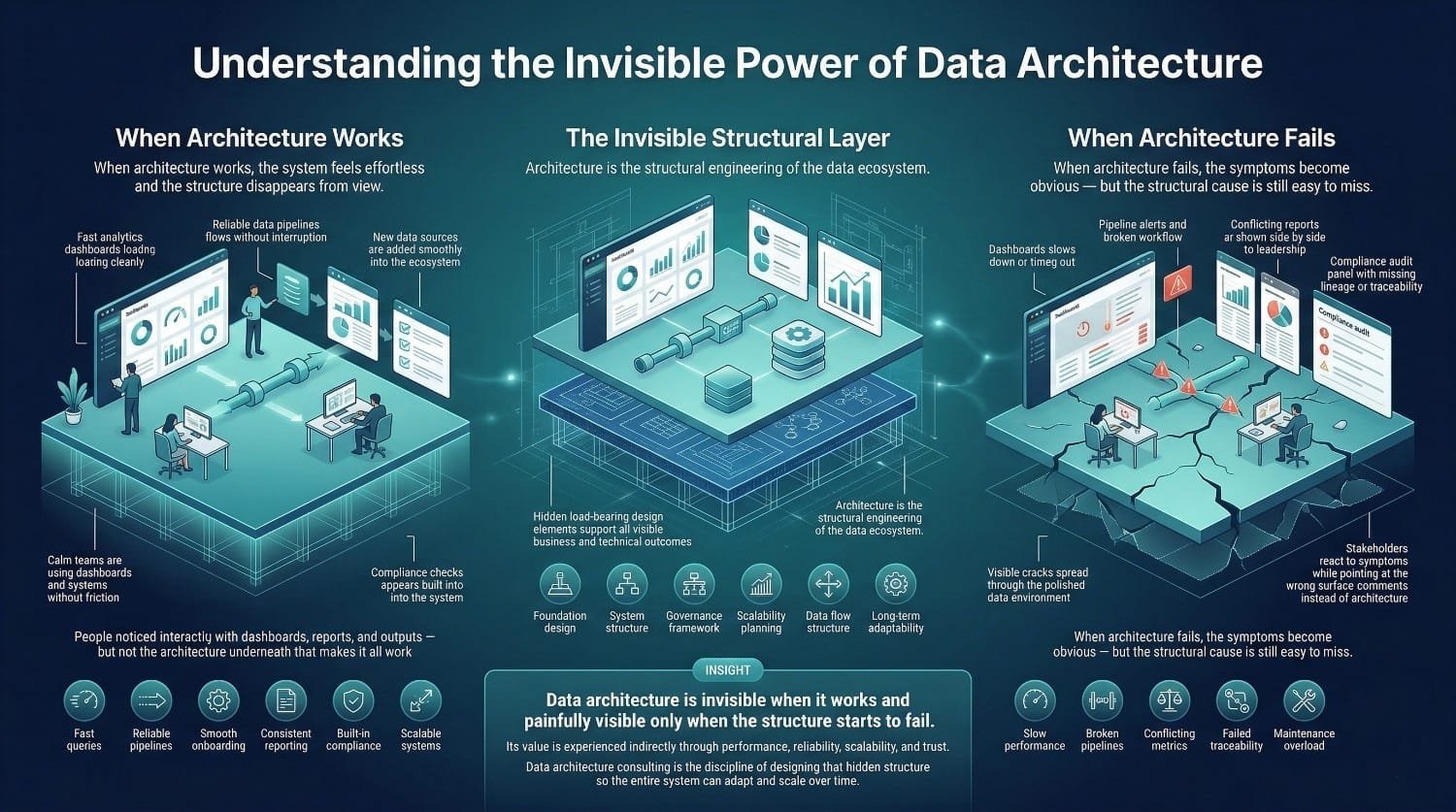
Well-designed architecture is often invisible in daily operations. When it’s working:
- Queries are fast, nobody thinks about why
- Pipelines run reliably, nobody notices
- New data sources get onboarded smoothly, it feels easy
- Reports are consistent across departments, it seems obvious
- The system scales with growth, it just works
- Compliance requirements are met, it’s built in
Architecture is rarely visible when systems operate smoothly. They praise the dashboards, the analytics, the AI models, the engineering team. The architecture is invisible, like gravity. You only notice it when it fails.
When Architecture Fails
Bad architecture is equally invisible, until a threshold is crossed. Then it becomes painfully, expensively visible:
- Queries that used to take seconds now take minutes, and nobody can explain why
- Adding a new data source triggers a month-long impact analysis
- Two departments present different numbers to the CEO
- A compliance audit reveals that nobody can trace a regulatory metric back to its source
- The data team spends 80% of its time maintaining existing systems instead of building new capabilities
At this point, the symptoms are obvious. But the root cause, architecture, remains hidden to most stakeholders. They see slow queries and blame the database. They see pipeline failures and blame the engineers. They see conflicting reports and blame the data. The connection between these symptoms and earlier structural design decisions is often overlooked.
Bad architecture is equally invisible, until a threshold is crossed. Then it becomes painfully, expensively visible:
- Queries that used to take seconds now take minutes, and nobody can explain why
- Adding a new data source triggers a month-long impact analysis
- Two departments present different numbers to the CEO
- A compliance audit reveals that nobody can trace a regulatory metric back to its source
- The data team spends 80% of its time maintaining existing systems instead of building new capabilities
At this point, the symptoms are obvious. But the root cause, architecture, remains hidden to most stakeholders. They see slow queries and blame the database. They see pipeline failures and blame the engineers. They see conflicting reports and blame the data. The connection between these symptoms and earlier structural design decisions is often overlooked.
Why This Makes Consulting Hard to Buy
It is inherently difficult to justify investment in structural improvements that are not immediately visible. Architecture consulting asks organizations to invest significantly in improving something that’s invisible when it works and misattributed when it fails. That’s a hard sell, especially compared to tools (which have demos), engineers (who write visible code), and analytics platforms (which produce visible dashboards).
The value of architecture is real. But it’s structural value, experienced indirectly through the performance of everything that sits on top of it. Communicating that value requires a different kind of conversation than selling a tool or a deliverable.
The Analogy
Think about the architecture of a building. You never see the structural engineering, the steel beams, the load calculations, the foundation design. You see the rooms, the windows, the finishes. You experience the building through what’s visible.
But the structural engineering determines everything. Whether the building can support another floor. Whether it withstands an earthquake. Whether the walls crack after 5 years or stand for 50. Whether the plumbing and electrical can be upgraded without gutting the walls.
Data architecture is the structural engineering of your data ecosystem. Invisible. Essential. And the difference between a system that adapts and scales for decades, and one that cracks under pressure.
Data architecture consulting is the discipline of getting that structural engineering right. The rest of this post explains exactly what that involves.
What Data Architecture Actually Is (The Foundation)
This is the section that replaces vague understanding with precise definition. If you read nothing else in this post, read this.
A Clear, Comprehensive Definition
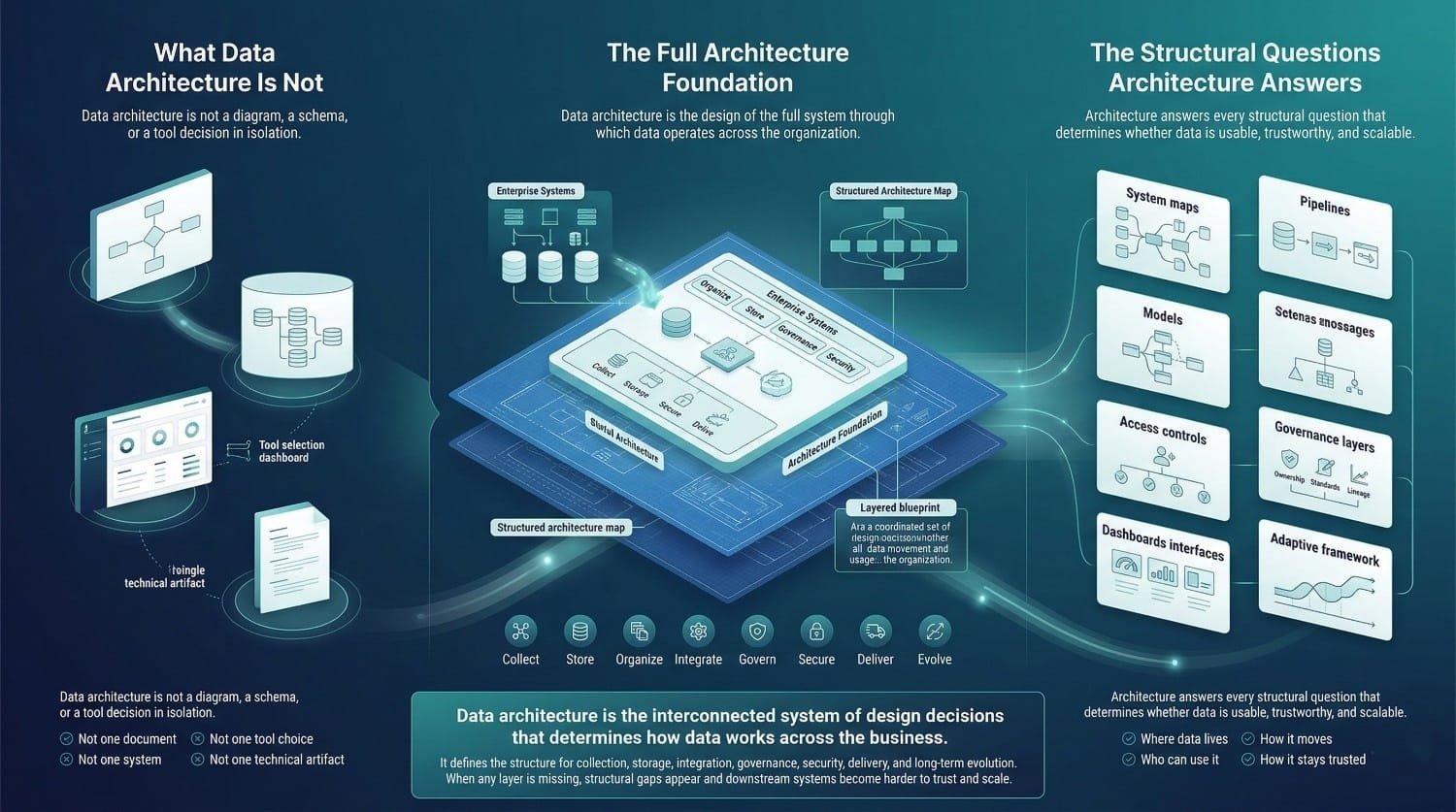
Data architecture is the design of the entire system by which an organization collects, stores, organizes, integrates, manages, secures, and delivers data to enable business outcomes.
Not a diagram. Not a schema. Not a tool selection. Not a single document. It is a layered and interconnected set of design decisions that together define how data operates across the organization. It answers every structural question about data:
- What data exists, and what data should exist but doesn’t
- Where it lives, which systems store which data, in what format, at what tier
- How it moves, the pipelines, integrations, and interfaces that transport data between systems
- How it’s structured, the models, schemas, and relationships that give data meaning
- Who can access it, the permissions, controls, and policies that govern who sees what
- How it’s governed, the ownership, stewardship, quality standards, and lineage tracking that keep data trustworthy
- How it’s consumed, the tools, interfaces, and products that deliver data to the people and systems that need it
- How it evolves, the principles, standards, and processes that ensure the architecture adapts as the organization changes
Each of these is a design decision. Together, they form the architecture. Omitting any of these elements increases the likelihood of structural gaps that may create downstream issues.
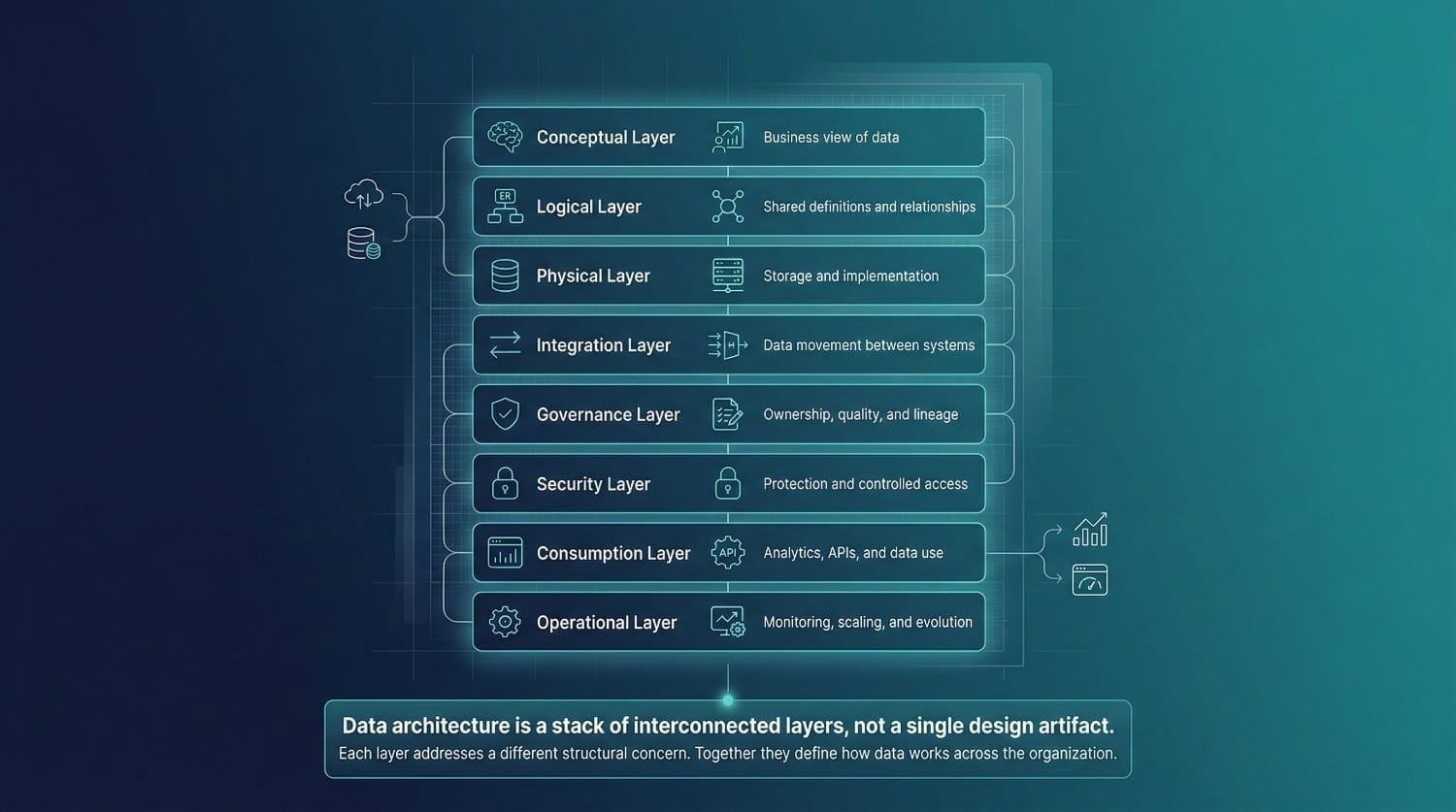
The Layers of Data Architecture
Architecture isn’t a single thing, it’s a stack of interconnected layers, each addressing a different structural concern. Understanding these layers is essential to understanding what data architecture consulting actually works on.
The Conceptual Layer
What it is: The highest-level view of the organization’s data landscape, expressed in business terms, not technical ones.
What it defines:
- The major data domains, customer, product, financial, operational, employee, compliance
- The key business entities within each domain, and the relationships between them
- How data domains map to business functions, which departments own which data, which processes produce and consume which entities
- The scope of the data ecosystem, what’s in, what’s out, what’s planned
Who it’s for: Business leadership, data governance teams, and anyone who needs to understand the organization’s data landscape without technical detail.
Why it matters: The conceptual layer creates shared understanding. When the CEO asks “what data do we have about our customers?” the conceptual model provides the answer, in language they understand, with relationships they can follow. Without it, every conversation about data starts from scratch.
The Logical Layer
What it is: The detailed data model, independent of any specific technology, that defines how data is structured and related.
What it defines:
- Entity definitions, what a “customer,” “order,” “product,” or “transaction” actually is, with precise attributes
- Attributes and data types, every field, its meaning, its format, and its constraints
- Relationships and cardinality, how entities connect (one-to-many, many-to-many) and what those connections mean
- Business rules, the logic that governs how data behaves (a customer can’t have a negative balance, an order must have at least one line item)
- Canonical models, the shared, authoritative definitions that all systems map into
Who it’s for: Data architects, data modelers, and senior engineers who need to translate business concepts into implementable structures.
Why it matters: The logical layer is the connective tissue of the architecture. It’s what makes it possible for different systems, different teams, and different tools to mean the same thing when they say “customer” or “revenue.” Without it, every system defines entities differently, and conflicting definitions are a common root cause of data trust problems.
The Physical Layer
What it is: The actual implementation of the logical model, specific to the platforms and technologies in use.
What it defines:
- Database schemas, the actual tables, columns, and indexes in each database or warehouse
- Partitioning strategies, how data is divided for performance optimization
- File formats and storage, Parquet, Delta, Iceberg, JSON, CSV, and which is used where and why
- Storage tiering, hot, warm, and cold storage for different access patterns and cost optimization
- Denormalization decisions, where the physical model deviates from the logical model for performance reasons, and why
Who it’s for: Data engineers and database administrators who build and maintain the actual systems.
Why it matters: The physical layer is where architecture meets reality. A brilliant logical model that’s poorly implemented physically will underperform. The physical layer translates design intent into operational performance.
The Integration Layer
What it is: The design of how data moves between systems, the pipes, the protocols, and the patterns.
What it defines:
- Integration patterns, batch ETL/ELT, streaming, CDC, API-based, event-driven, and which pattern applies where
- Data flow design, source-to-target mappings, transformation sequences, and orchestration
- Interface standards, how systems expose and consume data (APIs, file drops, streaming topics, database connections)
- Integration platform architecture, iPaaS, custom pipelines, cloud-native services, and how they fit together
- Error handling and retry patterns, what happens when integrations fail
Who it’s for: Integration architects, data engineers, and platform teams.
Why it matters: Integration is the circulatory system of the architecture. If data can’t move reliably between systems, nothing else works, regardless of how well-designed the storage and models are.
The Governance Layer
What it is: The policies, roles, and mechanisms that ensure data remains trustworthy, compliant, and well-managed.
What it defines:
- Data ownership model, who is accountable for each data domain
- Data stewardship, who handles day-to-day quality, issue resolution, and change management
- Data quality standards, the rules that define acceptable quality for each dataset, with monitoring and alerting
- Data lineage, end-to-end tracking of where data came from and every transformation applied to it
- Data catalog and metadata, how data is documented, discovered, and understood across the organization
- Policy framework, retention, classification, sharing, and lifecycle management
Who it’s for: Data governance teams, compliance officers, and data stewards.
Why it matters: Architecture without governance can produce data that is structurally organized but insufficiently controlled or trusted. Governance without architecture has no structural foundation to enforce policies. They’re inseparable, and the governance layer is where data architecture consulting often delivers its most lasting value.
The Security Layer
What it is: The design of how data is protected, from unauthorized access, from breaches, and from non-compliance.
What it defines:
- Data classification, PII, PHI, financial, confidential, public, with handling rules for each class
- Encryption architecture, at rest and in transit, with key management policies
- Access control design, role-based, attribute-based, row-level, and column-level permissions
- Data masking and anonymization, for non-production environments, analytics, and external sharing
- Audit trails, who accessed what data, when, and through what interface
Who it’s for: Security teams, compliance officers, and platform administrators.
Why it matters: Security retrofitted into a poorly designed architecture is expensive, incomplete, and fragile. Security designed into the architecture from the start is comprehensive, enforceable, and maintainable. The security layer determines whether the organization can meet regulatory requirements by design rather than by heroic effort.
The Consumption Layer
What it is: How data reaches the people and systems that need it, the last mile of the architecture.
What it defines:
- BI and analytics interfaces, which tools, how they connect, what semantic layers translate raw data into business metrics
- Self-service access, how business users find, understand, and query data without engineering support
- API and data product interfaces, how applications and external consumers access data programmatically
- AI/ML serving infrastructure, feature stores, model serving, and the pipeline from raw data to model-ready features
- Real-time vs. batch delivery, which consumers need real-time data and which can work with periodic refreshes
Who it’s for: Analysts, data scientists, application developers, and business users.
Why it matters: Architecture that is well designed but poorly adopted delivers limited business value. The consumption layer is where architecture translates into outcomes, decisions made, insights generated, models deployed, products delivered. If this layer is missing or poorly designed, the rest of the architecture risks becoming infrastructure with reduced measurable impact.
The Operational Layer
What it is: How the architecture is monitored, maintained, scaled, and evolved over time.
What it defines:
- Monitoring and observability, pipeline health, data freshness, quality scores, performance metrics, and cost tracking
- Alerting and incident response, what triggers alerts, who responds, and what the escalation path is
- Scaling strategy, how the architecture handles growth in data volume, user count, and query complexity
- Change management, how changes to the architecture are proposed, reviewed, approved, and documented
- Maintenance and evolution planning, how the architecture adapts to new requirements, new technologies, and new business conditions
Who it’s for: Data operations, platform engineering, and architecture owners.
Why it matters: Architecture that’s designed but not operationalized gradually degrades in effectiveness. The operational layer sustains architectural health after the consulting engagement concludes, monitoring for degradation, responding to issues, and evolving the design as the organization changes.
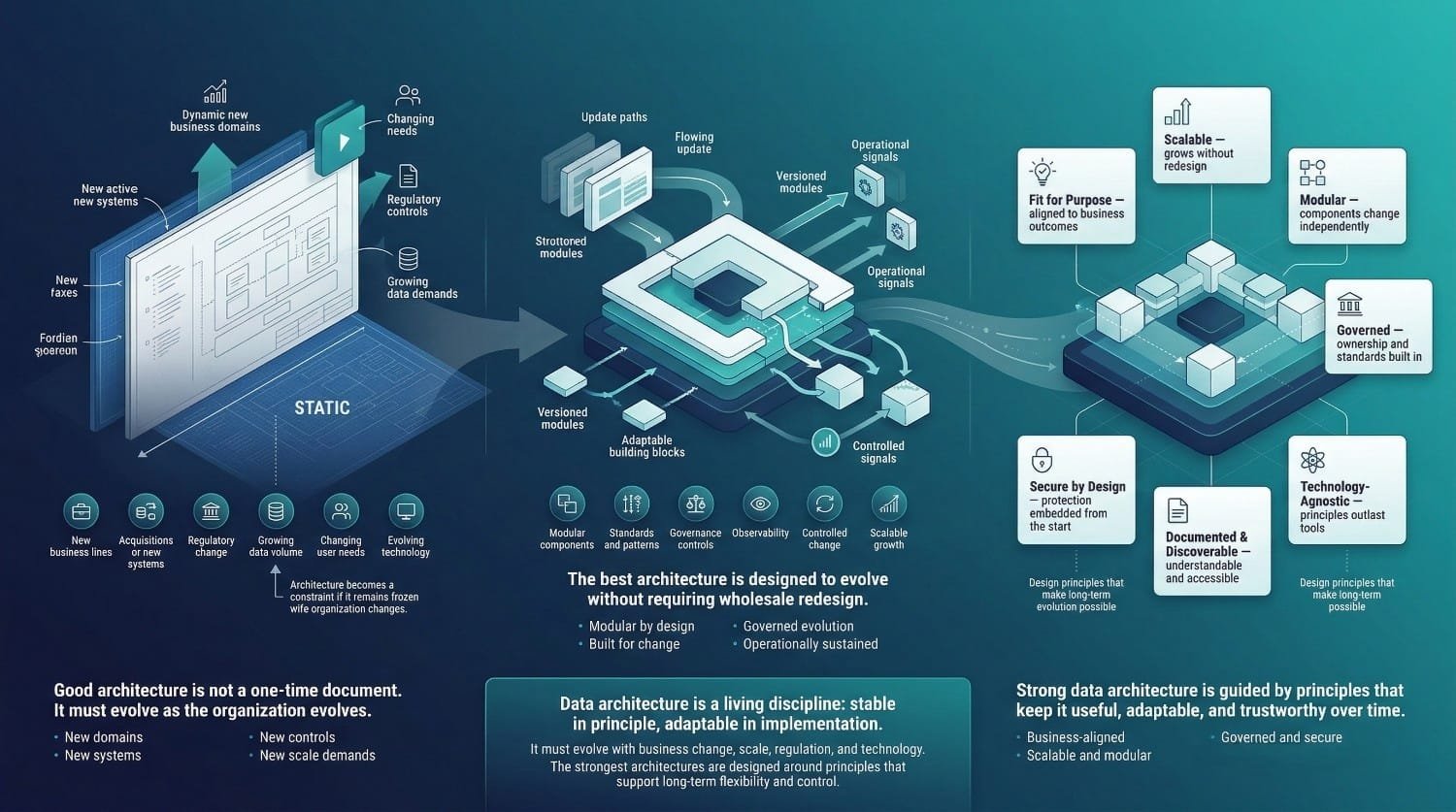
Architecture as a Living System
Not a Deliverable, a Discipline
The biggest misconception about data architecture is that it’s a one-time deliverable, a document produced, approved, and filed. Architecture is living. It changes because the organization changes:
- New business lines create new data domains
- Acquisitions bring new systems that need to be integrated
- Regulations change, requiring new governance and security controls
- Technology evolves, creating better options for storage, processing, and consumption
- Data volumes grow, stressing patterns that worked at smaller scale
- User needs shift, requiring new consumption interfaces and access patterns
Architecture that doesn’t evolve with these changes becomes a constraint instead of an enabler. Within 12–24 months, a static architecture document may no longer reflect the actual operating system landscape.
Evolutionary Architecture
The best architectures are designed for evolution, built on principles and patterns that accommodate change without requiring wholesale redesign.
This means modularity, components that can be modified independently without cascading impacts. It means standards that provide consistency without rigidity. It means governance that adapts to new requirements. And it means operational practices that detect when the architecture is drifting from its design, and mechanisms to correct course.
Data architecture consulting is intended to design an architecture that remains adaptable over time. It designs an architecture that can become tomorrow’s architecture through deliberate, managed evolution, not through the chaotic accumulation of ad hoc changes.
Key Principles of Good Data Architecture
Regardless of paradigm, technology, or scale, these principles separate architecture that delivers lasting value from architecture that creates lasting problems.
Fit for Purpose
The architecture serves the business, not the other way around. Every design decision connects to a business requirement. If the business needs real-time customer analytics, the architecture supports real-time. If the business needs monthly financial reporting, the architecture doesn’t over-engineer for real-time where batch suffices. Elegance matters less than effectiveness. The most effective architecture for an organization enables its specific outcomes while maintaining appropriate complexity.
Scalable
The architecture should accommodate significant growth without requiring fundamental redesign. Not by over-engineering for scale today, but by choosing patterns and technologies that scale naturally, and by avoiding design decisions that create hard ceilings. If moderate growth requires redesigning core structural components, the architecture may not be sufficiently scalable. It’s just adequately sized for the current moment.
Modular
Components can be changed, replaced, or upgraded independently.Core components should be replaceable with limited downstream impact. The BI tool can be replaced without redesigning the data model. A new integration platform can be adopted without rearchitecting the data flows. Modularity is what makes evolution possible without disruption.
Governed
Ownership, standards, and policies are embedded in the design, not layered on after the fact. Every data domain has an owner. Every entity has a definition. Every quality threshold has monitoring. Every access path has controls. Governance should be embedded within architectural design rather than treated as a separate initiative.
Secure by Design
Security and compliance are architectural concerns addressed at design time, not afterthoughts bolted on before an audit. Data classification, encryption, access controls, and audit trails are part of the architecture itself. Security controls should be enforced systematically through architectural design rather than relying solely on manual implementation.
Documented and Discoverable
The architecture is understandable by the people who need to work within it. Documentation is current, accessible, and written for its audience. Documentation should enable new team members to understand the architecture efficiently. Business stakeholders can find and understand the data they need without filing a ticket with engineering.
Technology-Agnostic Where Possible
Principles and patterns outlast specific tools. The architecture defines what needs to happen, store this data, transform it this way, serve it to these consumers, govern it by these rules. The technology is chosen to implement those requirements. When better technology becomes available, the architecture adapts, because the design is defined by requirements, not by vendor capabilities.
This is the last principle and perhaps the most important one for data architecture consulting: an architecture tightly coupled to a single tool may have a shorter effective lifespan. An architecture designed around principles is an architecture that evolves with the organization.
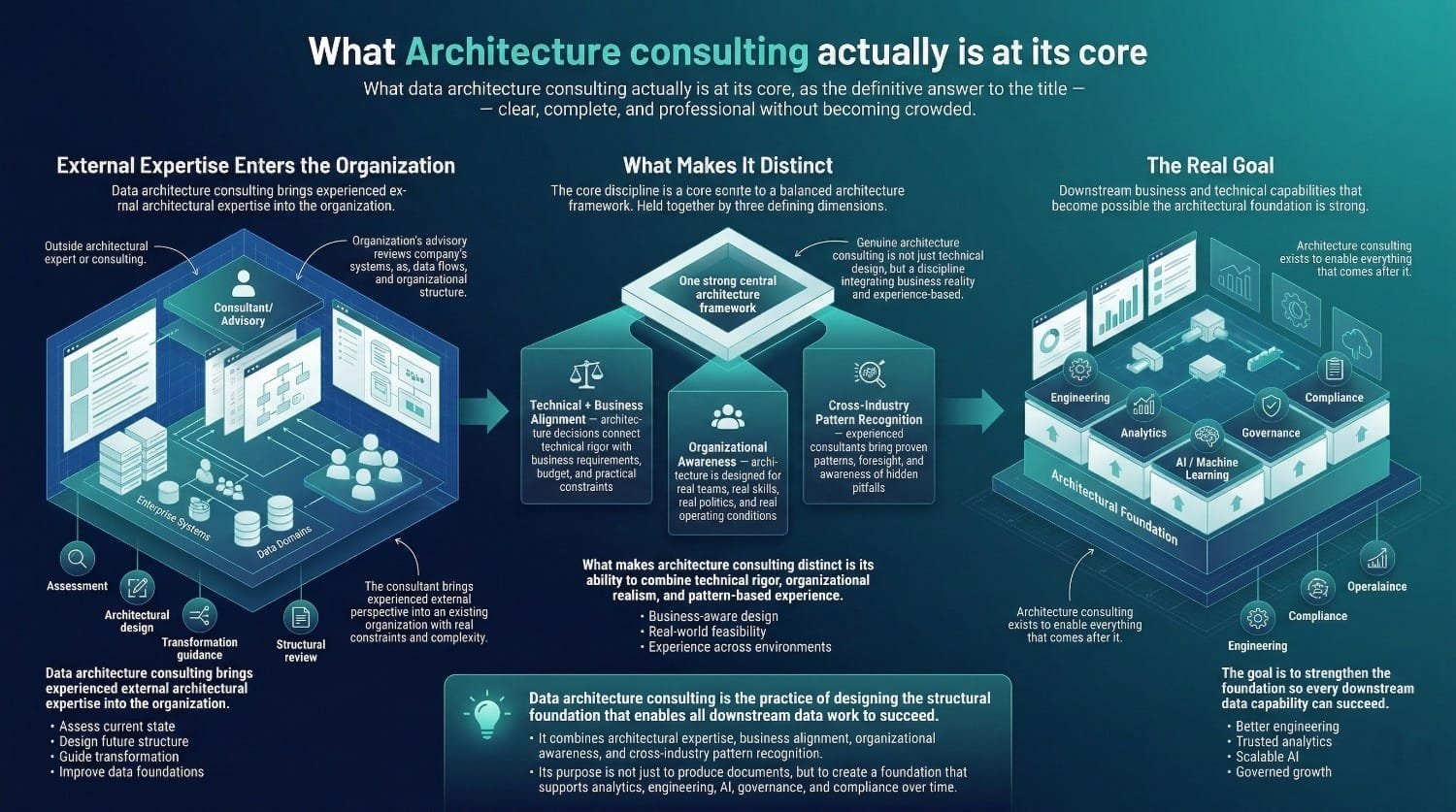
What Data Architecture Consulting Actually Is
This is the section that answers the title. Not abstractly, not partially, completely. What the discipline is, what an engagement actually looks like phase by phase, and what happens at each step.
The Core Definition
Data architecture consulting is the practice of bringing experienced, external architectural expertise into an organization to assess, design, guide, or transform how the organization structures and manages its data.
Three things make it distinct from other types of data consulting:
It combines deep technical knowledge with business acumen. Architecture isn’t just a technical exercise. Every design decision connects to a business requirement, a budget constraint, or an organizational reality. The consultant who designs a technically brilliant architecture that ignores the organization’s actual capabilities, culture, and goals has designed something that won’t get implemented. Genuine architecture consulting holds both dimensions simultaneously, technical rigor and business alignment.
It requires organizational awareness. Data architecture doesn’t exist in a vacuum. It lives inside an organization with departments that have competing priorities, teams with different skill levels, leaders with different visions, and a history of decisions that can’t be undone overnight. Architecture consulting navigates this landscape, not just designing what’s technically optimal, but designing what’s achievable within the organization’s real context.
It depends on cross-industry pattern recognition. The most valuable asset a data architecture consulting partner brings isn’t any single technical skill. It’s the accumulated experience of designing architectures across dozens of organizations with different scales, industries, and challenges. That experience creates pattern recognition, the ability to see where your situation fits within patterns they’ve seen before, which approaches work and which don’t, and where the hidden pitfalls are that your team wouldn’t encounter until it’s too late.
The Goal
The goal is not limited to producing documents or selecting tools. It isn’t even to design a beautiful architecture. The goal is to create or improve the architectural foundation so that all downstream data activities, engineering, analytics, AI, governance, compliance, can succeed. The architecture functions as an enabler for downstream data capabilities.
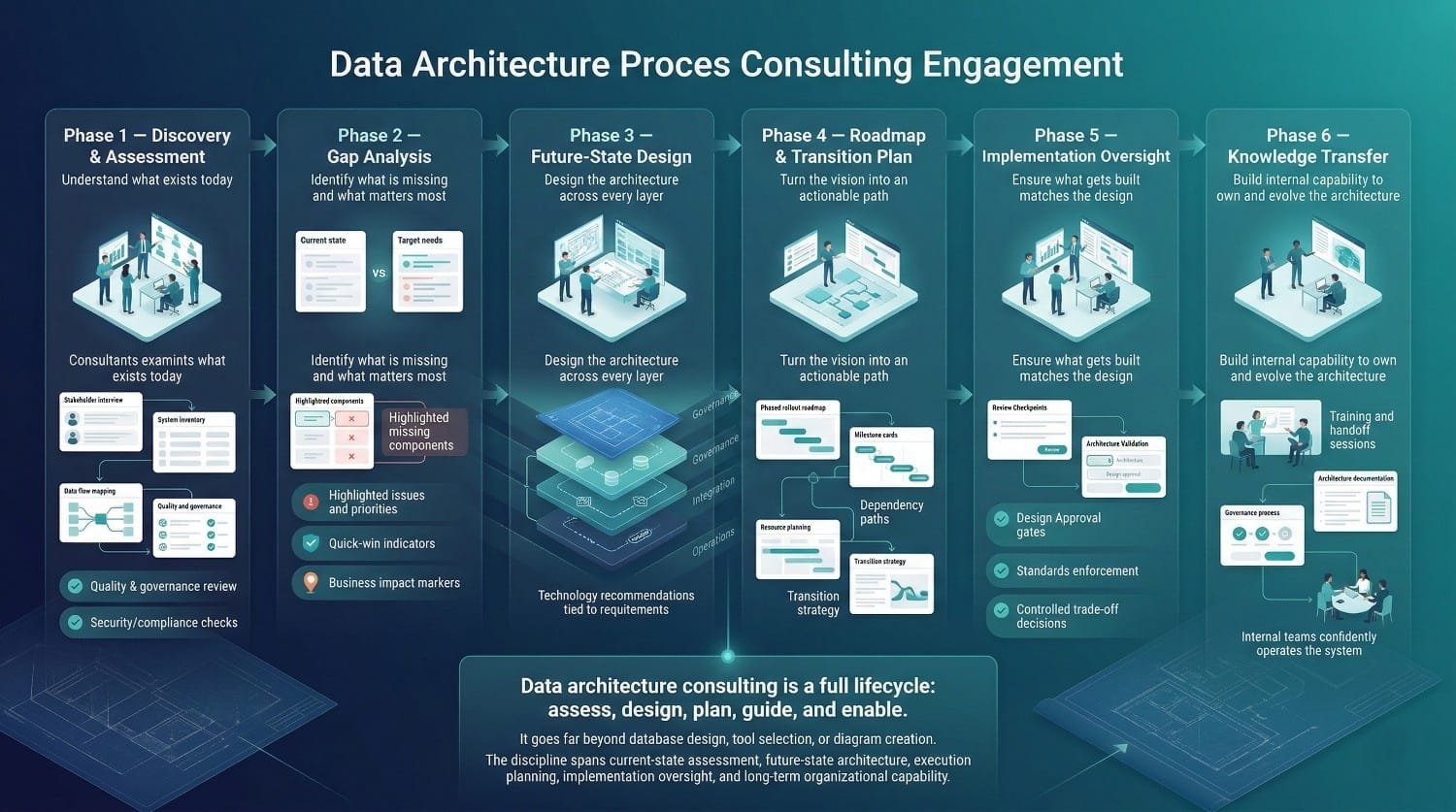
The Consulting Lifecycle: What an Engagement Actually Looks Like
Here’s what actually happens during a data architecture consulting engagement, not the sales pitch version, but the real work, phase by phase.
Phase 1: Discovery and Current-State Assessment
Purpose: Understand what exists today, completely, honestly, and without assumptions.
Duration: Typically 2–4 weeks
This is the most important phase. Everything that follows depends on the accuracy and completeness of what’s discovered here. Skipping or compressing this phase significantly increases the risk of engagement failure.
What actually happens:
The consulting team conducts stakeholder interviews across business and technology. Not just the data team, business leaders, analysts, compliance officers, and executives. Each has a different view of the data landscape, different pain points, and different requirements. The architecture must serve all of them.
They perform a complete system inventory. Every database, warehouse, lake, SaaS platform, legacy system, and shadow IT data store. Every pipeline, integration, API, and manual data transfer. Every tool in the ecosystem, BI platforms, quality monitoring, orchestration, governance tools. Nothing is excluded. Previously undocumented systems are frequently sources of structural issues.
They map existing data flows, where data originates, how it moves, where it’s transformed, and where it’s consumed. This mapping almost always reveals undocumented dependencies, redundant data copies, and flows that nobody on the team knew existed.
They assess data models. Are they documented? Consistent across systems? Aligned with how the business actually thinks about its data? In many organizations, the answer to all three is no, and that gap is a primary driver of data trust problems.
They profile data quality. Not by asking people whether quality is good, but by running quantitative profiling against source systems, measuring completeness, accuracy, duplication rates, and consistency. Quantitative profiling often reveals issues that were not previously visible.
They review governance practices. Is ownership defined? Are stewards active? Is lineage tracked? Are quality standards monitored? Is the data catalog maintained? In most organizations, some of these exist in theory. Few exist in practice.
They assess security and compliance posture. Data classification, encryption practices, access control consistency, and regulatory adherence. They identify where sensitive data exists that the organization didn’t know about, which happens more often than anyone wants to admit.
They identify pain points, bottlenecks, risks, and technical debt. Not just the obvious ones. The systemic ones, the architectural root causes that produce the symptoms the organization has been treating individually.
The output is a documented current-state assessment, understandable by both technical and business stakeholders, that serves as the foundation for everything that follows. It’s the honest mirror that most organizations have never held up to their data ecosystem.
Phase 2: Gap Analysis and Opportunity Identification
Purpose: Identify what’s broken, what’s missing, and what matters most.
Duration: Typically 1–2 weeks (often overlapping with late Phase 1)
Discovery tells you what exists. Gap analysis tells you what the distance is between where you are and where you need to be.
What actually happens:
The consulting team compares the current state against three benchmarks: the organization’s own stated business requirements, the scalability and performance needs implied by growth projections, and industry best practices for organizations of similar scale and complexity.
They identify architectural gaps, systematically, across every layer. Missing data models. Absent governance frameworks. Integration patterns that can’t scale. Security controls that don’t cover sensitive data. Consumption interfaces that don’t serve the users who need them. Operational monitoring that doesn’t exist.
They prioritize gaps, not by technical severity alone, but by business impact, risk exposure, and effort to remediate. A gap that’s technically concerning but has low business impact gets a different priority than one that’s actively blocking a revenue-generating initiative.
They identify quick wins. Not every gap requires a major architectural intervention. Some can be addressed with targeted changes that deliver immediate value, and building early momentum is strategically important for maintaining organizational support.
They benchmark against reference architectures relevant to the organization’s industry and scale. Not to copy someone else’s architecture, but to identify where the organization lags behind peers and where targeted investment would yield the highest return.
The output is a prioritized gap analysis, a map of what’s missing, what matters most, and where the highest-impact opportunities are. This becomes the input for the architecture design.
Phase 3: Future-State Architecture Design
Purpose: Design the architecture the organization should be building toward, across every layer.
Duration: Typically 3–6 weeks
This is the core creative and technical work of the engagement. It’s where the consulting team’s experience, pattern recognition, and design skills produce the most value.
What actually happens:
The consulting team designs the target-state architecture across all eight layers, conceptual, logical, physical, integration, governance, security, consumption, and operational. Not as separate documents, but as an interconnected design where every layer is consistent with every other layer.
They define architectural principles and standards that will govern ongoing decisions. These principles are what keep the architecture coherent as it evolves, even after the consulting team is gone. Principles like “single source of truth for every business entity” or “governance is embedded in the pipeline, not applied after” become the decision-making framework for every future architectural choice.
They select architectural patterns. Centralized warehouse, data lake, lakehouse, data mesh, data fabric, event-driven, streaming-first, or hybrid, chosen based on the organization’s specific requirements, team capabilities, and growth trajectory. Selected based on organizational requirements rather than industry trends alone.
They design data models at multiple levels. Enterprise-level conceptual models that create shared language. Domain-specific logical models that define entity structures and relationships. Physical model guidelines that translate logical design into platform-specific implementation.
They design the integration architecture. How data will flow between systems in the future state, which patterns, which protocols, which platforms, and how the integration layer relates to the storage and governance layers.
They design the governance framework. Ownership model, stewardship roles, quality standards with specific thresholds and monitoring, lineage tracking architecture, data catalog approach, and policy framework. Designed as an architectural component, not a separate initiative.
They design the security architecture. Data classification scheme, access control model, encryption strategy, masking and anonymization approach, and audit framework. Embedded in the architecture, not layered on top.
They design the consumption architecture. How business users, analysts, data scientists, and applications will access data, semantic layers, self-service interfaces, API designs, feature stores, and data product specifications.
They make technology recommendations. Vendor-neutral evaluation of platforms and tools that implement the target architecture, based on requirements analysis, not partnerships. The recommendations include rationale, alternatives considered, and trade-offs accepted.
And critically, they ensure the design is pragmatic. Every recommendation accounts for the organization’s actual budget, the team’s actual skills, the organizational culture, and realistic timelines. An architecture that is technically sound but infeasible to implement lacks practical value.
The output is a comprehensive target-state architecture, documented, explained, and designed for the organization’s specific reality.
Phase 4: Roadmap and Transition Planning
Purpose: Turn the future-state vision into an actionable, phased plan.
Duration: Typically 1–3 weeks
A target-state architecture without a practical path to get there is aspiration, not a plan. This phase bridges design and execution.
What actually happens:
The consulting team breaks the future state into phased, achievable milestones. Not a big-bang transformation, but a sequenced series of steps that each deliver measurable value while building toward the complete vision.
They prioritize phases based on three factors: business value (which phases unblock the highest-impact initiatives), risk reduction (which phases address the most dangerous gaps), and dependency management (which phases must precede others).
They define what “done” looks like for each phase, specific, measurable criteria that confirm a phase is complete before the next one begins. Without these, phases blur together and progress becomes unmeasurable.
They identify dependencies, prerequisites, and blockers. Which teams need to be involved. Which systems need to change first. Which organizational decisions need to be made before technical work can proceed. Which external factors (vendor timelines, regulatory deadlines) constrain the schedule.
They estimate effort, timeline, and resource requirements for each phase, giving leadership the information needed to budget, staff, and plan.
They design the transition strategy, how to move from current state to future state without disrupting ongoing operations. This is where architecture meets operational reality. The business can’t stop while the architecture is rebuilt. Coexistence strategies, parallel running, and phased cutover plans are designed to keep everything operational during the transition.
The output is an actionable roadmap, phased, prioritized, resourced, and designed for real-world execution.
Phase 5: Implementation Guidance and Oversight
Purpose: Ensure what gets built matches what was designed.
Duration: Varies, typically spans the implementation period (weeks to months)
Architecture design is one thing. Implementation is another. Without architectural oversight during the build, engineering teams inevitably make local decisions that deviate from the design, sometimes for good reasons, often for expediency. Those deviations accumulate into an implementation that looks nothing like the architecture it was supposed to follow.
What actually happens:
The consulting team provides architectural oversight during implementation, not writing code, but reviewing designs, validating decisions, and ensuring consistency with the architecture.
They review key design decisions made by engineering teams. When the implementation team faces a choice that has architectural implications, a new table structure, a different integration pattern, a deviation from the data model, the architect weighs in before the decision is implemented.
They conduct architecture reviews at critical milestones. Before each phase goes live, the architecture is reviewed against the design to confirm alignment, and to catch deviations early when they’re cheap to fix.
They resolve architectural trade-offs that arise during implementation. Reality always introduces constraints that weren’t visible during design. The architect helps navigate these trade-offs, adjusting the design where necessary while preserving architectural integrity.
They ensure standards and patterns are being followed consistently. Naming conventions, modeling patterns, integration standards, governance practices, the standards established during design need enforcement during build. Without oversight, standards can erode early in implementation.
Phase 6: Knowledge Transfer and Organizational Enablement
Purpose: Leave the organization capable of owning and evolving the architecture independently.
Duration: Ongoing throughout the engagement, with a focused period at the end
The engagement will end. The consultants will leave. The architecture must remain, and the organization must be able to maintain, operate, and evolve it without external help.
What actually happens:
The consulting team trains internal teams on the architecture, the standards, and the decision-making frameworks. Not a single training session, but a continuous process of working alongside internal staff throughout the engagement, so the knowledge is built through participation, not just presentation.
They document the architecture in formats the organization can maintain. Not in the consultant’s preferred format, but in formats that fit the organization’s tools, practices, and team. Documentation that can’t be maintained internally may become outdated quickly.
They establish architecture governance processes. Review boards, decision logs, exception handling, standards enforcement mechanisms, the organizational structures that keep the architecture healthy after the consulting team leaves.
They verify that the organization can operate independently. Before the engagement closes, the consulting team confirms that internal staff can make architectural decisions, onboard new components, maintain documentation, and evolve the design, without calling the consultant for every question.
They build internal architectural capability for the long term. Not just transferring knowledge about this specific architecture, but developing the skills and judgment that enable the internal team to handle architectural decisions going forward.
The output is less a document and more an organizational capability outcome., an organization that owns its architecture and can evolve it confidently.
The Complete Picture
These six phases, discovery, gap analysis, design, roadmap, implementation guidance, and knowledge transfer, are what data architecture consulting actually involves. Not all engagements include every phase. Some organizations need only an assessment and roadmap. Others need the full lifecycle.
But understanding the complete picture is essential, because it reveals how far the discipline extends beyond the common misconceptions of “database design” or “tool selection” or “diagram creation.”
Data architecture consulting is the practice of designing the structural foundation of the data ecosystem, from conceptual model to operational monitoring, from business alignment to security architecture, from current-state assessment to knowledge transfer.
It is comprehensive, strategic, technical, and organizational in scope.. And that combination is what makes it both difficult to do well and highly valuable when executed effectively.
What Data Architecture Consulting Delivers (Tangible Outputs)
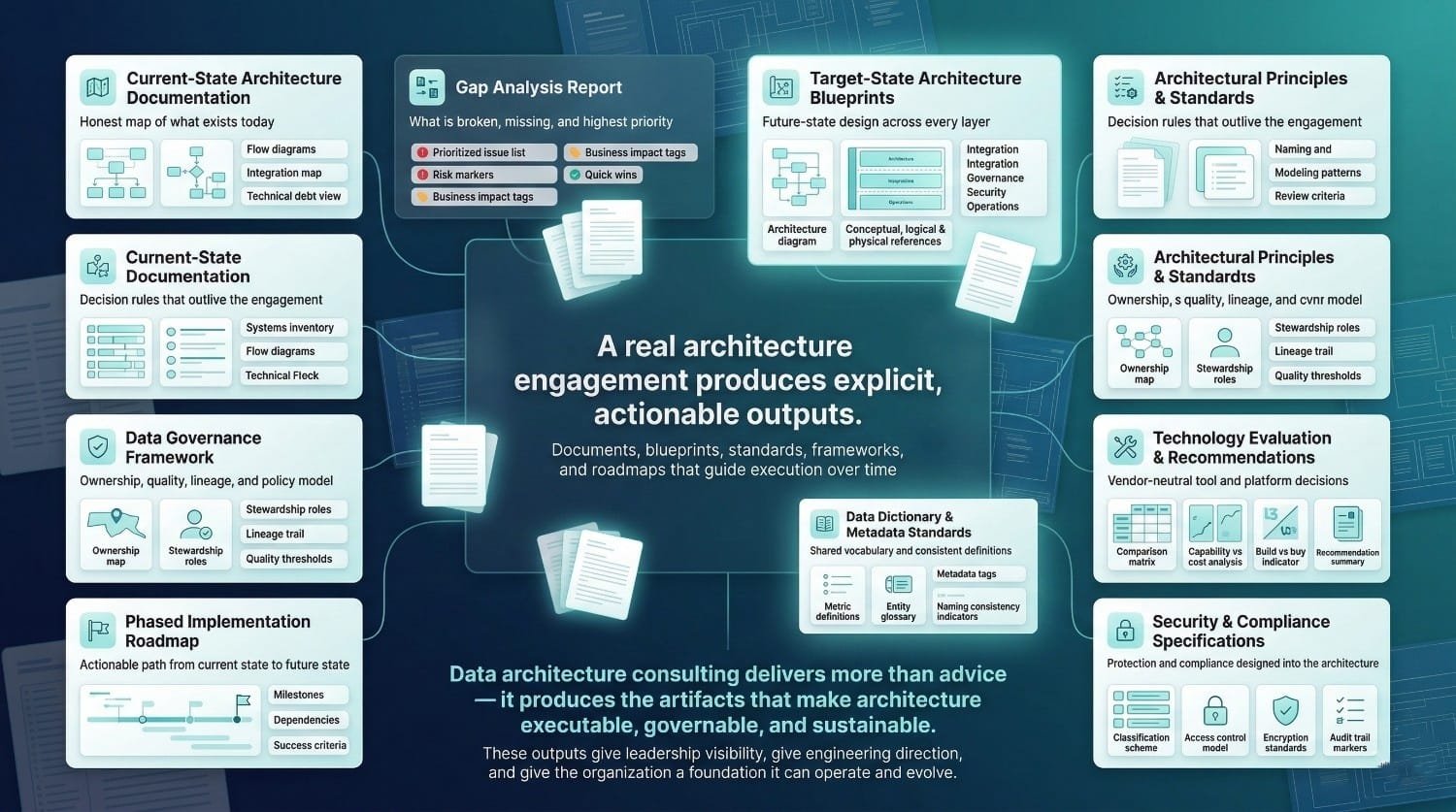
One of the reasons data architecture consulting is misunderstood is that its outputs are less visible than a working pipeline or a new dashboard. This section makes the deliverables explicit, every document, every decision, every organizational outcome, so you know exactly what a real engagement produces.
Documentation and Artifacts
These are the tangible deliverables, the documents, diagrams, and specifications that the engagement produces.
Current-State Architecture Documentation
The honest map of what exists today. This includes a complete systems inventory covering every database, warehouse, lake, SaaS platform, and legacy system in the ecosystem. Data flow diagrams showing how data moves from source through transformation to consumption. Integration maps documenting every connection between systems, including the undocumented ones that discovery reveals. A data model assessment evaluating what models exist, their quality, their coverage, and their alignment with business concepts. And a technical debt inventory cataloging the accumulated shortcuts, workarounds, and structural problems that need to be addressed.
Many organizations do not maintain a consolidated current-state architecture document. When it’s produced, it’s almost always the first time anyone has seen the complete picture in one place. That visibility alone frequently provides significant value during the discovery phase.
Gap Analysis Report
The prioritized assessment of what’s broken, what’s missing, and what matters most. Each gap is described with its business impact, its risk level, and an estimated effort to remediate. Quick wins are identified separately from structural improvements. The report gives leadership a clear, honest picture of the distance between where the architecture is and where it needs to be, with enough specificity to make investment decisions.
Target-State Architecture Blueprints
The core design deliverable. Layered architecture diagrams showing every component and how they relate, storage, integration, governance, security, consumption, and operations. Data models at the conceptual, logical, and physical levels. Integration pattern specifications defining how data flows in the future state. Technology stack diagrams showing which platforms implement which layers. These blueprints typically serve as a reference for engineering execution over the next several years, subject to evolution.
Architectural Principles and Standards Document
The decision-making framework that outlives the engagement. Core principles that guide every future architectural choice, things like “every business entity has a single authoritative source,” “governance is embedded in pipelines, not applied after the fact,” and “security is designed in, not bolted on.” Alongside the principles, specific standards covering naming conventions, modeling patterns, pipeline development practices, documentation requirements, and code review criteria. These standards are what prevent the architecture from reverting to organic chaos after the consultants leave.
Data Governance Framework and Operating Model
The complete governance design, not just policies, but the operational model that makes governance work. Data ownership model mapping every domain to an accountable owner. Stewardship roles with defined responsibilities. Quality standards with specific thresholds, monitoring approach, and escalation procedures. Lineage tracking requirements specifying what must be tracked and how. Data catalog strategy defining how metadata is captured, maintained, and made discoverable. Policy framework covering retention, classification, sharing, and lifecycle management.
Technology Evaluation and Recommendation Report
The vendor-neutral assessment of which tools fit the architecture. Evaluation criteria derived from architectural requirements, not vendor feature lists. Platform comparisons across capability, cost, scalability, ecosystem fit, and operational burden. Specific recommendations with documented rationale, alternatives considered, and trade-offs accepted. Build vs. buy analysis for each component of the architecture.
Phased Implementation Roadmap
The actionable plan that turns the architecture into reality. Phases sequenced by business value, risk, and dependency. Each phase defined with scope, milestones, success criteria, resource requirements, and timeline estimates. Dependencies and prerequisites mapped. Decision points and checkpoints identified. The roadmap is what leadership uses to budget, staff, and track the transformation.
Data Dictionary and Metadata Standards
The shared vocabulary that ensures consistency. Business definitions for every key entity and metric. Technical metadata standards specifying how schemas, tables, and fields are documented. Naming conventions that apply across all systems. This deliverable is what makes the data catalog useful, and what prevents the “same word, different meaning” problem that undermines data trust.
Security and Compliance Architecture Specifications
The detailed security design. Data classification scheme with handling rules for each class. Access control model specifying role-based and attribute-based permissions at every layer. Encryption standards for data at rest and in transit. Audit trail requirements defining what’s logged, where, and for how long. Compliance mapping outlining how the architecture supports relevant regulatory requirements such as GDPR, HIPAA, SOX, or CCPA where applicable..
Decisions and Recommendations
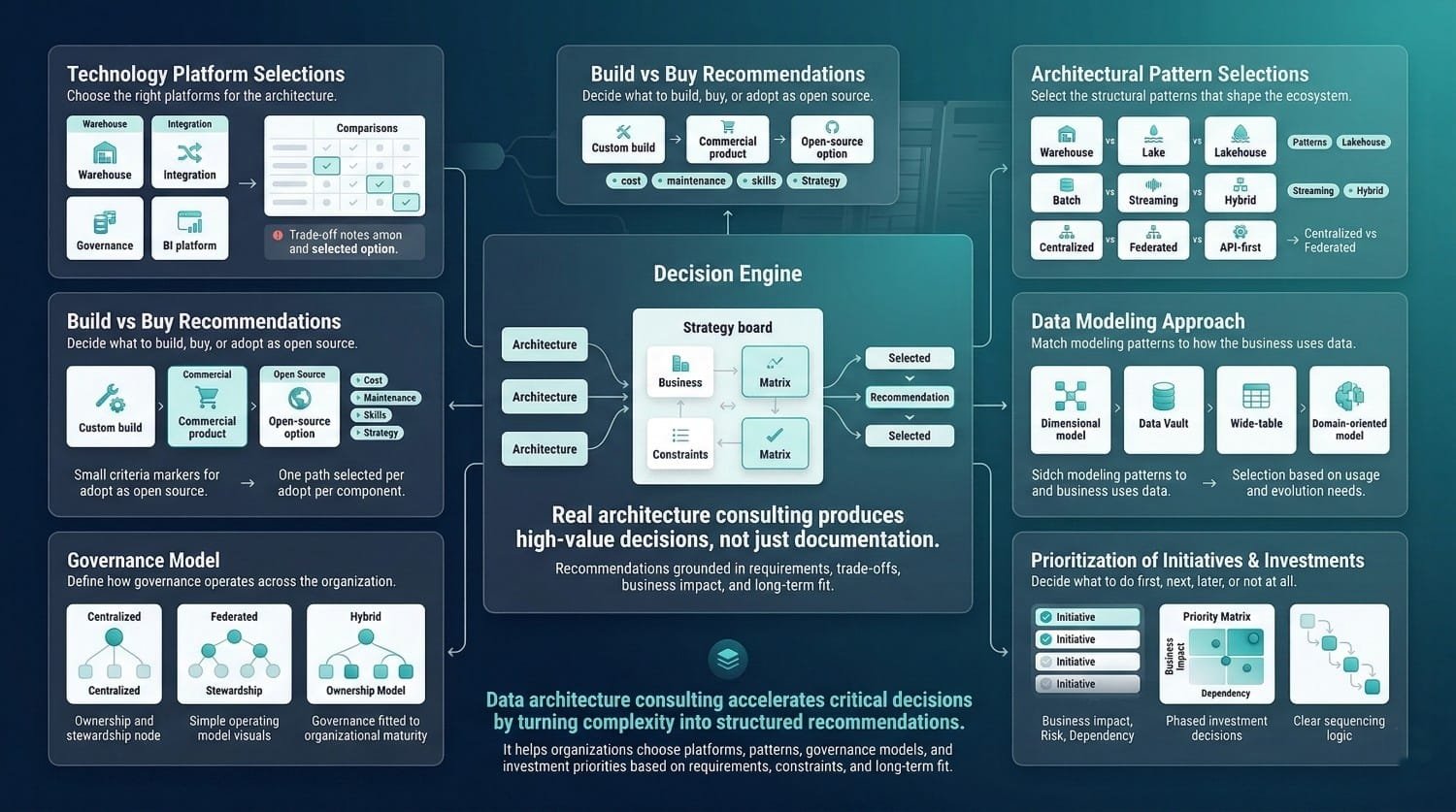
Beyond documents, data architecture consulting produces something equally valuable: decisions that would otherwise take months of internal deliberation and experimentation.
Technology Platform Selections
Which warehouse, which integration platform, which governance tool, which BI system, selected primarily based on architectural requirements rather than vendor demonstrations or analyst rankings alone. Each selection comes with documented justification explaining why this option was chosen over alternatives and what trade-offs were accepted.
Build vs. Buy Recommendations
For each component of the architecture, should the organization build a custom solution, buy a commercial product, or use an open-source option? Each recommendation is grounded in the organization’s specific context: team skills, budget, maintenance capacity, and long-term strategy.
Architectural Pattern Selections
The foundational pattern choices that shape the entire ecosystem. Warehouse vs. lake vs. lakehouse. Batch vs. streaming vs. hybrid. Centralized vs. federated vs. mesh. Hub-and-spoke vs. event-driven vs. API-first. Each selection is explained with the reasoning, the alternatives considered, and the conditions under which the choice should be revisited.
Data Modeling Approach
Dimensional modeling, Data Vault, wide-table approaches, or domain-oriented modeling patterns. The modeling approach is selected based on the organization’s query patterns, team skills, tool capabilities, and evolution requirements, not based on the consultant’s personal preference.
Governance Model
Centralized governance vs. federated vs. hybrid. The model is matched to the organizational structure, the team’s maturity, and the regulatory environment. It specifies not just who governs, but how governance operates day-to-day.
Prioritization of Initiatives and Investments
Perhaps the most pragmatically valuable decision output. Given limited budget and limited team capacity, what should be done first? Second? Third? What can wait? What should be deferred permanently? Prioritization based on business impact, risk, and architectural dependency, not on who lobbies hardest.
Organizational Outcomes
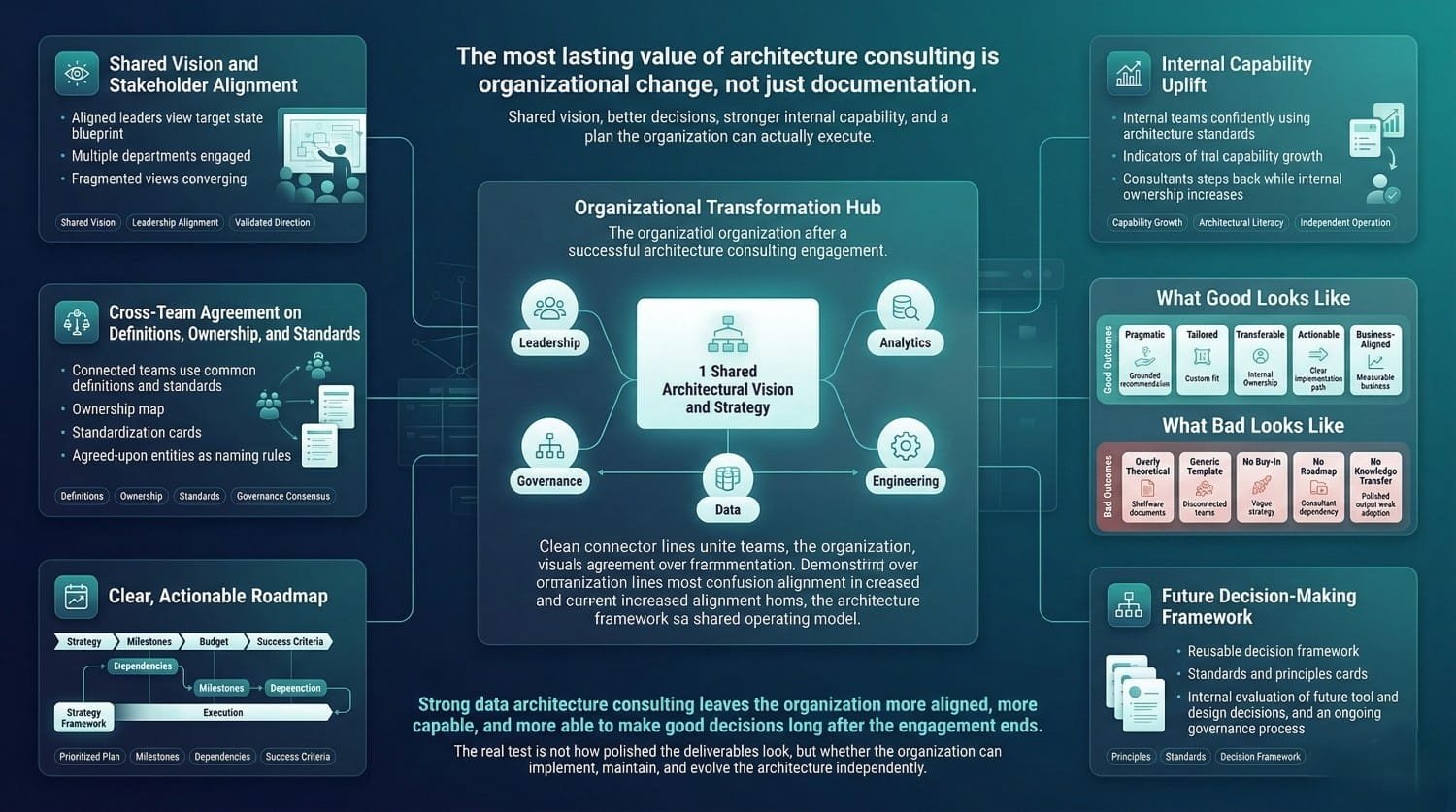
The most lasting value from data architecture consulting isn’t in the documents or the decisions. It’s in the organizational changes the engagement produces.
Stakeholder Alignment on a Shared Vision
Before the engagement, different leaders had different mental models of what the data ecosystem should look like. After the engagement, there is a documented and broadly aligned architectural vision, documented, presented, and validated by the people who need to support it. This alignment is often the engagement’s most valuable outcome, because without it, every subsequent investment faces political resistance.
Cross-Team Agreement on Definitions, Ownership, and Standards
The workshops and facilitation that happen during the engagement produce agreements that internal teams had been unable to reach on their own. Marketing and finance agree on what “customer” means. Sales and operations agree on who owns pipeline data. Engineering and analytics agree on naming conventions. These agreements are captured in the governance framework and the data dictionary, but the real value is the organizational consensus itself.
A Clear, Actionable Plan
Leadership has something they didn’t have before: a plan they can execute. Not a vague aspiration. A phased, prioritized, resourced roadmap with milestones, dependencies, and success criteria. They can budget against it. They can staff for it. They can track progress. They can make informed trade-off decisions when priorities shift.
Internal Team Capability Uplift
The team that worked alongside the consultants throughout the engagement emerges with capabilities they didn’t have before. They develop increased architectural literacy and decision-making capability. They know how to evaluate design decisions against principles. They can maintain the documentation, evolve the standards, and make architectural choices within the framework the engagement established. This is the capability that sustains the architecture long after the consultants leave.
A Decision-Making Framework for the Future
Perhaps the most underappreciated outcome. The principles, standards, and governance processes established during the engagement give the organization a framework for making every future architectural decision. When a new data source needs to be integrated, the patterns exist. When a new tool is evaluated, the criteria exist. When a design conflict arises, the principles provide resolution. The organization doesn’t need the consultant for every decision, because the framework enables confident internal decision-making.
What "Good" Looks Like vs. What "Bad" Looks Like
Not all data architecture consulting deliverables are created equal. Here’s how to tell the difference.
What Good Looks Like
Pragmatic. Every recommendation accounts for the organization’s actual budget, team skills, timeline, and culture. The architecture is designed for the organization as it is, not as the consultant wishes it were. Trade-offs are documented honestly. Constraints are respected, not ignored.
Tailored. The architecture is designed for this specific organization, these specific systems, these specific requirements. It doesn’t look like a template with the company name swapped in. The design decisions are justified with reasoning specific to this context, not generic best practices.
Documented for the audience. Technical specifications are precise enough for engineers to implement. Business descriptions are clear enough for executives to understand. Governance frameworks are operational enough for stewards to follow. Each deliverable speaks to the people who’ll use it.
Transferable. The internal team understands the architecture deeply, because they helped build it. Documentation is in formats the organization can maintain. Decision rationale is captured so future team members understand not just what was decided, but why. The organization can operate independently.
Actionable. Every recommendation connects to a specific step in the roadmap. Nothing is left as a vague “consider in the future.” The path from design to implementation is clear, phased, and resourced.
Aligned with business reality. The architecture serves measurable business outcomes. Every design choice can be traced to a business requirement. The ROI is articulable in terms leadership understands.
What Bad Looks Like
Overly theoretical. The architecture is elegant on paper but impossible to implement with the organization’s actual resources. It describes an ideal state with no practical path to reach it. The consultant optimized for design beauty rather than organizational reality.
Generic templates rebranded as custom work. The deliverables look suspiciously like they could apply to any organization. The same architectural patterns, the same tool recommendations, the same governance framework, regardless of whether they fit the specific context. The company name is the only thing that’s customized.
No stakeholder engagement. The consulting team worked in isolation, emerging periodically with finished deliverables. The internal team didn’t participate in discovery, wasn’t involved in design decisions, and doesn’t fully understand the architecture. The documents are comprehensive. The organizational buy-in is zero.
No implementation path. The architecture is beautifully designed with no roadmap, no phasing, no resource estimates, and no transition strategy. The organization has a vision of where it should go but no plan for how to get there. The gap between design and execution is left as someone else’s problem.
No knowledge transfer. The consulting team holds all the architectural knowledge. The internal team can’t explain the design decisions, can’t maintain the documentation, and can’t make architectural choices without calling the consultant. The engagement created dependency, not capability.
The difference between strong and weak data architecture consulting outcomes can be assessed through implementation success, sustainability, and organizational capability, in the organization’s ability to implement, maintain, and evolve the architecture independently after the engagement ends.
What Data Architecture Consulting Is NOT
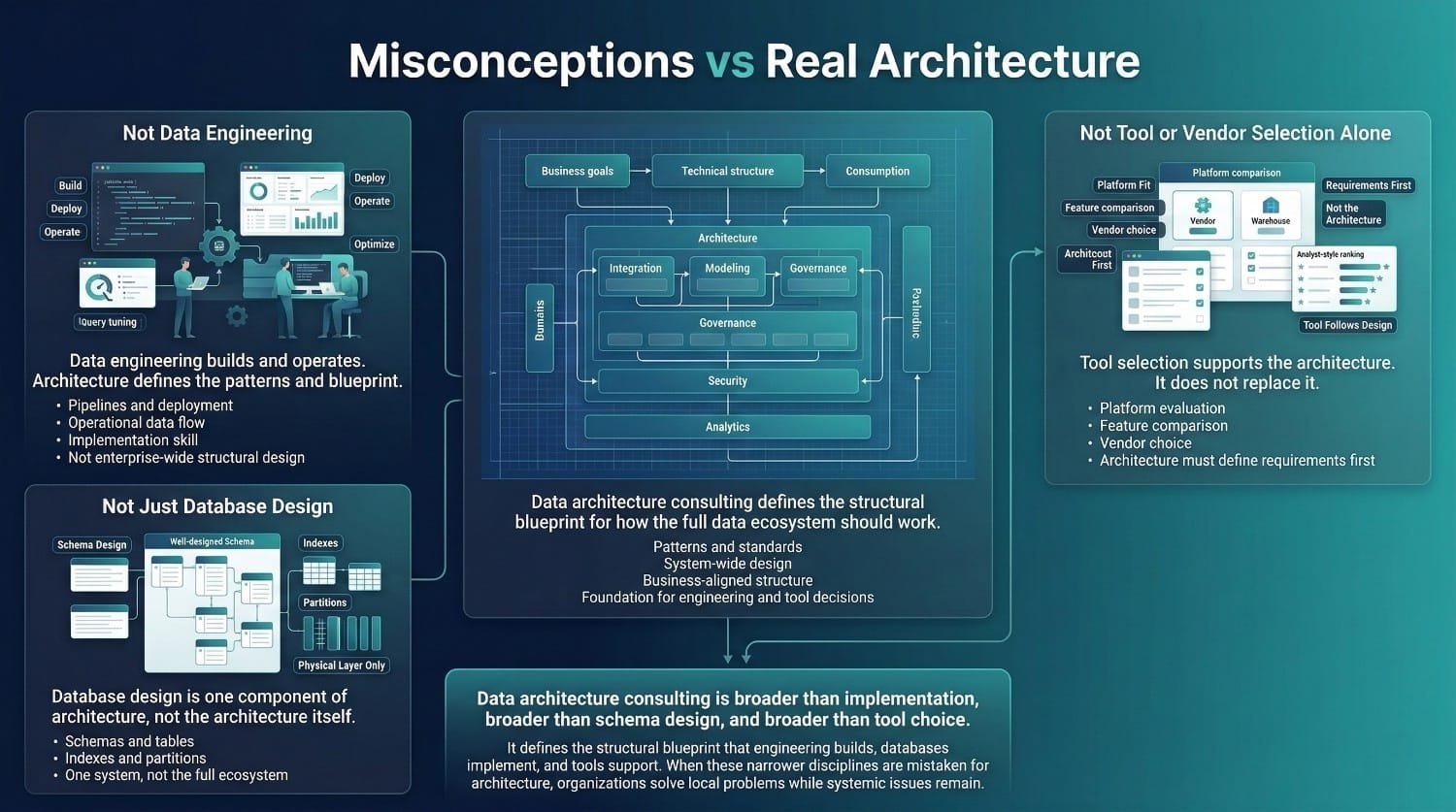
Half of understanding what data architecture consulting actually is comes from understanding what it isn’t. These seven distinctions are where the most common and costly misunderstandings occur.
It's Not Data Engineering
This is the most frequent confusion, and the one that causes the most damage when the wrong discipline is engaged for the problem.
The Distinction
Data engineering builds, deploys, and operates. Engineers write pipeline code, configure platforms, optimize queries, manage infrastructure, and keep data flowing day to day.
Data architecture designs the blueprint. Architects define the patterns, models, standards, and structural decisions that engineering builds within.
An engineer asks: “How should I build this pipeline?” An architect asks: “What pipeline patterns should all pipelines follow, and how does this pipeline fit into the broader ecosystem?”
An engineer asks: “What’s the best index for this query?” An architect asks: “What data model design ensures that the most common query patterns perform well across the entire warehouse?”
The Relationship
They’re complementary and interdependent. Architecture without engineering is a plan that never gets implemented, beautiful diagrams that sit in a shared drive. Engineering without architecture is building without a plan, solutions that work individually but don’t fit together, creating the organic chaos that eventually requires architectural intervention to untangle.
The best outcomes happen when both work together. Architecture provides the blueprint, the standards, and the guardrails. Engineering provides the implementation expertise, the operational knowledge, and the feedback on what’s practically buildable.
When You Need Which
You need engineering when the blueprint exists and is sound, you need skilled people to execute it. The patterns are defined, the models are designed, and the standards are established. What’s missing is capacity and implementation skill.
You need architecture when the blueprint doesn’t exist, is fundamentally flawed, or can’t support what the business needs. Strong engineering execution cannot fully compensate for structural design deficiencies. Accelerating development within a flawed architecture often amplifies existing structural issues.
You need both when you’re undertaking a major transformation, building a new platform, migrating to the cloud, consolidating post-acquisition, or modernizing a legacy environment. Architecture designs the target state. Engineering builds it. Without both, you get either an unimplemented plan or an unplanned implementation.
It's Not Just Database Design
The Distinction
Database design, schema structure, table definitions, indexing strategies, partitioning approaches, is one component of the physical layer of data architecture. It’s important. It’s also roughly 5–10% of the total architectural scope.
Data architecture consulting encompasses the entire ecosystem: how dozens or hundreds of systems work together. How data flows between them. How it’s modeled at the conceptual and logical levels. How it’s governed. How it’s secured. How it’s consumed. How it evolves.
Designing a great schema for one database while ignoring how that database relates to the warehouse, the lake, the BI platform, the integration layer, and the governance framework is like designing a great room while ignoring the rest of the building. The room might be excellent. The building might be structurally unsound.
The Consequence of Confusion
When organizations engage “architecture consulting” expecting ecosystem-level design but receive database-level design, the engagement solves a narrow problem while the systemic issues remain untouched. The database is well-designed. The architecture is still broken. And the organization has spent its architecture budget on something that doesn’t address the architectural problem.
It's Not Tool or Vendor Selection Alone
The Distinction
Selecting Snowflake vs. Databricks vs. BigQuery is a technology decision. It’s an important decision. But it’s not an architecture.
Architecture defines what you need from a technology. Tool selection determines which technology meets those needs. The architecture says: “We need a storage layer that supports semi-structured data, handles 5TB with 30% annual growth, serves both batch analytical queries and near-real-time dashboards, integrates with our existing BI platform, and fits within a $150K annual budget.” The tool selection process evaluates which platform best meets those requirements.
When organizations skip architecture and go straight to tool selection, they’re choosing a solution before defining the problem. The result is a platform purchased for the wrong reasons, because the demo was impressive, because a competitor uses it, because an analyst report ranked it highly, that may or may not fit the actual architectural requirements.
The Consequence of Confusion
Tool selection without architectural context is a common source of costly misalignment in data infrastructure. The organization commits to a platform, often with a multi-year contract and significant migration effort, before understanding whether it’s the right fit. When the misfit becomes apparent, the organization faces a painful choice: force the architecture to fit the tool (suboptimal) or re-platform at enormous cost (expensive).
Data architecture consulting prevents this by defining the architecture first and selecting the tool second. The tool serves the architecture. The architecture serves the business. The sequence is important.
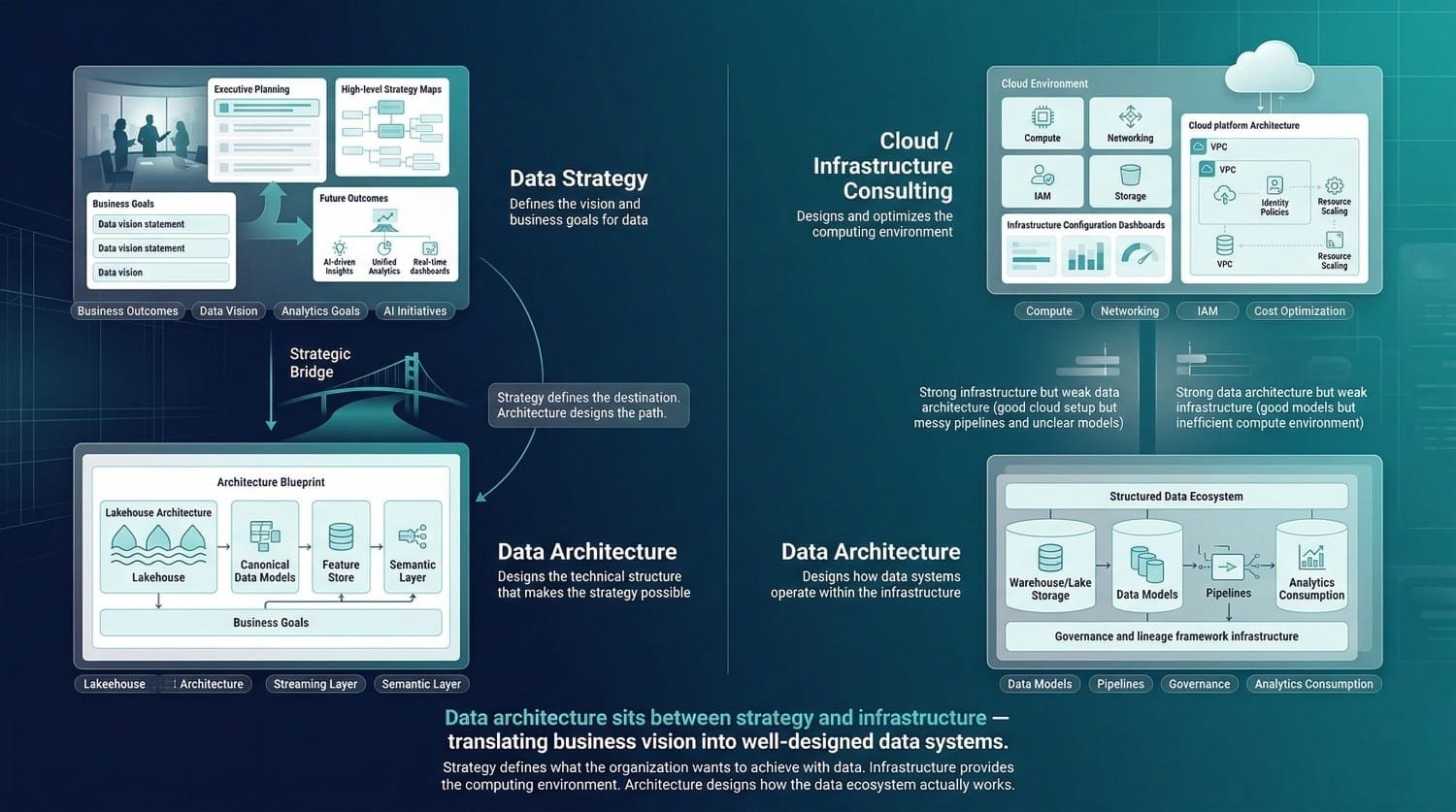
It's Not Data Strategy
The Distinction
Data strategy answers: “What do we want to achieve with data? What’s our vision? How does data support our business objectives?”
Data architecture answers: “How do we design our data systems to make that vision technically possible?”
Strategy says: “We need to become a data-driven organization with unified customer analytics, AI-powered personalization, and real-time operational dashboards.” Architecture says: “To achieve that, we need a lakehouse architecture with a canonical customer model, a real-time streaming layer, a feature store, and a semantic layer, implemented in these specific technologies, governed by this framework, and built in these phases.”
Strategy defines the destination. Architecture designs the structural path to reach it.
The Relationship
Strategy without architecture is aspiration without a plan. The organization knows where it wants to go but has no structural design for getting there. Goals are set. Budgets are allocated. But the technical foundation to support those goals doesn’t exist and nobody has designed it.
Architecture without strategy is design without direction. The technical blueprint is sound, but it’s not aligned with business priorities. The architecture supports capabilities the business doesn’t need while missing capabilities it does.
They’re complementary disciplines, often delivered together. Many data architecture consulting engagements include a strategy component, ensuring that architectural decisions are grounded in business objectives. But they’re distinct, and understanding the boundary prevents the mismatched expectation where someone buys strategy and expects architecture, or vice versa.
It's Not Cloud Consulting or Infrastructure Architecture
The Distinction
Cloud consulting focuses on the infrastructure layer, compute resources, networking configuration, identity and access management, storage provisioning, cost optimization, and cloud platform configuration.
Data architecture consulting focuses on the data layer, how data is modeled, stored, integrated, governed, secured, and consumed. These concerns exist regardless of whether the infrastructure is cloud, on-premises, or hybrid.
A cloud consultant ensures that your AWS environment is well-configured, secure, and cost-efficient. A data architect ensures that the data systems running in that environment are well-designed, well-modeled, and well-governed.
Why the Distinction Matters
It is possible to have a well-configured cloud environment alongside weak data architecture practices. The VPCs are configured correctly. The IAM policies are tight. The instances are right-sized. But the data warehouse has no coherent model. The pipelines are point-to-point spaghetti. There’s no governance. Nobody can trace a metric from report to source. The infrastructure is excellent. The data architecture is broken. No amount of cloud optimization fixes a data modeling problem.
The reverse is also true. You can have brilliant data architecture on poorly configured infrastructure. The models are elegant. The governance is mature. But the cloud environment is overprovisioned, the networking adds latency, and the security configuration has gaps. Both layers need to be right. They require different expertise. Data architecture consulting addresses the data layer. Cloud consulting addresses the infrastructure layer. Major transformations often require both, coordinated so that the data architecture defines what the infrastructure needs to support.
It's Not a One-Time Audit or Report
The Distinction
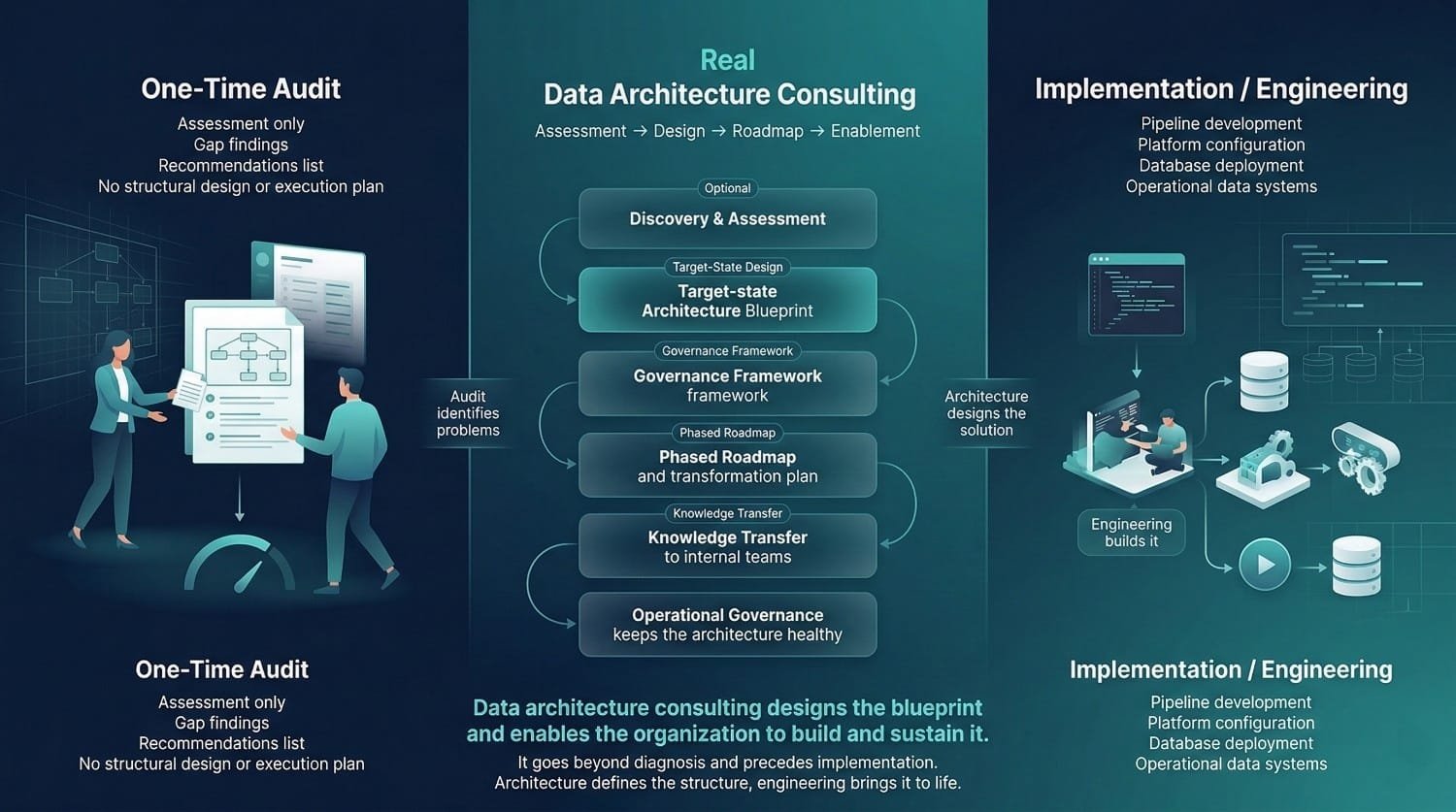
An audit or assessment produces findings. Data architecture consulting typically produces findings along with a design, a plan and organizational capability development. If the engagement delivers a PDF documenting the current state and a list of recommendations, and then the consulting team disappears, you’ve received an assessment, not architecture consulting. The assessment is a valuable component, but it’s Phase 1 of a multi-phase engagement. Stopping there can be comparable to receiving a diagnosis without a structured treatment plan.
What Full Architecture Consulting Includes Beyond an Audit
A target-state design that translates findings into structural solutions. A governance framework that operationalizes the recommendations. Standards and patterns that prevent the problems from recurring. A phased roadmap that turns the design into an executable plan. Knowledge transfer that enables the organization to own and evolve the architecture. Governance processes that keep the architecture healthy over time.
An audit primarily identifies gaps and risks. The architecture consulting tells you what’s wrong, designs what “right” looks like, creates a plan to get there, and ensures your team can sustain it.
The Test
If the consulting firm’s engagement ends with a deliverable handoff and no mechanism for ensuring the organization can implement, maintain, and evolve what was designed, the engagement was an audit with a label upgrade. Comprehensive data architecture consulting extends beyond diagnosis to include design, planning, knowledge transfer, and enablement.
It's Not Implementation
The Distinction
Architecture consulting designs the blueprint and guides the build. It typically doesn’t involve writing production code, deploying infrastructure, configuring platforms, or operating pipelines. Those are engineering activities, distinct from architecture, though informed by it.
The architect designs the data model. The engineer creates the tables. The architect defines the pipeline patterns. The engineer writes the pipeline code. The architect specifies the governance framework. The engineer implements the quality monitoring.
The Nuance
Some consulting firms offer both architecture and implementation services. That’s fine, even advantageous, when the same team that designed the architecture helps build it. But the two should be scoped and understood as distinct activities with different deliverables, different skill sets, and different cost structures.
When architecture and implementation are conflated, two problems arise. First, the architecture phase gets rushed to get to the “real work” of building, producing a shallow design that causes problems during implementation. Second, implementation decisions start driving architectural choices, the team designs what’s easiest to build rather than what’s structurally sound.
The Right Relationship
Architecture should precede and inform implementation. Architecture provides the blueprint, the standards, and the guardrails. Implementation provides the build, with architectural oversight ensuring alignment. They work together, but the architectural direction should be established before major implementation begins, not discovered along the way.
The Summary Principle
Data architecture consulting occupies a specific, distinct position in the data landscape. It’s not engineering (which builds), not database design (which is one component), not tool selection (which is one decision), not strategy (which defines the vision), not cloud consulting (which optimizes infrastructure), not a one-time audit (which only diagnoses), and not implementation (which executes the design).
It’s the discipline that designs the complete structural foundation, across every layer, for every stakeholder, aligned to business outcomes, and built to evolve.
When you engage it, you should know exactly what you’re getting. And when someone offers something else under the same label, you should know the difference.
Common Architectural Paradigms a Consultant Might Recommend (And Why)
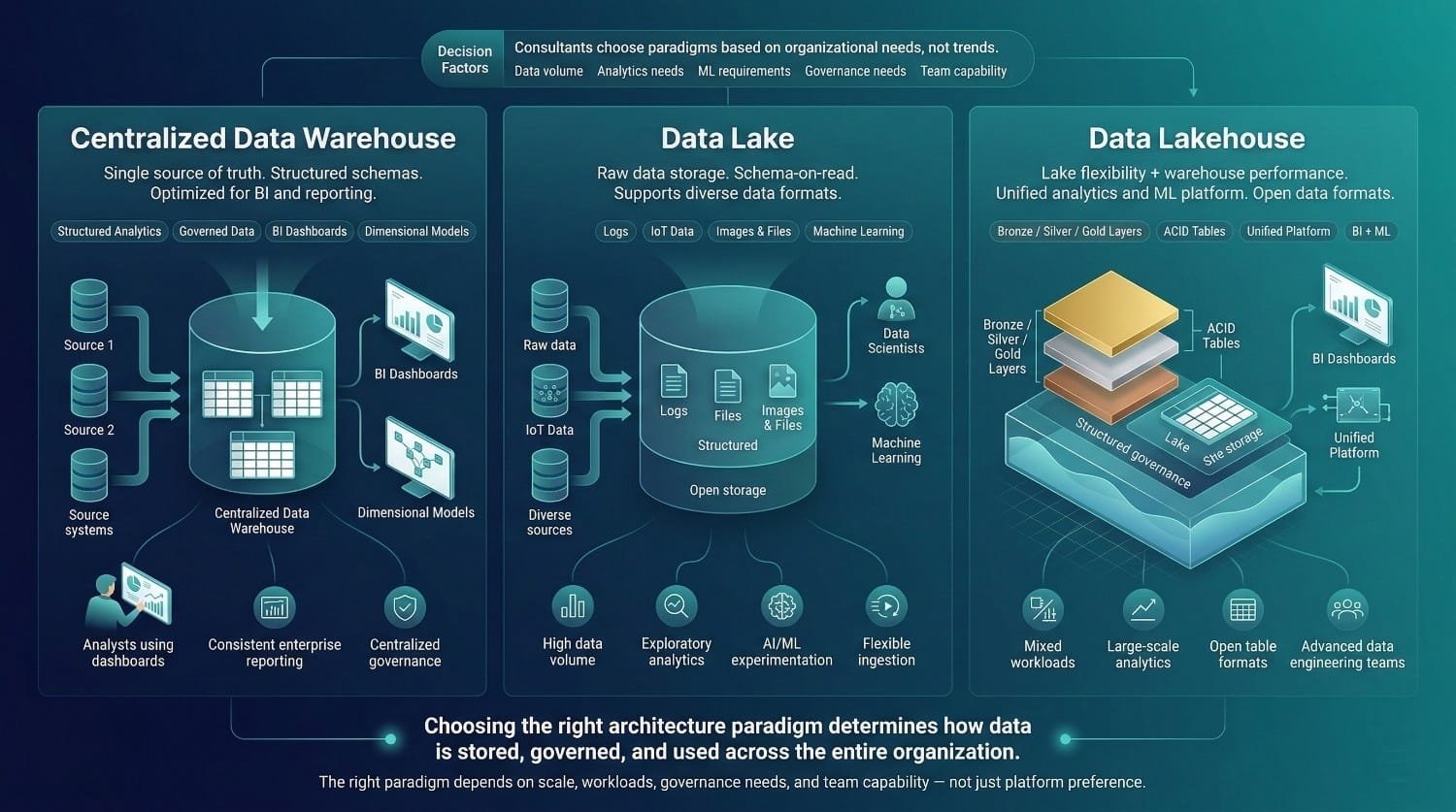
A significant portion of what data architecture consulting delivers is the selection and design of the right architectural paradigm, the foundational pattern that shapes how the entire data ecosystem is structured.
This isn’t a technology choice. It’s a structural design choice that determines how data is stored, how it moves, who owns it, and how it’s consumed. Getting it right sets the organization up for years of productive data work. Getting it wrong can create structural constraints that are difficult and costly to overcome through engineering alone. Here are the paradigms a consultant might recommend, with honest assessments of when each fits and where each falls short.
Centralized Data Warehouse
What It Is
A single, structured repository optimized for analytical queries and business reporting. Data is loaded from source systems, transformed into well-defined schemas (typically dimensional models or similar structured approaches), and served to analysts and BI tools through a governed, consistent interface.
This is one of the most established and widely adopted paradigms in analytical data architecture. It’s been the default analytical architecture for decades, and for good reason.
When It Fits
A centralized warehouse is often the right choice when the organization has a strong BI and reporting culture with well-defined analytical needs. When data volumes are moderate, terabytes, not petabytes. When consistency, governance, and a single source of truth are top priorities. When the primary consumers are business analysts and executives using structured queries and dashboards. And when the organization values reliability and simplicity over flexibility.
Popular Platforms
Snowflake, Google BigQuery, Amazon Redshift, Azure Synapse, and Teradata (legacy but still widely deployed).
Trade-Offs
Warehouses can become bottlenecks when a single team controls all data access and every request goes through a central queue. They are generally less optimized for large volumes of unstructured data without additional extensions, documents, images, logs, and streaming events. At extreme scale, cost and performance can become challenging, though modern cloud warehouses have pushed these limits significantly. And the structured, schema-on-write approach generally requires clearer upfront modeling decisions before structured transformation, which doesn’t always align with exploratory or AI/ML use cases.
Data Lake
What It Is
A large-scale storage layer that accepts data in any format, structured, semi-structured, and unstructured, without requiring schema definition upfront. Data is stored in its raw form and structured at the point of consumption (schema-on-read).
The data lake emerged as a response to the warehouse’s limitations, offering flexibility, scale, and the ability to store data before deciding exactly how it would be used.
When It Fits
Lakes are well-suited when the organization deals with high data volume and variety, logs, IoT streams, documents, images, and video alongside traditional structured data. When AI/ML workloads require access to raw, unprocessed data for feature engineering and model training. When the organization needs to store data before fully defining its analytical use cases. And when cost-effective storage of large volumes is a priority.
Popular Platforms
Amazon S3 with Athena or EMR, Azure Data Lake Storage with Synapse or Databricks, and Google Cloud Storage with BigQuery or Dataproc.
Trade-Offs
The lake’s greatest strength is also its greatest risk. The flexibility that allows any data in any format also allows ungoverned, undocumented, low-quality data to accumulate indefinitely. Without active governance, a data lake risks becoming poorly governed and difficult to navigate, a vast, expensive storage layer where data goes in but useful insights rarely come out. Query performance on raw lake data is typically slower than a well-modeled warehouse. And the schema-on-read approach can shift complexity toward downstream consumers if semantic layers are not introduced who need to make sense of the data, which often means the complexity isn’t managed, just redistributed.
Data Lakehouse
What It Is
A hybrid architecture that combines the flexibility and scale of a data lake with the structure, performance, and governance capabilities of a data warehouse. Data is stored in open formats on lake storage, but a metadata and transaction layer provides warehouse-like features, ACID transactions, schema enforcement, time travel, and optimized query performance. The lakehouse emerged as organizations realized they needed both the lake’s flexibility and the warehouse’s reliability, and didn’t want to maintain two separate systems.
When It Fits
The lakehouse fits organizations that need both exploratory and ML workloads (which benefit from lake flexibility) and structured analytics and BI (which require warehouse-like performance and governance). When the organization wants to avoid the cost and complexity of maintaining separate lake and warehouse systems. When open data formats (Delta Lake, Iceberg, Hudi) are strategically important for avoiding vendor lock-in. And when the team has the engineering sophistication to implement and manage the medallion pattern (bronze/silver/gold) or similar layered approach.
Popular Platforms
Databricks with Delta Lake, Apache Iceberg (platform-agnostic, increasingly supported across Snowflake, Spark, and Trino), and Apache Hudi.
Trade-Offs
The lakehouse paradigm is newer compared to traditional warehouse approaches than the warehouse or lake individually. The ecosystem continues to evolve rapidly, tooling, governance capabilities, and operational practices are evolving rapidly. Implementation requires skilled data engineering, the layered architecture and open table formats add complexity that simpler warehouse architectures don’t require. And the convergence of lake and warehouse creates a platform that can do many things but requires careful design to do any of them well. Without that design, a lakehouse can inherit the worst of both paradigms, the swamp risk of the lake and the rigidity of the warehouse.
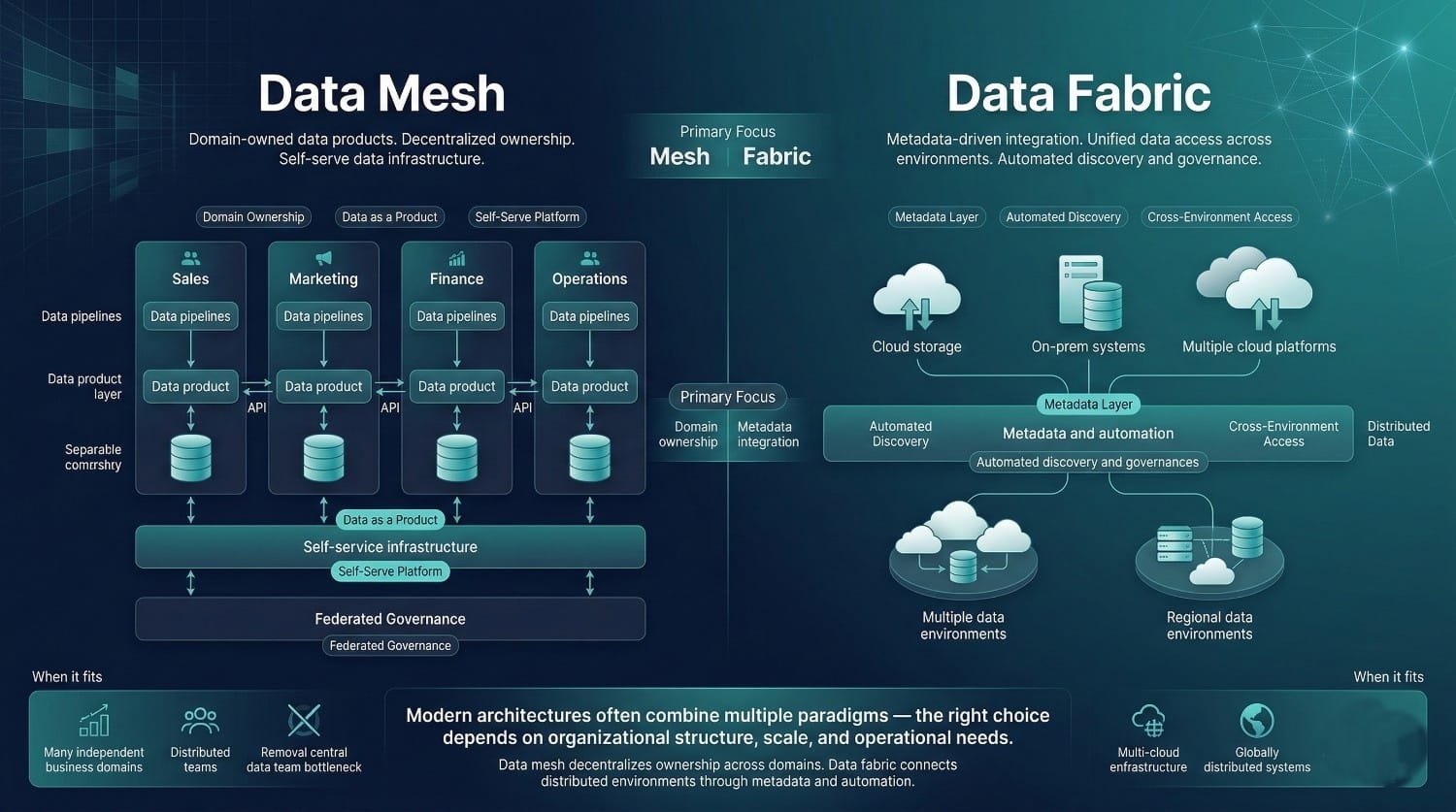
Data Mesh
What It Is
A decentralized organizational and architectural approach where individual business domains own and publish their data as products. Instead of a central data team that collects, transforms, and serves all data, each domain (sales, marketing, finance, operations) owns its data end-to-end, treating it as a product with clear interfaces, quality contracts, and documentation.
Data mesh is as much an organizational paradigm as a technical one. It’s built on four principles: domain ownership of data, data as a product (with defined interfaces and SLAs), self-serve data infrastructure (a platform that makes it easy for domains to build and publish), and federated computational governance (shared standards enforced through automation, not central control).
When It Fits
Data mesh fits large organizations where a centralized data team has become a bottleneck, where the backlog for data access is months deep and business domains are frustrated by their dependency on a single team. When strong domain expertise exists within business units and those units have the maturity and willingness to own their data. When the organization values autonomy and speed over centralized control. And when the organization is large enough to justify the coordination overhead, typically larger organizations with multiple autonomous business domains with multiple distinct business domains.
Trade-Offs
Data mesh requires significant organizational maturity. Domains must genuinely own their data, with dedicated engineers, defined quality standards, and operational accountability. That’s a significant investment for each domain. Governance is harder in a federated model, ensuring consistency, interoperability, and quality across autonomous domains requires sophisticated automation and strong organizational discipline.
Coordination overhead increases as the number of domains grows. And data mesh is genuinely less practical for smaller organizations where domain overhead outweighs benefits, where the overhead of domain ownership exceeds the bottleneck cost of centralization.
Data Fabric
What It Is
An architecture that uses metadata, AI, and automation to integrate and manage data across disparate environments, without requiring physical consolidation. Rather than moving all data into one place, data fabric creates a unified metadata layer that makes data discoverable, accessible, and governable wherever it physically lives.
Data fabric is particularly relevant for organizations with highly distributed environments, multi-cloud, hybrid on-premises/cloud, multiple geographies, where centralizing data is impractical or undesirable.
When It Fits
Data fabric fits environments where data is distributed across multiple clouds, on-premises systems, and geographies and cannot be easily consolidated. When automated data discovery and governance are priorities, especially in environments with hundreds or thousands of data assets. When the organization needs to integrate and query data across environments without large-scale data movement. And when metadata-driven automation is more practical than manual integration for the organization’s scale.
Trade-Offs
Vendor implementations of data fabric vary widely, the term is used to describe very different capabilities depending on the vendor. Implementation can be complex, requiring sophisticated metadata management, integration technologies, and governance automation. The concept continues to evolve across vendors and implementations, definitions of data fabric vary across vendors and industry analysts. And data fabric doesn’t eliminate the need for sound data modeling, quality management, and governance, it provides a layer of automation on top of those disciplines but doesn’t replace them.
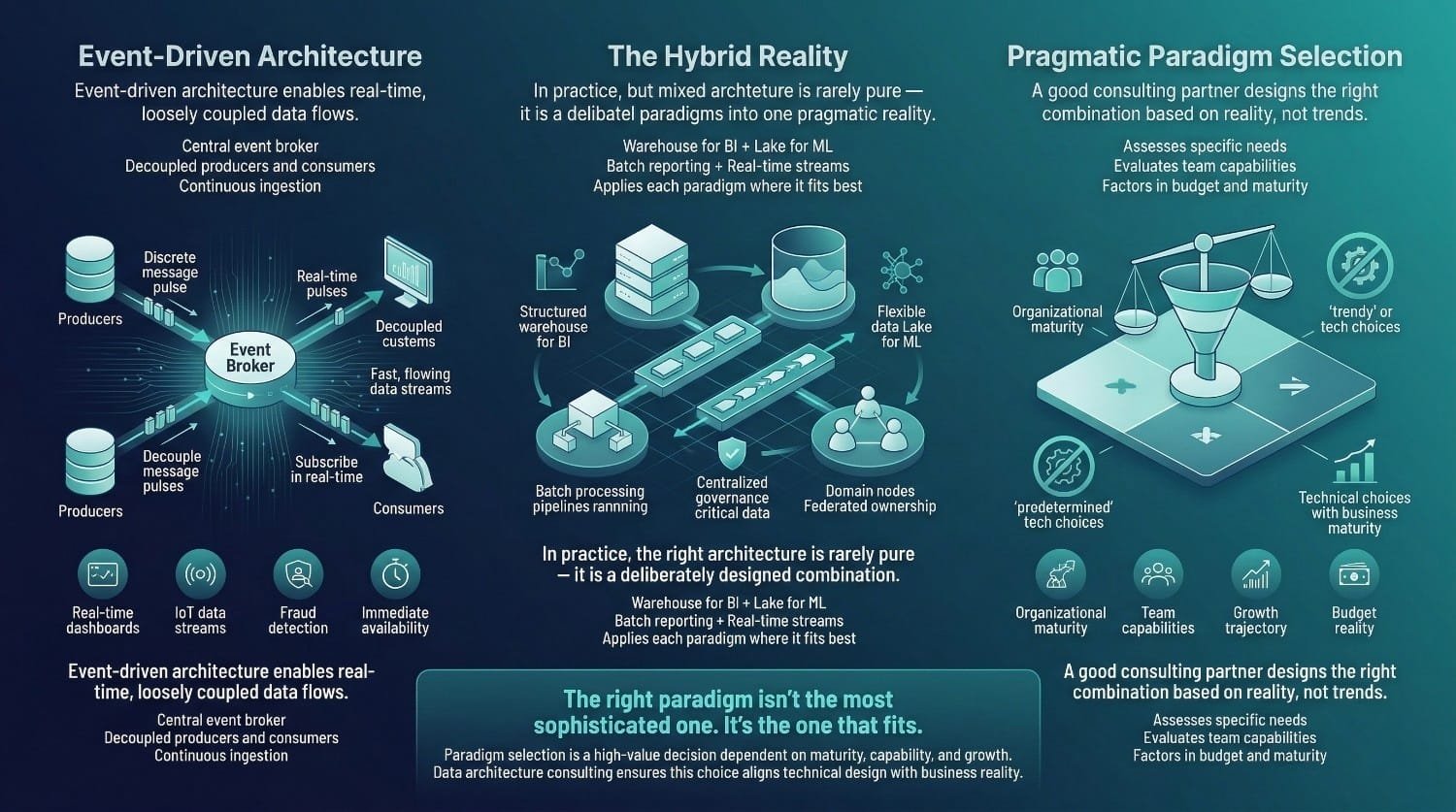
Event-Driven Architecture
What It Is
An architectural pattern where systems communicate through events, discrete messages representing something that happened (an order was placed, a customer profile was updated, a sensor reading was recorded), rather than through direct, synchronous calls. Events are published to a central broker, and any system that needs to know about the event subscribes to it.
This pattern enables real-time, loosely coupled data flows, systems don’t need to know about each other, just about the events they produce and consume.
When It Fits
Event-driven architecture fits organizations with real-time analytics requirements, dashboards that update in seconds, not hours. When the technical environment is microservices-based and systems need to communicate without tight coupling. When IoT data streams need to be ingested and processed continuously. When the organization needs to decouple data producers from consumers so systems can evolve independently. And when operational use cases require immediate data availability, fraud detection, real-time personalization, live monitoring.
Popular Platforms
Apache Kafka, Confluent, Amazon Kinesis, Azure Event Hubs, Google Cloud Pub/Sub, and Apache Pulsar.
Trade-Offs
Event-driven architecture introduces operational complexity that batch architectures don’t have. Event ordering, exactly-once processing, and handling late-arriving events are genuinely difficult problems. Debugging and monitoring event flows is harder than debugging batch pipelines. The skill set required to build and operate event-driven systems is specialized, not every data team has it. And not every use case needs real-time, applying event-driven patterns to workloads that are perfectly well-served by daily batch processing adds complexity without proportional value.
Hybrid and Pragmatic Approaches
The Reality
In practice, most organizations need a combination of paradigms. A warehouse for structured BI alongside a lake for ML workloads. Batch processing for daily reporting alongside event-driven streaming for real-time dashboards. Centralized governance for compliance-critical data alongside federated ownership for domain-specific datasets.
In practice, most environments combine multiple paradigms. And the right architecture is rarely pure, it’s a deliberately designed combination that applies each paradigm where it fits best.
Why This Matters for Consulting
A good data architecture consulting partner doesn’t arrive with a predetermined paradigm. They don’t recommend data mesh because it’s trendy, or lakehouse because they’ve implemented it most recently, or warehouse because it’s safe.
They assess the organization’s specific needs, constraints, and maturity, and design the right combination. Maybe that’s a lakehouse for analytics with an event-driven layer for real-time operational data. Maybe it’s a centralized warehouse today with a mesh roadmap for two years from now when the organization’s maturity supports it. Maybe it’s a simple warehouse because the organization’s needs are straightforward and complexity would be counterproductive.
The paradigm selection is one of the highest-value decisions in any architecture engagement. It is one of the decisions most prone to misalignment when made without broader architectural experience that data architecture consulting provides, because the right choice depends not just on technical requirements, but on organizational maturity, team capabilities, growth trajectory, and budget reality. These factors are invisible to tool vendors and difficult for internal teams to assess objectively.
The right paradigm isn’t the most sophisticated one. It’s the one that fits.
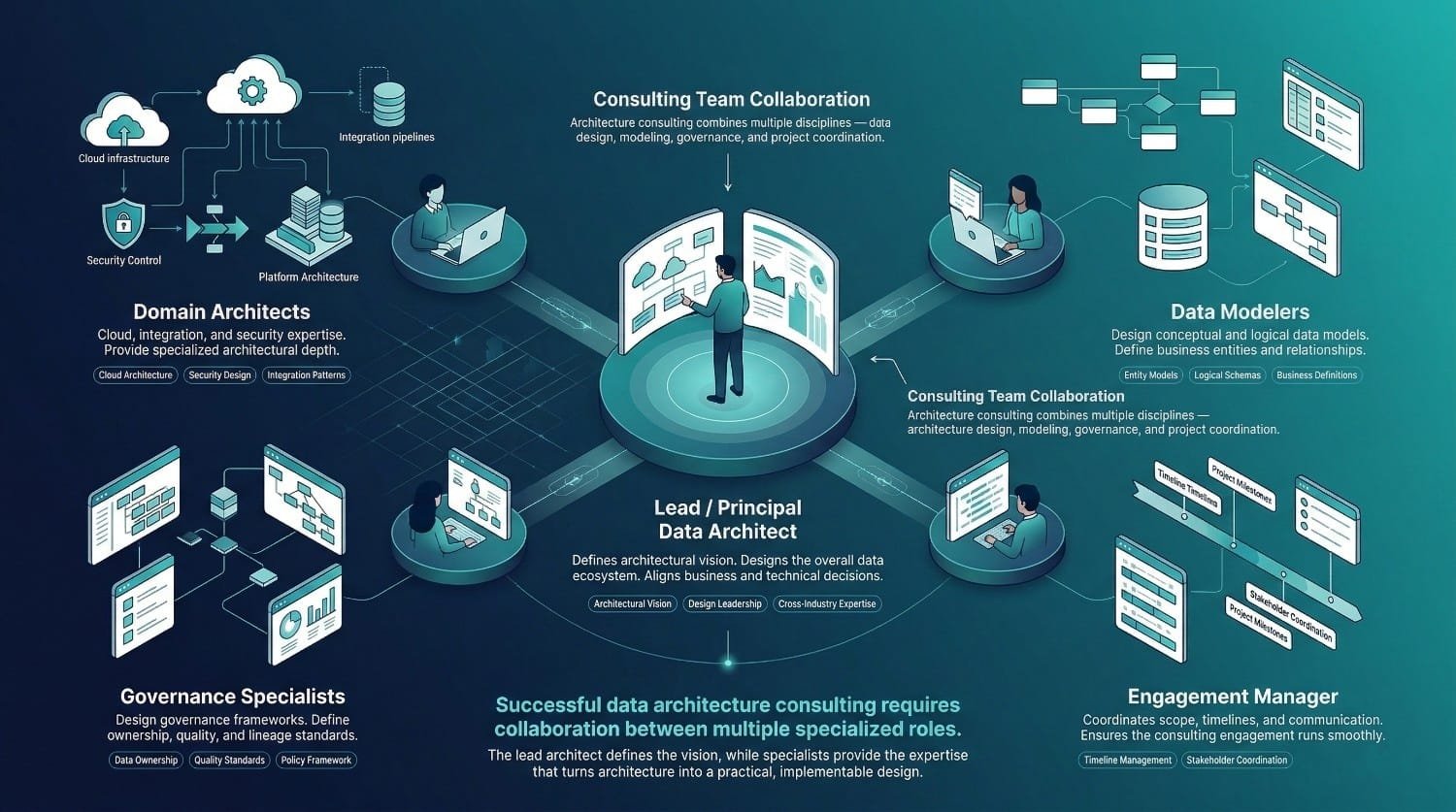
Who Is Involved in a Data Architecture Consulting Engagement?
Data architecture consulting isn’t a two-person exercise between a consultant and a data engineer. It’s a cross-functional effort that involves people from across the consulting team, the technical organization, and the business. Understanding who’s involved, and why, prevents the engagement gaps that produce architectures nobody adopts.
On the Consulting Side
Lead / Principal Data Architect
The senior expert driving the engagement. This person owns the overall architectural vision and design, synthesizing inputs from discovery, stakeholder interviews, and technical assessment into a coherent architecture that serves the organization’s needs.
They bring the cross-industry pattern recognition, the depth across architectural paradigms, and the judgment to navigate trade-offs. They’re typically someone with experience designing architectures across multiple organizations and industries and knows which patterns fit which situations, and where the hidden risks are.
This is the role that matters most. The experience and judgment of the lead architect significantly influence the quality of the engagement. If the consulting firm staffs a senior person for the sales pitch and a junior person for the work, that’s a red flag worth addressing before signing.
Domain-Specific Architects
For complex engagements, specialized architects may support the lead. A cloud architect with deep expertise in AWS or Azure infrastructure design. A security architect specializing in data classification, encryption, and access control frameworks. An integration architect focused on the patterns and platforms for data movement. A modeling specialist with deep experience in dimensional modeling, Data Vault, or domain-driven design.
Not every engagement needs all of these roles. But when the architectural scope spans multiple specialized domains, which it often does for enterprise-scale engagements, having domain-specific depth reduces the risk of superficial architectural treatment that a single generalist might produce.
Data Modelers
Focused specifically on designing the conceptual, logical, and physical data models. In many engagements, modeling is often the most labor-intensive design activity, translating business concepts into structural definitions, resolving entity relationships, and creating the shared vocabulary that the entire architecture depends on. Good data modelers combine technical precision with business empathy. They can design a normalized logical model and explain it to a marketing VP in the same meeting.
Governance Specialists
Focused on designing the governance framework, ownership models, stewardship roles, quality standards, lineage requirements, catalog strategy, and policy frameworks. Governance is architectural, and designing it well requires specific expertise that’s distinct from technical architecture.
The governance specialist ensures that the architecture isn’t just well-designed technically, but trustworthy and sustainable organizationally.
Engagement / Project Manager
Manages the operational side of the engagement, scope tracking, timeline management, deliverable coordination, and stakeholder communication. They ensure that the engagement stays on track, that deliverables are produced on schedule, and that issues are surfaced and resolved before they derail the work. This role doesn’t drive architectural decisions. But without it, even brilliant architecture work gets delivered late, over scope, or poorly communicated.
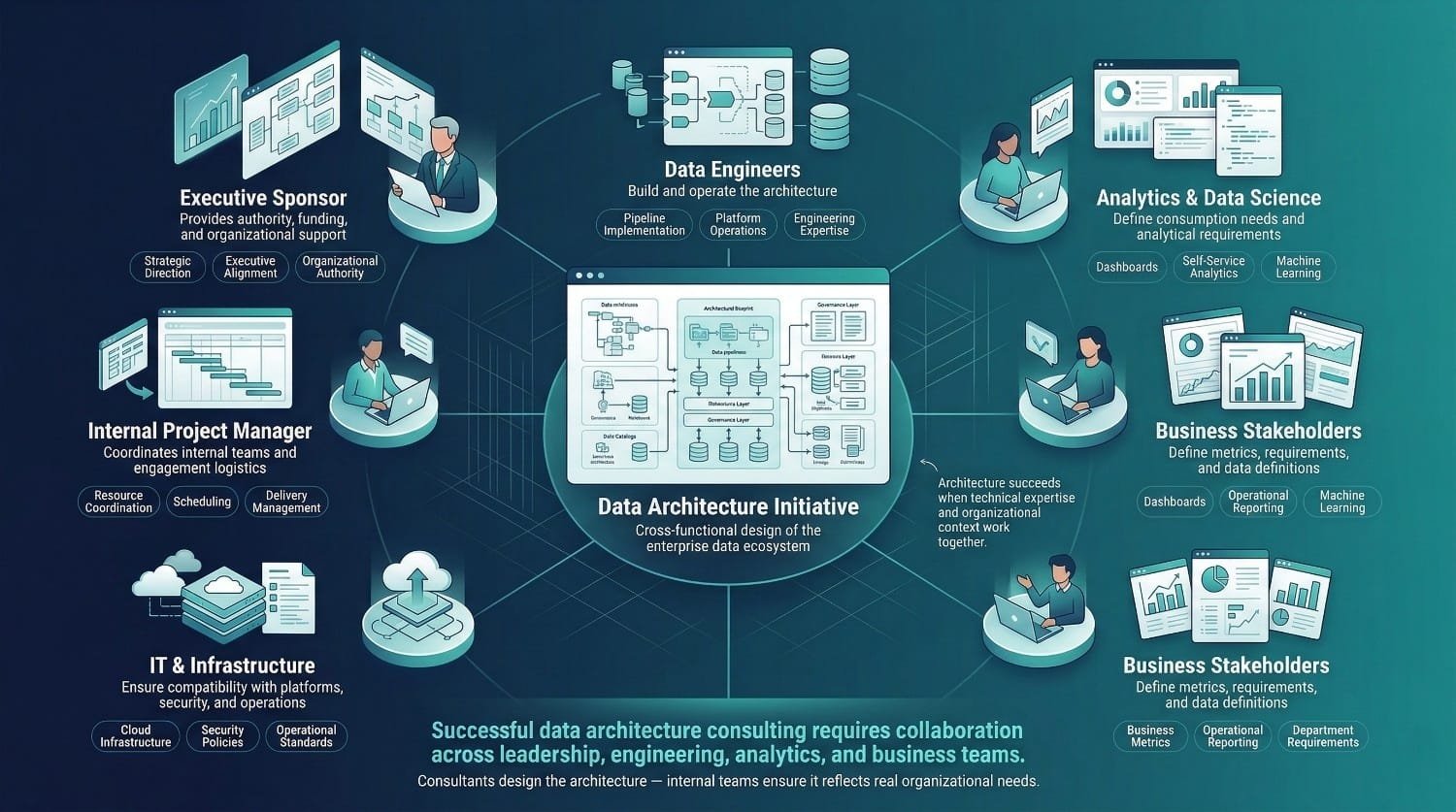
On the Client Side
The consulting team brings expertise. The client team brings context. Without both, the architecture fails.
Executive Sponsor
A senior leader, typically the CTO, CDO, CIO, or VP of Data, who champions and funds the initiative. Their role extends well beyond signing the purchase order.
The executive sponsor provides organizational authority. Architecture decisions affect multiple departments, require trade-offs between competing priorities, and sometimes mean telling a team that their preferred tool or approach isn’t the right architectural fit. Without an executive sponsor empowered to endorse cross-functional decisions, progress can slow at organizational boundaries.
They also provide visibility. When leadership visibly supports the architecture initiative, attending key reviews, communicating its importance, and allocating resources, the rest of the organization takes it seriously. Without that visibility, the engagement competes for attention with every other priority and usually loses.
Data Engineering Team
The people who will ultimately build and operate what’s designed. Their involvement isn’t optional, it’s critical for three reasons.
First, they bring operational reality. They know where the current architecture actually breaks, which workarounds exist, and what’s practically buildable with the team’s current skills and tools.Architecture designed without this input may be structurally sound but difficult to implement effectively.
Second, they need to understand the architecture deeply in order to implement it correctly. Participation during design is generally more effective than reading documentation after the fact.
Third, their buy-in matters. Engineers who helped shape the architecture will build it with ownership and pride. Engineers who receive it purely as a directive may implement it with limited ownership or enthusiasm.
Data Analysts / Data Scientists
The end consumers of the architecture, the people who will query the warehouse, build dashboards, train models, and create data products. Their input is essential for designing the consumption layer.
They know what queries they run most frequently. They know where current performance is unacceptable. They know what data they can’t access but need. They know what “self-service” actually means in their daily work. Without their input, the architecture may be perfectly designed for storing and governing data, and completely inadequate for consuming it.
Business Stakeholders
Representatives from the departments that produce and consume data, finance, marketing, operations, product, sales, customer success, compliance. Their involvement serves two purposes.
First, they define business requirements. What decisions does each department need data to support? What metrics matter? What reports are essential? What definitions need to be agreed upon? The architecture must serve these requirements, and only business stakeholders can articulate them.
Second, they contribute to governance design. Data ownership, metric definitions, quality standards, and access policies all require business input. A governance framework designed entirely by technologists will miss business context and likely won’t be adopted by the business users it’s supposed to serve.
IT / Infrastructure Team
Responsible for the underlying platforms, security infrastructure, networking, and operations that the data architecture runs on. Their involvement ensures that architectural decisions are compatible with infrastructure capabilities, security policies, and operational procedures.
They also provide critical input on constraints, what the infrastructure can support, what security policies must be followed, what operational standards apply, and what vendor relationships already exist.
Data Governance Team
If it exists, the governance team is a natural partner for governance framework design. They bring existing governance practices, policy frameworks, and organizational knowledge about what governance approaches have worked or failed in the past.
If a formal governance team doesn’t exist, governance design becomes even more important, because the architecture engagement may be the first time governance is addressed deliberately. In this case, the consulting team works with distributed stakeholders to build governance capability from scratch.
Internal Project Manager / Delivery Lead
Coordinates internal resources, manages schedules, facilitates internal decision-making, and serves as the primary operational liaison between the consulting team and the organization. They ensure that internal team members are available for interviews, workshops, and reviews, and that internal decisions don’t become blockers.
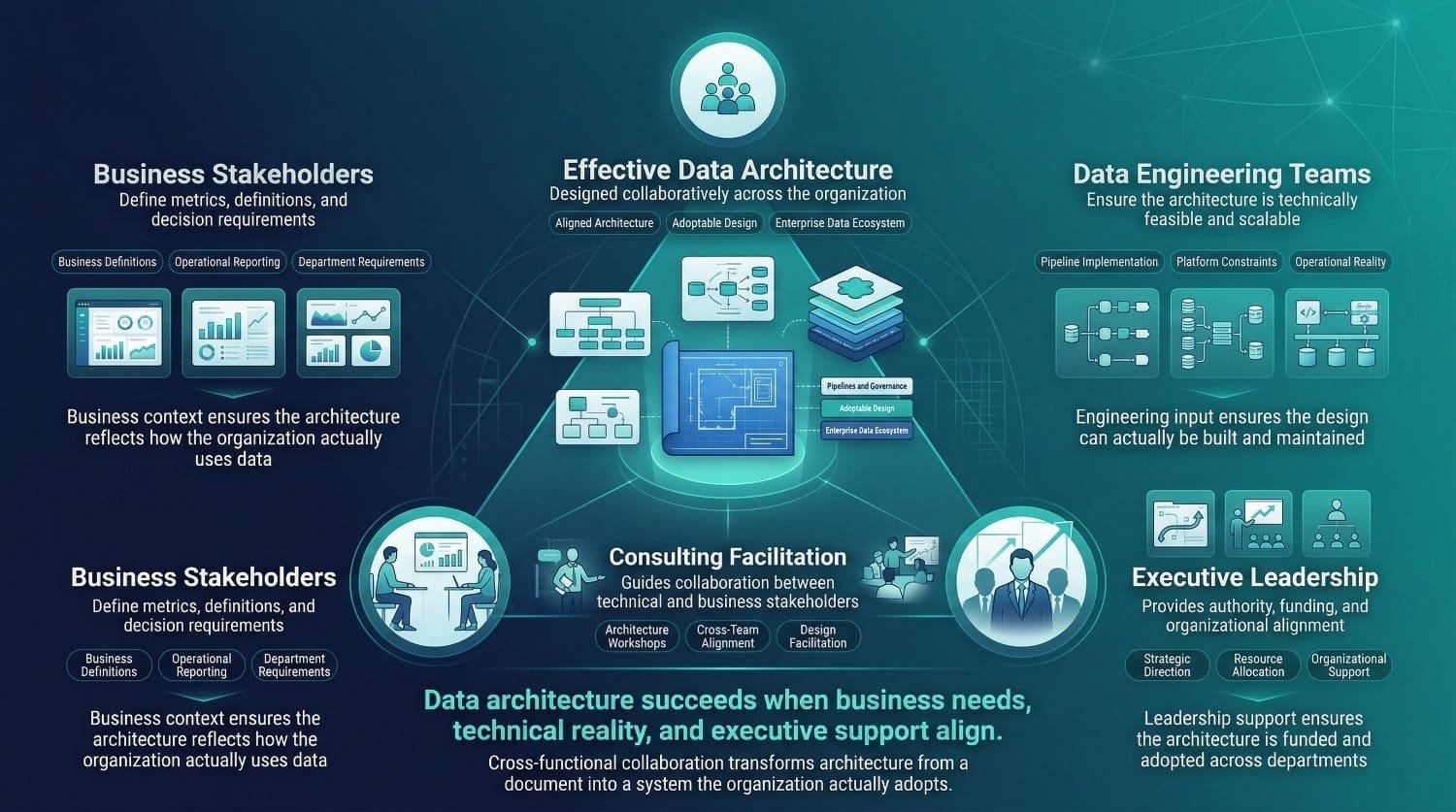
Why Cross-Functional Involvement Matters
Architecture designed without cross-functional input frequently struggles in practice.
Business Context Makes the Architecture Relevant
Without business stakeholder input, the architecture serves technical goals but not business ones. The data model is structurally elegant but doesn’t reflect how the business actually thinks about its entities. The governance framework is comprehensive but doesn’t align with how departments actually work. The consumption layer is powerful but doesn’t serve the queries analysts actually run.
Business context is what makes architecture useful, not just correct.
Engineering Input Makes the Architecture Buildable
Without engineering involvement, the architecture may describe a beautiful target state that the team can’t actually implement, because the skills don’t exist, the tools don’t support it, or the timeline is unrealistic. Engineers ground the design in practical reality.
They also surface constraints that aren’t visible from the outside. Legacy systems that can’t be changed. Vendor limitations that restrict certain approaches. Operational requirements that the architecture must accommodate. These constraints shape the design, and missing them produces architecture that fails on contact with implementation.
Executive Sponsorship Makes the Architecture Fundable and Adoptable
Without visible executive support, the architecture is a recommendation, not a mandate. Departments can ignore it. Budget requests get deprioritized. Competing initiatives take precedence. The architecture exists on paper but not in practice. Executive sponsorship significantly increases the likelihood that architectural recommendations translate into organizational commitment.
The Consultant as Facilitator
This is an underappreciated aspect of data architecture consulting. The consultant’s role isn’t just technical design. It’s facilitating conversations that wouldn’t happen organically.
Finance and marketing wouldn’t normally sit in a room and agree on what “customer” means. Engineering and analytics wouldn’t normally align on consumption layer requirements. Business units and IT wouldn’t normally negotiate governance policies together.
The architecture engagement creates the context, and the consultant provides the facilitation, for these conversations to happen. The resulting alignment is often as valuable as the architecture itself, because alignment is what makes adoption possible. Without cross-functional involvement, you get an architecture document. With it, you get an architecture that the organization understands, supports, and will actually implement.
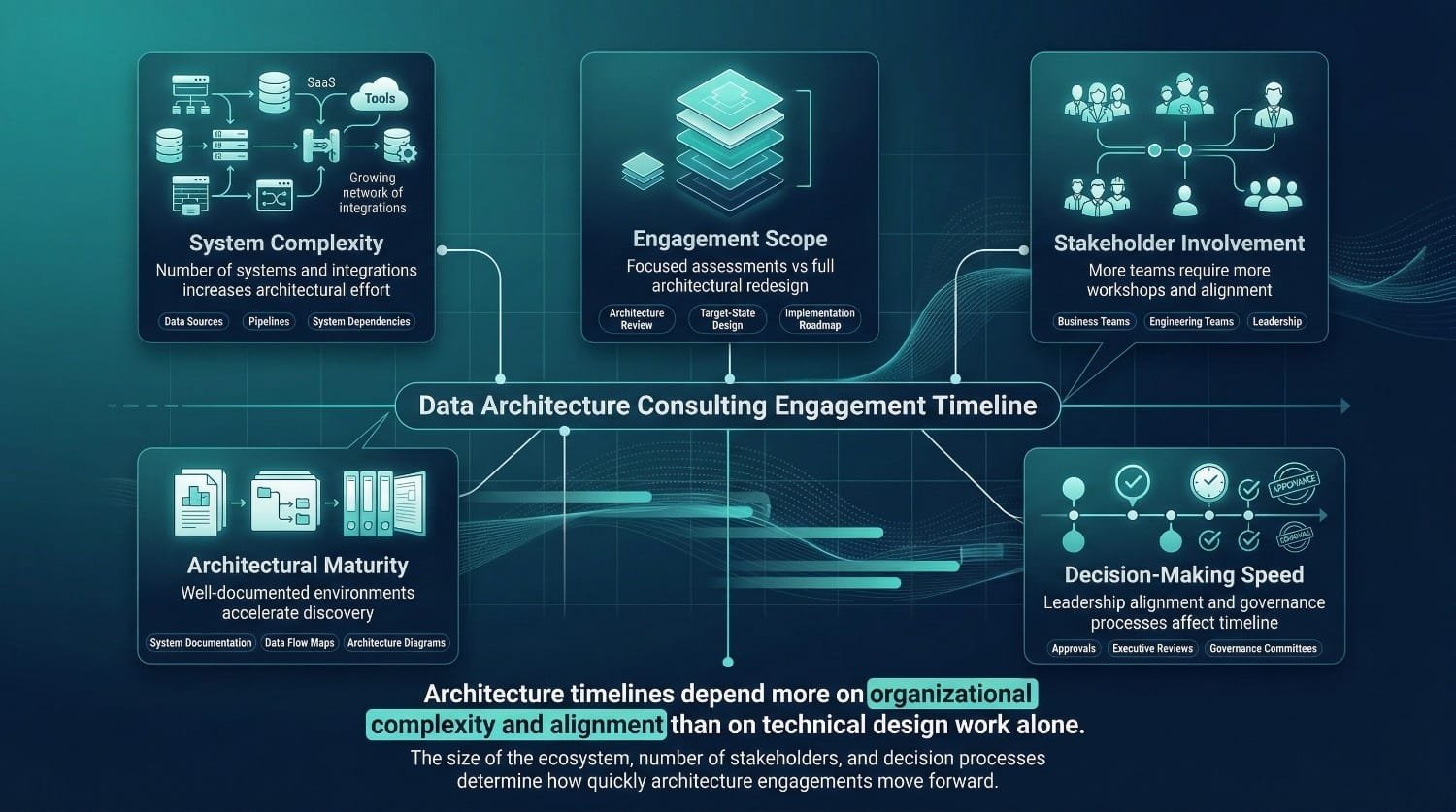
How Long Does a Data Architecture Consulting Engagement Take?
One of the first questions every organization asks about data architecture consulting is how long it takes. The honest answer is: it depends, on factors that are specific to your situation. But there are reliable ranges, and understanding what drives the timeline helps you plan realistically and resist the pressure to rush.
Factors That Influence Duration
Five variables determine how long an engagement takes. Each one can compress or extend the timeline significantly.
Size and Complexity of the Data Landscape
This is the primary driver. An organization with 8 systems, a single warehouse, and straightforward data flows can be assessed and architected far faster than one with 80+ systems spanning multiple cloud environments, legacy on-premises infrastructure, dozens of SaaS platforms, and hundreds of pipelines.
The relationship isn’t linear. Complexity grows faster than system count, because every additional system adds not just one more component to assess, but multiple new relationships, dependencies, and integration points with existing systems. The relationship between system count and effort is non-linear. As system interdependencies grow, assessment effort can increase disproportionately.
Scope of the Engagement
A focused architecture review covering critical gaps and high-level recommendations is fundamentally different from a comprehensive design engagement that produces target-state architecture across all eight layers with detailed data models, governance framework, technology recommendations, and implementation roadmap.
The scope decision should match the organization’s actual need. Not every situation requires a full design engagement. Sometimes an assessment and roadmap are exactly what’s needed, providing clarity and direction without the investment of a complete architecture project.
Number of Stakeholders and Business Domains
Architecture that serves the whole organization requires input from the whole organization. Every additional stakeholder group adds interview time, workshop time, review cycles, and alignment effort.
An engagement serving a single analytics team with one business sponsor can move quickly. An engagement serving five departments with competing priorities, separate data domains, and distinct compliance requirements takes longer, not because the technical work is harder, but because the organizational alignment work is more extensive.
Level of Existing Documentation and Architectural Maturity
If the organization has current, comprehensive documentation of its systems, data flows, models, and governance practices, the consulting team can absorb context quickly and move to analysis and design.
If, as is far more common, documentation is partial, outdated, or nonexistent, the consulting team must reconstruct the current state through investigation, interviews, and system exploration. This archaeological work is essential but time-consuming. Organizations with no documentation should expect the discovery phase to take 50–100% longer than those with comprehensive documentation.
Organizational Readiness and Decision-Making Speed
Architecture engagements require decisions, about scope, about priorities, about trade-offs, about technology, about governance. Some organizations make these decisions quickly, with empowered stakeholders and efficient approval processes. Others require multiple review cycles, committee approvals, and extended deliberation.
The consulting team can control their own pace. They can’t control how fast the organization makes decisions. Engagements that stall often do so not because of technical complexity, but because a critical decision is waiting for approval from a leader who’s unavailable, a committee that meets monthly, or a governance process that wasn’t designed for the pace the project requires.
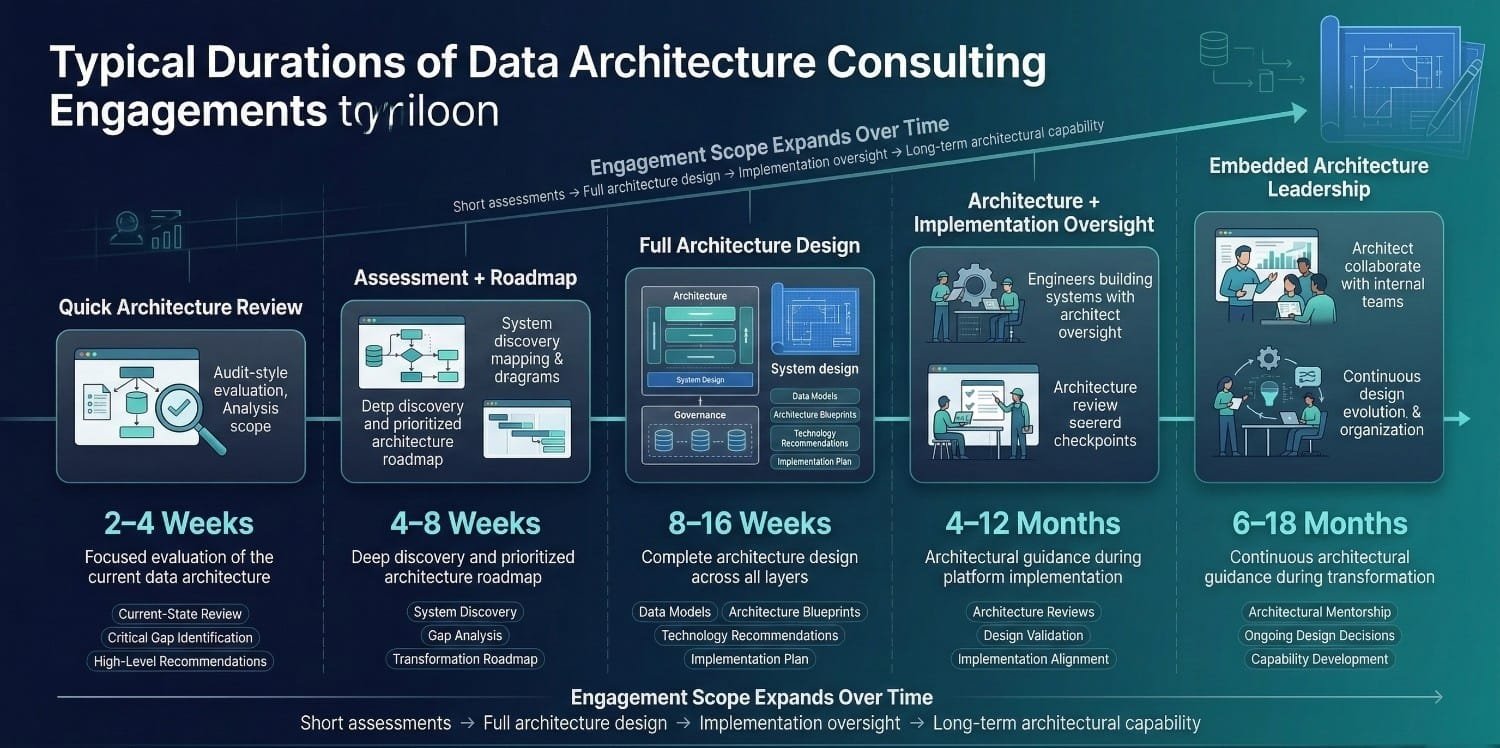
Typical Engagement Timelines
These ranges reflect real-world experience across different scopes and complexities. Your specific engagement may fall outside these ranges based on the factors above.
Quick Assessment / Architecture Review: 2–4 Weeks
What it covers: A focused evaluation of the current state, identification of the most critical gaps and risks, and high-level recommendations for next steps.
What it produces: A current-state summary, a prioritized list of architectural issues, and guidance on whether a deeper engagement is warranted and what it should focus on.
Who it’s for: Organizations that know something is wrong but aren’t sure what, or organizations that want an independent validation of their team’s assessment before committing to a larger investment.
What it doesn’t cover: Detailed target-state design, comprehensive data modeling, governance framework creation, or implementation roadmaps. This is diagnosis, not treatment.
Comprehensive Assessment + Roadmap: 4–8 Weeks
What it covers: Deep discovery across all systems and stakeholders. Thorough gap analysis comparing the current state against business requirements and best practices. A prioritized roadmap with phased recommendations. Preliminary architectural direction, not detailed design, but clear guidance on the paradigm, patterns, and approach the future state should follow.
What it produces: Complete current-state documentation, gap analysis report, and a phased roadmap that leadership can use to budget, plan, and prioritize the next steps. Often includes preliminary technology direction and governance recommendations.
Who it’s for: Organizations that need a clear plan before committing to a full design engagement. This is the most common starting point, it provides the clarity and evidence needed to justify the investment in a complete architecture initiative.
What it doesn’t cover: Detailed architecture design across all layers, comprehensive data modeling, or implementation guidance. The roadmap tells you what to do. The design engagement (next tier) tells you exactly how to do it.
Full Target-State Architecture Design: 8–16 Weeks
What it covers: Everything in the assessment plus the complete target-state architecture. Current-state assessment, gap analysis, and future-state design across all eight layers, conceptual, logical, physical, integration, governance, security, consumption, and operational. Detailed data modeling at multiple levels. Governance framework design. Technology evaluation and recommendations. Comprehensive implementation roadmap with milestones, dependencies, and resource estimates.
What it produces: The full set of architecture deliverables described in Section 5, the complete structural blueprint that engineering teams build against, governance teams operate within, and leadership funds.
Who it’s for: Organizations ready to commit to a deliberate architecture, whether they’re building from scratch, redesigning after a failure, or undertaking a major transformation. This is the engagement that most people mean when they say data architecture consulting.
What drives the range: An 8-week engagement is feasible for a moderately complex environment with 15–25 systems, cooperative stakeholders, and reasonable documentation. A 16-week engagement is typical for highly complex environments with 50+ systems, multiple business domains, significant legacy infrastructure, and minimal existing documentation.
Architecture Design + Implementation Oversight: 4–12 Months
What it covers: The full design engagement described above, followed by ongoing architectural oversight during the implementation phases. The consulting team reviews engineering decisions, conducts architecture reviews at milestones, resolves trade-offs that arise during the build, and ensures the implementation stays aligned with the design.
What it produces: Everything from the design engagement plus the confidence that what’s built actually matches what was designed. Without oversight, implementations drift from the architecture, sometimes deliberately when trade-offs arise, often inadvertently when standards aren’t enforced. Oversight catches both.
Who it’s for: Organizations undertaking major transformations where the architecture is complex enough that implementation decisions have significant architectural implications, cloud migrations, platform builds, post-acquisition consolidations, or enterprise-scale modernizations.
What drives the range: A 4-month engagement covers a focused implementation with limited phases. A 12-month engagement covers a multi-phase transformation where architectural decisions are being made continuously throughout the build.
Embedded Architect (Ongoing): 6–18 Months
What it covers: A senior architect placed within the organization to guide architectural decisions on a continuous basis. Not a project-based engagement with defined phases, but an ongoing advisory relationship where the architect participates in design reviews, evaluates new requirements, guides technology decisions, mentors the internal team, and ensures architectural integrity across all concurrent initiatives.
What it produces: Continuous architectural guidance, not a single deliverable, but a sustained capability. The architecture evolves soundly because every significant decision has architectural oversight. The internal team develops architectural skills through ongoing mentorship. Standards are maintained in real time, not reviewed periodically.
Who it’s for: Organizations in sustained transformation where architectural decisions are being made weekly or daily, not just during a single initiative. Also well-suited for organizations building internal architectural capability that doesn’t yet exist, where the embedded architect serves as both practitioner and teacher.
What drives the range: 6 months is sufficient for a focused transformation with a clear end state. 18 months covers a multi-year transformation with evolving requirements, multiple concurrent workstreams, and significant internal capability building.
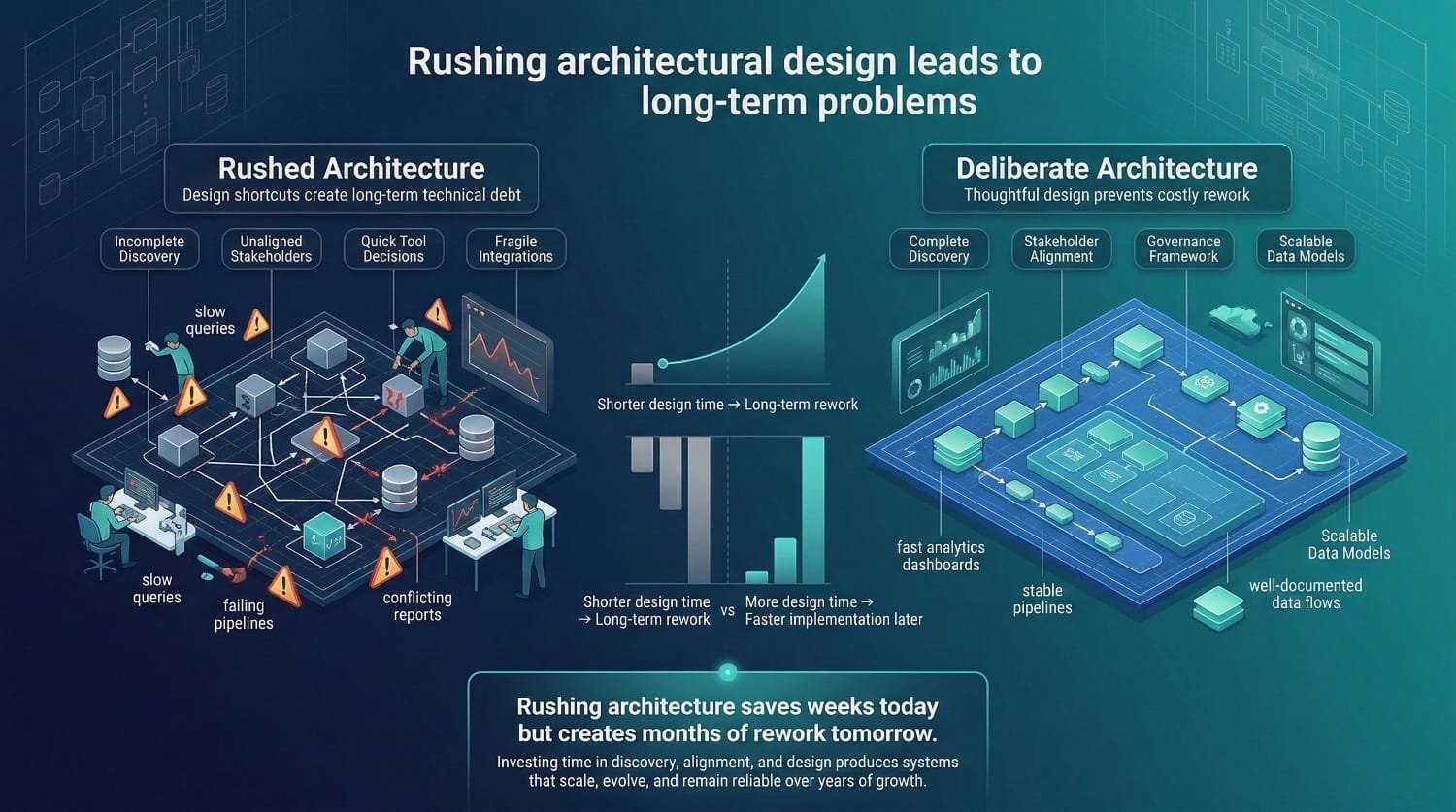
Why Rushing Architecture Is Counterproductive
The pressure to compress architectural timelines is universal. Leadership wants results. The team wants to start building. The business is impatient.
That pressure is understandable. Yielding to it is expensive.
Architecture Decisions Have Long-Lasting Consequences
The data model designed during this engagement will be in production for 3–5 years. The integration patterns will be replicated across every future pipeline. The governance framework will shape how every team interacts with data. The technology selections will create dependencies that persist for the length of their contracts and beyond.
These decisions deserve the time required to get them right. A modeling decision made in haste, choosing a structure that’s fast to implement but doesn’t accommodate foreseeable growth, creates rework measured in months when the growth arrives. A technology selection rushed through without proper evaluation creates lock-in that costs hundreds of thousands when the misfit becomes apparent.
Insufficient Discovery Produces Designs That Don't Fit
When discovery is rushed, the consulting team designs based on incomplete understanding. They miss undocumented systems, hidden dependencies, critical constraints, and stakeholder requirements that weren’t surfaced. The architecture looks sound, until implementation reveals the gaps that shorter discovery would have caught. Every week of discovery cut from the timeline typically adds 2–4 weeks of rework during implementation. The math is clear: invest the time upfront or pay multiples of it later.
Stakeholder Alignment Takes Time But Prevents Costly Rework
Getting five departments to agree on shared data definitions, ownership models, and governance policies can’t be compressed below a certain minimum. The conversations need to happen. The disagreements need to surface. The compromises need to be negotiated. Rushing alignment, or skipping it entirely, produces an architecture that looks finished but isn’t adopted. Departments that weren’t consulted don’t feel ownership. Definitions that weren’t negotiated get contested during implementation. Governance that was imposed rather than agreed upon gets ignored.
The Trade-Off
A few extra weeks of architectural design can save months of implementation delays and years of rework.
The organizations that regret their architecture engagement almost never say “we spent too long on design.” They say “we rushed the discovery” or “we didn’t align stakeholders” or “we skipped the governance framework because it seemed like it would take too long.” Give the architecture the time it deserves. It’s the cheapest time you’ll spend on the entire transformation, because every hour invested in sound design prevents days of fixing the consequences of unsound design.
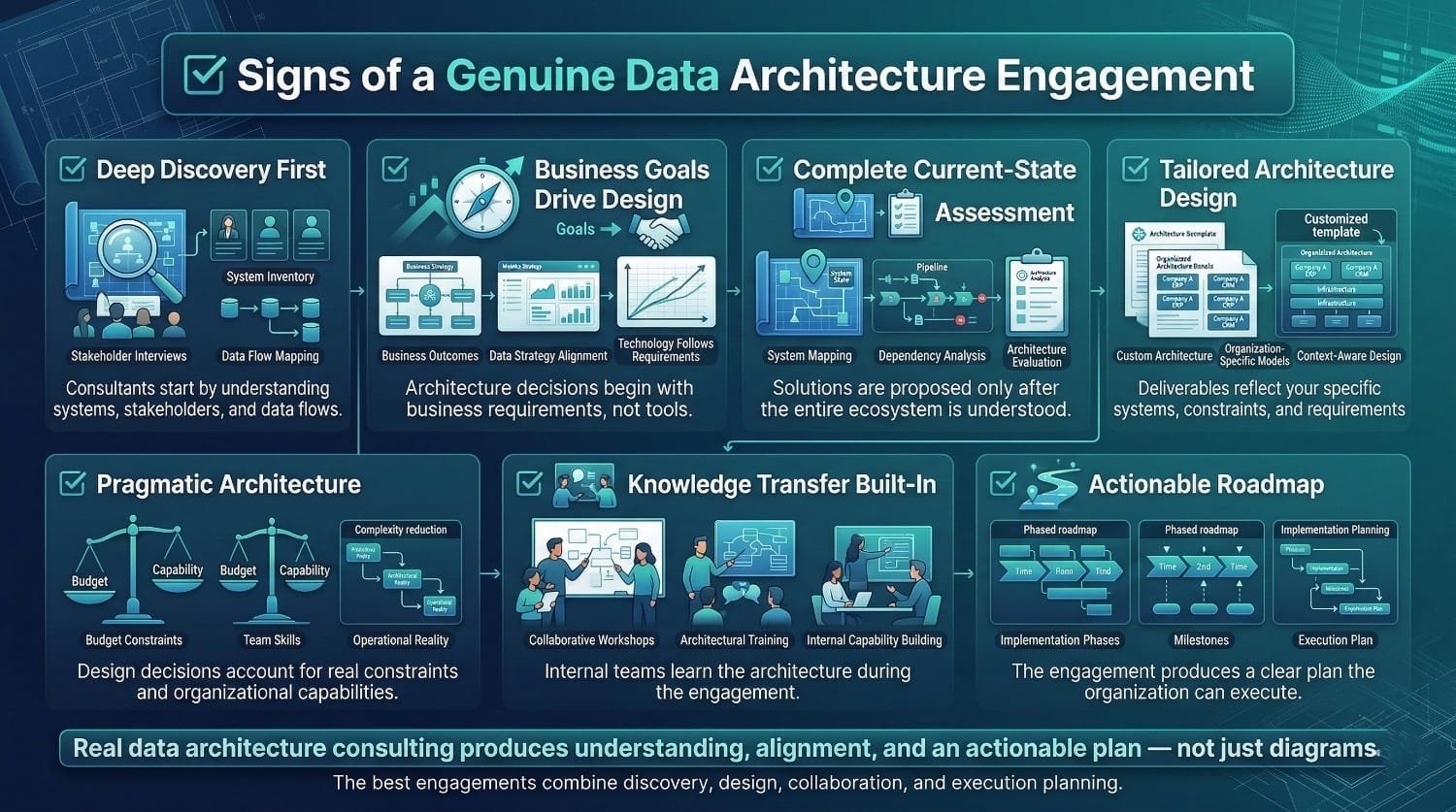
How to Know If You're Getting Real Data Architecture Consulting
The market is full of services labeled “data architecture consulting” that deliver something else. This section gives you the ability to distinguish the real thing from the repackaged alternative, both before you sign and during the engagement itself.
Signs of a Genuine Architecture Engagement
These are the indicators that you’re working with a partner who’s delivering real data architecture consulting, not a relabeled implementation, not a tool pitch, not a templated assessment.
The Engagement Starts with Deep Discovery
The first weeks are spent listening, mapping, and understanding, not presenting solutions. The consulting team interviews stakeholders across business and technology. They inventory systems, trace data flows, and profile data quality. They ask questions that reveal the current state in its full complexity, including the uncomfortable parts.
If the first meeting involves a tool recommendation or an architecture diagram, the engagement isn’t starting with discovery. It’s starting with assumptions, and assumptions produce architectures that don’t fit.
Business Goals Come Before Technology Discussion
The first substantive questions are about the business, not the tech stack. What decisions does leadership need data to support? What initiatives are blocked? What compliance requirements must be met? What does success look like in terms the CEO would understand?
Technology is discussed after business requirements are established, because the business requirements determine what the technology needs to do. A consulting partner who leads with “what cloud platform are you on?” before asking “what are you trying to achieve?” has the sequence backward.
The Current State Is Assessed Thoroughly Before Solutions Are Proposed
No architecture is proposed until the consulting team has a complete, documented understanding of what exists today. They don’t assume they know the answer after a few interviews. They don’t extrapolate from partial information. They map the landscape systematically, including the parts that are undocumented, the systems the team forgot to mention, and the dependencies that nobody knew existed.
Solutions proposed before thorough assessment are solutions to the wrong problem. A genuine architecture partner earns the right to recommend by first demonstrating that they understand.
Deliverables Are Tailored to Your Organization
The architecture documents, data models, governance frameworks, and roadmaps are specific to your systems, your requirements, your constraints, and your organizational context. They reference your actual databases by name, your actual data flows by path, and your actual business requirements by department.
If the deliverables feel like they could apply to any mid-sized company in any industry, with a few names swapped, they’re templates, not architecture.Effective data architecture consulting produces work clearly tailored to the specific organization.
The Design Accounts for Your Real Constraints
The architecture is designed for the team you actually have, the budget you’ve actually allocated, the skills your engineers actually possess, and the organizational culture you actually operate within. Trade-offs between the ideal and the practical are made explicitly and documented honestly. An architecture that assumes a team twice your size, a budget three times your allocation, or skills your team hasn’t developed isn’t pragmatic architecture. It’s academic exercise. Real architecture consulting designs within constraints, making them explicit, navigating them intelligently, and phasing the ambition to match the organization’s real capacity.
Knowledge Transfer Is Embedded from Day One
Your team is participating in discovery, attending design sessions, reviewing deliverables, and asking questions throughout the engagement, not receiving a finished document at the end. The consulting team actively ensures that internal staff understand not just what was designed, but why each decision was made.
By the engagement’s midpoint, your team should be able to explain the architectural direction to a colleague who wasn’t involved. By the end, they should be able to make routine architectural decisions independently, using the framework and standards the engagement established.
The Consultants Challenge Your Assumptions
A genuine architecture partner isn’t a “yes” team. They push back when your assumptions don’t align with what they’ve discovered. They tell you when a preferred tool isn’t the right fit. They surface uncomfortable truths about technical debt, governance gaps, or organizational dynamics that are contributing to your problems.
This can feel confrontational. It’s not. It’s the consulting team doing their job, ensuring the architecture is designed based on reality, not on the version of reality that’s most comfortable.
If the consulting team consistently avoids challenging assumptions, validates every assumption, and never challenges a decision, they’re either not doing real architecture work or they’re prioritizing the relationship over the outcome. Neither serves you.
The Output Is Actionable
When the engagement ends, you know exactly what to do next. Not in vague terms, but specifically: which phase to start, which systems to address first, which team members to assign, what the milestones are, and what success looks like at each stage.
If the deliverable requires a second engagement just to figure out what to do with it, the first engagement didn’t deliver enough actionability. Real architecture consulting produces outputs that connect directly to execution, a roadmap the organization can start building against immediately.
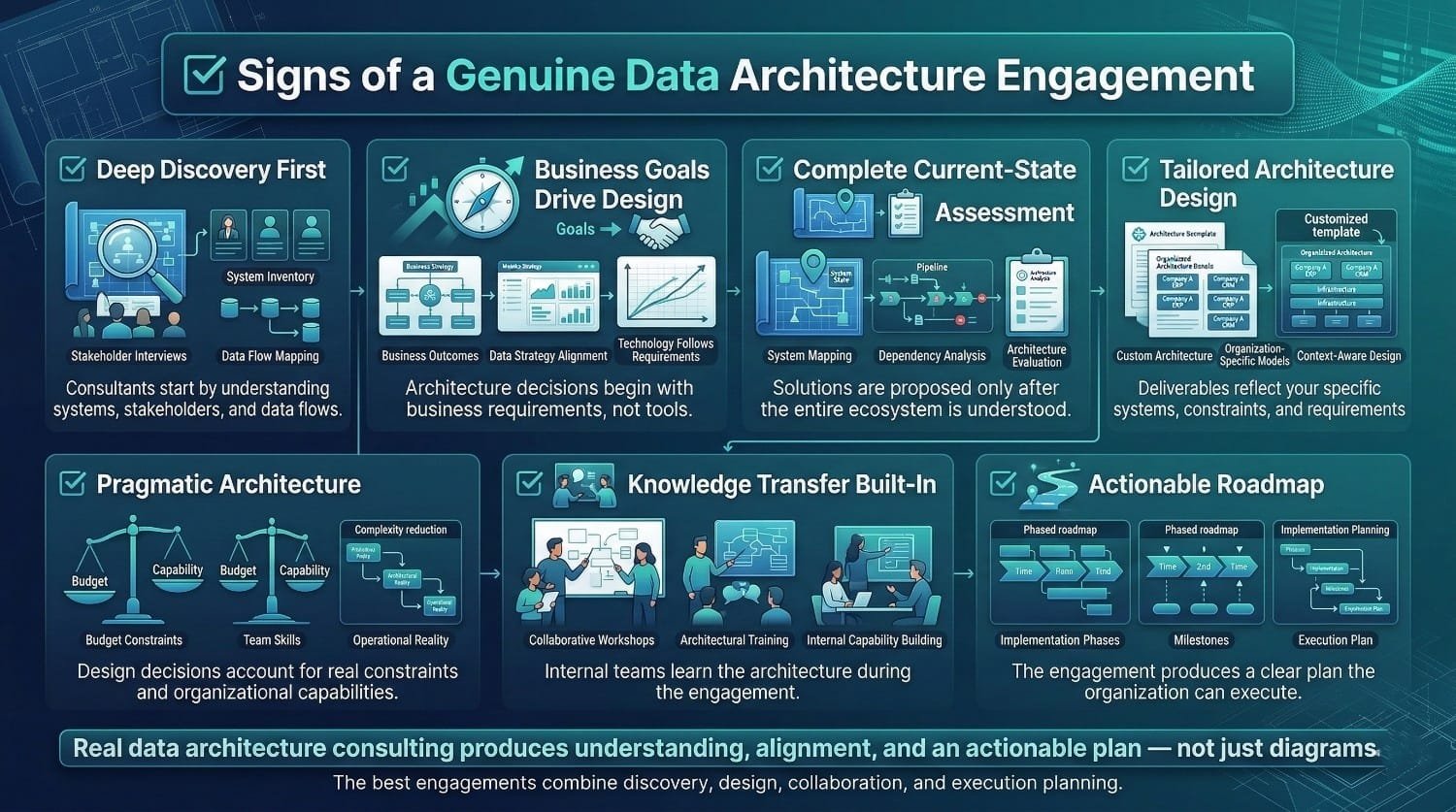
Signs You're NOT Getting Real Architecture Consulting
These are the red flags, observable during the sales process, the early weeks, or at delivery, that indicate the engagement isn’t delivering genuine data architecture consulting.
They Jump Straight to Tool Recommendations
Before understanding your landscape, your requirements, or your constraints, the consulting team is already recommending a platform. “You need Snowflake” or “you should be on Databricks” or “let’s get you on our partner’s iPaaS”, said in the first or second meeting, before any discovery has occurred.
Tool recommendations are an output of architecture. They’re not the starting point. A consultant who leads with tool selection is selling, not architecting.
The Deliverable Is a Vendor-Specific Implementation Plan
The “architecture” document describes how to configure, implement, and optimize a specific vendor’s platform, not how to design the data ecosystem as a whole. It covers one tool’s features, one tool’s patterns, and one tool’s best practices. The broader questions, data modeling, governance, security, cross-system integration, consumption layer design, are either absent or treated as footnotes.
This is implementation consulting, not architecture consulting. Valuable in its place, but not what the label promises.
There's No Discovery Phase
The consulting team claims to know what you need based on a few conversations, a slide deck, or their experience with “similar organizations.” They propose a solution before they’ve assessed your situation. They start designing before they’ve mapped the current state. This isn’t confidence. It’s a shortcut that produces architecture designed for a generic organization rather than yours. Every organization’s data landscape has unique characteristics, hidden dependencies, and specific constraints that only systematic discovery reveals.
Deliverables Look Generic
The architecture documents, governance frameworks, and roadmaps feel like they were produced from a template with your company name inserted. The patterns are standard. The technology recommendations are the same ones this firm always recommends. The governance framework is their standard model, not one designed for your organizational structure and maturity. Templates are useful starting points. They are not architecture consulting. The value of data architecture consulting is in the tailoring, the specific design decisions made for your specific context. If the specificity isn’t there, the value isn’t either.
No Engagement with Business Stakeholders
The entire engagement is conducted within IT and the data team. No business leaders are interviewed. No department heads provide requirements. No analysts describe their consumption needs. No compliance officers contribute regulatory constraints. Architecture designed without business input serves technical goals but not business outcomes. It produces models that don’t reflect how the business thinks, governance that doesn’t align with how departments work, and consumption layers that don’t serve the people who actually need the data.
No Governance, Quality, or Organizational Components
The deliverables are entirely technical, system diagrams, pipeline designs, and technology recommendations. There’s no governance framework. No data quality architecture. No ownership model. No organizational change management. No standards or principles document.
This is technical design, not architecture. Architecture encompasses the organizational and governance dimensions as inseparably as the technical ones. Without them, the technical design will be implemented but not governed, operated but not trusted, built but not sustained.
No Knowledge Transfer
The consulting team works independently, producing deliverables that they present to you as finished products. Your team wasn’t involved in the creation. The documentation is in the consultant’s format, not yours. Decision rationale isn’t captured. And when you ask how to maintain or evolve the architecture, the answer is “we offer ongoing support contracts.”
This is dependency creation, not consulting. Genuine architecture consulting leaves the organization more capable than before. If the engagement ends and your team can’t operate independently, the most important deliverable, capability transfer, was never delivered.
The Engagement Ends with a Document Handoff
The consulting team delivers a comprehensive document, presents it in a final meeting, and walks away. No implementation guidance. No transition support. No governance process establishment. No follow-through to ensure the architecture is understood, adopted, and actionable. A document without adoption has limited practical value. Real data architecture consulting doesn’t end at delivery. It ends when the organization can implement, maintain, and evolve the architecture independently, which requires more than handing over a PDF.
The Evaluation Principle
Genuine data architecture consulting is recognizable by its depth, its specificity, its organizational engagement, and the capability it leaves behind. Anything less is something else wearing the label.
Before engaging a partner, ask for examples of their deliverables. Talk to past clients about their experience, not just whether the documents were good, but whether the architecture was adopted, whether the team was uplifted, and whether the design is still serving the organization months or years later.
The answers will tell you whether you’re getting real data architecture consulting, or a label applied to something that won’t deliver the value the investment deserves.
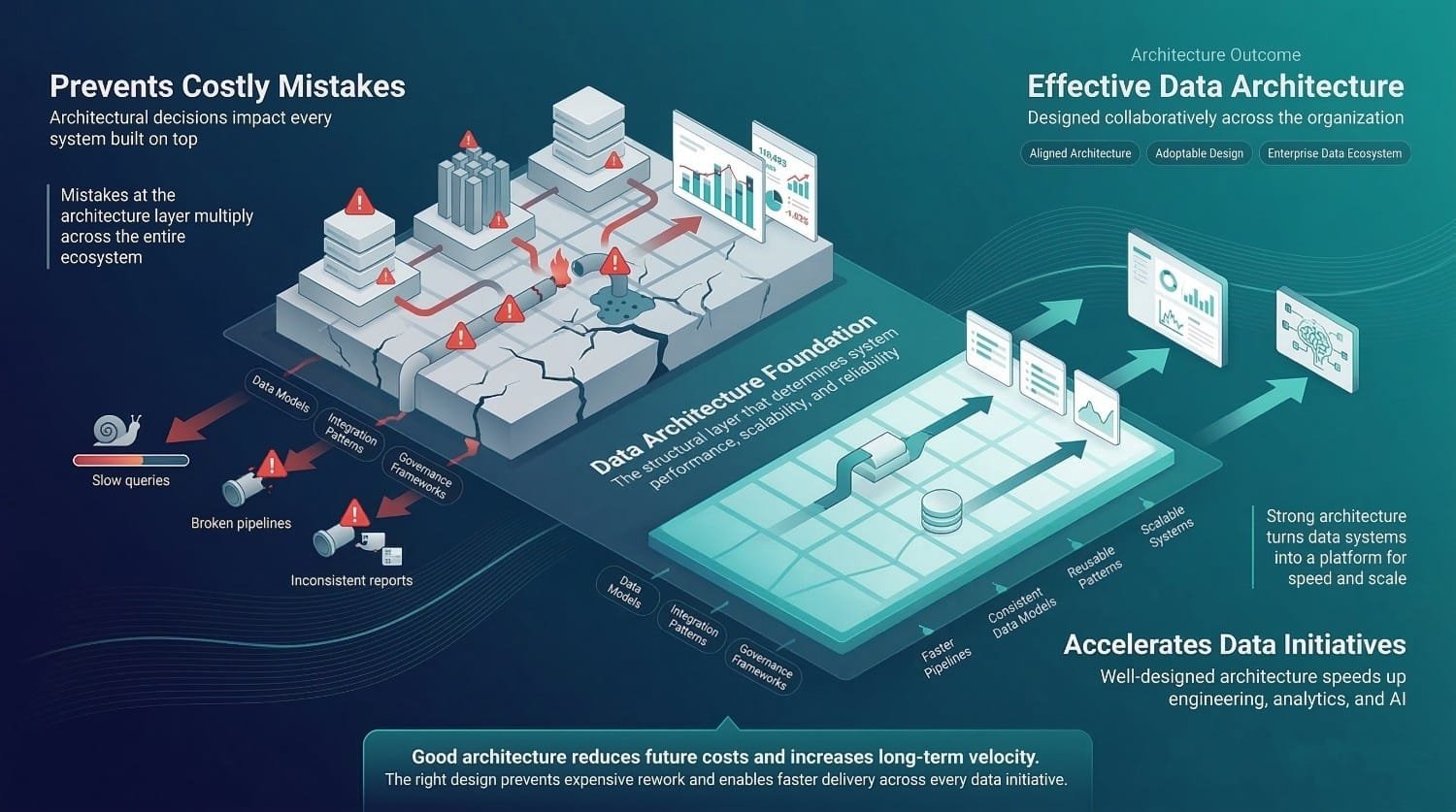
The Value of Data Architecture Consulting: Why It Matters
Understanding what data architecture consulting is and isn’t is essential. Understanding why it matters, the specific mechanisms through which it creates value, is what turns understanding into action. The value isn’t abstract. It’s measurable, specific, and shows up in five distinct ways.
It Prevents Costly Mistakes
This is the value dimension that’s hardest to see and easiest to underestimate, because you’re measuring the cost of things that didn’t happen.
How Architectural Mistakes Cascade
Architecture is the foundation layer. Every decision made here propagates upward through every system, pipeline, model, dashboard, and business process built on top of it.
A data model designed without understanding the full range of query patterns creates performance problems that surface in every report and every dashboard, not just one. An integration pattern that doesn’t scale creates bottlenecks that affect every team consuming integrated data, not just the team that built the pipeline. A governance framework that’s missing from the architecture creates trust problems that undermine every analytics initiative, not just the first one.
Architectural mistakes don’t stay contained. They multiply.
The Cost of Getting It Wrong
The industry rule of thumb is well-established: re-architecting after building on a flawed foundation is typically significantly more expensive than getting the foundation right initially. This isn’t just the cost of redesigning. It’s the cost of decommissioning what was built, migrating data and processes to the new design, retraining teams, and absorbing the productivity loss during the transition, all while the business continues to need the data that the old architecture was (poorly) delivering.
Preventing a flawed foundation can avoid substantial future re-architecture and migration costs in future re-architecture costs. That’s not theoretical. It’s the math that organizations who’ve been through re-architecture can confirm from painful experience.
What Consulting Brings
Pattern recognition. The consulting team has seen what fails and what succeeds across dozens of organizations. They know which modeling approaches create scaling problems at 10x growth. They know which integration patterns become unmaintainable at 30+ sources. They know which governance shortcuts create compliance exposure that surfaces 18 months later.
Your organization encounters each architectural decision for the first time. The consulting team has encountered most of them dozens of times. That experience is what prevents the mistakes that first-timers make, mistakes that are entirely predictable to someone who’s seen the pattern before.
It Accelerates Everything Else
Architecture is the accelerator, or the bottleneck, for every data initiative that follows.
How Sound Architecture Creates Speed
When the architecture is clear and well-designed, many downstream initiatives move more efficiently.
Data engineering accelerates because engineers aren’t debating fundamental design questions with every new pipeline. The patterns exist. The standards are documented. The models are defined. Engineers spend their time building within a proven framework rather than inventing a new approach for every project.
Analytics accelerates because analysts aren’t spending weeks assembling data from multiple systems, reconciling conflicting definitions, and cleaning quality issues. The data is unified, governed, and served through interfaces designed for analytical consumption.
AI and ML initiatives often benefit because less time is spent on ad hoc data preparation on data preparation. The feature engineering pipeline exists. The training data is clean and documented. The serving infrastructure is designed for model deployment.
Governance accelerates because the framework is embedded in the architecture, not bolted on as a separate initiative. Ownership is defined. Quality is monitored. Lineage is tracked. Governance operationalizes naturally because the architecture was designed to support it.
New projects accelerate because they leverage established patterns and standards instead of starting from scratch. The second project that uses the architecture is dramatically faster than the first. Later initiatives often benefit from increasing standardization and repeatability.
The Compounding Effect
The acceleration compounds over time. Each new initiative built on the architecture benefits from the patterns, standards, and infrastructure established by previous ones. The architecture becomes a platform for velocity, not just for the current set of projects, but for every future initiative the organization undertakes.
Organizations without architecture reinvent the wheel with every project. Organizations with architecture build on an expanding foundation of reusable capability. Over 2–3 years, the cumulative speed difference is enormous.
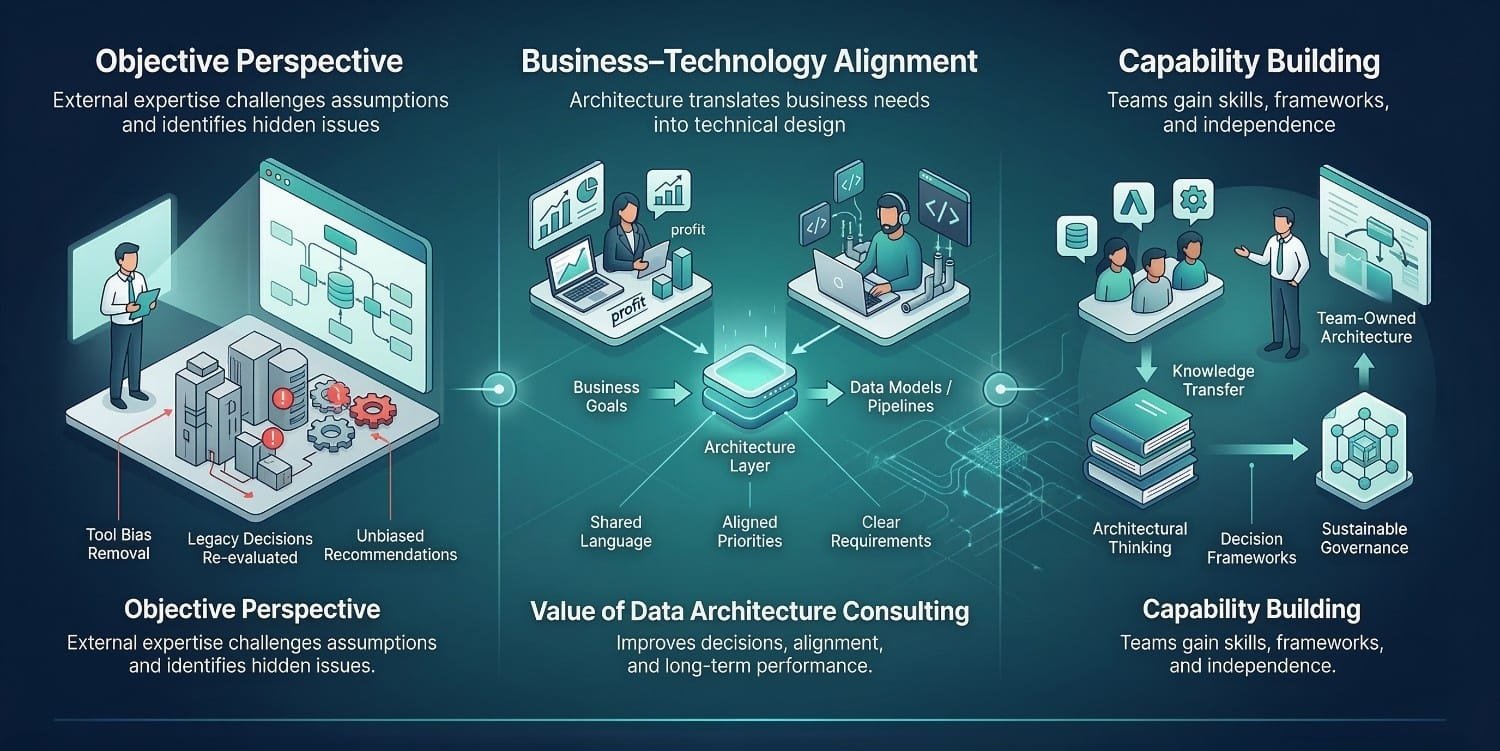
It Provides Objectivity
Internal teams make good decisions. But they make them within constraints that an external perspective can see more clearly.
The Constraints Internal Teams Operate Within
Existing tooling bias. The team is deeply skilled in their current tools. Recommending a different platform feels like admitting their investment was wrong, even when a different platform is genuinely a better fit for the architecture.
Historical decision anchoring. The team made architectural decisions years ago for reasons that may no longer apply. But those decisions feel permanent because so much has been built on top of them. Questioning them feels risky and disruptive.
Vendor relationship inertia. The organization has a relationship with their current vendors, contracts, support agreements, trained staff. Recommending a change means disrupting those relationships and absorbing switching costs. Even when the architecture would benefit from a different tool, the path of least resistance is to stay.
Organizational politics. A team lead championed the current architecture. A VP approved the tool purchase. Questioning those decisions questions the people who made them. Internal team members may not feel empowered, or safe, challenging decisions made by more senior colleagues.
Normalization of dysfunction. The team has lived with the current architecture for so long that its problems feel normal. “That query always takes 20 minutes” or “we always have to reconcile those numbers manually”, these aren’t seen as architectural failures because they’ve been accepted as the way things work.
What External Objectivity Provides
An external architect arrives without any of these constraints. They have no loyalty to existing tools, no investment in historical decisions, no vendor relationships to protect, and no political considerations about who made which choices.
They can raise issues that internal teams may recognize but find difficult to surface: “This tool isn’t the right fit.” “This data model was designed for a use case that no longer exists.” “This governance gap is creating compliance risk.” “The architecture you built five years ago was sound then, but it’s constraining you now.”
This objectivity isn’t about being smarter than the internal team. It’s about having the freedom to see and say things that organizational context makes difficult for insiders to see and say. Strong internal teams often value external validation and perspective, because it gives them the evidence and the authority to advocate for changes they’ve been wanting to make.
It Bridges Business and Technology
One of the most valuable, and least recognized, contributions of data architecture consulting is serving as a translator between two groups that struggle to communicate directly.
The Communication Gap
Business stakeholders think in terms of outcomes: revenue, customer retention, operational efficiency, competitive advantage, regulatory compliance. They don’t think in terms of data models, pipeline patterns, or storage tiers. When they say “we need better customer data,” they mean “I want a single, trustworthy view of every customer that helps me sell more effectively.” They don’t mean “design a canonical customer entity with resolved duplicates served through a semantic layer.”
Data teams think in terms of systems, models, and infrastructure. When they hear “better customer data,” they think about ETL pipelines, entity resolution, and warehouse optimization. They can solve the technical problem brilliantly, but may miss the business requirement entirely if they don’t understand what “better” means in business terms.
The gap between these two perspectives is where most data initiatives lose alignment, and where architecture consulting adds unique value.
How Architecture Consulting Bridges the Gap
The architect operates in both worlds simultaneously. In a business stakeholder workshop, they translate “I need to understand customer lifetime value across all touchpoints” into architectural requirements: unified customer model, cross-channel data integration, calculated metrics in the semantic layer, historical tracking for trend analysis.
In a technical design session, they translate “we’re building a star schema with a customer dimension and a transaction fact table” into business language: “this design gives your team the ability to analyze customer purchasing patterns across all channels, with history going back three years, updated daily.”
The architecture provides a shared framework through which both sides can align, because the architecture is the structural translation between business needs and technical design.
The Alignment Outcome
When business and technology teams share a common framework, the architecture, conversations become productive instead of frustrating. Business leaders can describe what they need without learning technical jargon. Engineers can design solutions with confidence that they’re solving the right business problem. Priorities can be negotiated based on shared understanding rather than mutual incomprehension.
This alignment is often the engagement’s most lasting contribution. Long after the specific architectural decisions have been implemented and evolved, the shared language and collaborative framework remain, enabling every future conversation between business and technology to be more productive.
It Builds Long-Term Capability
The final value dimension, and the one that separates data architecture consulting that creates lasting impact from consulting that creates lasting dependency.
What Capability Transfer Looks Like
The internal team gains architectural thinking. Not just the specific architecture for this engagement, but the ability to think architecturally, to evaluate trade-offs, to consider cross-system implications, to design for evolution rather than just for today’s requirements. This mindset shift can have long-term impact.
Decision-making frameworks persist. The principles, standards, and governance processes established during the engagement give the organization a framework for making every future architectural decision. When a new requirement arises, the team doesn’t need to call the consultant. They apply the principles and standards to evaluate their options.
Documentation enables continuity. When team members leave and new ones join, the architecture documentation, with decision rationale, design principles, and standards, enables new team members to understand the architecture and contribute to its evolution. The knowledge isn’t lost with any single departure.
Governance processes sustain quality. Review boards, standards enforcement, and decision logs keep the architecture healthy without external oversight. The organization has the mechanisms to maintain architectural integrity on its own.
The Test of Real Capability Transfer
Ask one question 12 months after the engagement ends:
“Can your team make significant architectural decisions confidently and independently, without consulting the external team?”
If yes, the engagement delivered genuine capability. The organization is stronger and more self-sufficient than before. The consulting investment has permanent, compounding returns because every future decision benefits from the capability that was built.
If no, if the team still calls the consultant for every significant decision, still can’t explain the architectural rationale to new hires, and still can’t evolve the design when requirements change, the engagement created dependency, not capability. The organization is paying ongoing costs for something that should have been a one-time investment in internal strength.
This distinction is the difference between data architecture consulting that delivers lasting value and consulting that delivers a recurring invoice. Strong partners aim to build internal capability that reduces long-term dependency, leaving an organization that no longer needs them, equipped with the capability to thrive independently.
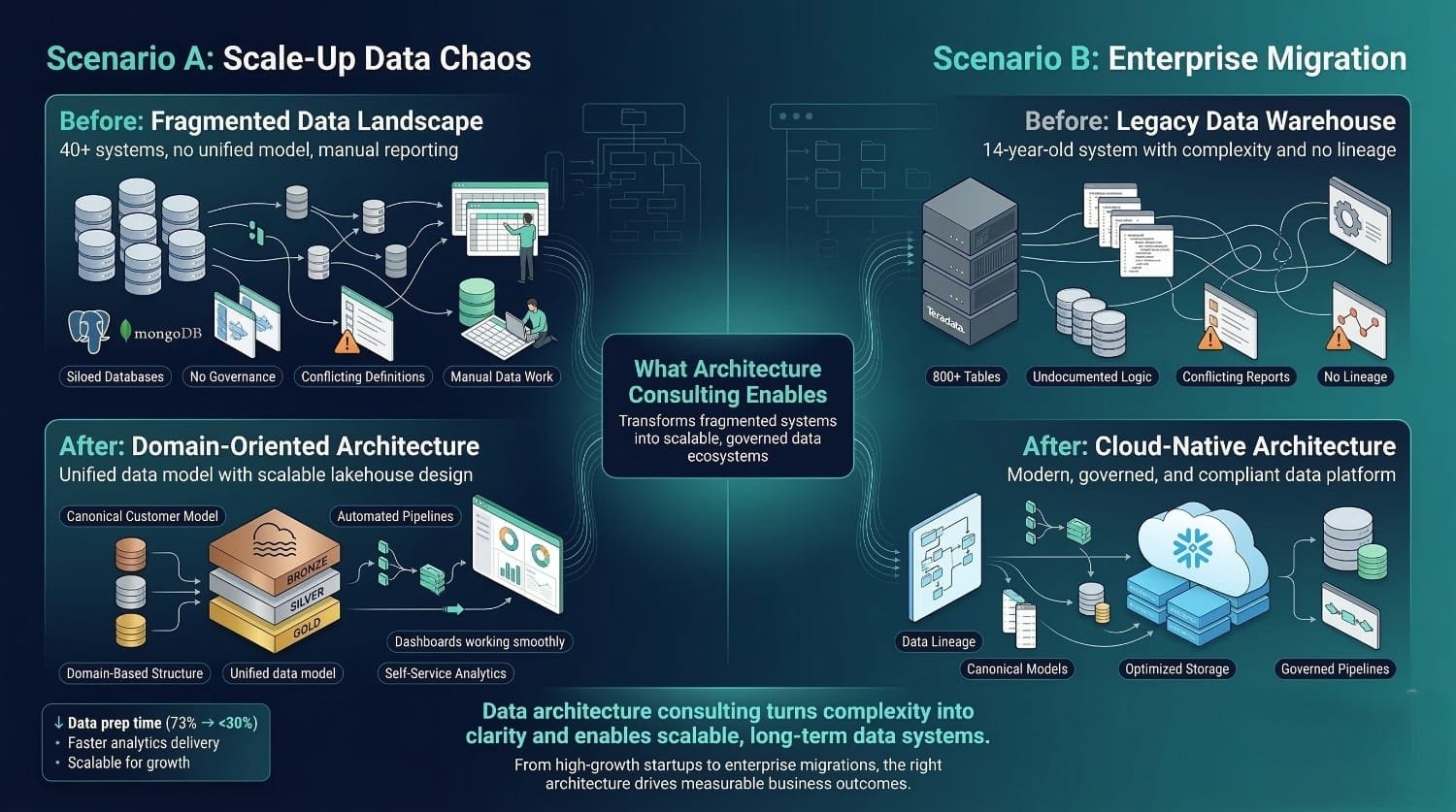
Real-World Scenarios
The previous sections defined data architecture consulting in theory. These four scenarios show what it looks like in practice, real complexity, real constraints, real decisions, and real outcomes.
The details are illustrative. The patterns are what actually happens.
Scenario A: The Scale-Up That Outgrew Its Data Infrastructure
The Situation
A 500-person B2B SaaS company, $75M ARR, growing 40% year-over-year. The engineering team had built a great product. The data infrastructure had received no deliberate architectural attention.
Over five years of rapid product development, 40+ microservice databases had been deployed. PostgreSQL, MongoDB, DynamoDB, Redis, each service managed its own data in whatever technology the developing team preferred. No unified analytical layer existed. No data models spanned across services. No standards governed how data was structured, named, or documented.
The data team (5 people) was supposed to be building analytics capabilities. Instead, they were buried in ad hoc requests, manually joining data across dozens of databases using Python scripts and spreadsheets, producing reports that took days to assemble and minutes to distrust. The VP of Data had been hired six months earlier to fix the problem. She knew the architecture needed to change. She didn’t have anyone on the team who’d designed a data architecture from scratch at this scale.
The Engagement
Model: Architecture assessment and design, 10 weeks
What the Consultants Actually Did
Weeks 1–3: Discovery. The consulting team mapped the entire data landscape, all 40+ databases, their schemas, their relationships (documented and undocumented), and every data flow between them. They interviewed stakeholders from engineering, product, finance, marketing, customer success, and the executive team.
They identified numerous undocumented data dependencies between services. They found that “customer” was defined differently in 7 separate databases, with no canonical definition. They identified 3 databases that stored sensitive PII with no encryption and no access controls. And they found that the data team was spending a significant majority of its time on data preparation and ad hoc requests, leaving 27% for actual analytics work.
Weeks 4–7: Design. Based on the discovery findings and business requirements, the consulting team designed a domain-oriented lakehouse architecture. They organized the 40+ source databases into 6 business domains, customer, product, subscription, engagement, financial, and operational. They designed a medallion architecture with bronze (raw ingestion), silver (cleaned and conformed), and gold (business-ready) layers.
They created a canonical customer model that resolved the 7 competing definitions into a single, governed entity. They defined data product standards, specifying what every domain data product must include: schema, quality contract, documentation, SLA, and ownership.
They recommended Databricks as the lakehouse platform, dbt for transformation, and Airflow for orchestration, with documented rationale for each choice and alternatives considered.
Weeks 8–10: Roadmap and knowledge transfer. The consulting team created a 12-month implementation roadmap in four phases, starting with the customer and financial domains (highest business impact) and ending with operational and engagement domains. Each phase had milestones, resource requirements, and success criteria.
They conducted hands-on workshops with the data engineering team, walking through the architecture, the patterns, and the standards. By the end of week 10, the engineering team could articulate the architectural vision and had already started building the first domain ingestion pipelines.
The Outcome
- Engineering team had a clear blueprint for the first time, no more ad hoc decisions about where data goes and how it’s structured
- First domain data product (customer) was live within 8 weeks of implementation starting
- Ad hoc data request volume decreased materially, because self-serve access to the gold layer answered most of the questions that previously required custom work
- Data team time on data preparation dropped from 73% to under 30% within 6 months
- The architecture supported the company’s subsequent 50% growth without requiring redesign
Scenario B: The Enterprise Preparing for Cloud Migration
The Situation
A Fortune 1000 financial services company, 12,000 employees, $4B in assets, was migrating from an on-premises data environment to the cloud. The existing infrastructure centered on a Teradata data warehouse that had been in production for 14 years. It contained 800+ tables, 200+ active reports, and transformation logic embedded in hundreds of stored procedures and SSIS packages.
Regulatory requirements (SOX, SEC reporting) mandated full data lineage from source to regulatory report, something the current architecture couldn’t provide. The organization had already attempted the migration once. The approach was lift-and-shift, replicate the Teradata structures in a cloud warehouse. After 7 months and $1.8M spent, the attempt was abandoned. Performance was worse. The legacy transformations didn’t translate cleanly. And the lineage requirement remained completely unaddressed. The CTO’s mandate for the second attempt: “We are not doing this again. Get it right.”
The Engagement
Model: Full architecture design (14 weeks) + implementation oversight (6 months)
What the Consultants Actually Did
Weeks 1–4: Comprehensive discovery. The consulting team mapped every table, every transformation, every report, and every downstream dependency. They traced data flows from 23 source systems through the warehouse to every consuming report and application.
They discovered that a substantial portion of the 800+ tables were no longer referenced by any active report or process, legacy artifacts from years of accumulated development. They found 47 stored procedures containing business logic that existed nowhere else, no documentation, no version control, no business owner who could explain the rules. They identified 31 reports that produced numbers conflicting with other reports for the same metrics.
Weeks 5–10: Target-state architecture design. The consulting team designed a cloud-native architecture on Snowflake with dbt for transformation and Airflow for orchestration.
They redesigned the data model, eliminating the legacy workarounds that the original Teradata design had accumulated over 14 years. They extracted business logic from stored procedures and documented it in version-controlled dbt models with full testing. They designed a lineage framework that tracked every data point from source through every transformation to every regulatory report, addressing the compliance requirement that the previous attempt had not fully resolved.
They created a comprehensive data dictionary covering every entity, every metric, and every business rule, something that had never existed for the Teradata environment.
Weeks 11–14: Migration planning. The consulting team designed a 6-phase migration plan spanning 10 months. Each phase migrated a set of related domains, with parallel running between old and new environments for validation. Entry and exit criteria were defined for each phase. Rollback procedures were documented.
Months 4–10: Implementation oversight. During the 6-month implementation, the consulting team provided continuous architectural oversight, reviewing engineering decisions, conducting milestone reviews, resolving trade-offs, and ensuring the lineage framework was implemented correctly in every phase.
The Outcome
- Migration completed within the planned timeline, a stark contrast to the failed first attempt
- Approximately 35% infrastructure cost reduction, driven by eliminating unused tables, optimizing the model for Snowflake’s architecture, and right-sizing compute
- 340 legacy tables retired, reducing ongoing maintenance burden permanently
- Full data lineage from source to regulatory report, auditors confirmed compliance in the first post-migration review
- 31 conflicting reports resolved, through the canonical models and shared definitions that the architecture established
- 47 undocumented business rules captured, documented, and version-controlled for the first time
The CTO’s post-migration assessment: “The first attempt cost us $1.8M and failed because we treated it as a move. The second attempt succeeded because we treated it as an architecture engagement that included a move.”
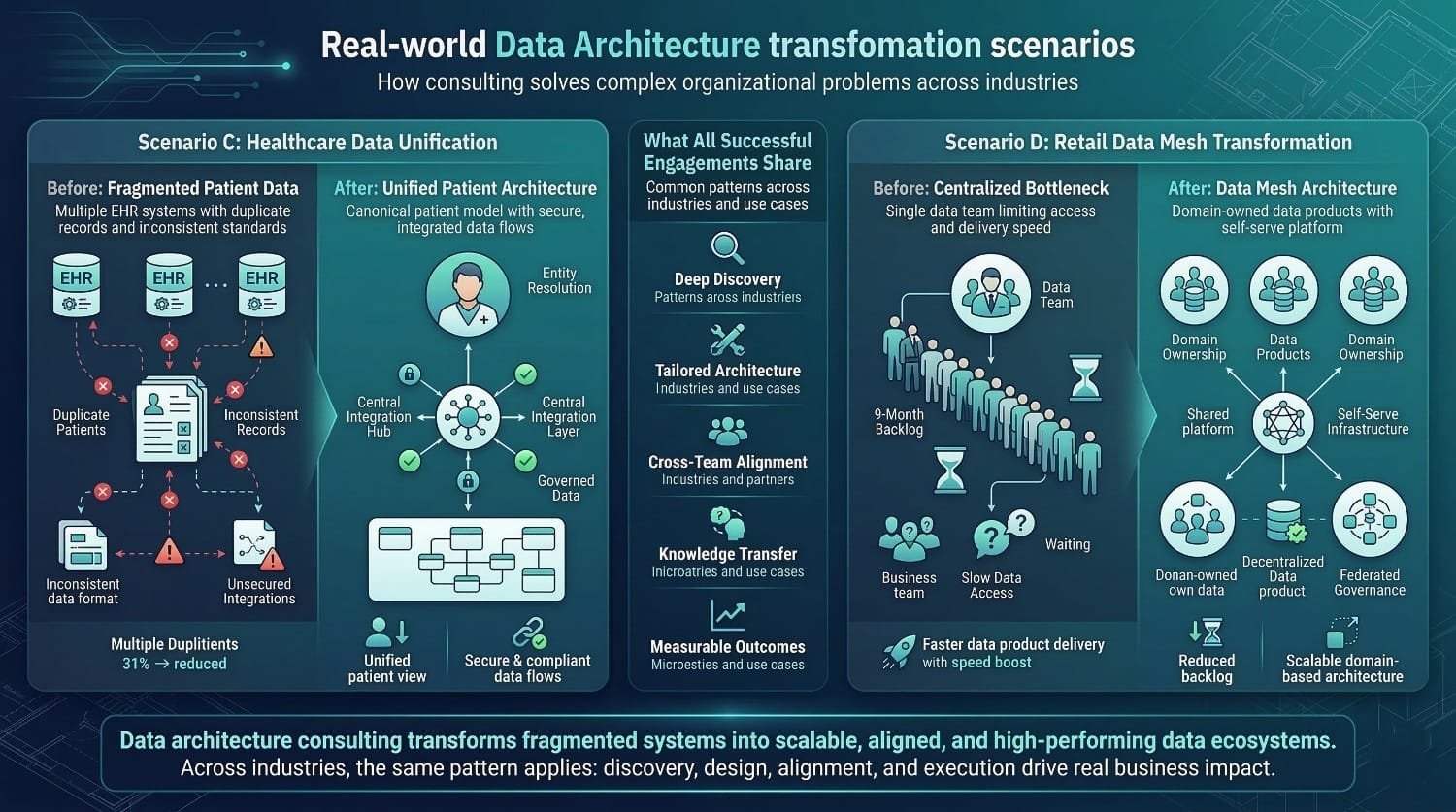
Scenario C: The Healthcare Network Needing Unified Patient Data
The Situation
A regional healthcare network, 4 facilities, 3,200 employees, 420,000 patients, operated 3 different EHR systems acquired through expansions. Each facility maintained independent patient records, billing systems, and reporting tools.
The consequences were clinically and financially significant. The same patient treated at two facilities existed as two separate records with potentially inconsistent medical histories. Billing was fragmented, with no ability to identify duplicate claims or reconcile across facilities. And regulatory pressure was mounting, the organization needed unified patient reporting for quality metrics and compliance, and the current architecture made it impossible.
The internal IT team was strong but had no experience designing enterprise data architecture across multiple clinical systems. Previous attempts to “just connect the EHRs” had produced point-to-point interfaces that were fragile and incomplete.
The Engagement
Model: Assessment and architecture design (8 weeks) + governance framework
What the Consultants Actually Did
Weeks 1–3: Clinical data discovery. The consulting team profiled patient data across all three EHR systems, a process that required understanding not just the technical schemas but the clinical workflows that produced the data.
They discovered that the three systems used different patient identifier formats, different coding standards (a mix of ICD-10 and legacy ICD-9 in one system), different demographic field structures, and different approaches to recording clinical encounters. Duplicate patient records across the combined entity were estimated at 31%. And sensitive PHI was flowing through 4 unsecured integration points that had been built during previous point-to-point connection attempts.
Weeks 4–6: Architecture and model design. The consulting team designed a canonical patient data model that all three EHR systems could map into, resolving the structural differences without requiring any EHR system to change its internal operations.
They designed an entity resolution strategy using probabilistic matching on name, date of birth, address, and SSN (where available), with manual review queues for ambiguous matches and clinical validation for matches that affected medical history.
They designed the integration architecture using a hub-and-spoke pattern, each EHR feeding into a central integration layer rather than connecting directly to each other. This decoupled the systems and made future EHR consolidation (an eventual goal) dramatically simpler.
Weeks 7–8: Governance and roadmap. The consulting team designed a governance framework with clinical data stewards, clinicians at each facility responsible for patient data quality in their domain, supported by the central IT team for technical operations.
They recommended an integration platform, designed the phased implementation roadmap (starting with patient identity resolution, then clinical history, then billing), and created the HIPAA compliance architecture, classification standards, access controls, audit trails, and encryption requirements.
The Outcome
- Unified patient view available within 6 months of implementation starting
- 28% reduction in duplicate records through entity resolution, with ongoing matching catching new duplicates as they’re created
- HIPAA-compliant architecture with enhanced audit capabilities, access logging, PHI tracking, and automated compliance monitoring and reporting workflows
- 4 unsecured integration points eliminated and replaced with governed, encrypted data flows
- Clinical data stewardship operational at all 4 facilities, the first time clinical staff had formal responsibility for data quality
Foundation for eventual EHR consolidation, the canonical model and integration architecture materially reduced the estimated consolidation timeline
Scenario D: The Retailer Adopting Data Mesh
The Situation
A large multi-brand retailer, $1.2B revenue, 70+ stores, 4 e-commerce brands, 6,000 employees. The centralized data warehouse team (15 people) owned all data ingestion, transformation, and serving for the entire organization.
The model was breaking. The team’s backlog was 9 months deep. Every business domain, merchandising, supply chain, marketing, finance, e-commerce, waited in a single queue for data access. Frustration was universal. Merchandising couldn’t get inventory data fast enough to optimize stock allocation. Marketing couldn’t access customer data for personalization without a 4-month wait. Finance spent weeks manually reconciling data that should have been automated.
The CDO had investigated data mesh as an alternative, decentralizing data ownership to the domains. But the organization had no idea how to actually design it. How do you define domain boundaries? What does a “data product” look like technically? How do you maintain governance across decentralized teams? How do you build a platform that domain teams can actually use?
The Engagement
Model: Data mesh architecture design, 12 weeks
What the Consultants Actually Did
Weeks 1–3: Assessment and domain identification. The consulting team assessed the current centralized architecture and facilitated domain identification workshops with leaders from each business area.
Rather than imposing domain boundaries based on organizational structure alone, they analyzed data ownership patterns, data flow dependencies, and business process alignment. The result was 7 domains: merchandising, supply chain, customer, marketing, finance, e-commerce, and operations, each with clear data ownership boundaries and identified interdependencies.
They also assessed organizational readiness, evaluating each domain’s technical capability, willingness to own data, and resource availability. Two domains (merchandising and customer) were ready to operate as data product owners immediately. Three others would need 6–12 months of capability building. Two were better served by remaining centrally managed for the foreseeable future.
Weeks 4–8: Mesh architecture design. The consulting team designed the mesh architecture across four pillars. They created data product interface standards, specifying what every data product must provide: a published schema, a quality contract with specific SLAs, documentation including business context and lineage, an access API, and monitoring. These standards ensured interoperability across domains while allowing each domain autonomy in how they built their products internally.
They designed the self-serve data infrastructure, a platform built on Databricks and dbt that domain teams could use to build, test, publish, and monitor data products without requiring central team involvement. The platform provided templates, CI/CD pipelines, quality checks, and catalog registration, reducing the barrier to entry for domain teams.
They designed federated governance policies, shared standards for data classification, naming conventions, quality thresholds, and access controls that all domains must follow, enforced through automated checks in the self-serve platform rather than through manual review by a central team.
They built an onboarding playbook, a step-by-step guide for new domains to define their data products, register them in the catalog, and publish them on the platform.
Weeks 9–12: Roadmap and transition design. The consulting team designed a 3-phase transition. Phase 1: merchandising and customer domains publish their first data products while the central team continues operating for all other domains. Phase 2: marketing and finance domains onboard, with the central team transitioning to a platform and governance role. Phase 3: remaining domains onboard or remain centrally served based on readiness assessment.
The Outcome
- First three domain data products published within 4 months of implementation starting
- Central team backlog reduced materially, because domains were self-serving their own data needs
- Time to publish a new data product decreased significantly compared to the prior centralized model)
- Clear playbook for scaling, each new domain follows the established pattern, with the self-serve platform reducing onboarding effort
- Federated governance maintained, automated quality checks and catalog registration ensure consistency without re-centralizing control
- Central team transformed from a delivery bottleneck to a platform team, providing infrastructure, standards, and support rather than building every data product themselves
What All Four Scenarios Share
Despite different industries, different scales, and different architectural challenges, the same pattern holds across every scenario.
Discovery revealed what the organization couldn’t see on its own. Undocumented dependencies, hidden data quality issues, competing definitions, security gaps, and structural problems that internal normalization had rendered invisible.
The architecture was designed for the specific organization. Not a template applied generically, but a deliberate design accounting for real systems, real constraints, real skills, and real business requirements.
The consulting team facilitated alignment that hadn’t happened organically. Cross-departmental agreement on definitions, ownership, and standards, conversations that the architecture engagement created the context for.
Knowledge transfer left the organization more capable. In every case, the internal team emerged able to operate and evolve the architecture independently. The consulting engagement was a catalyst, not a crutch.
The architecture delivered measurable business value. Reduced costs, faster delivery, better data quality, improved compliance, and unblocked initiatives, in every case, within the first year.
That’s what data architecture consulting actually looks like in practice. Not documents on a shelf. Not theoretical frameworks. Real architectural design, producing real outcomes, for real organizations.
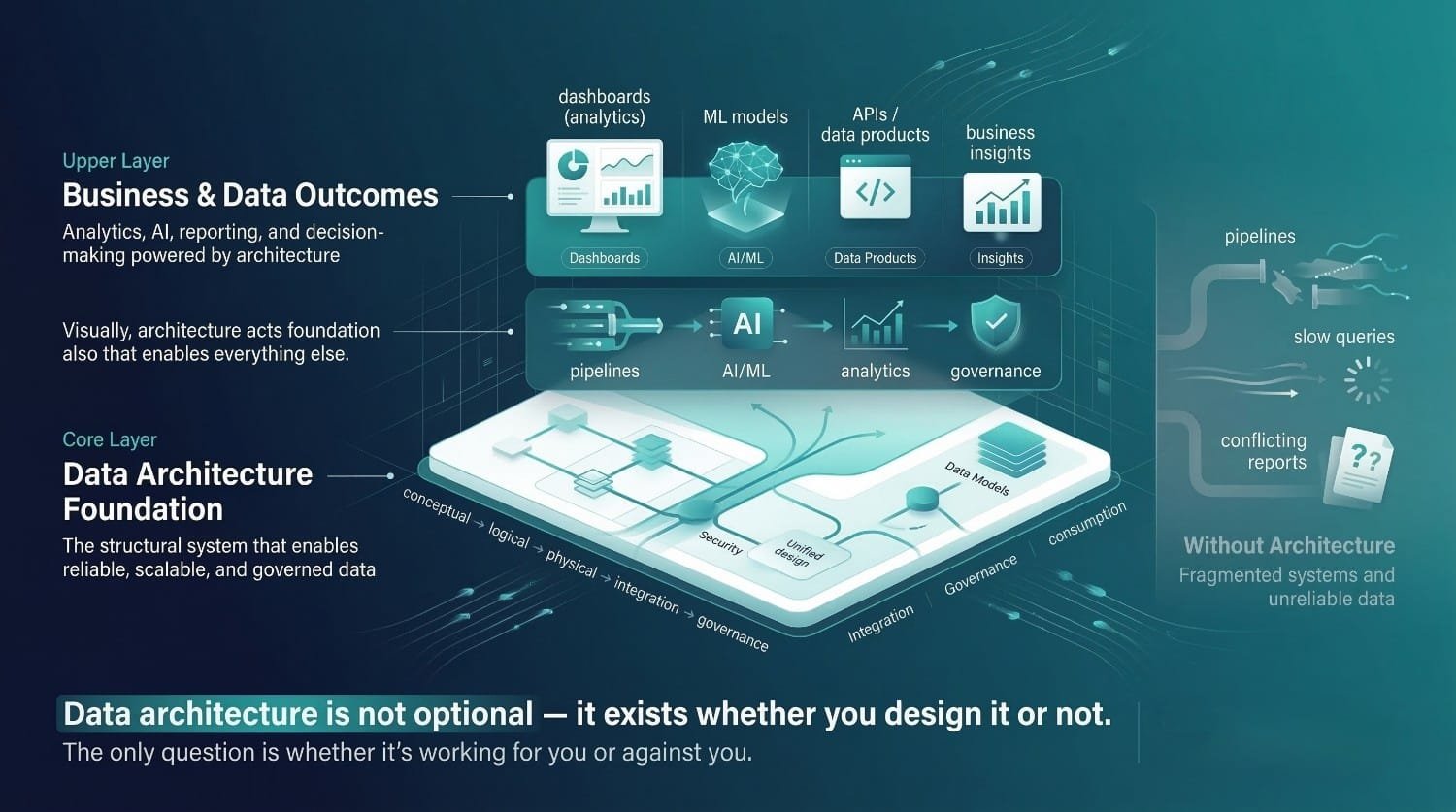
Final Thoughts
What This Post Set Out to Do
This post existed to clear the fog around a term that’s used constantly and understood rarely. Data architecture consulting has been confused with database design, conflated with data engineering, mistaken for tool selection, and diluted by vendors repackaging implementation services under a prestige label. That confusion is now behind you.
What Data Architecture Consulting Actually Is
It’s the structured, strategic discipline of designing the complete foundation for how an organization collects, stores, organizes, integrates, governs, secures, and delivers data, aligned to business outcomes and built to evolve.
It operates across eight interconnected layers, conceptual, logical, physical, integration, governance, security, consumption, and operational, because architecture that omits key layers introduces structural risk. It’s a partial solution that leaves structural gaps.
It follows a defined lifecycle, discovery, gap analysis, design, roadmap, implementation guidance, and knowledge transfer, because each phase builds on the previous one and skipping phases increases the risk of incomplete outcomes.
It’s delivered by people who combine deep technical expertise with business acumen, organizational awareness, and cross-industry pattern recognition, because architecture that’s technically brilliant but organizationally impractical is architecture that never gets implemented.
And it creates value through five specific mechanisms: preventing costly mistakes, accelerating everything downstream, providing objectivity, bridging business and technology, and building long-term organizational capability.
What It Is Not
Not data engineering. Not database design. Not tool selection. Not data strategy. Not cloud consulting. Not a one-time audit. Not implementation.
Each of these is a legitimate discipline. Each overlaps with architecture in some areas. None is a substitute for it. And engaging the wrong one when you need architecture leaves the foundational problem unaddressed, regardless of how well the wrong discipline is executed.
The Analogy, One Last Time
Data architecture is the circulatory system of your data ecosystem. When it’s well-designed, data flows reliably to every part of the organization that needs it, at the right speed, in the right form, with the right controls. You don’t see it working. You just see everything else working well.
When it’s poorly designed, or when it was never designed at all, symptoms appear everywhere. Slow queries. Broken pipelines. Conflicting reports. Failed initiatives. Compliance gaps. Frustrated teams. Each symptom gets treated individually. The underlying cause, the architecture, remains unaddressed.
Data architecture consulting treats the system, not the symptoms. It designs the circulatory system so that every organ in the organization receives what it needs.
The Signal to Watch For
If your data challenges feel systemic rather than isolated, that’s the signal. If every new project feels harder than it should. If the data team spends more time maintaining than building. If reports conflict and nobody can explain why. If adding a new data source takes months instead of days. If the compliance team can’t trace a metric back to its source. If leadership says “we need to be data-driven” but nobody trusts the data enough to drive with it.
These aren’t tool problems. They aren’t talent problems. They aren’t pipeline problems.
They are often architectural in nature. And architecture problems require architectural solutions.
The Investment Case
The cost of data architecture consulting is measured in tens or hundreds of thousands of dollars. The cost of operating without architecture, or with architecture that was never deliberately designed, is measured in millions, accumulated over years through wasted infrastructure spend, failed initiatives, manual workarounds, compliance exposure, talent attrition, and the compounding drag of technical debt.
Many organizations that have measured outcomes conclude the engagement generated strong return: the engagement paid for itself, usually within the first year, often many times over.
The organizations that reach this conclusion last are the ones that waited longest. They paid the most. Not for the consulting, but for the years of accumulated cost that earlier intervention would have prevented.
What to Do Next
If This Resonated
You recognized your organization somewhere in this post. The organic growth pattern. The systemic symptoms. The feeling that every data initiative is harder than it should be. The suspicion that the problem is structural, not surface-level. Trust that recognition. It’s almost certainly accurate.
Explore the Series
This post is part of an ongoing series on data strategy, integration, and architecture. Previous posts go deeper on related topics:
- The Difference Between Data Movement and Data Integration, the foundational concepts that underpin integration architecture
- Why Data Integration Projects Fail Even When Connectors Work, the hidden failure modes that proper architecture prevents
- When Do You Actually Need Data Integration Consulting?, recognizing inflection points for integration-specific expertise
- Data Integration Consulting vs iPaaS Tools, understanding how tools and consulting complement each other
- How to Measure the ROI of Data Integration Consulting, a framework for quantifying the return on consulting investments
- When Do You Actually Need Data Architecture Consulting?, the ten inflection points that signal it’s time for architectural expertise
Subscribe to get the next post delivered directly.
Start the Conversation
You don’t need to commit to a six-figure engagement today. The highest-value first step is almost always a conversation, an honest discussion about where your architecture is, where the pain points are, and whether the situation calls for external expertise or can be managed internally.
If the answer is internal, great. You’ve gained clarity and confidence. If the answer is consulting, you now know exactly what to look for, what to expect, what questions to ask, and how to evaluate whether you’re getting the real thing.
Either way, the most important thing you can do for your organization’s data future is to take the architecture seriously. Not as an abstract concept. Not as a future initiative. As the foundational layer that determines whether every other data investment succeeds or falls short. The architecture exists, whether you designed it or not. The only question is whether it’s working for you or against you.
Frequently Asked Questions (FAQs)
Data architecture consulting is expert-led advisory and design services that help organizations assess, plan, design, and evolve how their data is collected, stored, organized, integrated, governed, secured, and delivered. It’s the practice of designing the complete structural foundation of the data ecosystem, not just one database or one pipeline, but the entire system of systems that determines how data works across the organization. The goal is to create an architectural foundation that enables every downstream data activity, engineering, analytics, AI, governance, compliance, to succeed.
Three factors create the confusion. First, the term means different things to different people, a CTO hears platform selection, an engineer hears schema design, a CDO hears enterprise blueprint, and all are partially right but none captures the full scope. Second, the market makes it worse, vendors relabel implementation services as “architecture consulting,” and consulting firms use “architecture” as a catch-all for any strategic data work. Third, architecture is invisible by design, when it works, nobody notices it; when it fails, the symptoms get attributed to other causes like bad tools, insufficient staffing, or poor data quality. The root cause stays hidden.
A full engagement follows six phases. Discovery and current-state assessment maps every system, data flow, and dependency while profiling data quality and governance maturity. Gap analysis identifies what’s broken, missing, or misaligned and prioritizes by business impact. Future-state architecture design creates the target architecture across all layers, storage, integration, modeling, governance, security, consumption, and operations. Roadmap and transition planning breaks the vision into phased, achievable milestones. Implementation guidance ensures what gets built matches what was designed. Knowledge transfer leaves the organization capable of owning and evolving the architecture independently. Not every engagement includes all six phases, scope is matched to the organization’s actual need.
Data architecture consists of eight interconnected layers. The conceptual layer defines data domains and business entities in business terms. The logical layer provides detailed data models independent of technology. The physical layer translates models into actual database schemas and storage implementations. The integration layer defines how data moves between systems. The governance layer establishes ownership, quality standards, lineage, and policies. The security layer covers classification, encryption, access controls, and audit trails. The consumption layer determines how data reaches end users through BI tools, APIs, and data products. The operational layer covers monitoring, maintenance, scaling, and evolution. Architecture that omits key layers increases long-term structural risk.
Architecture designs the blueprint. Engineering builds and operates what the blueprint specifies. An architect defines the patterns, models, standards, and structural decisions for the ecosystem. An engineer writes pipeline code, configures platforms, optimizes queries, and keeps data flowing day to day. They’re complementary, architecture without engineering is a plan that never gets implemented, and engineering without architecture is building without a plan. You need architecture when the blueprint doesn’t exist or is fundamentally flawed. You need engineering when the blueprint is sound and you need skilled people to execute it. You need both for major transformations.
Strategy answers “what do we want to achieve with data?” Architecture answers “how do we design our systems to make that possible?” Strategy defines the destination, unified customer analytics, AI-powered personalization, real-time operations. Architecture designs the road, the models, platforms, patterns, governance, and technology that deliver those capabilities. Strategy without architecture is aspiration without a plan. Architecture without strategy is design without direction. They’re complementary and often delivered together, but they’re distinct disciplines.
Cloud consulting focuses on infrastructure, compute, networking, identity management, storage provisioning, and cost optimization. Data architecture consulting focuses on the data layer, how data is modeled, stored, integrated, governed, and consumed, regardless of infrastructure. You can have a perfectly optimized cloud environment with terrible data architecture, and vice versa. Both layers need to be right, but they require different expertise. Major transformations often require both, coordinated so that the data architecture defines what the infrastructure needs to support.
No. Database design is one component of the physical layer of data architecture, roughly 5–10% of the total scope. Data architecture encompasses the entire ecosystem: how dozens or hundreds of systems work together, how data flows between them, how it’s modeled at conceptual and logical levels, how it’s governed, how it’s secured, how it’s consumed, and how it evolves. Designing a great schema for one database while ignoring how that database relates to the warehouse, the lake, the integration layer, and the governance framework is like designing a great room while ignoring the rest of the building.
Typical deliverables include current-state architecture documentation with system inventories and data flow maps, a gap analysis report with prioritized findings, target-state architecture blueprints across all layers, architectural principles and standards documents, data governance framework and operating model, technology evaluation and recommendation reports, phased implementation roadmaps with milestones and estimates, data dictionaries and metadata standards, and security and compliance architecture specifications. Beyond documents, the engagement also produces critical decisions (technology selections, pattern choices, governance models, prioritization) and organizational outcomes (stakeholder alignment, shared definitions, team capability uplift, and decision-making frameworks for the future).
It depends on scope and complexity. A quick assessment or architecture review takes 2–4 weeks. A comprehensive assessment with roadmap takes 4–8 weeks. A full target-state architecture design takes 8–16 weeks. Architecture design with implementation oversight runs 4–12 months. An embedded architect placement runs 6–18 months. The primary drivers are the size and complexity of the data landscape, the scope of the engagement, the number of stakeholders involved, the level of existing documentation, and the organization’s decision-making speed.
Architecture decisions have consequences that last 3–5 years. A modeling decision made in haste creates rework measured in months when growth exposes its limitations. A technology selection rushed through without evaluation creates lock-in costing hundreds of thousands when the misfit becomes apparent. Insufficient discovery leads to designs based on incomplete understanding, every week cut from discovery typically adds 2–4 weeks of rework during implementation. The organizations that regret their architecture engagement almost never say “we spent too long on design.” They say “we rushed the discovery” or “we didn’t align stakeholders.” A few extra weeks of architectural design saves months of implementation delays and years of rework.
Look for these signs: the engagement starts with deep discovery and stakeholder interviews rather than tool demos, business goals are discussed before technology, the current state is assessed thoroughly before solutions are proposed, deliverables are tailored to your specific organization, the design accounts for your real constraints, knowledge transfer is embedded from day one, the consultants challenge your assumptions constructively, and the output is actionable with a clear path to execution. Red flags include jumping straight to tool recommendations, vendor-specific implementation plans presented as architecture, no discovery phase, generic template deliverables, no business stakeholder engagement, no governance components, no knowledge transfer, and the engagement ending with a document handoff and no follow-through.
Deep hands-on experience across multiple architectural paradigms, warehouse, lake, lakehouse, mesh, fabric, event-driven, not just one. Cross-industry pattern recognition from designing architectures in different organizational contexts. Genuine vendor neutrality with no undisclosed financial relationships influencing recommendations. A methodology that starts with business outcomes and works backward to technical design. Communication skills that bridge technical and business audiences. Evidence of knowledge transfer in past engagements. And references demonstrating long-term success, architectures that are still effective years after delivery, not just impressive at handoff.
The main paradigms include centralized data warehouse for strong BI cultures with well-defined reporting needs, data lake for high volume and variety with AI/ML workloads, data lakehouse combining lake flexibility with warehouse structure, data mesh for large organizations where centralized teams are bottlenecks, data fabric for highly distributed multi-cloud environments, and event-driven architecture for real-time requirements and loosely coupled systems. In practice, most organizations need a hybrid, a deliberately designed combination that applies each paradigm where it fits best. A good consultant doesn’t arrive with a predetermined paradigm but designs the right combination for your specific context.
It’s an ongoing discipline. Architecture evolves because the organization evolves, new business lines, acquisitions, regulatory changes, technology evolution, volume growth, and shifting user needs all require architectural adaptation. An architecture document from 18 months ago that hasn’t been updated describes a system that no longer exists. Good data architecture consulting establishes the governance processes, standards, and decision-making frameworks that enable the internal team to evolve the architecture continuously, not just the point-in-time design. Periodic architecture reviews (annually at minimum) help ensure the architecture stays fit for purpose.
Absolutely. Architecture consulting isn’t only for greenfield builds. Many engagements focus on assessing and improving existing architectures, identifying structural problems, designing targeted remediation, optimizing what’s already built, and creating a roadmap for evolution. If your current infrastructure is underperforming, hard to scale, expensive to maintain, or blocking strategic initiatives, an architecture assessment can identify the root causes and design a practical path forward. Evolving an existing architecture is usually faster, cheaper, and less disruptive than starting over.
Through five specific mechanisms. It prevents costly mistakes by bringing pattern recognition that avoids the architectural errors first-timers make, errors that are significantly more expensive to fix after implementation than to prevent. It often accelerates everything downstream by giving engineering, analytics, and AI teams a clear blueprint with established patterns instead of starting from scratch on every project. It provides objectivity that internal teams can’t, freedom from existing tool bias, historical anchoring, vendor relationships, and organizational politics. It bridges business and technology by translating between stakeholders who speak different languages. And it builds long-term capability through knowledge transfer that leaves the organization stronger and more self-sufficient than before.
This post is part of an ongoing series on data strategy, integration, and architecture. Previous posts include “The Difference Between Data Movement and Data Integration” covering foundational concepts, “Why Data Integration Projects Fail Even When Connectors Work” exploring hidden failure modes, “When Do You Actually Need Data Integration Consulting?” identifying integration inflection points, “Data Integration Consulting vs iPaaS Tools” examining how tools and consulting work together, “How to Measure the ROI of Data Integration Consulting” providing a framework for quantifying returns, and “When Do You Actually Need Data Architecture Consulting?” detailing the ten inflection points that signal it’s time for architectural expertise. Subscribe to get the next post in the series delivered directly