
Table of Contents
Introduction
Let’s Be Honest, Not Every Data Problem Needs a Consultant
Some data challenges are straightforward. Your team sets up a connector, builds a pipeline, writes dbt models, and the data flows where it needs to go. In those cases, the problem may be effectively resolved without external support.
And that’s fine. Not every integration needs warrants bringing in external expertise. If your situation is simple, one source, one target, compatible schemas, clean data, your internal team can absolutely handle it.
But here’s where things get complicated.
Many organizations operate in environments that are more complex than a simple one-source-to-one-target integration. They have:
- Dozens of source systems with incompatible schemas
- Multiple departments with conflicting definitions of the same metrics
- Growing data quality issues that nobody has time to address
- A cloud migration on the horizon with no integration strategy
- An executive team that’s starting to lose confidence in the numbers
And yet, the default response is almost always the same:
“We’ll handle it internally. We have tools. We have a team. We’ll figure it out.”
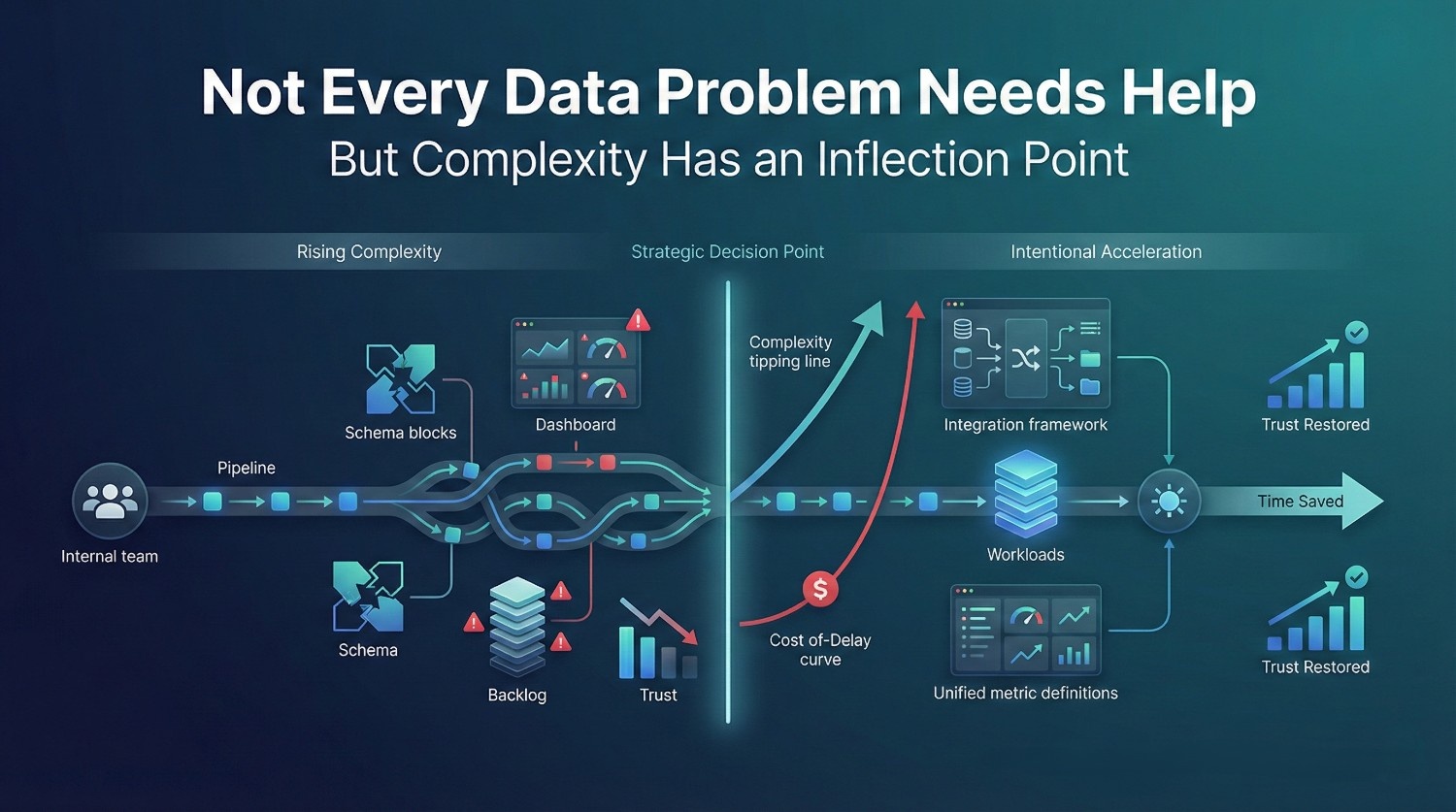
The Cost of Figuring It Out Too Late
The instinct to handle everything in-house is understandable. It feels efficient. It feels cost-effective. It feels like the responsible thing to do.
Until the complexity outpaces the original assumptions about scope and effort.
What “figuring it out internally” often looks like in practice:
- Month 1–3, The team starts building. Connectors go live. Data starts flowing. Early momentum feels good.
- Month 4–6, Transformation complexity explodes. Schema conflicts surface. Data quality issues multiply. Stakeholders disagree on definitions. Progress slows.
- Month 7–9, The project stalls. Engineers are firefighting. The backlog of fixes grows faster than the backlog of features. Nobody wants to admit the project is off track.
- Month 10–12, Leadership asks why the dashboards still don’t work. Trust erodes. The project is quietly deprioritized. The data team moves on to the next urgent request.
Sound familiar?
Prolonged delays can compound technical debt, organizational friction, and opportunity cost:
- Technical debt accumulates, workarounds become permanent, undocumented, and fragile
- Business initiatives stall, analytics, AI/ML, personalization, all waiting on data that isn’t ready
- Trust can erode when discrepancies persist, and rebuilding confidence in data often takes significantly longer than implementing technical fixes.
Costs escalate, the longer you wait to fix the foundation, the more expensive the fix becomes
The Real Question
The question isn’t:
“Should we ever use data integration consulting?”
The question is:
“At what point does our situation cross the line from ‘we can handle this’ to ‘we need help before this gets worse’?”
That line exists. And it’s not theoretical, it’s defined by specific, recognizable inflection points that show up consistently across organizations of every size and industry.
The Thesis
There are clear, identifiable moments where data integration consulting can shift from optional support to a strategic accelerator when complexity, risk, or time constraints exceed internal capacity.
This isn’t about being incapable. It’s about being strategic. The best internal teams in the world still benefit from outside expertise when the complexity exceeds what any single organization encounters regularly.
What You'll Get from This Post
By the end of this article, you’ll have:
- A clear understanding of which data challenges your team can realistically handle, and which ones require outside expertise
- A framework of specific inflection points, the recognizable signals that it’s time to engage data integration consulting
- Honest guidance on what to look for and what to avoid when evaluating consulting partners
- The confidence to make a timely decision, not too early, not too late, about when outside help becomes the smartest investment
Let’s get into it.
What Data Integration Consulting Actually Involves
Before you can decide whether you need data integration consulting, you need to understand what it actually is, because most organizations have a narrow and outdated view of what consulting in this space looks like.
It’s not what most people think.
Clarifying the Scope
What It's Not
“So… they come in and set up our Fivetran connectors?”
No.
If that is the only requirement, vendor documentation or implementation guidance may be sufficient without broader consulting engagement.
Data integration consulting is not:
- Connector configuration
- Basic ETL pipeline development
- Tool installation and setup
- A vendor’s professional services team getting their own product running
What It Actually Is
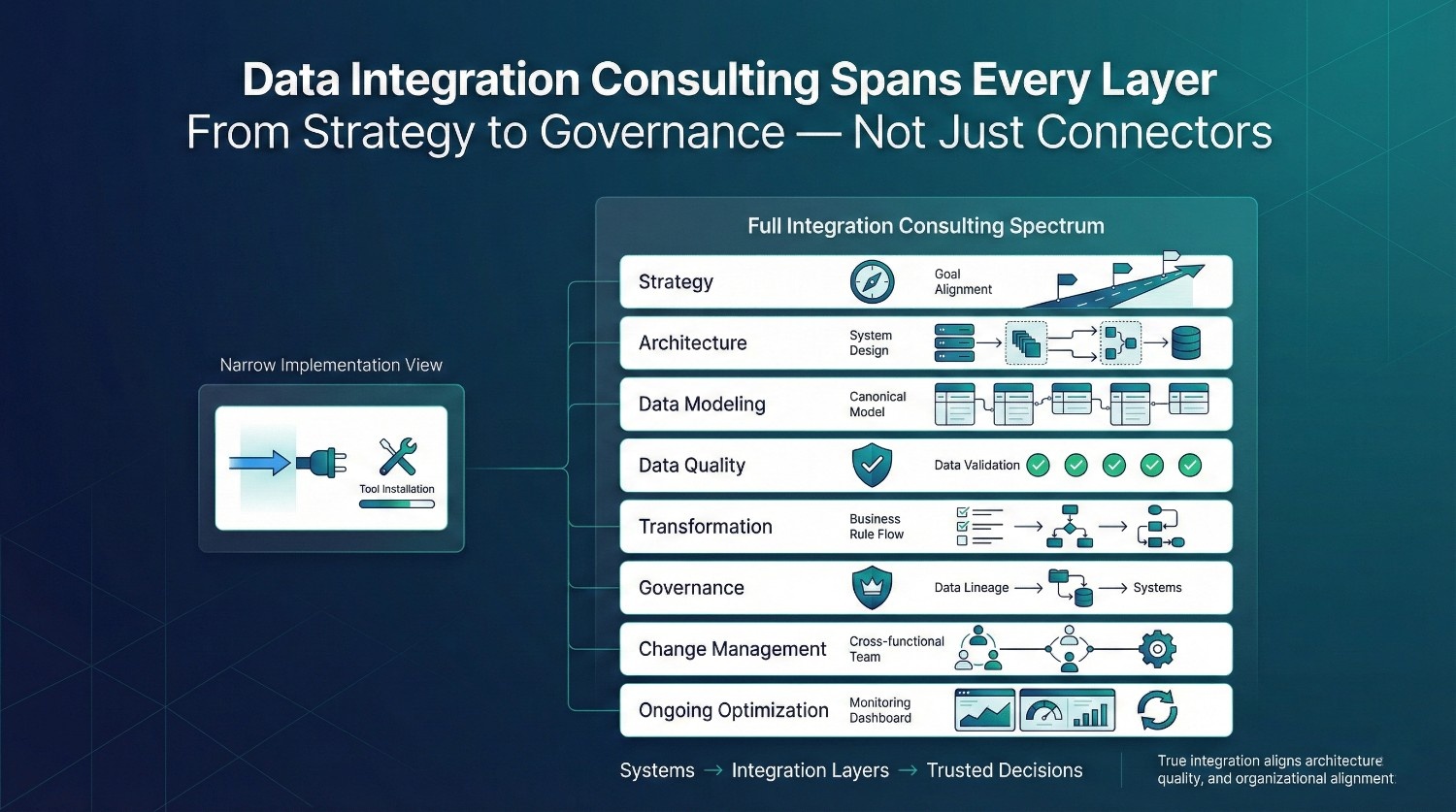
The full spectrum of data integration consulting spans every layer between “we have data in systems” and “our data drives business decisions”:
Layer | What It Covers |
|---|---|
Strategy |
Aligning integration goals with measurable business outcomes |
Architecture |
Designing the right integration approach, centralized, federated, hybrid, streaming, batch |
Data Modeling |
Building canonical models that unify disparate schemas into one coherent structure |
Data Quality |
Profiling, assessing, and remediating quality issues before and during integration |
Transformation |
Defining, documenting, and implementing business rules that turn raw data into usable assets |
Governance |
Establishing ownership, lineage, access controls, and golden record logic |
Change Management |
Aligning stakeholders, driving adoption, and managing organizational resistance |
Ongoing Optimization |
Monitoring, maintaining, and evolving integration pipelines as the business changes |
If an engagement only addresses one or two of these layers, it may be implementation-focused rather than strategic integration consulting.
Vendor Professional Services vs. Independent Consulting
This is a distinction worth understanding clearly:
Vendor Professional Services | Independent Data Integration Consulting | |
|---|---|---|
Primary goal |
Get their product running in your environment |
Solve your data integration problem, regardless of tooling |
Tool bias |
Inherent, they're selling and supporting their own platform |
Tool-agnostic, recommendations based on your requirements |
Scope |
Typically limited to their product's capabilities |
Full spectrum, strategy, architecture, governance, change management |
Long-term view |
Focused on product adoption and expansion |
Focused on business outcomes and organizational capability |
When it's appropriate |
You've already chosen the tool and need help implementing it |
You need help figuring out what to do, not just how to use a specific product |
Both have their place. But if you haven’t yet defined your strategy, architecture, or requirements, vendor professional services are typically optimized around their product ecosystem, which may or may not align perfectly with your broader architectural needs.
Types of Engagement Models
Data integration consulting isn’t one-size-fits-all. The right engagement model depends on where you are, what you need, and what your internal team can handle.
Advisory / Strategy
What it looks like:
- Current-state assessment of your data landscape, pipelines, and quality
- Architecture review and recommendations
- Integration roadmap with phased priorities
- Tool evaluation guidance
- Governance framework design
Best for:
- Organizations that have a capable team but need strategic direction
- Pre-migration or pre-acquisition planning
- “We know something’s wrong but we don’t know exactly what” situations
What you get:
- A roadmap and architecture your team executes against
- Clear priorities, what to fix first, what can wait
- Confidence that you’re solving the right problem
Implementation
What it looks like:
- End-to-end delivery, from discovery through go-live
- Data modeling, transformation development, quality frameworks, governance setup
- Testing, validation, and deployment
- Documentation and knowledge transfer
Best for:
- Organizations that need the full solution built, not just a plan
- Complex, multi-source integration projects with tight timelines
- Situations where the internal team lacks specific integration expertise
What you get:
- A working, production-ready integration solution
- Documented architecture, business rules, and operational procedures
- A foundation your team can maintain and evolve
Staff Augmentation
What it looks like:
- Experienced integration specialists embedded within your existing team
- Working under your team’s direction, but bringing specialized skills
- Filling specific gaps: data modeling, governance design, transformation engineering, stakeholder facilitation
Best for:
- Teams that have the strategy and leadership but need additional hands with deep expertise
- Projects where hiring full-time would take too long or isn’t justified permanently
- Scaling up temporarily for a large integration initiative
What you get:
- Immediate access to skills your team doesn’t have today
- Knowledge transfer through day-to-day collaboration
- Flexibility to scale up or down as the project evolves
Managed Services
What it looks like:
- Ongoing monitoring, maintenance, and operation of integration pipelines
- Handling source system changes, schema evolution, and quality degradation
- Regular governance reviews and optimization
- Incident response and troubleshooting
Best for:
- Organizations that have completed an integration project but don’t have the internal capacity to maintain it
- Smaller data teams that need operational support without hiring dedicated integration engineers
- Environments with high source system volatility, frequent API changes, schema updates, new data sources
What you get:
- Pipelines that stay healthy without consuming your team’s time
- Proactive issue resolution, problems caught before stakeholders notice
- Freedom for your internal team to focus on new capabilities instead of maintenance
Hybrid
What it looks like:
- Combining models based on project phases
- Example: Advisory first to define strategy and architecture → Implementation to build the core → Staff augmentation to support the team through expansion → Managed services for ongoing operations
Best for:
- Most real-world situations, because integration isn’t a single-phase problem
- Organizations whose needs evolve as the project progresses
- Engagements where the right level of support changes over time
What you get:
- The right level of expertise at each stage, no overpaying for hands-on help when you only need guidance, no under-investing when you need deep implementation support
The best data integration consulting partners offer all of these models and help you determine which combination fits, rather than applying a uniform engagement structure regardless of client context.
What Good Data Integration Consulting Delivers
Beyond the specific deliverables of any engagement, here’s what good data integration consulting actually provides at a strategic level:
Faster Time to Value with Fewer False Starts
- Consulting teams have done this across dozens of organizations
- They know which approaches work, which patterns fail, and where the hidden pitfalls are
- Your team doesn’t have to learn these lessons the hard way, at the cost of months and budget
- In many cases, structured methodology and prior experience can reduce delivery timelines by minimizing rework and misalignment.
Architecture Decisions That Scale Beyond the Immediate Project
- Internal teams tend to design for the problem in front of them
- Experienced consultants often design with foreseeable scale and adjacent use cases in mind, not just the immediate requirement.
- The result: an architecture that handles today’s 5 data sources and next year’s 25, without a rebuild
Knowledge Transfer That Upskills Your Internal Team
High-quality consulting engagements prioritize knowledge transfer and capability building rather than long-term dependency:
- Your engineers learn integration patterns they hadn’t encountered before
- Your analysts understand the data model and governance framework
- Your data stewards have operational runbooks and documented procedures
When the engagement ends, your team is stronger, not stranded
Risk Mitigation Through Proven Methodology
- Integration initiatives frequently encounter recurring failure patterns related to governance, alignment, and transformation complexity.
- Quality issues? There’s a profiling and assessment framework for that.
- Stakeholder misalignment? There’s a discovery and facilitation process for that.
- Transformation edge cases? They’ve seen them, hundreds of times.
- The methodology doesn’t eliminate risk. It can materially reduce risk through structured methodology and early-stage validation.
Organizational Alignment That Internal Teams Struggle to Drive
This is the underrated superpower of data integration consulting:
- Internal technical teams may face organizational constraints when attempting to resolve cross-departmental definition conflicts.
- A data engineer can’t tell the VP of Sales that their definition of “revenue” is wrong
- An external consultant, with executive sponsorship and a structured facilitation process, can
- Cross-functional alignment is frequently one of the most significant success factors in enterprise-scale integration initiatives.
Signs You Can Handle It In-House (And Don't Need Consulting Yet)
Let’s be fair. Not every data integration challenge requires outside help.
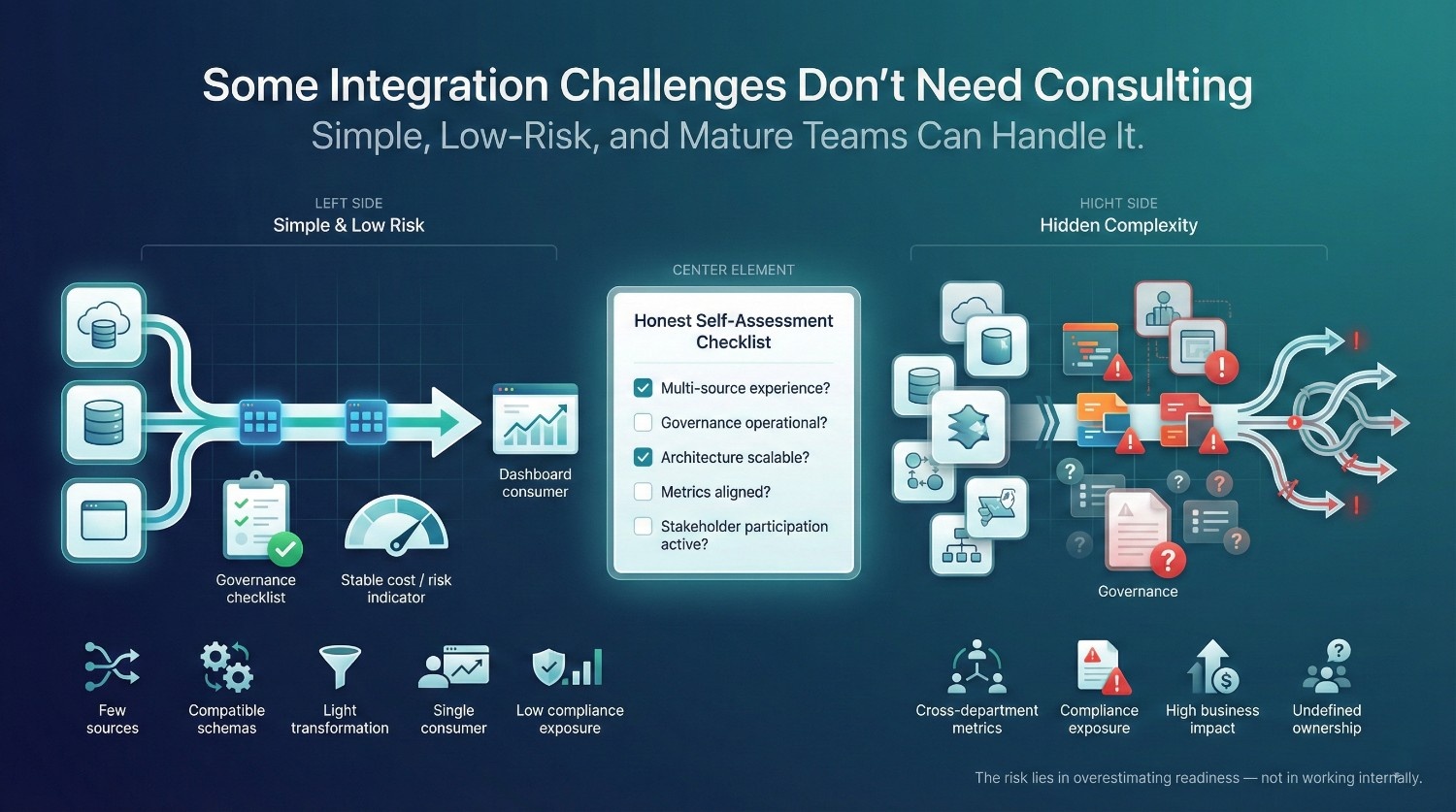
There are real, legitimate scenarios where your internal team is perfectly equipped to handle the work, and bringing in a consultant may not provide proportional value relative to the scope and risk involved. Knowing when you don’t need data integration consulting is just as important as knowing when you do.
Here’s how to tell.
Simple, Low-Complexity Scenarios
If your integration challenge checks most of these boxes, you’re likely in DIY territory:
Small Number of Well-Documented Sources
- You’re connecting two or three systems, not twenty
- The source systems have clear, well-documented APIs and schemas
- You’re not dealing with legacy systems that lack documentation or contain significant undocumented behaviors.
Compatible Schemas with Minimal Conflict
- Field names and data types are similar or identical across sources
- There are no major semantic mismatches, “customer” means the same thing in both systems
- No complex entity resolution required, records match cleanly on a shared key
Straightforward Replication or ELT
- A modern connector platform (Fivetran, Airbyte, Stitch) handles the extraction and loading
- Transformation is light, basic renaming, type casting, simple joins
- No complex business rules, calculated metrics, or cross-system reconciliation needed
Small Data Volumes
- You’re dealing with thousands or low millions of records, not billions
- No real-time streaming requirements, daily or hourly batch is sufficient
- Performance and scalability are not expected to be limiting factors at this stage.
Single Consumer with Clear Requirements
- One team is consuming the data, typically analytics or a specific business unit
- Their requirements are well-defined and stable
- There’s no need to serve multiple departments with conflicting definitions or access needs
If this describes your situation: set up your connectors, write your dbt models, build your dashboards, and move on. You don’t need a consultant for this.
Strong Internal Capabilities Already in Place
Even with moderate complexity, your team may be able to handle it, if you already have the right skills and organizational maturity.
Experienced Data Engineers Who've Done This Before
- Your team has delivered integration projects successfully in the past, not just pipelines, but full integration including transformation, quality, and governance
- They’ve dealt with schema conflicts, entity resolution, and business rule complexity before
- They’re not learning integration patterns for the first time on a high-stakes project
Established Data Governance Practices
- You already have defined data owners and stewards
- There’s an existing data catalog or at least documented data definitions
- Access controls, lineage tracking, and quality standards are already in place, even if imperfect
- The organization doesn’t treat governance as a future initiative, it’s already operational
Well-Defined Data Architecture and Standards
- Your team has an existing architecture that new sources can plug into
- There are documented standards for:
- Data modeling conventions
- Naming standards
- Transformation patterns
- Testing requirements
- New integration work follows established patterns rather than starting from scratch each time
Healthy Cross-Team Collaboration on Data
- Business stakeholders and data engineers already work together effectively
- There’s a process for defining and approving business rules and metric definitions
- Departments share data willingly and align on common definitions
- There’s no active political resistance to data unification
If this describes your organization: you have the foundation. Your team can likely handle most integration challenges with the right time and resources. Data integration consulting might still accelerate things, but it’s not critical.
Low Business Risk
Sometimes the stakes just aren’t high enough to warrant outside help.
Not Feeding Critical Decision-Making
- The integration supports exploratory analysis, internal experimentation, or a low-stakes reporting use case
- Executive decisions, customer-facing systems, and revenue operations don’t depend on this data
- If data discrepancies persist temporarily, they are unlikely to materially impact strategic decisions.
No Compliance or Regulatory Exposure
- The data involved isn’t subject to GDPR, HIPAA, SOX, or other regulatory mandates
- There’s no audit trail requirement
- PII and sensitive data aren’t part of the integration scope
Failure Won't Significantly Impact the Business
- If the project takes longer than expected, that’s okay
- If the pipeline breaks and needs a day to fix, no downstream systems are affected
- There’s no hard deadline tied to a merger, migration, product launch, or regulatory filing
You Have Room to Experiment
- The team has bandwidth to learn, iterate, and course-correct without business pressure
- There’s no expectation of immediate ROI from this initiative
- It’s a learning opportunity as much as a delivery commitment
If this describes your situation: you have the luxury of time and low risk. Use this lower-risk environment to build internal capability, experiment thoughtfully, and establish stronger integration practices.
The Honest Self-Assessment
Before you decide you don’t need help, run through this checklist honestly. Not aspirationally, honestly.
Questions to Ask Your Team
Question | Honest Answer Needed |
|---|---|
Have we successfully delivered a multi-source integration project before, end to end, including governance and quality? |
Not "we've built pipelines", actual integration |
Do we have agreed-upon, documented definitions for every key metric across departments? |
Not "we're working on it", do they exist today? |
Can our current architecture handle adding 5 more data sources without significant rework? |
Not "probably", has it been tested? |
Do business stakeholders actively participate in data modeling and rule definition? |
Not "they will when we ask", do they already? |
Is our data governance operational, with owners, stewards, and escalation paths? |
Not "we have a governance doc somewhere", is it active? |
Can we trace any dashboard metric back to its source and explain every transformation? |
Not "mostly", every metric, every step? |
The Danger of Overestimating Internal Readiness
This is where organizations get burned most often. The gap between perceived capability and actual execution maturity can become one of the most expensive risks in data integration initiatives.
Common overestimations:
- “Our engineers are smart, they’ll figure it out”
- Smart engineers figure out the technical parts. Schema mapping, business rule reconciliation, cross-departmental alignment, and governance design are different skills, and most engineers haven’t had to do them at scale.
- “We’ve done ETL before, integration is just more of the same”
- ETL is one component. Enterprise integration also includes data modeling, quality management, entity resolution, governance, stakeholder alignment, and long-term operational design.
- “We have the tools, we just need to use them better”
- Tools alone do not resolve strategic misalignment or governance gaps. The best tools in the world, without the right architecture and methodology, produce expensive pipelines that nobody trusts.
- “We’ll start small and scale”
- Great in theory. But “starting small” without an architecture that supports scaling means rebuilding everything when you try to expand. The small start becomes a dead end.
The Honest Rule of Thumb
If your integration challenge involves more than 3 source systems, requires cross-departmental metric alignment, has compliance implications, or feeds business-critical decisions, at minimum, get an independent assessment before committing to a fully internal approach.
That assessment might confirm you’re ready to handle it. Or it might reveal gaps you hadn’t considered. Either way, it’s the cheapest insurance you can buy against a stalled project and compounding technical debt.
A scoped diagnostic assessment is often one of the lowest-risk, highest-leverage uses of data integration consulting.
The Inflection Points
This is the section that answers the title question directly.
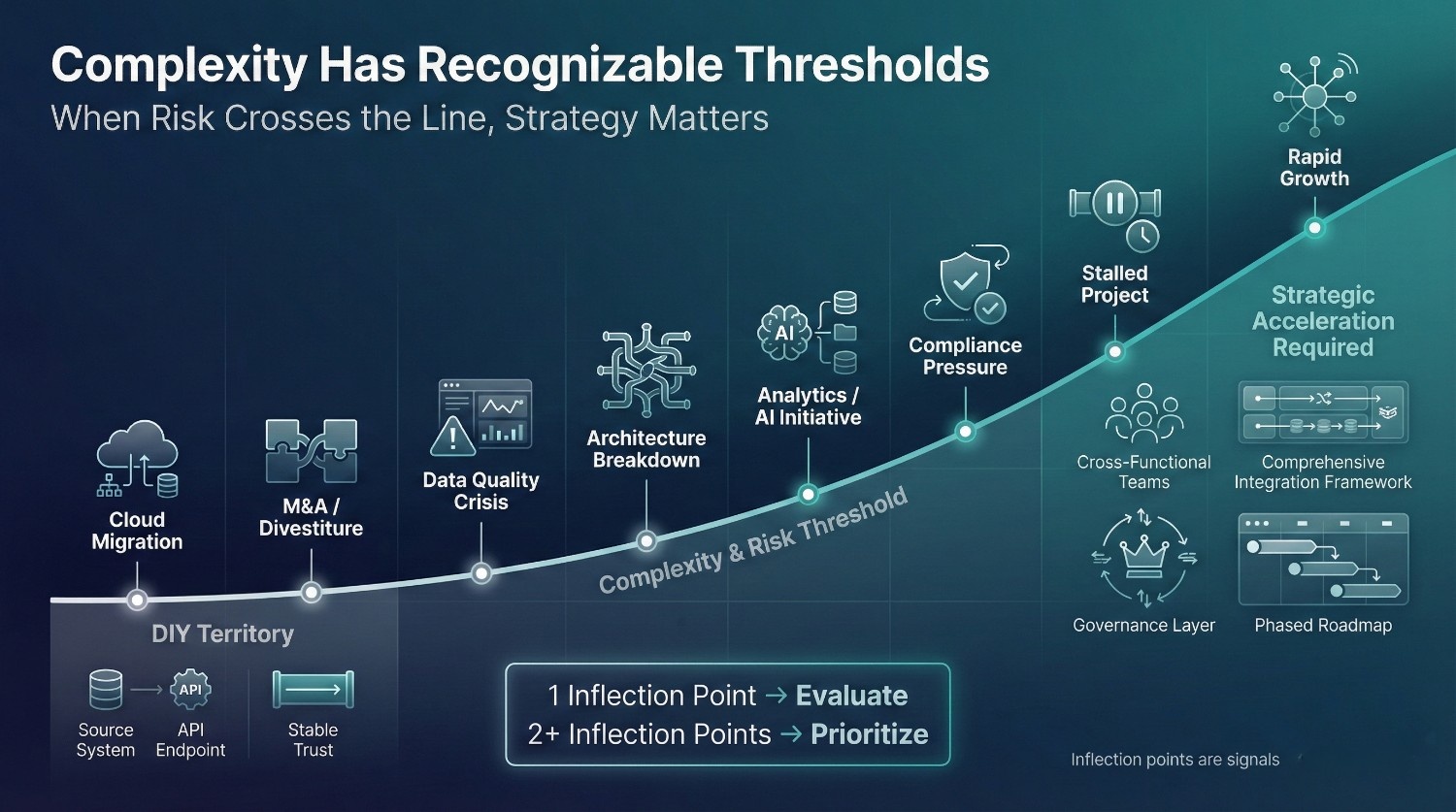
These aren’t vague guidelines. They’re specific, recognizable moments that organizations hit, moments where the complexity, risk, or stakes cross a threshold that internal teams alone typically can’t navigate successfully.
If you see your situation in any of these inflection points, it’s time to seriously evaluate data integration consulting, not as a luxury, but as a strategic investment.
Inflection Point #1, You're Undertaking a Major Cloud Migration
The Scenario
You’re moving from on-premises infrastructure to a cloud platform, AWS, Azure, GCP, or migrating between cloud providers. Maybe it’s a data warehouse migration (Oracle to Snowflake, SQL Server to BigQuery). Maybe it’s a full-stack modernization.
Why This Is Harder Than It Looks
The phrase “lift and shift” can be misleading in complex data environments.
Moving data to the cloud is data movement. But making that data work in a new environment, with new architecture, new tooling, new consumption patterns, is data integration. And most migration plans only account for the first part.
What actually needs rethinking during migration:
- Data models, your on-prem schema may not be optimal for cloud-native analytics
- Dependencies, downstream reports, dashboards, and applications that depend on the current structure
- Integration patterns, point-to-point connections that made sense on-prem may not translate to cloud architecture
- Performance characteristics, query patterns, partitioning, clustering, all different in the new environment
Governance and security, access controls, encryption, and compliance requirements may change
How Data Integration Consulting Helps
Activity | What It Delivers |
|---|---|
Migration assessment |
Full inventory of data assets, dependencies, and integration points that need to move |
Architecture redesign |
A cloud-native integration architecture, not a copy of your on-prem setup running in the cloud |
Phased execution plan |
Prioritized migration waves that minimize risk and deliver value incrementally |
Validation framework |
Source-to-target reconciliation ensuring nothing was lost or corrupted during migration |
Warning Signs You Need Help
- There’s no clear migration roadmap beyond “move everything to Snowflake”
- Nobody has mapped the full dependency chain, which reports, dashboards, and applications will break when sources move
- You’ve attempted a migration before and it stalled or caused downstream failures
- The migration plan covers moving data but not modeling, governing, or optimizing it in the new environment
Inflection Point #2, Mergers, Acquisitions, or Divestitures
The Scenario
Two companies merge. Or your company acquires another. Or a business unit is being divested and needs its data separated cleanly.
Suddenly, you have two of everything:
- Two CRMs with overlapping customer records
- Two ERPs with different chart-of-accounts structures
- Two HR systems with incompatible employee models
- Two definitions of “revenue,” “customer,” “product,” and “active user”
Why This Is One of the Hardest Integration Challenges
Post-acquisition data consolidation concentrates multiple integration challenges simultaneously:
- Schema conflicts, different systems model the same entities differently
- Semantic mismatches, the same terms mean different things in each organization
- Entity resolution, which records across both companies refer to the same real-world customer, employee, or product?
- Cultural sensitivity, “whose system wins?” is a political question as much as a technical one
- Time pressure, regulators, investors, and customers expect unified operations within months, not years
- Operational continuity, both businesses need to keep running while data is being consolidated
How Data Integration Consulting Helps
Activity | What It Delivers |
|---|---|
Neutral facilitation |
A third party that can navigate political dynamics without organizational bias |
Canonical data model |
A unified model that both organizations map into, neither "wins," both contribute |
Entity resolution |
Systematic deduplication and matching across overlapping customer, employee, and product records |
Phased consolidation plan |
A roadmap that maintains operational continuity while progressively unifying data |
Governance alignment |
Unified ownership, definitions, and standards that both organizations adopt |
Warning Signs You Need Help
- It’s been months since close and there’s still no unified customer or employee view
- Teams from both organizations are still running parallel systems with no convergence plan
- Revenue reporting requires manual reconciliation between two finance systems every month
- Nobody has been assigned ownership of the data consolidation workstream
- The “integration” discussion keeps getting deferred because it’s too complex and politically fraught
This is textbook data integration consulting territory, and one of the highest-ROI engagements because the cost of delay is measured in operational inefficiency, customer confusion, and regulatory risk.
Inflection Point #3, Your Data Quality Is Undermining Business Decisions
The Scenario
The dashboards exist. The warehouse is running. The pipelines are green.
But nobody trusts the numbers.
What This Looks Like in Practice
- Leadership has stopped referencing data in meetings. Decisions are made on instinct, experience, and anecdote, not analytics.
- Departments report different numbers for the same KPI. Finance says Q3 revenue was $18M. Sales says $21M. Marketing has a third number. All pulled from the “same” warehouse.
- Analysts are data janitors. They spend 60-80% of their time reconciling, validating, and cleaning data, not analyzing it.
Customer records are a mess. The same customer appears three times in the CRM with different spellings, different addresses, and different account IDs.
Why Internal Teams Struggle with This
Data quality problems that undermine trust are rarely isolated to one source or one pipeline. They’re systemic, rooted in:
- Missing governance, no agreed-upon definitions, no ownership, no golden record logic
- Schema conflicts that were never resolved during initial integration
- Transformation logic that was built by one engineer, undocumented, and never validated by the business
- Source system quality issues that were never profiled or addressed
Addressing systemic quality issues typically requires coordinated architectural, governance, and stakeholder alignment efforts.
How Data Integration Consulting Helps
Activity | What It Delivers |
|---|---|
Root cause analysis |
Systematic identification of where quality breaks down, source, extraction, transformation, or loading |
Data profiling and assessment |
Quantitative quality baseline across every critical source and domain |
Golden record logic |
Business-approved rules for resolving conflicts when systems disagree |
Governance framework |
Governance framework |
Metric reconciliation |
Aligned definitions and calculations so every department reports the same number |
Warning Signs You Need Help
- Executives make decisions based on gut feeling because they don’t trust the data
- The phrase “I don’t trust the data” has become normalized in your organization
- You’ve tried to fix data quality issues multiple times but they keep recurring
- Nobody can trace a dashboard metric back to its source and explain every step
Inflection Point #4, You're Scaling Beyond What Your Architecture Can Handle
The Scenario
What started as a few clean integrations has grown into an unmanageable mess:
- 15 source systems connected to 8 targets through dozens of point-to-point pipelines
- Adding a new data source takes weeks or months of custom development
- Pipeline failures happen weekly, and debugging takes days because nobody understands the full dependency chain
- Performance is degrading as data volumes grow
The Architecture Problem
This isn’t a skills problem. It’s a structural problem.
Point-to-point integrations may function at a small scale, but they introduce combinatorial complexity as systems increase. At some point, the architecture becomes:
- Unmaintainable, too many connections for any team to monitor and manage
- Fragile, one change cascades unpredictably through the dependency chain
- Slow, adding new capabilities requires untangling existing complexity first
- Undocumented, nobody has a complete picture of how data flows through the system
If your integration landscape has grown highly interconnected and difficult to trace end-to-end, and nobody can confidently trace a data flow from source to consumption, you’ve hit this inflection point.
How Data Integration Consulting Helps
Activity | What It Delivers |
|---|---|
Architecture assessment |
Full mapping of current integration landscape, every source, target, pipeline, and dependency |
Architecture redesign |
Migration from point-to-point spaghetti to a scalable pattern, hub-and-spoke, event-driven, or data mesh |
Scalability planning |
An architecture that handles 5x your current volume and source count without rework |
Technical debt remediation |
Prioritized plan for cleaning up legacy pipelines while maintaining operational continuity |
Warning Signs You Need Help
- Your integration diagram looks like a tangled web, and nobody fully understands all the dependencies
- Adding a new data source requires touching multiple existing pipelines
- Pipeline failures cascade, one break triggers a chain reaction across downstream systems
- The team spends more time maintaining existing integrations than building new ones
- Performance is degrading and the fixes are becoming increasingly complex
Inflection Point #5, You're Launching a Major Analytics, AI, or Data Product Initiativ
The Scenario
The business is investing in a significant data-driven initiative:
- Building a data warehouse or lakehouse for enterprise-wide analytics
- Standing up a customer data platform (CDP) for unified customer profiles
- Launching AI/ML models that need clean, unified, feature-rich training data
- Creating data products, APIs, embedded analytics, or data marketplaces for internal or external consumers
The Integration Gap
These initiatives have one thing in common: they depend on integrated, well-governed, high-quality data that may not yet be production-ready.
The gap between raw source data and analytics-ready or model-ready data is enormous:
- Raw data needs to be profiled, mapped, transformed, cleansed, and unified
- Business rules need to be defined, documented, and encoded
- Data quality needs to be measured, monitored, and enforced
- Governance needs to be designed and implemented, especially for AI training data and external data products
Without disciplined integration practices, these initiatives frequently underperform or stall:
- The warehouse becomes a dumping ground nobody trusts
- The CDP has duplicate and conflicting customer profiles
- ML models may produce unstable or biased outputs when training data is inconsistent, incomplete, or poorly governed.
- The data product delivers bad data to consumers, destroying credibility
How Data Integration Consulting Helps
Activity | What It Delivers |
|---|---|
Integration architecture for analytics |
A design that feeds clean, unified data to the warehouse, lakehouse, or CDP |
Feature engineering pipelines |
Transformation workflows that produce model-ready datasets for AI/ML |
Data modeling |
Canonical models that serve analytics, operations, and data products from a single source |
Quality gates |
Automated validation at every stage, ensuring validated and quality-checked data reaches downstream consumers. |
Semantic layer design |
Consistent metric definitions enforced across every BI tool and consumer |
Warning Signs You Need Help
- Your AI/ML team spends 80% of their time on data preparation instead of modeling
- The warehouse has hundreds of tables but analysts still can’t answer basic business questions
- Your CDP was supposed to deliver a unified customer view, but it has more duplicates than the source systems
- Data product consumers are complaining about inconsistencies or stale data
Inflection Point #6, Regulatory or Compliance Pressure Is Mounting
The Scenario
Compliance requirements are tightening, and your data infrastructure can’t keep up:
- GDPR requires you to know exactly where personal data lives, how it flows, and who has access, across every system
- HIPAA demands auditable data handling for protected health information
- SOX requires financial data integrity and traceable reporting
- CCPA gives consumers the right to know what data you have about them, and to request deletion
Industry-specific mandates add additional layers of complexity
Why Compliance Is an Integration Problem
Regulators don’t care that your data lives in 12 systems. They expect one coherent answer:
- Where did this data point originate?
- How was it transformed between source and report?
- Who accessed it and when?
- Can you demonstrate that it’s accurate and complete?
If your data is fragmented, ungoverned, and lacks lineage, these questions become difficult and costly to answer in audit contexts
How Data Integration Consulting Helps
Activity | What It Delivers |
|---|---|
Compliance-driven integration design |
Architecture specifically designed to meet regulatory requirements, not retrofitted |
Lineage implementation |
End-to-end tracking from source through every transformation to final consumption |
Access controls |
Role-based permissions, data classification, and audit trails built into the integration layer |
Audit trail architecture |
The ability to answer "where did this number come from?" in minutes, not weeks |
Warning Signs You Need Help
- You can’t confidently answer an auditor’s question about where a specific number originated
- Audit findings have flagged data inconsistencies, gaps, or untraceable transformations
- Responding to a data subject access request (DSAR) takes weeks of manual effort
- Your compliance team is working around the data infrastructure instead of through it
Inflection Point #7, Previous Integration Efforts Have Failed or Stalled
The Scenario
- You can’t confidently answer an auditor’s question about where a specific number originated
- Audit findings have flagged data inconsistencies, gaps, or untraceable transformations
- Responding to a data subject access request (DSAR) takes weeks of manual effort
- Your compliance team is working around the data infrastructure instead of through it
Why Stalled Projects Are Especially Dangerous
A stalled integration project often extends beyond sunk cost, creating additional operational and reputational drag if not addressed:
- Organizational scar tissue, stakeholders become skeptical of any future data initiative
- Technical debt, half-built pipelines and undocumented workarounds become permanent fixtures
- Talent attrition, good engineers leave because they’re stuck maintaining failed infrastructure
Opportunity cost, every month the project is stalled, business initiatives that depend on integrated data are also stalled
How Data Integration Consulting Helps
Activity | What It Delivers |
|---|---|
Objective assessment |
An honest, unbiased evaluation of what went wrong, technical, organizational, or both |
Rescue planning |
A concrete plan to get the project unstuck, what to keep, what to rebuild, what to abandon |
Course correction |
Addressing root causes (not symptoms) so the same problems don't recur |
Fresh perspective |
Pattern recognition from dozens of similar situations, your failure mode is likely one they've seen and resolved before |
Warning Signs You Need Help
- The project has been “almost done” for months
- You’re on your second or third attempt at the same integration
- The team can describe what they’ve built but can’t articulate the business value it’s delivering
- Stakeholders have stopped asking for updates, they’ve already mentally moved on
- There’s no documented root cause analysis of why previous attempts failed
Bringing in data integration consulting at this stage isn’t admitting defeat. It’s the most efficient path to recovering the investment and getting the project to a place where it actually delivers value.
Inflection Point #8, You're Experiencing Rapid Growth or Digital Transformation
The Scenario
The business is expanding, fast:
- New business lines, new products, new geographies, each bringing new systems and data sources
- Customer base is growing, transaction volumes are increasing, and data is multiplying
- The company is undergoing digital transformation, adopting new platforms, retiring legacy systems, modernizing processes
- New SaaS tools are being adopted faster than the data team can integrate them
Why Growth Breaks Integration
Integration architectures designed for 5 data sources and 50 users don’t survive scaling to 30 sources and 500 users.
What happens:
- The backlog explodes, new integration requests arrive faster than the team can deliver
- Quality degrades, shortcuts are taken to keep up with demand, and data quality suffers
- Architecture strains, pipelines that worked at low volume fail at high volume
- The team burns out, overwhelmed, reactive, and unable to do anything except keep the lights on
Legacy and modern coexist messily, old systems aren’t retired cleanly, creating parallel data flows that nobody fully manages
How Data Integration Consulting Helps
Question | Honest Answer Needed |
|---|---|
Scalable integration strategy |
An architecture designed for your growth trajectory, not just today's footprint |
Prioritization framework |
A structured approach to deciding which integration requests get done first based on business impact |
Growth-ready architecture |
Patterns (event-driven, data mesh, modular pipelines) that accommodate new sources without rework |
Resource planning |
Clarity on what your team can handle internally versus where you need additional capacity |
Warning Signs You Need Help
- You can’t confidently answer an auditor’s question about where a specific number originated
- Audit findings have flagged data inconsistencies, gaps, or untraceable transformations
- Responding to a data subject access request (DSAR) takes weeks of manual effort
- Your compliance team is working around the data infrastructure instead of through it
The Summary: All Eight Inflection Points at a Glance
# | Inflection Point | Core Challenge | Key Signal |
|---|---|---|---|
1 |
Cloud Migration |
Replicating old problems in a new environment |
No integration strategy beyond "lift and shift" |
2 |
M&A / Divestitures |
Unifying two incompatible data ecosystems |
Still running parallel systems months after close |
3 |
Data Quality Crisis |
Systemic quality issues undermining trust |
"I don't trust the data" is normalized |
4 |
Architecture at Breaking Point |
Point-to-point spaghetti that can't scale |
Adding a new source takes weeks, not days |
5 |
Analytics / AI / Data Products |
Gap between raw data and usable data is massive |
80% of time spent on data prep, not analysis |
6 |
Compliance Pressure |
Can't demonstrate data provenance or integrity |
Auditor questions can't be answered confidently |
7 |
Failed Previous Attempts |
Stalled projects with compounding damage |
"Almost done" for months with no clear path forward |
8 |
Rapid Growth |
Integration can't keep pace with business expansion |
Data team is the bottleneck for every initiative |
If you recognize your organization in even one of these inflection points, the conversation about data integration consulting should already be happening.
If you recognize yourself in two or more, it’s not a conversation. It’s a priority.
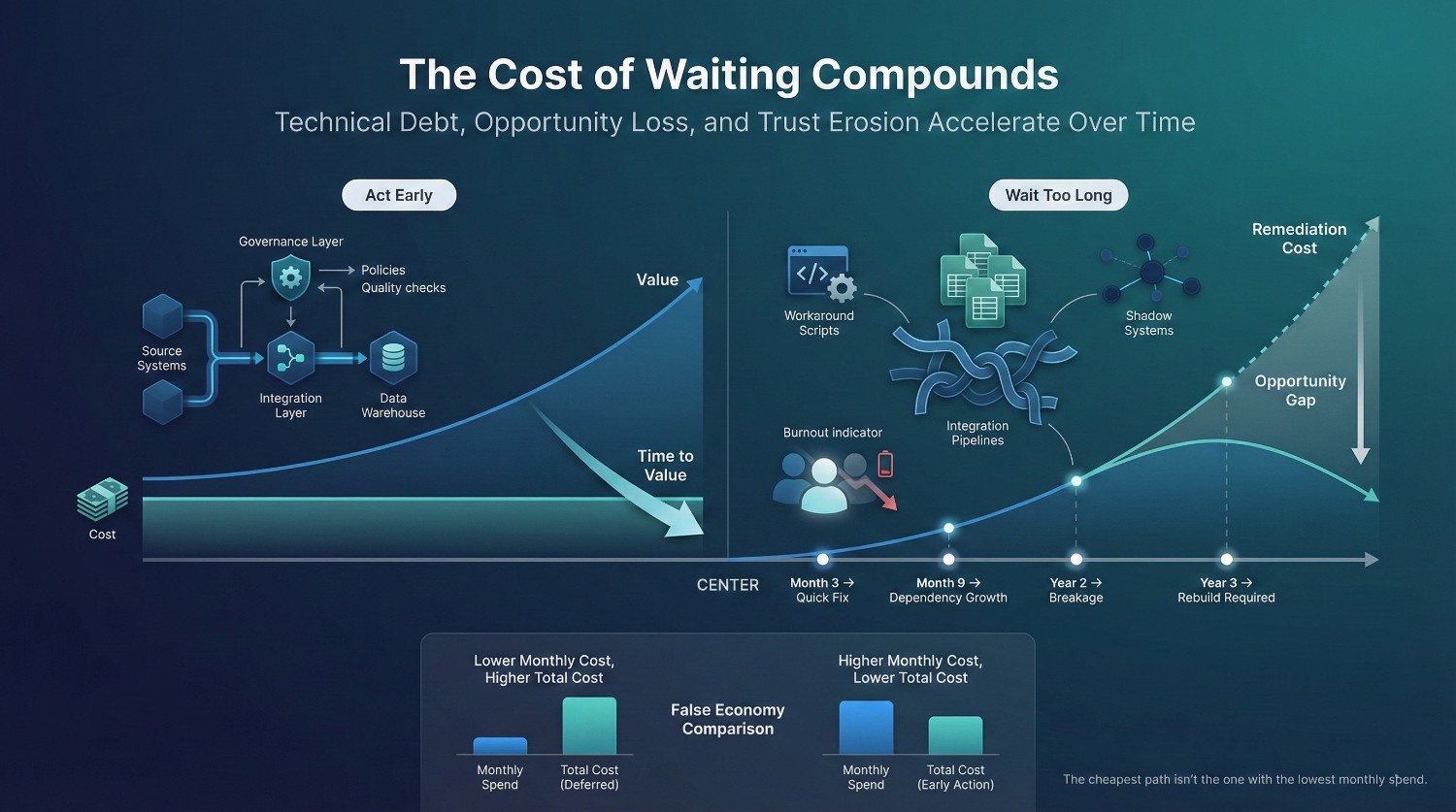
The Cost of Waiting Too Long
Every section so far has been about recognizing when you need help. This one is about what happens when you recognize it, and don’t act.
The cost of waiting is rarely linear; complexity and remediation effort tend to compound over time.
Technical Debt Accumulation
How Debt Builds
When integration isn’t done right, or isn’t done at all, teams create workarounds. And every workaround becomes a piece of technical debt:
- A Python script that manually reconciles two data sources every Monday morning
- A spreadsheet that maps customer IDs between systems because nobody built proper entity resolution
- A pipeline that “mostly works” but silently drops 2% of records under high volume
- A transformation that an engineer built, didn’t document, and has since left the company
- A staging table that was supposed to be temporary, three years ago
Each one of these is small. Collectively, they create architectural fragility and operational risk.
How Debt Compounds
Technical debt doesn’t sit still. It compounds:
Time | What Happens |
|---|---|
Month 1–3 |
Workaround is created. It's fast. It works. Nobody documents it. |
Month 4–6 |
Other pipelines start depending on the workaround. It becomes load-bearing. |
Month 7–12 |
The original creator moves to another team or leaves. Nobody fully understands the workaround anymore. |
Year 2 |
The source system changes. The workaround breaks. Fixing it requires understanding the entire dependency chain, which nobody does. |
Year 3 |
The workaround has been patched so many times it's effectively unmaintainable. But replacing it means rebuilding everything that depends on it. |
The Tipping Point
There’s a moment, and most organizations cross it without realizing, where the cost of remediation exceeds what it would have cost to do it right from the start.
- Fixing one workaround means untangling five dependencies
- Replacing one pipeline means rebuilding three downstream consumers
- Migrating off a temporary solution means a project the size of the original integration
By the time you reach this point, you’re not paying for integration. You’re paying for integration plus the cleanup of everything you built wrong while waiting.
Structured intervention is typically lower-cost and lower-risk when engaged before architectural debt becomes systemic., before the debt accumulates. But even when engaged late, the first step is always quantifying the debt so leadership understands the true cost of the current state.
Opportunity Cost
Technical debt is visible once you look for it. Opportunity cost is invisible, which makes it even more dangerous.
Business Initiatives Stuck in the Queue
Every initiative that depends on integrated data is waiting:
- The customer 360 project that was supposed to launch in Q1, still blocked because customer data from five systems hasn’t been unified
- The churn prediction model that the data science team scoped 8 months ago, still in “data preparation” because the training data isn’t clean
- The personalization engine that marketing has been asking for, can’t personalize without a unified customer profile
- The financial consolidation that would save 40 hours per month-end close, still requires manual reconciliation because the data isn’t integrated
Each of these represents revenue, efficiency, or competitive advantage that you’re not capturing.
The Competitive Gap
While your organization debates whether to invest in proper integration, your competitors may not be debating:
- They have unified data. You have silos.
- They make decisions in hours. You make decisions in weeks.
- They launch data products. You launch spreadsheets.
- They train AI on clean datasets. You spend months preparing data that still isn’t ready.
The longer you wait, the wider this gap becomes, and the harder it is to close.
The AI/ML Bottleneck
This deserves special emphasis because it’s where opportunity cost is most acute right now:
- Every organization wants to leverage AI and machine learning
- AI/ML models are only as good as their training data
- Training data requires exactly what integration delivers, clean, unified, well-structured datasets
- Organizations without proper integration often struggle to operationalize AI initiatives effectively until foundational data issues are addressed
Gartner predicts that through 2026, organizations will abandon 60% of AI projects unsupported by AI-ready data. The bottleneck isn’t AI capability. It’s data readiness, which is an integration problem.
Organizational Damage
Beyond dollars and timelines, waiting too long causes damage to the organization itself, damage that takes years to repair.
Data Distrust Becomes Cultural
The first time leadership gets conflicting numbers, it’s a bug. The second time, it’s a concern. By the third time:
“I don’t trust the data” becomes the default organizational posture.
Once data distrust is embedded in culture:
- Executives stop using dashboards, decisions revert to gut instinct
- Teams stop collaborating on shared data, everyone builds their own version
- Investment in data initiatives gets questioned, “Why should we spend more when the last project didn’t work?”
- The organization becomes data-rich and insight-poor, the worst of both worlds
Rebuilding data trust after erosion typically takes substantially longer than establishing it correctly from the outset. It requires not just fixing the data, but demonstrating, repeatedly, that the fixed data is reliable. That’s a multi-quarter effort at minimum.
Shadow IT Proliferates
When the “official” data can’t be trusted, people find alternatives:
- Departments build their own databases and data stores
- Analysts maintain personal spreadsheets as their source of truth
- Teams subscribe to their own SaaS tools to get the data they need, without IT’s knowledge
- Business units hire their own data contractors to build independent pipelines
Each ungoverned shadow system increases long-term consolidation complexity and risk:
- More data silos to eventually consolidate
- More inconsistencies to eventually reconcile
- More security and compliance exposure
- More cost, often invisible to leadership because it’s buried in departmental budgets
Talent Attrition
Good data professionals don’t stay in broken environments:
- Engineers leave because they’re tired of maintaining duct-tape infrastructure instead of building real solutions
- Analysts leave because they spend their days as data janitors instead of doing the analytical work they were hired for
- Data leaders leave because they can’t deliver results when the foundation is broken
And the replacements? They inherit the same broken infrastructure, face the same frustrations, and often leave for the same reasons.
Structured architectural and governance intervention can help reset the operating model and stabilize the environment.
The False Economy of Doing It All In-House
The Logic
“Consulting is expensive. We have smart people. Let’s do it ourselves and save the money.”
It sounds reasonable. Here’s why it often isn’t.
The Hidden Costs of Learning on the Job
When your team lacks specific integration expertise, multi-source data modeling, entity resolution, governance framework design, cross-departmental facilitation, they learn on the job. And that learning happens at the project’s expense:
Hidden Cost | What It Looks Like |
|---|---|
Slower delivery |
What an experienced team delivers in 3 months takes an internal team 9–12 months through trial and error |
Rework cycles |
Architecture decisions made early turn out to be wrong; rebuilding costs more than building right |
Missed edge cases |
Problems that experienced consultants catch in discovery surface in production, causing outages and trust damage |
Incomplete governance |
Ownership, lineage, and quality frameworks either don't get built or get built poorly |
Stakeholder misalignment |
Internal teams lack the organizational authority to drive cross-departmental alignment |
The Math That Changes Minds
Consider two scenarios for a mid-complexity integration project:
Scenario A: Internal Only
Item | Cost |
|---|---|
12 months of engineering time (2 FTEs) |
~$400K–$500K |
Tool licenses |
~$60K–$100K |
Rework from initial architecture mistakes |
~$100K–$150K |
Delayed analytics initiative (6 months of missed value) |
$200K–$500K+ |
Data quality cleanup after go-live |
~$50K–$100K |
Total estimated cost |
$810K–$1.35M |
Scenario B: With Data Integration Consulting
Item | Cost |
|---|---|
6 months of consulting engagement |
~$250K–$400K |
Internal team time (working alongside consultants) |
~$150K–$200K |
Tool licenses |
~$60K–$100K |
Delayed analytics initiative (2 months vs. 6) |
~$70K–$170K |
Total estimated cost |
$530K–$870K |
The consulting engagement costs more per month, but the project finishes faster, with fewer mistakes, and starts delivering value sooner.
The Real Cost Comparison
“We can’t afford consulting” often really means “We can’t afford to keep paying the hidden costs of doing this wrong.”
The cheapest path to a working integration isn’t always the one with the lowest line-item cost. It’s the one that delivers trusted, usable data to the business in the shortest time with the fewest false starts.
That’s the math that makes data integration consulting not just justifiable, but economically obvious.
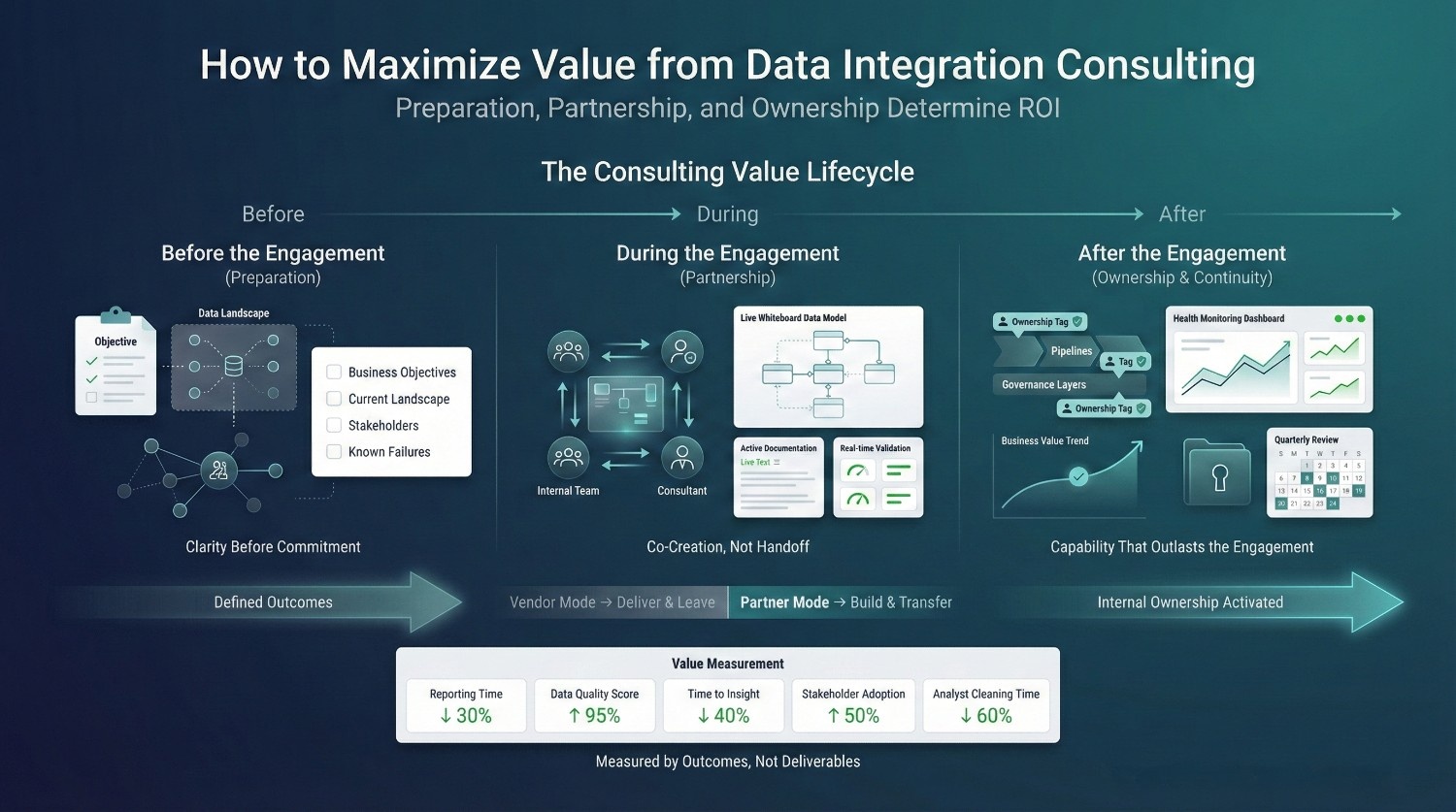
How to Get the Most Value from Data Integration Consulting
Hiring a data integration consulting partner is a significant investment. Like any investment, the return depends not just on what the consultant delivers, but on how well your organization prepares for, participates in, and follows through after the engagement.
Here’s how to maximize value at every stage.
Before the Engagement
The work you do before the first consultant walks in the door determines how quickly the engagement produces results. Come prepared.
Define Your Business Objectives Clearly
Don’t make the consulting team guess what success looks like.
Vague Objective | Clear Objective |
|---|---|
"We need to integrate our data" |
"We need a unified customer view that reduces churn reporting time from 5 days to 5 hours" |
"Our data is a mess" |
"Customer records are duplicated across three systems and we can't reconcile revenue between finance and sales" |
"We want better analytics" |
"We need a governed data warehouse that supports self-service BI for marketing, finance, and operations by Q3" |
The clearer your objectives, the faster the consulting team can design a solution that hits them.
Document Your Current Data Landscape
You don’t need a perfect map. You need an honest one:
- What source systems exist and what data they hold
- How data currently flows between systems, including manual processes and workarounds
- Known pain points, what’s broken, what’s slow, what’s unreliable
- Previous integration attempts, what was tried, what worked, what didn’t
The more context you provide upfront, the less time the consulting team spends on discovery and the more time they spend on solutions.
Identify Key Stakeholders and Decision-Makers
Integration touches every department. Before the engagement starts, know:
- Who owns the data in each source system?
- Who consumes the integrated data, and what do they need from it?
- Who has decision-making authority on metric definitions, business rules, and conflict resolution?
- Who needs to be informed vs. who needs to actively participate?
Nothing stalls an engagement faster than discovering mid-project that a critical stakeholder was never consulted, and they have strong opinions that override weeks of work.
Be Honest About What's Failed
This is the hardest part, and the most important.
Don’t hide previous failures. The consulting team needs to know what didn’t work and why.
- If a previous integration attempt stalled, say so, and share what you think went wrong
- If there’s political resistance from a specific department, surface it early
- If the data quality is worse than you’ve admitted to leadership, be transparent
- If the team is burned out and skeptical, that’s critical context
Consultants can’t fix problems they don’t know about. Transparency upfront saves months of misdirection.
Set Realistic Expectations
- Integration is iterative, not instantaneous. Value comes in phases.
- The discovery and assessment phase may feel slow, but it prevents the false starts that feel even slower
- There will be uncomfortable conversations about data quality, governance gaps, and organizational alignment
- The timeline will depend on complexity, not just effort, and complexity is usually higher than expected
During the Engagement
This is where most organizations either maximize or waste their consulting investment. The difference comes down to one word: partnership.
Treat the Consulting Team as Partners, Not Vendors
Vendor Mindset | Partner Mindset |
|---|---|
"Here's the requirements. Deliver it." |
"Here's what we're trying to achieve. Let's figure out the best approach together." |
Minimal context shared |
Full transparency, including the messy parts |
Feedback given at the end |
Continuous feedback and collaboration |
Internal team waits for deliverables |
Internal team works alongside consultants daily |
The best outcomes come from co-creation, not handoff.
Keep Your Internal Team Actively Involved
This is non-negotiable if you want long-term value:
- Your engineers should be working alongside the consultants, pairing, reviewing, learning
- Your analysts should be participating in data validation and testing
- Your business stakeholders should be attending workshops and approving business rules
- Nobody on your team should be passively waiting for deliverables
If the consultants build everything and your team watches, you’ll have a working integration that nobody internally understands how to maintain. That’s not a solution, it’s a dependency.
Establish Regular Checkpoints
- Weekly progress reviews, what was accomplished, what’s next, what’s blocked
- Bi-weekly stakeholder updates, keeping decision-makers informed and aligned
- Monthly executive briefings, demonstrating progress against business objectives
- Immediate escalation paths, for blockers that need quick resolution
Don’t wait for the final deliverable to discover the project is off track. Regular checkpoints catch issues early when they’re cheap to fix.
Don't Skip Discovery and Assessment
“We already know what we need. Let’s just start building.”
Every data integration consulting team has heard this. And every one of them knows it’s a red flag.
The discovery phase exists because:
- What you think the problem is and what the problem actually is are often different
- Data quality issues, schema conflicts, and governance gaps only become visible through systematic assessment
- Building without discovery means building on assumptions, and assumptions fail
The discovery phase is typically 2–4 weeks. Skipping it to “save time” routinely costs 2–4 months of rework later.
Insist on Documentation and Knowledge Transfer Throughout
Don’t accept “we’ll document everything at the end.” That never happens completely.
Demand documentation as deliverables are produced:
- Architecture decisions documented as they’re made, including the rationale and alternatives considered
- Transformation rules documented as they’re built, with business logic explanations, not just code comments
- Governance frameworks documented as they’re designed, including ownership, escalation, and conflict resolution
- Runbooks documented as operational patterns emerge, not reconstructed from memory after go-live
Knowledge transfer isn’t a phase at the end of the engagement. It’s a continuous process that happens every day the consulting team is working alongside yours.
After the Engagement
The engagement ends. The consultants leave. This is where the real test begins, and where preparation during the engagement pays off (or doesn’t).
Establish Clear Ownership of Everything That Was Built
Before the last consultant logs off, every component needs an internal owner:
Component | Who Owns It |
|---|---|
Pipeline infrastructure |
Data engineering lead |
Transformation logic and business rules |
Data engineering + business stakeholders jointly |
Data quality monitoring |
Data steward or quality lead |
Governance framework |
Data governance lead or CDAO |
Documentation and runbooks |
Data operations team |
Stakeholder communication |
Data product owner or analytics lead |
If ownership isn’t assigned, maintenance doesn’t happen. And unmaintained integration decays, fast.
Verify Documentation Completeness
Before the engagement formally closes, audit the documentation:
- Architecture diagrams, current state, not just the original design
- Data model documentation, every entity, relationship, and field definition
- Transformation logic, every business rule documented with rationale and approval
- Governance framework, ownership, stewardship, golden record rules, escalation paths
- Runbooks, step-by-step procedures for common scenarios (failures, schema changes, new sources)
- Training materials, for engineers, analysts, and business users
If anything is missing, request it before the engagement ends. Gaps in documentation after the consultants leave become permanent gaps.
Schedule Periodic Reviews
Integration doesn’t stay static. Schedule regular health checks:
Frequency | Review Focus |
|---|---|
Monthly |
Pipeline health metrics, data quality scores, SLA compliance |
Quarterly |
Governance effectiveness, new source requirements, business rule changes |
Annually |
Architecture fitness for current scale and future needs, tool evaluation |
These reviews catch decay before it becomes a crisis, and keep the integration evolving alongside the business.
Keep the Door Open for Advisory Support
Even after a successful engagement, new challenges will arise:
- A new acquisition brings another set of systems to integrate
- A new regulation changes your governance requirements
- Your data volume doubles and performance degrades
- A new analytics initiative requires an extension of the current architecture
Having a trusted data integration consulting partner you can call on for targeted advisory support, without re-engaging for a full project, is one of the most valuable ongoing relationships a data organization can have.
Measure Outcomes Against Original Success Criteria
Remember those business objectives you defined before the engagement? Now is the time to measure against them:
- Did reporting time decrease as expected?
- Is the data quality baseline improving?
- Are stakeholders actually using the integrated data for decisions?
- Has the time-to-insight metric improved?
- Are analysts spending more time analyzing and less time cleaning?
If the answer is yes, the engagement delivered value. If the answer is partially, identify the gaps and address them. If the answer is no, conduct a retrospective and determine whether the issue was in the engagement, the adoption, or the ongoing maintenance.
Data integration consulting should be measured by business outcomes, not deliverables. The deliverables are a means to an end. The outcomes are the end.
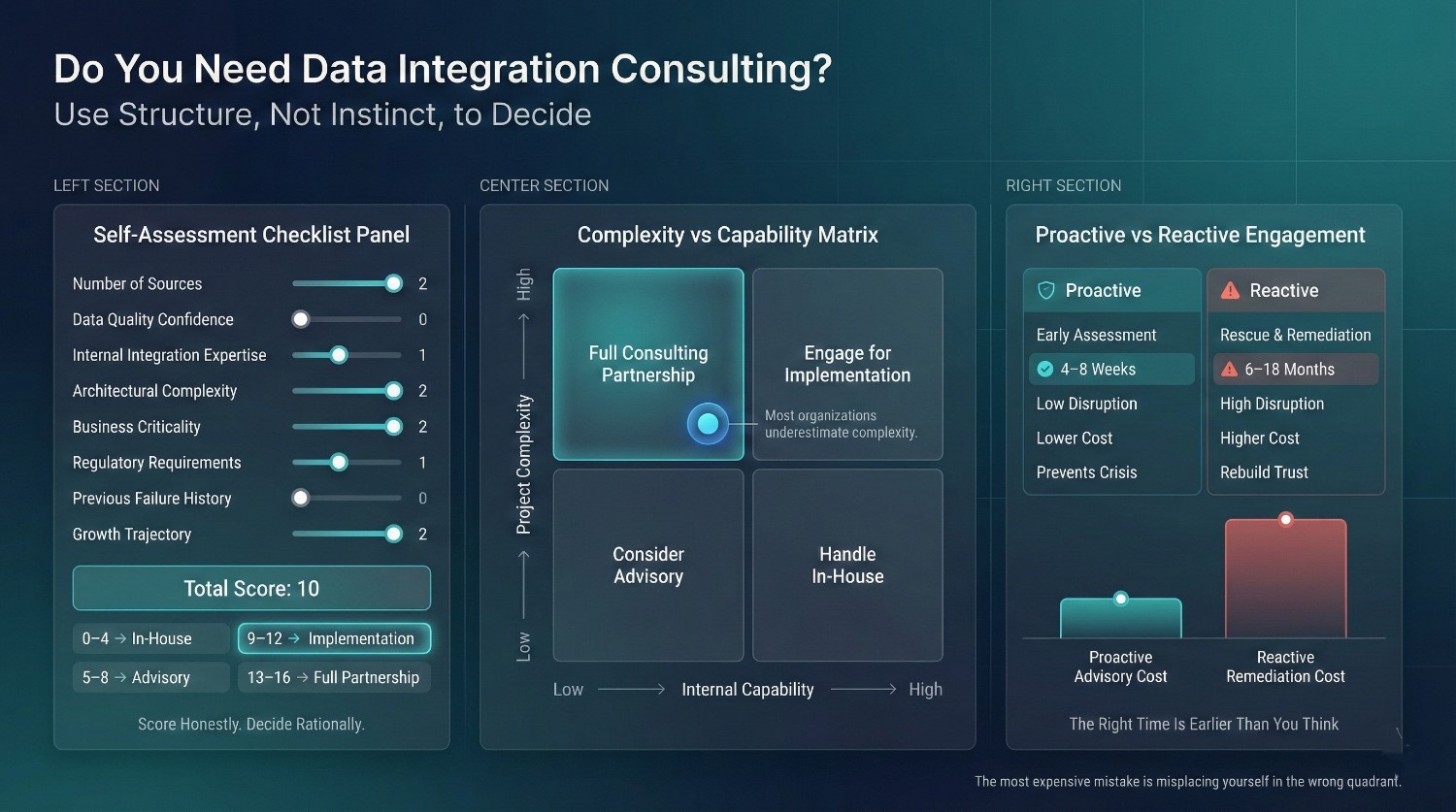
A Decision Framework: Do You Need Data Integration Consulting?
Enough theory. Let’s give you a concrete, usable framework for making this decision, based on your actual situation, not generalizations.
The Self-Assessment Checklist
Score your organization honestly across these eight dimensions. No aspirational answers, where you are today.
The Checklist
# | Dimension | Score 0 | Score 1 | Score 2 |
|---|---|---|---|---|
1 |
Number of source systems |
1–3 sources |
4–10 sources |
11+ sources |
2 |
Data quality confidence |
High, data is clean, consistent, and trusted across the org |
Moderate, some known issues but manageable |
Low, widespread quality problems, conflicting data, nobody fully trusts the numbers |
3 |
Internal integration expertise |
Strong, team has successfully delivered multi-source integration including governance and quality |
Moderate, team has built pipelines but hasn't tackled full integration end-to-end |
Limited, team is skilled at engineering but hasn't done complex integration work at scale |
4 |
Architectural complexity |
Simple, few connections, clear data flows, documented dependencies |
Moderate, growing number of pipelines, some undocumented dependencies |
High, point-to-point spaghetti, frequent failures, nobody has the full picture |
5 |
Business criticality |
Low, integration supports exploratory or non-critical use cases |
Moderate, integration feeds important but not mission-critical decisions |
High, integration feeds executive decisions, customer-facing systems, revenue operations, or compliance |
6 |
Regulatory requirements |
None, no compliance-driven data mandates |
Some, general compliance awareness but no active audit pressure |
Significant, GDPR, HIPAA, SOX, or industry-specific mandates with active or imminent audit exposure |
7 |
Previous failure history |
None, this is the first attempt |
Minor, some false starts but nothing major |
Significant, previous attempts have stalled, failed, or been abandoned |
8 |
Growth trajectory |
Stable, systems and data volumes aren't changing significantly |
Growing, new sources and use cases are emerging but manageable |
Rapid, new systems, acquisitions, product lines, or geographies are outpacing the team's capacity |
Scoring Guide
Add up your total score across all eight dimensions.
Total Score | What It Suggests | Recommended Action |
|---|---|---|
0–4 |
Low complexity, manageable internally |
Handle in-house. Focus on building good practices early. |
5–8 |
Moderate, some known issues but manageable |
Consider an advisory engagement, assessment, architecture review, roadmap. Get expert eyes on the plan before committing to execution. |
9–12 |
High complexity with real business impact |
Engage data integration consulting for implementation support, architecture, modeling, governance, and delivery. |
13–16 |
Critical complexity with compounding risk |
Full consulting partnership, strategy through implementation through operationalization. The cost of waiting exceeds the cost of engagement. |
Be honest with yourself. The most expensive score is the one you know is a 2 but written down as a 1.
The Complexity vs. Capability Matrix
The checklist gives you a score. This matrix gives you a visual framework for mapping your situation and determining the right engagement level.
The Two Axes
Project Complexity (vertical axis) How hard is the integration challenge itself?
- Number of sources, schema conflicts, transformation requirements
- Data quality issues, governance needs, compliance mandates
- Organizational alignment challenges, cross-departmental dependencies
- Scale, performance requirements, real-time needs
Internal Capability (horizontal axis) How equipped is your team to handle it?
- Integration experience (not just engineering experience)
- Governance maturity
- Architectural standards and documentation
- Cross-functional facilitation skills
- Available bandwidth
The Four Quadrants
HIGH COMPLEXITY | |||
|---|---|---|---|
LOW CAPABILITY |
Full Consulting Partnership |
Engage for Implementation |
HIGH CAPABILITY |
Consider Advisory |
Handle In House | ||
LOW COMPLEXITY | |||
What Each Quadrant Means
Handle In-House (High Capability + Low Complexity)
- Your team has the skills and the problem is straightforward
- No consulting needed, execute with confidence
- Focus on maintaining good practices and documentation
Consider Advisory (Low Capability + Low Complexity)
- The problem isn’t complex, but your team hasn’t done this before
- A lightweight advisory engagement, architecture review, best practice guidance, roadmap validation, gives you guardrails without full implementation support
- Your team builds the solution; the consultant ensures they’re building the right one
Engage for Implementation (High Capability + High Complexity)
- Your team is strong but the problem is genuinely hard, M&A consolidation, enterprise-wide unification, compliance-driven integration
- Consultants bring specialized depth, additional capacity, and proven methodology
- Your team stays actively involved and takes ownership after delivery
Full Consulting Partnership (Low Capability + High Complexity)
- The problem is hard and your team doesn’t have the experience to navigate it
- This requires end-to-end partnership, strategy, architecture, implementation, governance, change management, and operationalization
- The engagement should explicitly include knowledge transfer so your team builds capability alongside delivery
Where Organizations Get It Wrong
Most organizations overestimate their capability and underestimate the complexity. They plot themselves in the “Handle In-House” quadrant when they actually belong in “Engage for Implementation”, or even “Full Partnership.”
Common misplacements:
- “Our engineers are great” → True, but integration requires governance, facilitation, and data modeling skills that engineering alone doesn’t cover
- “We’ve done ETL before” → ETL is one component of integration. The full scope is significantly broader.
- “It’s only 5 sources” → But those 5 sources have incompatible schemas, conflicting definitions, and no governance framework. Complexity isn’t just about count.
- “We’ll figure out governance later” → Governance designed after the fact is 3x harder to implement than governance designed alongside the integration.
Be ruthlessly honest about where you sit. The cost of misplacement is months of wasted effort and compounding technical debt.
The Right Time Is Usually Earlier Than You Think
The Pattern
Here’s what happens in most organizations:
- Early signals appear, conflicting reports, growing quality issues, scaling challenges
- The team tries to handle it internally, workarounds, patches, incremental improvements
- The problems compound, technical debt grows, trust erodes, initiatives stall
- A crisis forces action, a failed audit, a blown migration, a board-level data embarrassment
- Consulting is engaged, reactively, to rescue, remediate, and rebuild
By step 5, remediation costs can be materially higher than early intervention, particularly when technical debt and trust erosion accumulate.
Proactive vs. Reactive Consulting
Proactive Consulting | Reactive Consulting | |
|---|---|---|
When it happens |
At the first signs of complexity, before problems compound |
After a crisis, failed project, compliance violation, leadership revolt |
What it involves |
Assessment, architecture review, roadmap, targeted guidance |
Rescue planning, remediation, rebuilding, stakeholder trust recovery |
Typical cost |
$50K–$150K for advisory |
$300K–$1M+ for full remediation |
Timeline |
4–8 weeks for assessment and roadmap |
6–18 months for recovery |
Business impact |
Minimal disruption, problems prevented before they materialize |
Significant disruption, initiatives stalled while the foundation is rebuilt |
Organizational stress |
Low, feels like smart planning |
High, feels like crisis management |
The Analogy
- Proactive consulting is preventive medicine. A checkup, some tests, a plan to stay healthy. Affordable, low-stress, and highly effective.
- Reactive consulting is emergency surgery. Expensive, disruptive, stressful, and with a longer recovery, even when it’s successful.
The right time to engage in data integration consulting is when you first notice the symptoms, not when they’ve become a crisis.
What Early Engagement Looks Like
You don’t need to commit to a full implementation to get value. The lowest-risk, highest-value first step is usually a scoped assessment:
- 2–4 weeks of effort
- Current-state analysis of your data landscape, quality, and architecture
- Gap identification, what’s working, what’s at risk, what’s already broken
- Prioritized recommendations, what to fix first, what can wait, what to monitor
- Roadmap, phased plan aligned to your business objectives and budget
Cost: a fraction of a full engagement. Value: clarity on exactly where you stand and what you actually need.
That clarity alone prevents more waste than most organizations realize, because the most expensive decision is the one made without understanding the full picture.
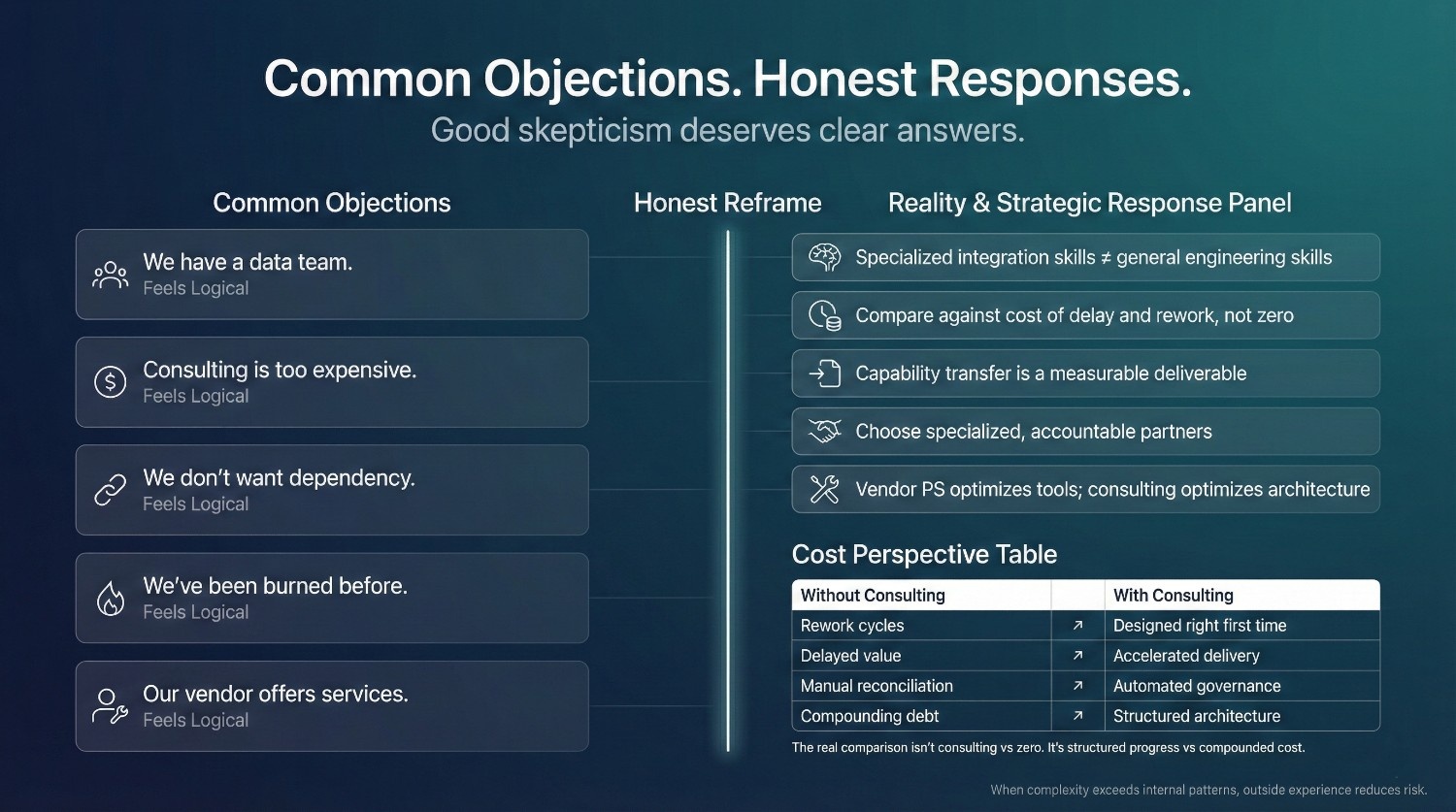
If you’re considering data integration consulting and haven’t raised at least one of these objections, you’re probably not thinking hard enough about the decision. These are legitimate concerns.
Let’s address each one honestly.
"We have a data team, we should be able to do this ourselves."
Why This Feels Right
You hired smart people. You’re paying them well. They build pipelines, manage infrastructure, and deliver dashboards. Saying “we need outside help” feels like saying “our team isn’t good enough.”
It’s not.
The Reality
Having a data team and having integration-specific expertise are not the same thing.
What Your Data Team Likely Has | What Integration Specifically Demands |
|---|---|
Strong engineering skills |
Canonical data model design across 10+ incompatible schemas |
Experience building pipelines |
Entity resolution and golden record logic |
Familiarity with your tools |
Cross-departmental stakeholder facilitation |
Knowledge of your systems |
Governance framework design and implementation |
Ability to write SQL and Python |
Business rule reconciliation when departments disagree |
Pattern recognition from doing this across dozens of organizations |
Your team is likely excellent at what they do. But Integration at scale often becomes a specialized discipline requiring experience in architecture, governance, and cross-functional alignment, like asking a great general contractor to also do structural engineering. They’re related skills, but they’re not the same skills.
The Honest Answer
Data integration consulting doesn’t replace your team. It brings a specific set of capabilities that most internal teams encounter too infrequently to develop organically.
Your team works with the consultants. They learn the patterns, the frameworks, and the methodology. When the engagement ends, your team is stronger, not sidelined.
"Consulting is too expensive."
Why This Feels Right
Consulting rates are higher than internal salaries. The budget request is visible and requires justification. It’s easy to look at the price tag and conclude it’s not worth it.
The Reality
The real comparison isn’t consulting cost vs. zero cost. It’s consulting cost vs. the cost of not consulting:
Cost Category | Without Consulting | With Consulting |
|---|---|---|
Project timeline |
12–18 months with rework cycles |
6–9 months with fewer false starts |
Engineering rework |
$100K–$200K in wasted effort rebuilding what didn't work |
Minimal, architecture gets designed right the first time |
Delayed business value |
6–12 months of analytics, AI, or personalization initiatives stuck waiting |
2–3 months, value delivery begins in early phases |
Manual workarounds |
Ongoing, analysts spending 60%+ of time on data prep |
Eliminated or dramatically reduced within the engagement |
Opportunity cost |
Competitors leveraging data you can't |
Competitive position protected |
When you factor in delayed value, rework, and the ongoing tax of broken integration, doing it wrong internally almost always costs more than doing it right with help.
The Honest Answer
The question isn’t “can we afford consulting?” It’s “can we afford the cost of a failed or stalled project, again?”
And if budget is genuinely constrained, a scoped advisory engagement, assessment, architecture review, roadmap, costs a fraction of full implementation and prevents the most expensive mistakes.
"We don't want to be dependent on outside consultants."
Why This Feels Right
Nobody wants to pay consultants forever. The fear is real: they build something only they understand, and you’re locked into ongoing fees just to keep the lights on.
It’s a valid concern, because bad consulting actually does create this dynamic.
The Reality
Good data integration consulting has a specific, measurable goal: make your team self-sufficient.
Long-term dependency without capability transfer should be considered a red flag in vendor selection.
What Independence-Focused Consulting Looks Like
- Knowledge transfer is a deliverable, not an afterthought. It’s in the scope, in the timeline, and in the success criteria.
- Documentation is produced alongside the work, architecture decisions, transformation rules, governance frameworks, and operational runbooks are delivered as the engagement progresses.
- Your team is actively involved throughout, pairing with consultants, reviewing designs, participating in workshops. They’re building capability while the solution is being built.
- The engagement has a defined exit, a clear point where the consulting team steps back and your team takes full ownership. With a transition period, not an abrupt cutoff.
Ongoing support is optional, available if you want it, but the system and your team are designed to operate independently.
The Honest Answer
If a consulting partner’s business model depends on your ongoing dependency, they’re the wrong partner. The right partner measures success by how confidently your team operates without them.
Ask explicitly during evaluation: “What does the handoff look like? What will my team be able to do independently after this engagement?” If the answer is vague, walk away.
"We've had bad experiences with consultants before."
Why This Feels Right
Because bad consulting is real and widespread:
- Consultants who deliver a beautiful slide deck and disappear before implementation
- Teams that staff senior people for the pitch and junior people for the work
- Engagements that drag on with no clear deliverables or accountability
- Recommendations that are technically impressive but completely disconnected from your business reality
- Partners who create dependency instead of capability
If you’ve been burned before, skepticism is completely reasonable.
The Reality
Not all consulting is the same. And specifically, data integration consulting from a specialized firm is fundamentally different from generic IT consulting.
Generic IT Consulting | Specialized Data Integration Consulting |
|---|---|
Broad capabilities, shallow depth in any one area |
Deep expertise specifically in integration architecture, modeling, quality, and governance |
Generalist consultants assigned based on availability |
Specialists with direct experience in multi-source integration challenges |
Methodology borrowed from software development or project management |
Methodology built specifically for integration, discovery, profiling, modeling, governance, testing |
Success measured by deliverables and hours |
Success measured by business outcomes, data trust, time-to-insight, quality improvement |
How to Protect Yourself This Time
- Check references, talk to actual clients, not just logos on a slide
- Define scope and success criteria upfront, measurable outcomes, not just activities
- Require milestone-based delivery, payment and progress tied to concrete deliverables
- Insist on named resources, know who will actually do the work, not just who pitches
- Build in exit clauses, if the engagement isn’t delivering value by a defined checkpoint, you can adjust or exit
The Honest Answer
A bad experience with a consultant is a reason to choose your next consultant more carefully, not a reason to avoid consulting when
you genuinely need it.
The cost of letting a past bad experience prevent you from getting help you need now is compounding damage to your data infrastructure, your team’s capacity, and your organization’s trust in data
"Our tool vendor offers professional services, isn't that enough?"
Why This Feels Right
Your vendor knows their tool better than anyone. Their professional services team can get you up and running quickly. It’s a single relationship to manage. The pricing might even be bundled.
The Reality
Vendor professional services serve an important purpose, getting their tool working in your environment. But that’s a fundamentally different goal from solving your integration problem.
Vendor Professional Services | Independent Data Integration Consulting | |
|---|---|---|
Primary objective |
Get their product running and adopted |
Solve your data integration challenge, regardless of which tools are involved |
Tool perspective |
Their tool is always the answer |
Tool-agnostic, recommends what fits your situation |
Scope |
Limited to their product's capabilities and ecosystem |
Full spectrum, strategy, architecture, governance, change management, multi-tool |
Architecture advice |
Optimizes for their platform |
Optimizes for your business and your entire data stack |
Conflict of interest |
Inherent, their success is measured by your product adoption and expansion |
None, their success is measured by your business outcomes |
When Vendor PS Is Sufficient
- You’ve already chosen the tool and your only challenge is implementing it
- The scope is limited to that tool’s functionality
- You’re not dealing with cross-platform integration, governance, or organizational alignment
When You Need Independent Consulting Instead
- You haven’t decided which tool is the right fit, and you need unbiased evaluation
- Your challenge spans multiple tools, platforms, and systems
- You need architecture, governance, and change management, not just tool configuration
- You want someone who will tell you if the tool you’ve chosen isn’t the right answer
The Honest Answer
Vendor professional services are primarily designed to optimize implementation and adoption of their specific platform. Independent data integration consulting optimizes you for your business. Sometimes
those align. Often they don’t.
Use vendor PS for what it’s good at, tool implementation. Use data integration consulting for what it’s good at, solving the strategic, architectural, and organizational problem that no single tool can address alone.
The Summary
Objection | The Short, Honest Response |
|---|---|
"Our team can handle it" |
Your team is capable, but integration at scale requires specialized skills most teams don't develop organically |
"It's too expensive" |
Compare it to the cost of failure, rework, and delayed value, not to zero |
"We'll become dependent" |
Good consulting builds your capability, demand knowledge transfer as a deliverable |
"We've been burned before" |
Choose more carefully this time, specialized, accountable, outcome-focused partners |
"Our vendor offers services" |
Vendor PS implements their tool. Consulting solves your problem. Different goals. |
Every one of these objections has merit. None of them change the underlying reality: when your data integration challenge crosses the complexity threshold, experienced consulting is the fastest, most cost-effective path to a working solution.
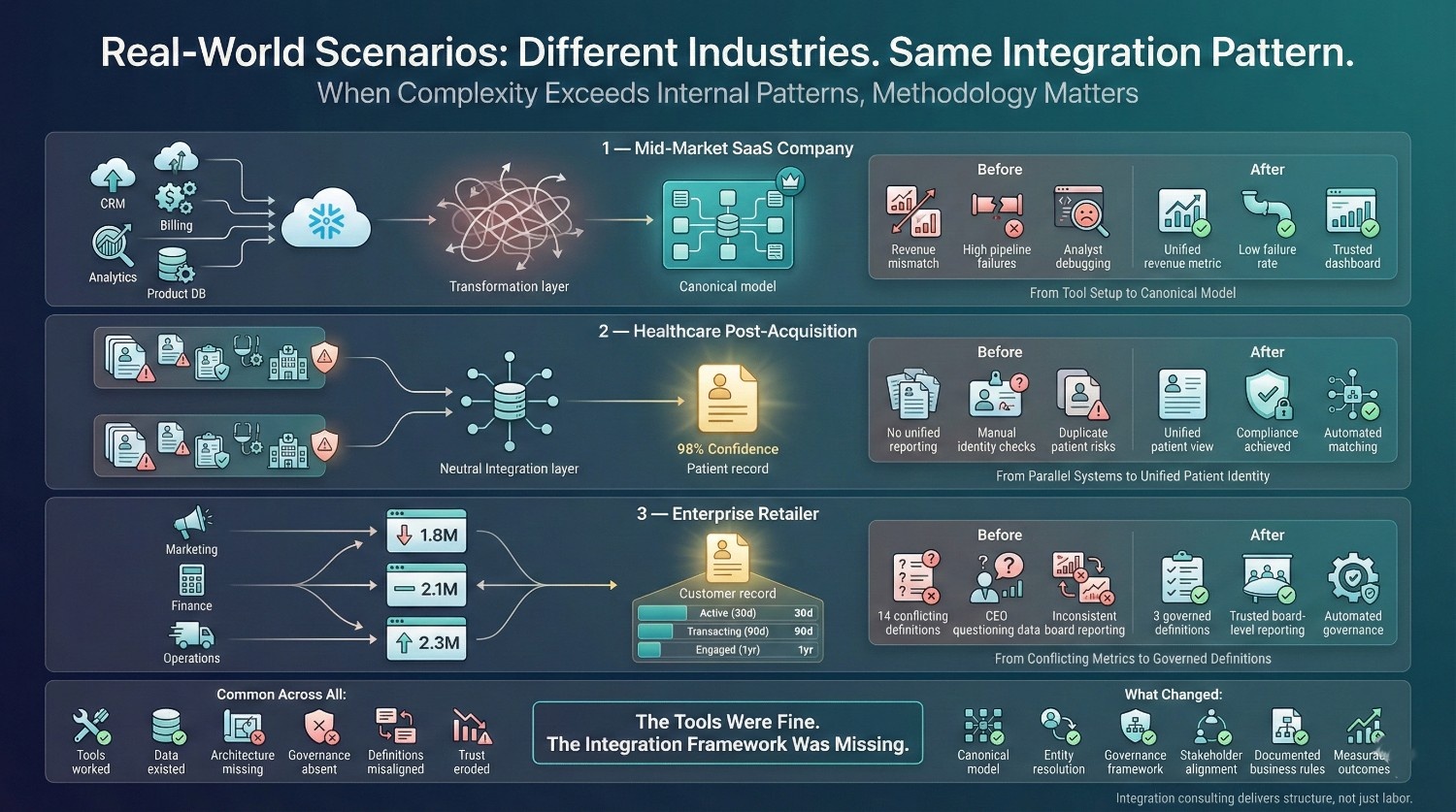
Real-World Scenarios (Illustrative Examples)
Theory is useful. But seeing how data integration consulting plays out in practice, with real complexity, real constraints, and real outcomes, is what makes the decision tangible.
Here are three scenarios based on common patterns across industries. The details are illustrative, but the challenges, approaches, and results reflect what actually happens.
Scenario A: The Mid-Market SaaS Company
The Situation
Company profile:
- B2B SaaS, 200 employees, $35M ARR, growing 40% year-over-year
- 15+ data sources, Salesforce, HubSpot, Stripe, Intercom, product database, Google Analytics, and a handful of internal tools
- Small data team, 2 data engineers, 1 analytics engineer, 1 data analyst
- No existing data warehouse or integration architecture
What they were trying to do: Build their first data warehouse to support company-wide analytics, customer health scoring, revenue reporting, marketing attribution, and product usage insights.
What they tried first:
- Set up Fivetran to pull data from all 15 sources into Snowflake
- Started building dbt models to transform and unify the data
- Felt like great progress.
- Connectors went live in 2 weeks, creating the perception of rapid progress.
What went wrong:
- Transformation logic became a mess within 2 months
- No canonical data model, each dbt model was built ad hoc
- “Customer” was defined differently in Salesforce, Stripe, and the product database
- Revenue calculations didn’t match between Stripe and the finance team’s spreadsheet
- Nobody documented the business rules, they lived in the engineers’ heads
- Pipeline failures started happening weekly as source schemas changed
- The analyst spent 70% of their time debugging data issues instead of analyzing
- After 6 months, leadership still couldn’t get a reliable customer health dashboard
The inflection point: The VP of Sales asked why the churn numbers on the new dashboard didn’t match what the CS team reported. The data team couldn’t explain the discrepancy. Leadership confidence in the data began to erode.
The Consulting Engagement
Engagement model: Advisory + targeted implementation (12 weeks)
What the consulting team did:
Phase | Duration | Activities |
|---|---|---|
Discovery and Assessment |
Weeks 1–2 |
Profiled all 15 sources for quality, mapped current dbt models and their issues, interviewed stakeholders across sales, CS, finance, and product |
Architecture and Data Modeling |
Weeks 3–5 |
Designed a canonical customer model, defined golden record logic for customer identity across systems, created a standardized revenue model aligned with finance |
Transformation Framework |
Weeks 6–9 |
Rebuilt the dbt project with modular, documented, tested transformation layers. Encoded business rules with explicit documentation and stakeholder sign-off |
Quality and Governance |
Weeks 10–11 |
Implemented data quality tests (Great Expectations), set up freshness monitoring, established data ownership for each domain |
Knowledge Transfer |
Week 12 |
Paired with the internal team on every component, delivered complete documentation and runbooks, conducted training sessions |
The Outcome
Metric | Before | After |
|---|---|---|
Time from source to trusted dashboard |
6+ months (and still not trusted) |
6 weeks from engagement start |
Revenue discrepancy between teams |
3 different numbers depending on who you asked |
A single finance-approved revenue number adopted consistently across departments |
Analyst time on data prep |
~70% |
~20% |
Pipeline failures per month |
8–12 |
1–2 (with automated alerts and documented resolution) |
Internal team capability |
Building ad hoc, no framework or standards |
Operating against a documented architecture with governance |
The real win: The data team went from being seen as a bottleneck to being seen as an enabler. Leadership started requesting new dashboards, because they trusted the data.
Scenario B: The Healthcare Organization Post-Acquisition
The Situation
Company profile:
- Regional healthcare network, 3,000 employees, serving 500,000+ patients
- Recently acquired a smaller competitor with 800 employees and 150,000 patients
- Combined organization now operates two of everything, two EHR systems (Epic and Cerner), two billing platforms, two scheduling systems
The business challenge:
- Regulatory requirement for unified patient reporting within 90 days of close
- Clinicians in both organizations need a unified patient view to avoid duplicate tests, missed medication interactions, and fragmented care records
- Finance needs consolidated billing and revenue reporting
What made this hard:
- Patient records overlapped significantly, many patients had been seen at both organizations
- Naming conventions, ID systems, and data structures were completely different
- Patient identity resolution in healthcare is high stakes, a wrong match could link the wrong medical history to the wrong patient
- Cultural tension, staff at both organizations believed their system should be the surviving standard
- 90-day compliance deadline with no room for extension
The inflection point: 30 days after close, the compliance team flagged that unified reporting was legally required by day 90. No plan existed. The internal data team had never done entity resolution at this scale, and certainly not with the clinical risk involved.
The Consulting Engagement
Engagement model: Full implementation partnership (16 weeks, with 4-week overlap past deadline for stabilization)
What the consulting team did:
Phase | Duration | Activities |
|---|---|---|
Emergency Assessment |
Weeks 1 |
Rapid inventory of both data ecosystems, identified overlap zones, assessed patient record quality in both systems |
Identity Resolution Design |
Weeks 2–4 |
Designed a multi-layered patient matching strategy, deterministic matching (SSN, DOB + exact name), probabilistic matching (fuzzy name + address + phone), manual review queue for edge cases |
Canonical Patient Model |
Weeks 3–5 |
Created a unified patient model that both EHR systems could map into, without requiring either system to change its internal structure |
Phased Consolidation |
Weeks 5–10 |
Migrated and matched patient records in priority order, starting with patients seen at both organizations (highest risk and regulatory priority) |
Compliance Reporting |
Weeks 8–12 |
Built unified reporting layer to meet regulatory requirements, with full lineage tracking and audit trail |
Governance and Stabilization |
Weeks 12–16 |
Established golden record rules, ongoing matching processes for new patients, quality monitoring, and escalation procedures |
Key decision: The consulting team recommended not choosing a “winning” system. Instead, they built a neutral integration layer that both systems fed into, avoiding the political and operational risk of forcing a premature system migration.
The Outcome
Metric | Before | After |
|---|---|---|
Regulatory compliance |
At risk, no unified reporting capability |
Met, 90-day deadline achieved with 5 days to spare |
Duplicate patient records identified |
Unknown |
Approximately 30% of records in the acquired system required reconciliation due to duplication or overlap |
Time to resolve a patient identity question |
Hours of manual cross-referencing |
Seconds, automated matching with confidence scores |
Unified patient view |
Nonexistent |
Available to clinicians at both organizations |
Billing reconciliation |
Manual, monthly, error-prone |
Automated, weekly, with exception handling |
The real win: Patient safety. Clinicians could now see a complete medical history for patients who had been treated at both organizations, reducing the risk of duplicate procedures, drug interactions, and fragmented care.
Scenario C: The Enterprise Retailer Struggling with Data Trust
The Situation
Company profile:
- National retailer, 5,000+ employees, $800M annual revenue
- 50+ stores, e-commerce platform, mobile app, loyalty program
- Data infrastructure includes Salesforce, SAP ERP, Shopify (e-commerce), a custom POS system, Google Analytics, and a legacy data warehouse
The data trust problem:
- Marketing, finance, and operations all reported different customer counts
- Marketing: 2.3 million (based on email list and loyalty program)
- Finance: 1.8 million (based on customers with at least one transaction)
- Operations: 2.1 million (based on POS records including in-store only)
- None of them were wrong, they were using different definitions of “customer” drawn from different systems
- The CEO called out the discrepancy in a board meeting. Nobody could explain it.
Previous attempts to fix it:
- Attempt 1: Data engineering built a “unified customer table” in the warehouse. It had more duplicates than the source systems because no entity resolution was performed.
- Attempt 2: Hired a BI analyst to “fix the data.” They built reconciliation spreadsheets that took 3 days to produce each month and were outdated by the time they were shared.
- Attempt 3: Purchased a CDP. Fed it raw data from all sources. The CDP inherited all the same quality and definitional problems, now in a more expensive system.
The inflection point: After three failed attempts over 18 months, the CMO and CFO jointly escalated to the CEO. The message: “We can’t run this business on data we don’t trust. We need outside help.”
The Consulting Engagement
Engagement model: Assessment + implementation (20 weeks)
What the consulting team did:
Phase | Duration | Activities |
|---|---|---|
Root Cause Analysis |
Weeks 1–3 |
Mapped every definition of "customer" across all departments and systems. Documented where each number came from, which sources it used, and what logic it applied. Identified 14 distinct definitions of "customer" across the organization. |
Stakeholder Alignment |
Weeks 3–5 |
Facilitated cross-departmental workshops with marketing, finance, operations, and e-commerce. Reached consensus on a tiered customer definition, Active Customer, Transacting Customer, Engaged Contact, with clear, documented criteria for each. |
Entity Resolution |
Weeks 5–10 |
Implemented deterministic and probabilistic matching across all sources. Created a golden customer record with a master customer ID. Linked every source system record to its golden record. |
Governance Framework |
Weeks 8–12 |
Defined data owners for customer data (CMO for marketing attributes, CFO for transaction attributes, COO for operational attributes). Established golden record rules, conflict resolution logic, and quality monitoring. |
Unified Customer Model |
Weeks 10–16 |
Built and deployed a canonical customer model in the warehouse. All departments query the same model, with role-appropriate views and filters. |
Validation and Adoption |
Weeks 16–20 |
Parallel testing with all three departments. Each confirmed the new numbers aligned with their expectations when using the agreed-upon definitions. Training on the new model, query patterns, and issue reporting. |
The Outcome
Metric | Before | After |
|---|---|---|
Customer count discrepancy across departments |
3 conflicting numbers, 1.8M, 2.1M, 2.3M |
1 trusted number per defined tier (Active: 1.95M, Transacting: 1.78M, Engaged: 2.31M) |
Analyst time spent on data reconciliation |
~45% of working hours |
~5%, mostly monitoring, not manual work |
Time to produce customer-level reporting |
3–5 days of manual assembly |
Same-day, self-service from the warehouse |
Executive trust in customer data |
None, gut instinct prevailed |
High, customer metrics are now referenced in every board meeting |
Number of "customer" definitions in use |
14 undocumented, conflicting definitions |
3 clearly defined, documented, and governed tiers |
The real win: For the first time in the company’s history, every department operated from the same customer data. The CEO stopped asking “whose numbers are right?”, because there was only one set of numbers
What All Three Scenarios Have in Common
Pattern | Present in All Three |
|---|---|
Working connectors and tools weren't the problem |
Yes |
The real issue was strategic, architectural, or organizational |
Yes |
Internal attempts had stalled or produced untrusted results |
Yes |
Data integration consulting brought methodology, not just labor |
Yes |
Knowledge transfer left the internal team stronger |
Yes |
Measurable business outcomes, not just technical deliverables |
Yes |
The tools were fine. The data was there. What was missing was the strategic framework, cross-functional facilitation, and integration expertise that turned connected systems into trusted, usable data.
That’s what data integration consulting delivers.
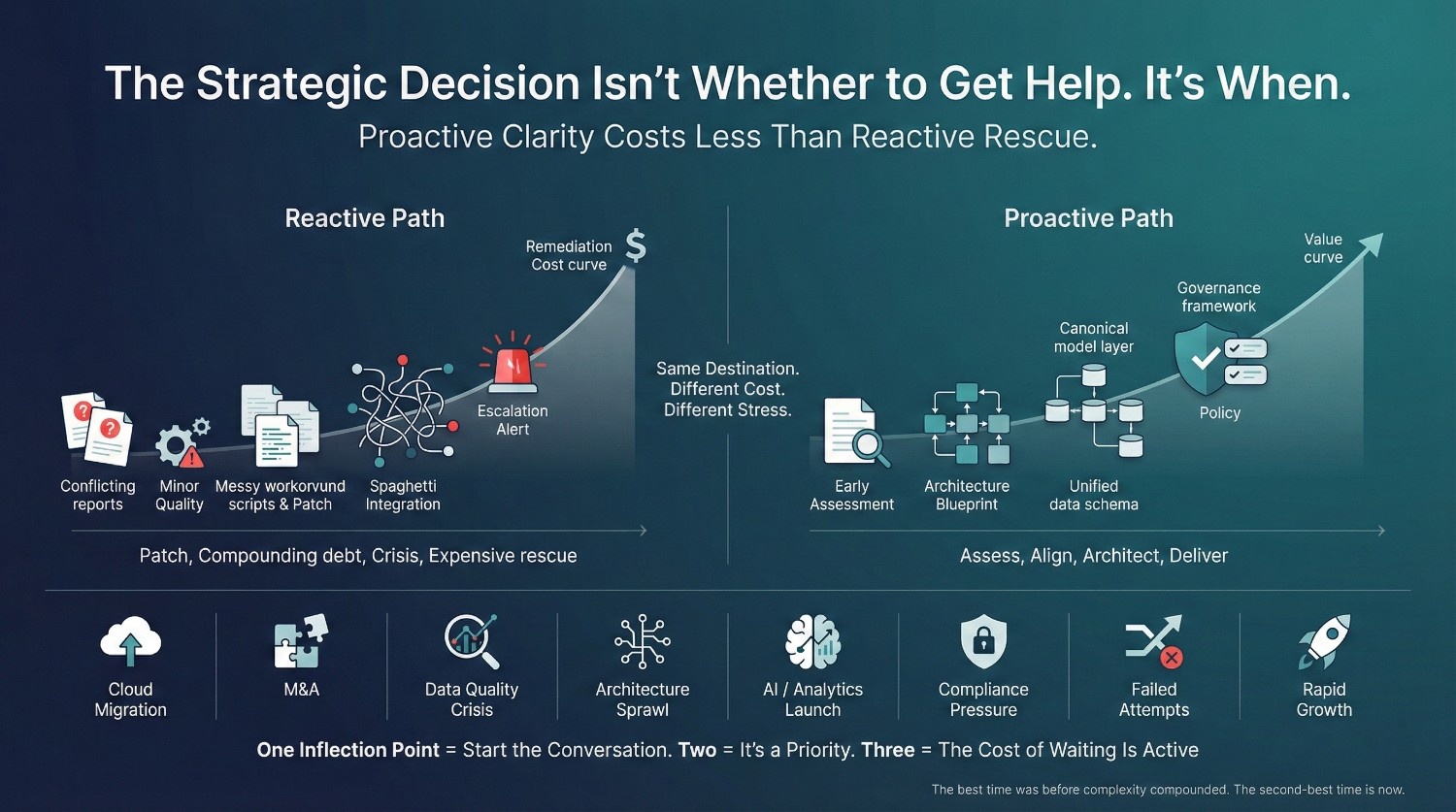
Final Thoughts
Let's Reframe This
There’s a misconception that bringing in data integration consulting is an admission that your team failed.
It’s not.
It’s an admission that data integration at scale is one of the hardest problems in enterprise technology, and that the smartest organizations don’t try to solve every hard problem from scratch with internal resources alone.
The most successful data-driven companies in the world, the ones with trustworthy data, fast analytics, working AI, and confident leadership, aren’t the ones who did everything themselves. They’re the ones who knew when to bring in specialized expertise and did it before the problems compounded.
That’s not a weakness. That’s a strategy.
The Two Paths
Every organization that faces a complex data integration challenge ends up on one of two paths:
Path A: Reactive
- Problems emerge, conflicting data, quality issues, scaling challenges
- Internal team tries to handle it, workarounds, patches, heroic effort
- Problems compound, technical debt, stalled initiatives, eroding trust
- A crisis forces action, failed audit, board-level embarrassment, abandoned project
- Consulting engaged to rescue and rebuild, at 3–5x the cost of early intervention
Path B: Proactive
- Early signals recognized, growing complexity, emerging quality issues, architectural strain
- Scoped assessment engaged, current state mapped, gaps identified, roadmap built
- Right level of support determined, advisory, implementation, augmentation, or partnership
- Integration built on a sound foundation, architecture, governance, quality, and change management addressed together
- Value delivered incrementally, trust built, adoption driven, capability transferred
Same destination. Dramatically different cost, timeline, and organizational stress.
For organizations experiencing high-complexity integration challenges, external expertise often becomes valuable at some stage. It’s whether you’ll seek it on Path B’s timeline or Path A’s.
The Inflection Points, Quick Reference
Keep this list somewhere visible. When you recognize your organization in any of these, the conversation about data integration consulting should start immediately:
# | Inflection Point | The Signal That It's Time |
|---|---|---|
1 |
Major cloud migration |
No integration strategy beyond "lift and shift" |
2 |
Merger, acquisition, or divestiture |
Still running parallel systems months after close |
3 |
Data quality undermining decisions |
"I don't trust the data" has become normalized |
4 |
Architecture at breaking point |
Adding a new source takes weeks; pipeline failures are routine |
5 |
Launching analytics, AI, or data products |
80% of time spent on data prep, not analysis or modeling |
6 |
Regulatory or compliance pressure |
Can't confidently answer an auditor's question about data provenance |
7 |
Previous integration efforts have failed |
The project has been "almost done" for months |
8 |
Rapid growth or digital transformation |
Integration backlog growing faster than the team can deliver |
One inflection point = start the conversation. Two or more = it’s already a priority. Three or more = the cost of waiting is actively exceeding the cost of acting.
Where You Go from Here
Assess Where You Stand Today
Go back to the self-assessment checklist in Section 7. Score your organization honestly. Plot yourself on the complexity vs. capability matrix. Don’t grade on a curve, grade on reality.
If the score says you need help, trust the score.
Start the Conversation Early
You don’t have to commit to a six-figure engagement tomorrow. The highest-value, lowest-risk first step is almost always a scoped assessment:
- 2–4 weeks
- Current-state analysis, gap identification, prioritized recommendations
- A clear picture of where you stand, what you need, and what the right next step is
- Costs a fraction of a full engagement, and prevents the most expensive mistakes
Subscribe to This Series
Specifically, the one who’s:
- Stuck maintaining a failing integration project
- Watching their data team burn out on pipeline maintenance
- Trying to convince leadership that the data problem is real and needs investment
- Evaluating whether to bring in outside help but unsure if it’s justified
This post gives them the framework to make that case clearly.
Share This with a Colleague
You don’t have to commit to a six-figure engagement tomorrow. The highest-value, lowest-risk first step is almost always a scoped assessment:
- 2–4 weeks
- Current-state analysis, gap identification, prioritized recommendations
- A clear picture of where you stand, what you need, and what the right next step is
- Costs a fraction of a full engagement, and prevents the most expensive mistakes
The Final Word
The best time to invest in data integration consulting is before the problems compound. The second-best time is right now.
Your data team isn’t failing. Your tools aren’t broken. Your situation is just complex enough to benefit from the methodology, pattern recognition, and cross-functional expertise that specialized consulting brings.
Recognizing that isn’t a weakness. It’s the most strategically mature decision a data leader can make.
Thanks for reading. Now go score that checklist.
Frequently Asked Questions (FAQ)
There are eight specific inflection points where data integration consulting shifts from optional to critical:
- Major cloud migration, moving to or between cloud platforms without an integration strategy
- Mergers, acquisitions, or divestitures, combining or separating data ecosystems from multiple organizations
- Data quality crisis, leadership doesn’t trust the data and decisions are reverting to gut instinct
- Architecture at breaking point, point-to-point spaghetti, frequent failures, new sources taking weeks to add
- Launching analytics, AI, or data products, the gap between raw data and usable data is massive
- Regulatory or compliance pressure, auditors are asking questions you can’t confidently answer
- Previous integration attempts have failed, stalled projects, burned budget, lost momentum
- Rapid growth or digital transformation, new systems and data sources are outpacing your team’s capacity
Recognizing one of these suggests evaluating your integration posture. Two or more typically indicate higher urgency.
It’s far more than setting up connectors or building pipelines. The full scope covers:
- Strategy and planning, aligning integration with measurable business outcomes
- Architecture design, selecting the right patterns, tools, and approaches for your situation
- Data modeling, building canonical models that unify disparate schemas
- Data quality, profiling, assessing, and remediating issues before and during integration
- Transformation, defining, documenting, and implementing business rules
- Governance, establishing ownership, lineage, access controls, and golden record logic
- Change management, aligning stakeholders and driving adoption across departments
- Ongoing optimization, monitoring, maintenance, and evolution planning
Any engagement that only covers one or two of these layers is implementation services, not true consulting.
Sometimes, yes. Your team can likely handle it if:
- You’re connecting 2–3 well-documented systems with compatible schemas
- Transformation requirements are minimal and straightforward
- Your team has delivered multi-source integration, including governance and quality, before
- Cross-departmental collaboration on data is already healthy
- The integration doesn’t feed critical decisions, compliance, or customer-facing systems
Where internal teams typically struggle:
- Multi-source integration with incompatible schemas and conflicting definitions
- Entity resolution and golden record logic across overlapping datasets
- Cross-departmental stakeholder facilitation, getting finance, marketing, and ops to agree on shared definitions
- Governance framework design at enterprise scale
- Post-acquisition data consolidation with cultural and political dynamics
Data integration consulting doesn’t replace your team. It brings specialized capabilities that most teams encounter too infrequently to develop organically, and transfers that knowledge so your team is stronger afterward.
Preparation maximizes the value of the engagement:
- Define business objectives, what does success look like in measurable terms?
- Document your current landscape, systems, data flows, known pain points, previous attempts
- Identify stakeholders, who owns data, who consumes it, who makes decisions
- Be transparent about failures, what’s been tried, what didn’t work, and why
- Set realistic expectations, integration is iterative, discovery takes time, uncomfortable truths will surface
The more prepared you are, the faster the engagement produces results.
This is a valid concern, and the right partner addresses it explicitly:
- Knowledge transfer is a deliverable, scoped, scheduled, and measured
- Documentation is produced alongside the work, not crammed in at the end
- Your team is actively involved throughout, pairing, reviewing, building alongside consultants
- The engagement has a defined exit, a clear point where your team takes full ownership
- Ongoing support is optional, available but not required for the system to function
If a consulting partner can’t clearly articulate what your team will be able to do independently after the engagement, they’re the wrong partner.
In most organizations, data integration functions as an ongoing program rather than a one-time project.
Source systems change. Business requirements evolve. New acquisitions bring new data. Regulations shift. Without ongoing governance and monitoring, integration quality typically degrades over time:
- APIs deprecate and connectors break
- New fields appear in source systems but aren’t captured
- Business rules change but transformation logic doesn’t update
- Data quality degrades without active monitoring
The best approach is to treat integration as a program, with dedicated monitoring, scheduled maintenance, periodic governance reviews, and a process for onboarding new sources.
Data integration consulting helps set up this operational framework, so the integration delivers value long after the engagement ends.