
Table of Contents
Introduction
Data Warehouse Consulting is one of the most frequently used and misunderstood responses to data problems. When dashboards feel unreliable, numbers don’t match, or stakeholders complain, many teams assume the answer is external help. So they hire consultants early, expecting expertise to create clarity.
Consulting is often hired because it represents visible action in moments of uncertainty. When data issues surface at the leadership level, external expertise signals progress, even when the underlying challenges are about ownership, alignment, and decision-making rather than technical capability. In reality, those engagements often deliver pipelines and models while underlying organizational problems remain untouched.
At the same time, other organizations make the opposite mistake. Delaying consulting does not preserve simplicity. It allows informal decisions to accumulate into structural debt. Definitions harden, workarounds normalize, and expectations diverge.
By the time help arrives, the problem is no longer technical. It is organizationally entrenched. They delay consulting for too long. They keep adding workarounds, allow every team to define metrics independently, and scale data volume without scaling structure. By the time they bring in help, confusion is already baked into systems, processes, and expectations.
Both paths often lead to disappointment. The issue is not whether Data Warehouse Consulting is inherently good or bad. It’s timing and readiness.
The real question leaders should be asking is this:
At what point does internal effort stop being the highest-leverage option?
Early on, many data problems are best solved internally:
- Clearer ownership
- Better prioritization
- Fewer parallel definitions
- Stronger communication between teams
No consultant can substitute for leadership making those decisions. But there is a point where internal fixes stop scaling. When ambiguity spreads faster than teams can resolve it, when trust erodes despite technical improvements, and when every change triggers debate, external help can help create leverage if the organization is prepared to absorb it.
Consulting amplifies existing structure. In organizations with clear ownership and decision discipline, it accelerates progress. In organizations without them, it accelerates confusion. Readiness determines outcome.
This article will help leaders:
- Decide whether they truly need Data Warehouse Consulting
- Avoid premature or unnecessary engagements
- Recognize the signals that internal fixes won’t scale anymore
The goal is not to sell consulting. It’s to help you know when it actually makes sense and when it doesn’t.
What Data Warehouse Consulting Is (Quick Reset)
Before deciding when Data Warehouse Consulting makes sense, it’s important to reset what it actually is and what it is not. Most timing mistakes happen because leaders engage in consulting for the wrong job.
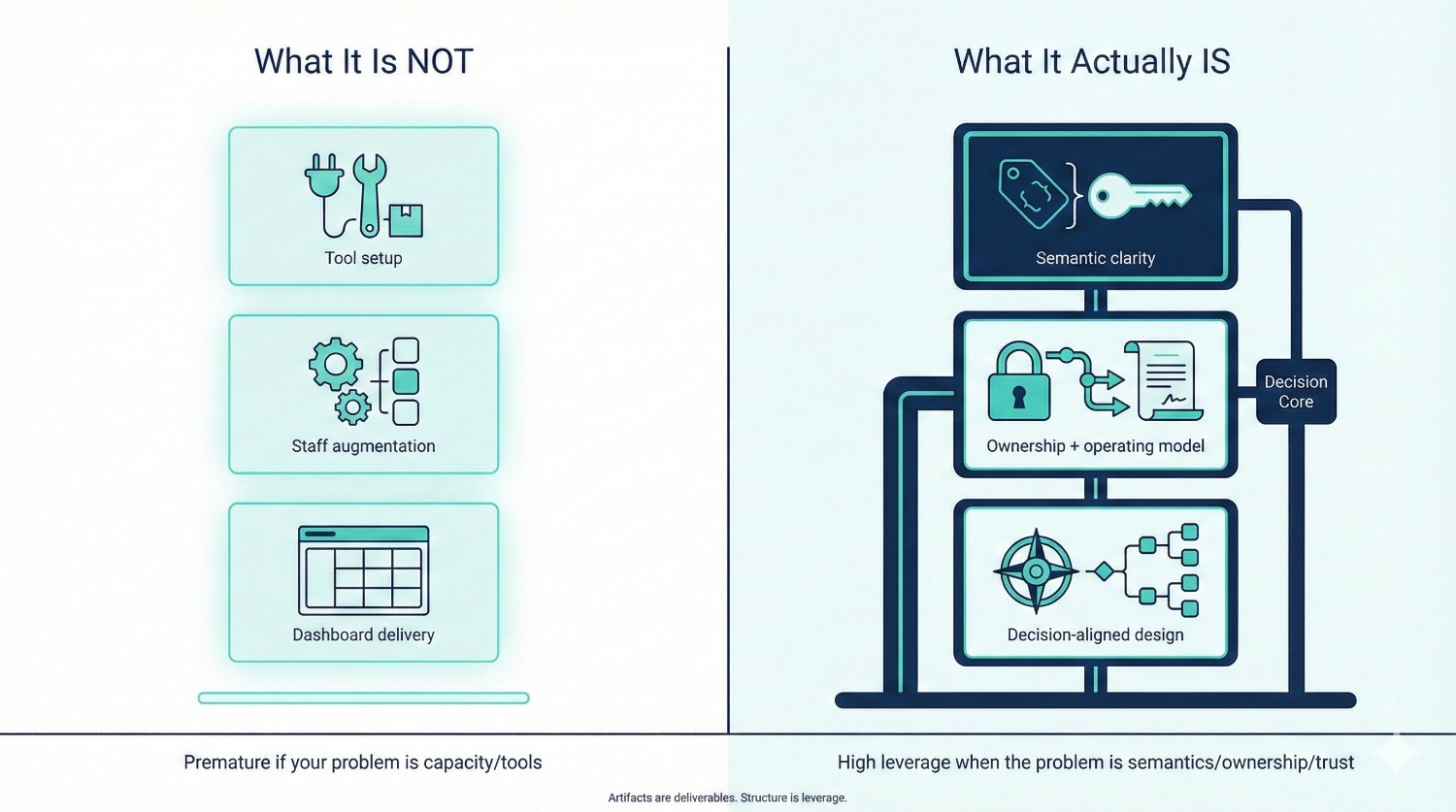
What Data Warehouse Consulting Is Not
Data Warehouse Consulting is not:
- Tool setup
Standing up Snowflake, BigQuery, or Redshift is implementation work. Necessary, but rarely the core problem.
- Staff augmentation
Adding more engineers increases output but does not create clarity. Output scales linearly with headcount. Alignment does not. Without shared definitions and ownership, additional capacity accelerates divergence rather than progress. If definitions and ownership are unclear, more hands accelerate confusion.
- Dashboard delivery
Dashboards reflect trust.They don’t create it. Dashboards succeed only when users already believe the numbers are safe to use. When trust is missing, better design increases exposure without reducing risk, which often deepens hesitation rather than adoption. If meaning is unstable, adoption will fail regardless of design quality.
These activities produce visible artifacts, which is why they’re often mistaken for the work itself.
What Data Warehouse Consulting Actually Is
Structural work is where organizations hesitate because it forces decisions about authority, accountability, and compromise. That discomfort is precisely why this work creates leverage when done correctly.
At its core, Data Warehouse Consulting focuses on:
- Clarifying data semantics
Making explicit what metrics mean, which assumptions apply, and how definitions evolve over time.
- Designing ownership and operating models
Deciding who owns which numbers, how changes are approved, and how disputes are resolved once, rather than repeatedly.
- Aligning technology with business decisions
Ensuring the warehouse supports real decision-making, not just data availability.
This work is less visible, more uncomfortable, and significantly more valuable.
Why This Distinction Matters for Timing
If your primary problem is missing tools or insufficient engineering capacity, consulting is probably premature. Internal teams can often solve those issues faster and cheaper.
But if your problem is:
- Persistent metric disputes
- Unclear ownership
- Low trust despite good tech
- Changes that stall due to debate
then the issue is no longer technical,it is structural. That’s when Data Warehouse Consulting creates leverage. Understanding this distinction helps leaders avoid hiring consultants too early, or waiting until confusion has already become entrenched.
Situations Where You Do Not Need Data Warehouse Consulting
Not every data challenge justifies external consulting. In fact, many organizations reach for Data Warehouse Consulting at a stage where it adds little leverage and creates unnecessary complexity. Consulting often feels attractive at this stage because it promises structure and speed.
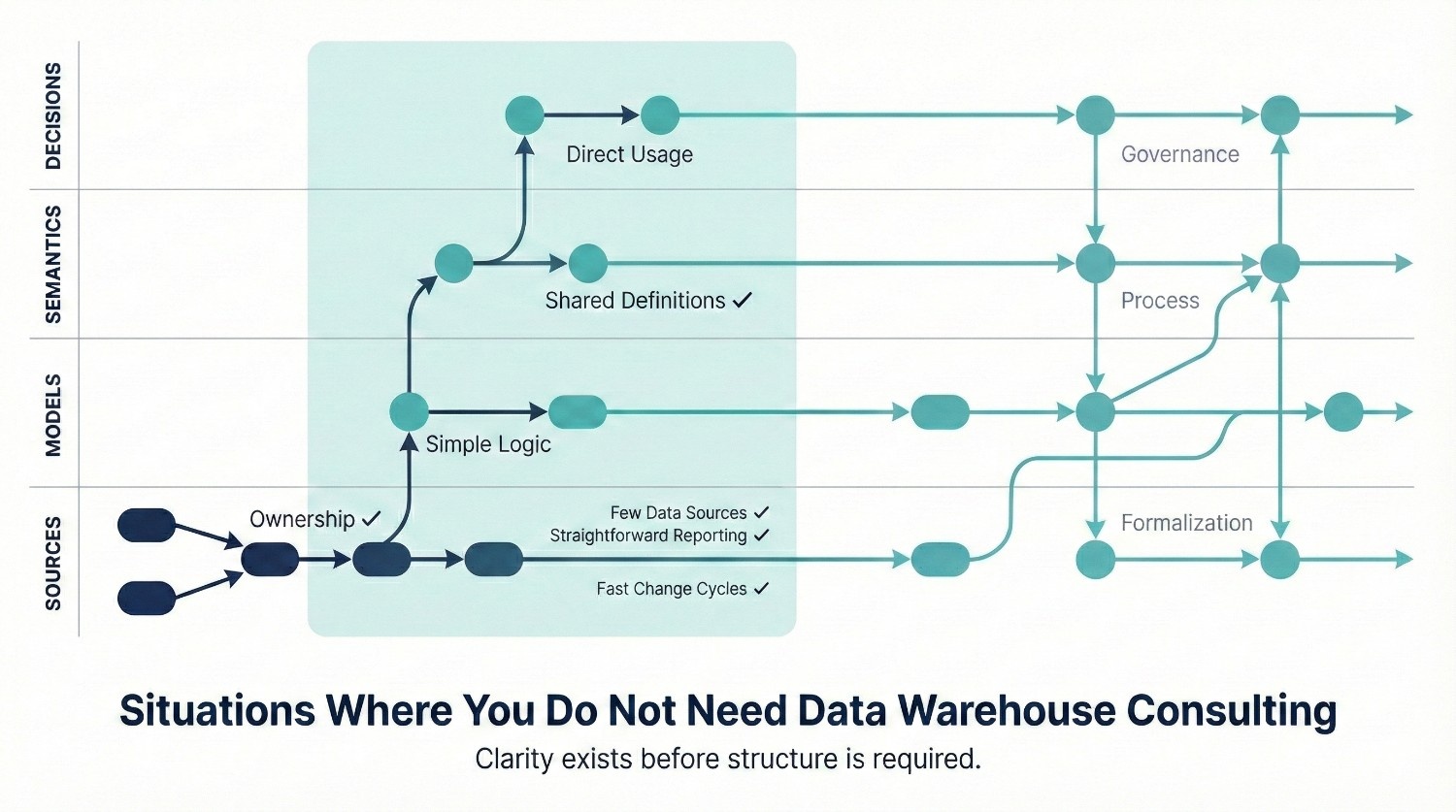
However, when systems and teams are still simple, imposed structure frequently creates rigidity before it creates clarity. You likely do not need consulting if the following conditions describe your environment.
You’re Early Stage and Still Operating Simply
If your organization has:
- A small number of data sources
- Straightforward reporting needs
- Limited historical complexity
then most data problems are still solvable through focused internal effort. At this stage:
- Definitions haven’t fragmented yet
- Edge cases are manageable
- Change happens quickly
Consulting often over structures systems that are still evolving naturally. Hiring a strong internal data engineer or analyst often delivers higher ROI than external engagement.
A Single Team Owns Definitions, Reporting, and Decisions
Natural alignment is fragile but powerful. As long as definitions, usage, and accountability sit within the same group, most disputes resolve through conversation rather than process.
When one team:
- Defines metrics
- Builds reports
- Uses the data to make decisions
alignment is largely implicit.
There are fewer political trade-offs and minimal semantic drift. Questions are resolved quickly because ownership is clear and authority is concentrated.
In this setup, friction is primarily technical rather than organizational. Bringing in consultants before ownership naturally fragments often introduces process overhead without solving a real problem.
Your Problems Are Primarily Technical
When failure modes are well understood and bounded, targeted engineering effort almost always outperforms broad consulting engagements in both speed and cost. Some data issues are unambiguously technical, such as:
- Pipelines that fail or are unreliable
- Queries that need performance tuning
- Costs that are growing faster than expected
These problems benefit from:
- Focused engineering work
- Tool-specific expertise
- Internal upskilling
They do not require consulting focused on governance, semantics, or operating models.
Why Consulting Is Low ROI in These Cases
Governance introduced too early often feels like friction because it solves problems that do not yet exist. In young systems, speed and learning matter more than formalization. When clarity already exists:
- Consulting duplicates internal understanding
- Governance feels premature
- Decision frameworks add friction
In these scenarios, Data Warehouse Consulting doesn’t fail in these cases. It simply doesn’t add much value.The higher-leverage move is usually:
- Hiring or training internal talent
- Improving technical hygiene
- Letting systems evolve organically
A practical self-check is this. If most data questions are answered by the same people who build the data, consulting is likely premature. When those roles separate and disputes become frequent, leverage shifts. Consulting becomes valuable later,when internal fixes stop scaling and organizational complexity begins to dominate.
The First Real Signal: When Teams Argue Over Numbers
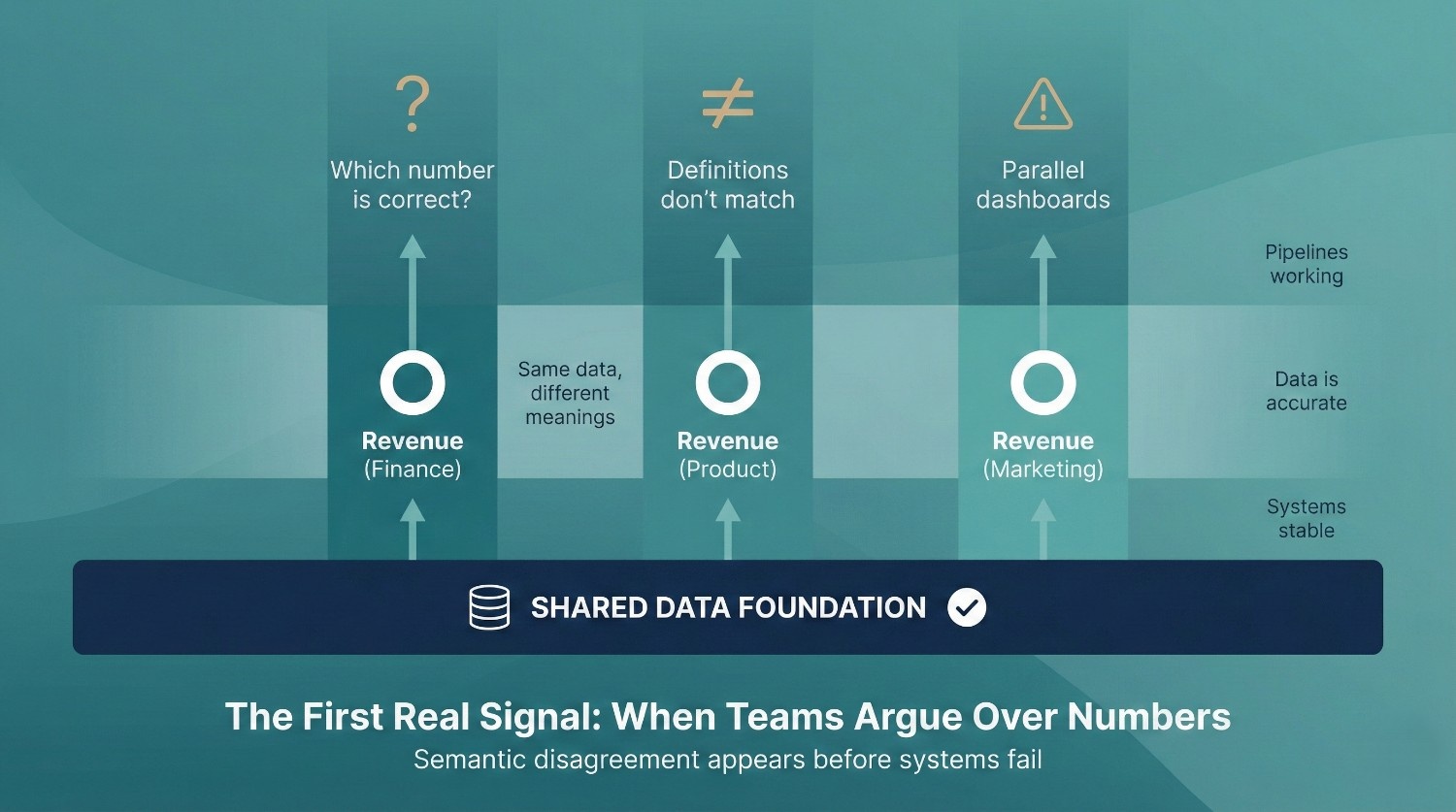
The clearest early signal that internal fixes are no longer enough is simple, and often dismissed. Teams begin arguing over numbers.
This signal appears early because numerical disagreement surfaces before formal breakdowns occur. It is one of the first visible signs that shared meaning has fractured, even while systems still appear to function normally.
You hear questions like:
- “Which report is correct?”
- “Finance and Product don’t agree on revenue.”
- “Marketing has their own dashboard because the main one doesn’t work for them.”
At first, these issues sound like data quality or reporting problems. They rarely are the root cause.
Data quality failures are usually binary. Pipelines break, reports fail, or values are clearly wrong. Semantic failures are subtler. The data is correct, but the interpretation is contested.
Why This Matters More Than It Seems
When teams disagree on numbers, the issue is usually not:
- Broken pipelines
- Incorrect joins
- Missing data
Those problems produce obvious failures. What you’re seeing instead is semantic disagreement, meaning different interpretations of the same underlying data. Each team is often “right” within its own context. The problem is that the organization no longer shares a single definition of reality.
Why Internal Teams Struggle to Resolve These Conflicts
These disputes persist because:
- They are not technical problems
Engineering can ensure data is correct, but it cannot decide what “revenue” or “active user” should mean for the business. - There is no neutral arbiter
No one is explicitly empowered to say, “This is the definition we will use,” and stand behind that decision. - Internal teams lack authority
Analysts and engineers are often pushed into mediating business disagreements without the mandate to resolve them.
As a result, conflicts linger. Temporary compromises become permanent. Logic gets duplicated instead of aligned.
Why This Is a Consulting Signal
This is the point where Data Warehouse Consulting begins to create leverage. Not because consultants have better definitions, but because they can:
- Force semantic disagreements into the open
- Structure trade-offs clearly
- Make decision ownership unavoidable
- Prevent ambiguity from being encoded into systems
Consultants don’t resolve the conflict for you. Effective consultants act as forcing functions. They surface trade-offs explicitly, make inaction visible, and require leaders to choose. The leverage comes from structure, not substitution.
What Happens If You Don’t Act
If these disputes are left unresolved:
- Parallel dashboards proliferate
- Reconciliation becomes routine
- Trust erodes quietly
- Decision-making slows
At that point, the warehouse becomes a reporting tool, not a decision platform. When teams are arguing over numbers, the problem is no longer data availability. It is organizational alignment.
And that is the first moment when Data Warehouse Consulting moves from “nice to have” to genuinely useful.
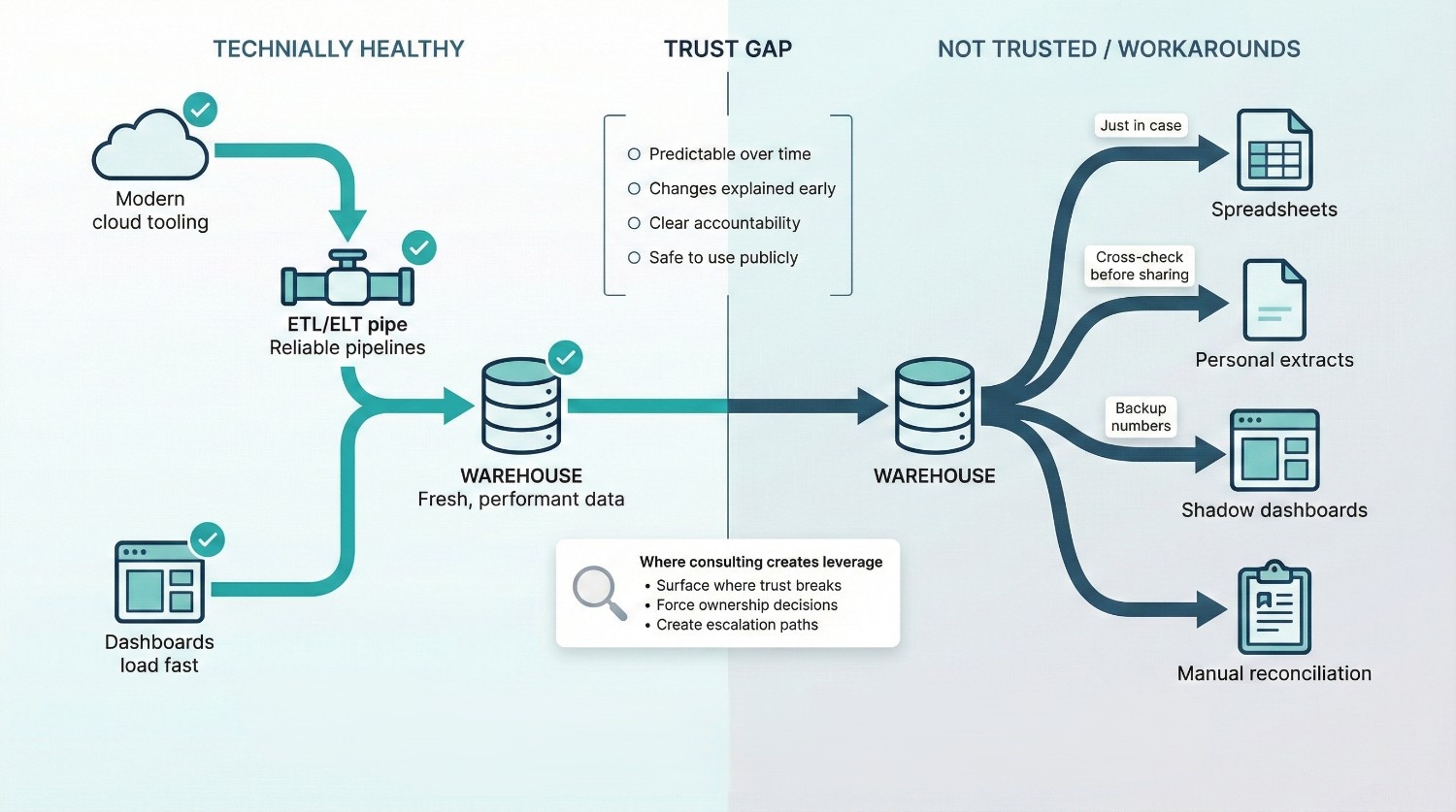
When the Warehouse Exists, but Isn’t Trusted
Internal scaling has failed when the warehouse is technically healthy, but operationally irrelevant.
On paper, everything looks right:
- Modern cloud tooling is in place
- Pipelines are reliable
- Data is fresh and performant
- Dashboards load quickly
And yet, business teams continue to rely on:
- Spreadsheets
- Personal extracts
- Shadow dashboards
- Manually reconciled numbers
This is not primarily a tooling failure. It is a trust failure.
Why Trust Doesn’t Follow Technical Success
From a technical perspective, trust is often assumed to be a byproduct of correctness. From a business perspective, trust is built differently.
Business users trust data when:
- Numbers behave predictably over time
- Changes are explained before they surprise them
- Someone is accountable when results are questioned
- Using the data doesn’t feel personally risky
When these conditions are missing, the warehouse feels unsafe, even if it’s accurate. So teams hedge.
They keep spreadsheets “just in case.” They cross-check before sharing numbers. They maintain shadow systems to protect themselves. These behaviors are rational responses to uncertainty.
Why Internal Fixes Stop Working Here
At this stage, internal teams often try:
- More validation
- More dashboards
- More documentation
- More training
None of it reliably restores trust. Why?
Additional dashboards, documentation, or training often amplify confusion because they introduce more surfaces where inconsistencies can appear, rather than resolving the underlying authority problem. Trust failures are never solved by producing more artifacts. They are solved by structural clarity:
- Explicit ownership
- Stable semantics
- Clear escalation paths
- Leadership-backed decisions
Internal teams usually lack the authority to enforce these changes on their own.
Why This Requires External Intervention
This is where Data Warehouse Consulting can create leverage. Not because consultants are more trusted, but because they can:
- Surface where trust is breaking
- Force ownership discussions that internal teams avoid
- Separate technical correctness from business confidence
- Structure conversations leadership hasn’t prioritized
Consultants create a neutral space where:
- Disagreements can be named
- Trade-offs can be made explicit
- Decisions can be owned
Without that intervention, organizations tend to normalize distrust and work around it indefinitely.
The Cost of Ignoring This Signal
When the warehouse exists but isn’t trusted:
- Data spend continues to rise
- Decision-making slows
- Confidence erodes
- The warehouse becomes optional
At that point, internal effort becomes maintenance rather than progress. This is a strong signal that Data Warehouse Consulting is no longer premature. It becomes necessary to realign trust, ownership, and decision-making before the system is permanently sidelined.
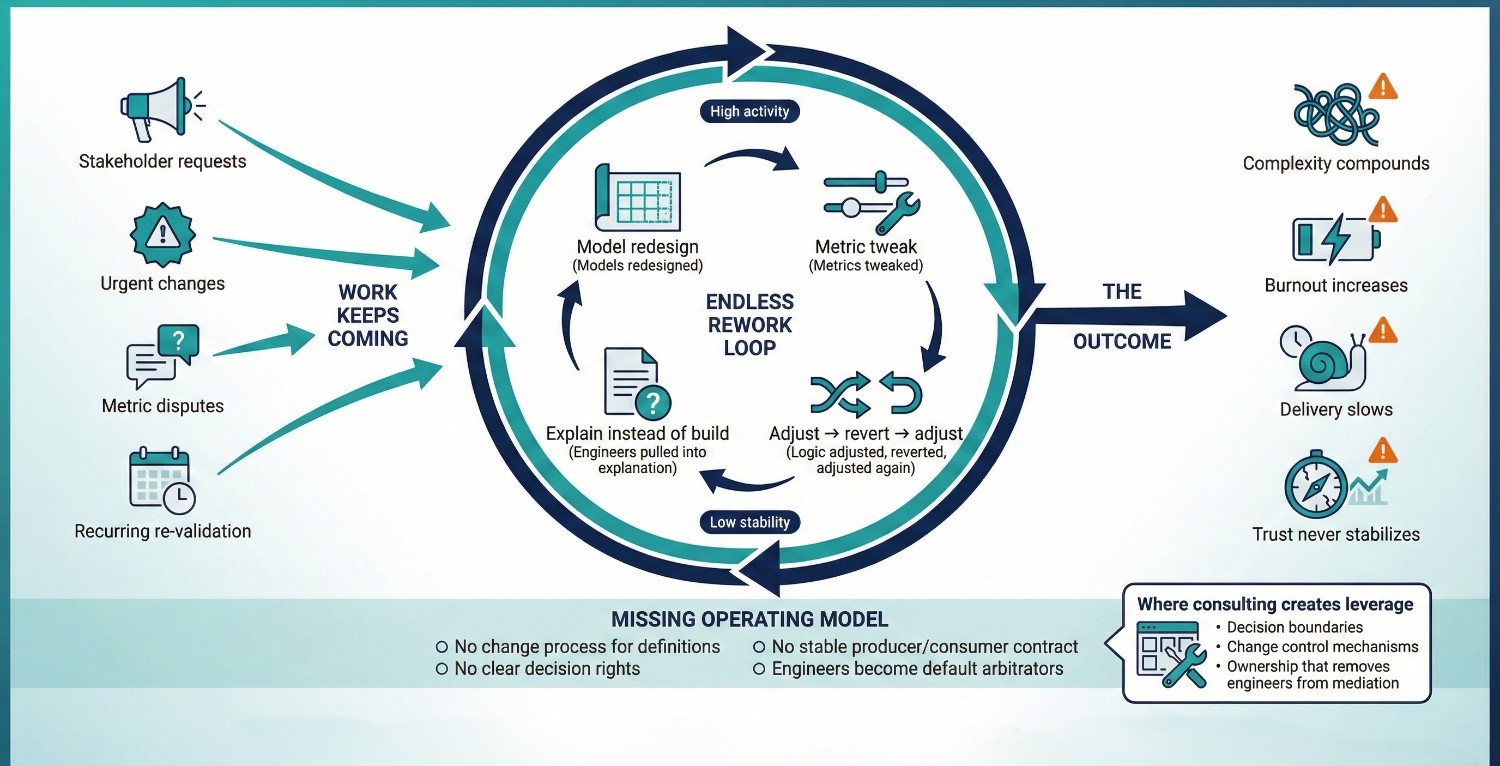
When Internal Teams Are Stuck in Endless Rework
Another clear signal that internal effort has stopped being the highest leverage move is persistent rework. Rework initially feels productive because it creates motion and responsiveness. Over time, however, it masks the absence of durable decisions and turns effort into churn.
Not the healthy kind, iteration based on learning, but the exhausting kind where teams keep rebuilding the same things without getting closer to stability. You see patterns like:
- The same models being redesigned every few months
- Metrics repeatedly “tweaked” to satisfy different stakeholders
- Logic adjusted, reverted, and adjusted again
- Engineers pulled into meetings to explain numbers instead of building systems
Progress feels busy, but nothing meaningfully settles.
Why This Isn’t a Skills Problem
At this stage, the issue is rarely about:
- Lack of SQL expertise
- Poor modeling ability
- Insufficient engineering capacity
Strong teams can still end up here. The underlying problem is the absence of an operating model for data. An operating model defines how change happens, who decides, and how disagreements are resolved. Without it, every request restarts the same negotiation.
Without one:
- There is no agreed process for changing definitions
- Every request feels urgent and legitimate
- Engineers become default arbitrators
- Temporary compromises harden into permanent complexity
Rework effectively becomes the system.
How Endless Rework Signals the Need for Consulting
Endless rework is a sign that:
- Ownership is unclear
- Decision rights are undefined
- There is no stable contract between producers and consumers of data
Internal teams lack the authority to say:
“This definition is stable.”
“This change requires a trade-off.”
“This request needs executive input.”
Data Warehouse Consulting becomes useful here not because it adds more builders, but because it helps design:
- Clear decision boundaries
- Change control mechanisms
- Ownership models that remove engineers from political mediation
At this stage, the value of consulting is stabilization rather than acceleration. It reduces rework by narrowing decision paths and making outcomes durable.
The Hidden Cost of Letting This Continue
If this pattern persists:
- Complexity compounds
- Burnout increases
- Delivery slows despite high effort
- Trust never stabilizes
At that point, internal fixes only rearrange the same problems. Endless rework is not a signal to hire better engineers.
It’s a signal that the organization needs help structuring how data decisions are made. That’s where Data Warehouse Consulting creates real leverage.
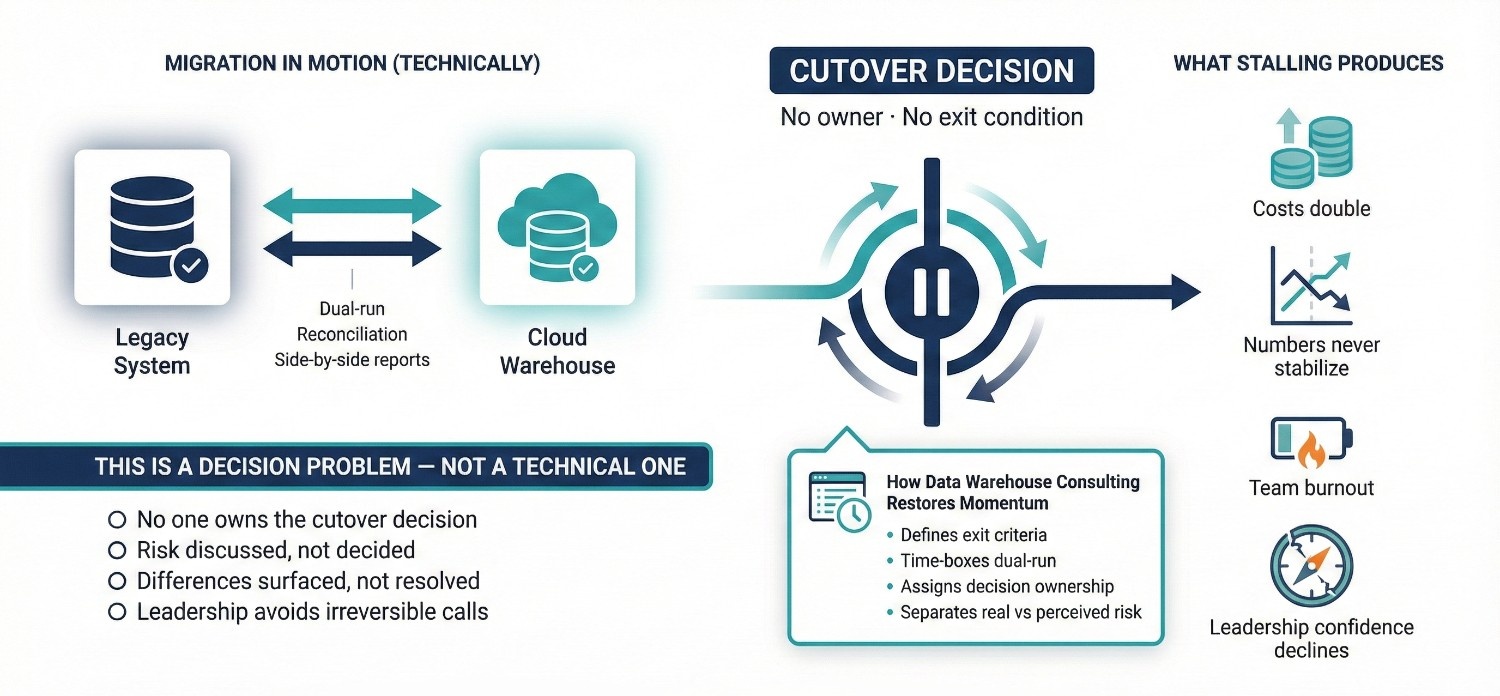
During (or After) a Stalled Cloud Migration
When a cloud migration progresses technically but never reaches completion, internal effort has usually stopped being sufficient.
You see familiar symptoms:
- Legacy and cloud systems running in parallel far longer than planned
- No confidence to fully cut over
- Reports constantly compared instead of trusted
- “Almost done” status updates that persist for months
Work is happening, but forward momentum is gone.
Why Migrations Stall at This Stage
Stalled migrations are rarely blocked by tooling or engineering skill alone. They stall because:
- No one owns the cutover decision
- Risk is discussed abstractly, not explicitly
- Differences between systems are surfaced but not resolved
- Leadership avoids making irreversible calls
As a result, dual systems often become permanent. Dual-run periods rarely fail because they last too long. They fail because there is no explicit exit condition.
Without a named owner and acceptance criteria, safety mechanisms turn into long-term operating models. What began as a safety mechanism quietly turns into the default operating state.
This is not a technical problem, it’s a decision problem.
Why Internal Teams Struggle to Unstick This
Internal teams lack leverage because they feel the operational cost of change without owning the organizational authority to approve it. Escalation without structure simply recycles the same conversations.
Internal teams are often trapped:
- Engineers cannot approve semantic differences
- Analysts cannot accept mismatches without cover
- Product and Finance protect their own interpretations
- Leadership waits for “perfect” alignment
Without structure, every discrepancy is treated as a blocker.
No one is empowered to say:
“This risk is acceptable.”
“This difference is intentional.”
“We are cutting it out on this date.”
So nothing moves.
How Data Warehouse Consulting Helps Restore Momentum
At this stage, the primary value of consulting is enabling exit. It defines what completion means, who decides, and when trade-offs are acceptable, so progress can resume.
Specifically, it helps:
- Separate real risk from perceived risk
- Make discrepancies explicit and explainable
- Assign ownership for unresolved questions
- Time-box dual-run periods
- Define what “good enough” looks like for cutover
Consultants do not make the decision for leadership. They make indecision more expensive and visible.
The Cost of Staying Stalled
When migrations stall:
- Costs double as systems are maintained in parallel
- Trust erodes as numbers never stabilize
- Teams burn out from constant reconciliation
- Leadership confidence declines
Eventually, organizations normalize the stall and label the migration as “ongoing.”
At that point, Data Warehouse Consulting is no longer about acceleration. It is about preventing permanent fragmentation. If your migration is technically sound but stuck in limbo, internal effort alone is unlikely to resolve it.
What’s missing is structure around risk, ownership, and decision-making. That’s exactly where Data Warehouse Consulting is designed to help.
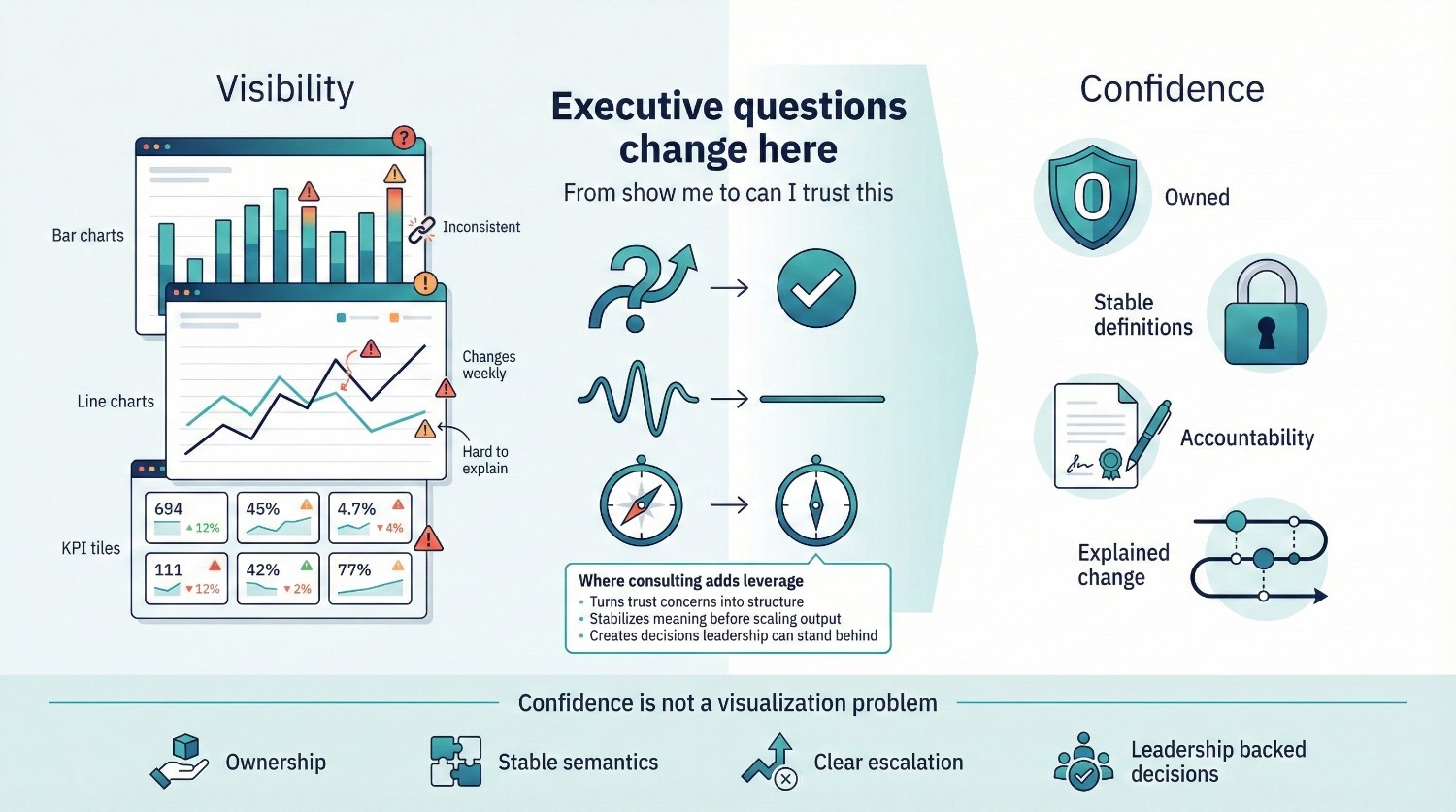
When Leadership Needs Answers, Not More Dashboards
A clear shift occurs when executive questions change in tone. They stop asking for new dashboards and start asking questions like:
- “Can we actually trust these numbers?”
- “Why does this metric change every week?”
- “Are we getting real value from our data investment?”
These are not feature requests. They are expressions of uncertainty and risk. A change in executive questioning usually marks a phase change in the data journey. Leaders stop asking for visibility and start asking for reliability when decisions carry material risk.
Why Dashboards Stop Being the Right Response
Dashboards are a lagging indicator of organizational readiness. When trust and ownership are weak, improved visualization increases exposure without increasing confidence. At this point, delivering more dashboards often compounds the problem.
Why?
- More dashboards surface more discrepancies
- Conflicting numbers become more visible
- Executives lose confidence faster, not slower
The problem is no longer access to data alone. It is interpretability and stability.
Leadership wants:
- Predictable numbers
- Clear explanations for change
- Confidence that decisions won’t be challenged later
Those outcomes cannot be delivered by visualization alone.
Why These Are Organizational Questions
Questions like “Can we trust this?” are fundamentally about:
- Who owns the number
- Whether definitions are stable
- How disagreements are resolved
- What governance exists behind the scenes
No SQL query can resolve those questions. When leadership starts asking these questions, it signals that:
- Technical delivery has outpaced organizational readiness
- Trust has not kept up with capability
- Internal teams are being asked to defend decisions they don’t own
Why Internal Teams Get Stuck Here
Engineers and analysts can:
- Explain how numbers are calculated
- Justify why they are correct
- Show lineage and logic
But they cannot provide:
- Executive-level accountability
- Organizational guarantees
- Stability commitments
Without leadership-backed structure, every explanation feels provisional.
Where Data Warehouse Consulting Creates Leverage
At this stage, consulting acts as a translation layer between executive intent and data execution. It converts concerns about trust into enforceable structures rather than additional outputs. Data Warehouse Consulting helps by:
- Translating executive concerns into structural fixes
- Designing ownership and escalation models
- Stabilizing semantics before optimizing delivery
- Creating narratives leadership can stand behind
When executives stop asking for dashboards and start asking for confidence, the challenge has moved beyond implementation. That is when Data Warehouse Consulting stops being optional and becomes necessary to restore clarity, trust, and control.
What Data Warehouse Consulting Should Deliver (If You Hire It)
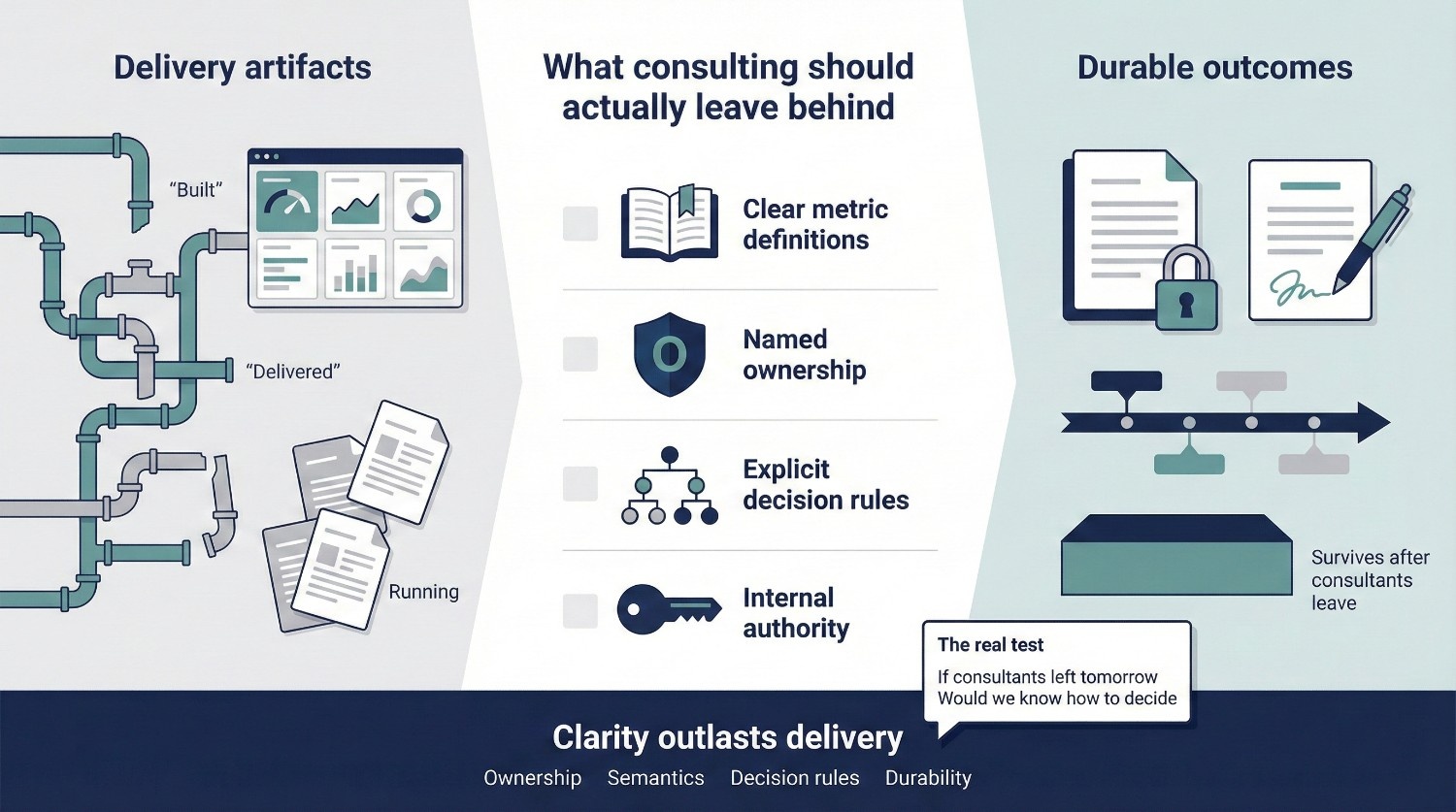
Once you decide that Data Warehouse Consulting is warranted, the next risk is hiring it for the wrong outcomes. Scope defines what gets built. Outcomes define what changes. Engagements fail when scope is detailed but outcomes are assumed, because delivery can succeed while impact does not.
Many engagements fail not because consultants underperform, but because expectations are too vague or too technical. If you hire Data Warehouse Consulting, there are minimum outcomes you should explicitly expect. Without them, the engagement will almost certainly disappoint.
Explicit Metric Definitions
You should not leave a consulting engagement still debating what core metrics mean. At minimum, consultants should help you produce:
- Clear definitions for critical metrics
- Inclusion and exclusion rules
- Assumptions and edge cases
- Effective dates for changes
These definitions should be:
- Written in plain language
- Reviewed with business stakeholders
- Treated as contracts, not suggestions
If semantics remain implicit, little else will stabilize.
Clear Data Ownership
Ownership only works when it is visible at the point of use. If business users do not know who stands behind a number, accountability remains theoretical. Every important metric and dataset should have:
- A named owner
- Decision authority over changes
- Accountability when questions arise
Ownership must be operational rather than symbolic. If engineers are still mediating disputes after consultants leave, ownership was not actually established.
Published Decision Rules
Consulting should leave behind clarity on:
- How metric changes are proposed
- Who approves them
- What requires executive escalation
- What “good enough” looks like
These rules prevent endless renegotiation and protect teams from political churn. Without decision rules, even small changes become disproportionately expensive and risky.
A Path to Internal Ownership
A successful engagement does not create long term dependency. It should leave:
- Internal teams confident to evolve the system
- Clear documentation of decisions and rationale
- Governance that is lightweight and practical
- Ownership that does not revert to consultants
If the organization cannot operate the warehouse without external help, consulting has failed, regardless of code quality.
The Simple Test
Durability is the real measure of consulting value. If clarity, ownership, and decision making survive beyond the engagement, the work succeeded. If not, delivery masked fragility. Ask one question when evaluating an engagement:
“If the consultants left tomorrow, would we know how to decide, not just how to run?”
If the answer is no, the engagement is optimizing for delivery rather than durability. Data Warehouse Consulting should leave your organization clearer, not just more built. If those outcomes aren’t explicitly included, disappointment is not a risk. It is the default.
A Simple Self-Assessment Checklist
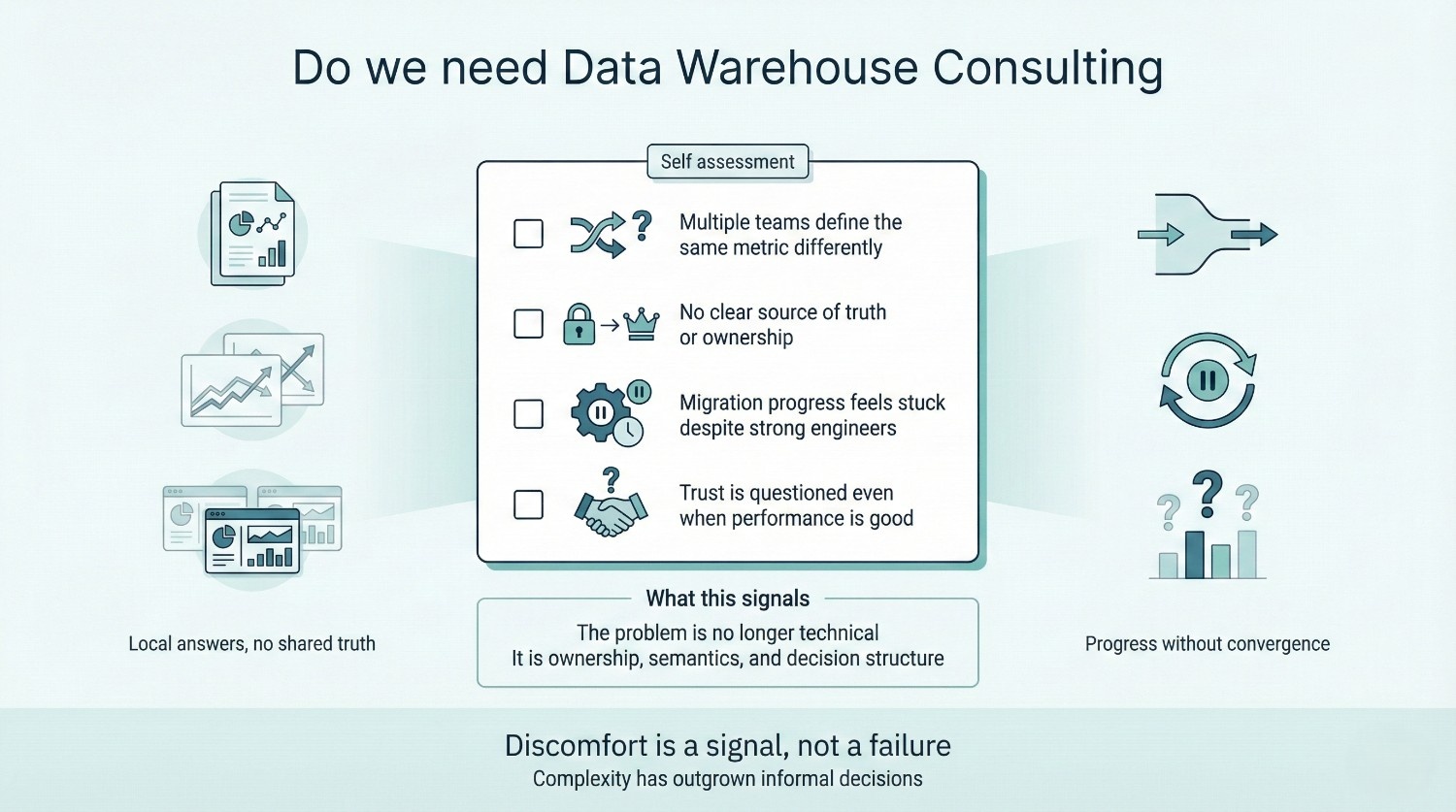
Before hiring Data Warehouse Consulting, it’s worth pausing for a candid self-assessment. Not to justify the decision,but to make sure the problem you’re trying to solve actually matches what consulting is designed to fix.
If most of the following statements feel uncomfortably familiar, internal effort may no longer be the highest leverage move. Discomfort is an important signal in this checklist. These conditions often feel normal because teams adapt to them gradually. Familiarity does not mean they are healthy or scalable.
You Likely Need Data Warehouse Consulting If the Following Conditions Apply:
Multiple teams define the same metric differently
You hear phrases like “Finance’s version,” “Product’s version,” or “Marketing’s number.” Reports disagree, and reconciliation has become routine rather than exceptional. Persistent metric disagreement indicates that the organization lacks a shared decision framework. Without one, every team optimizes locally and defends its own interpretation.
No one can clearly explain where “truth” lives
When asked which dataset or model is authoritative, answers vary, or depend on who’s asking. Ownership is implicit, disputed, or undocumented. A single source of truth only exists when someone is accountable for it. Without ownership, truth becomes contextual and authority dissolves under pressure.
Migration progress feels slow despite strong engineers
Work is happening, pipelines are being built, but momentum stalls. Decisions block delivery more often than technical issues, and “almost done” persists for months. Apparent progress without decision authority creates the illusion of velocity. Teams move, but outcomes do not converge.
Trust, not performance, is the core complaint
Dashboards are fast, data is fresh, but executives still ask, “Can we trust this?” Business teams hesitate to use numbers in high-stakes discussions.
Why This Checklist Matters
Each of these signals points to the same root issue:
- The problem is no longer technical execution
- It’s semantic alignment, ownership, and decision structure
Hiring more engineers will not fix that. Better tools will not either.
How to Use This Honestly
You don’t need every signal to justify consulting. But if two or more apply consistently, it is a strong indicator that:
- Internal fixes are being outpaced by organizational complexity
- Data problems are now coordination problems
- External structure may create leverage that internal teams can’t
Data Warehouse Consulting is not a shortcut. It’s a way to reset clarity when complexity has outgrown informal decision-making. If this checklist resonates, the final section will help you understand how to engage consulting without repeating the failures that make leaders skeptical in the first place.
Final Thoughts
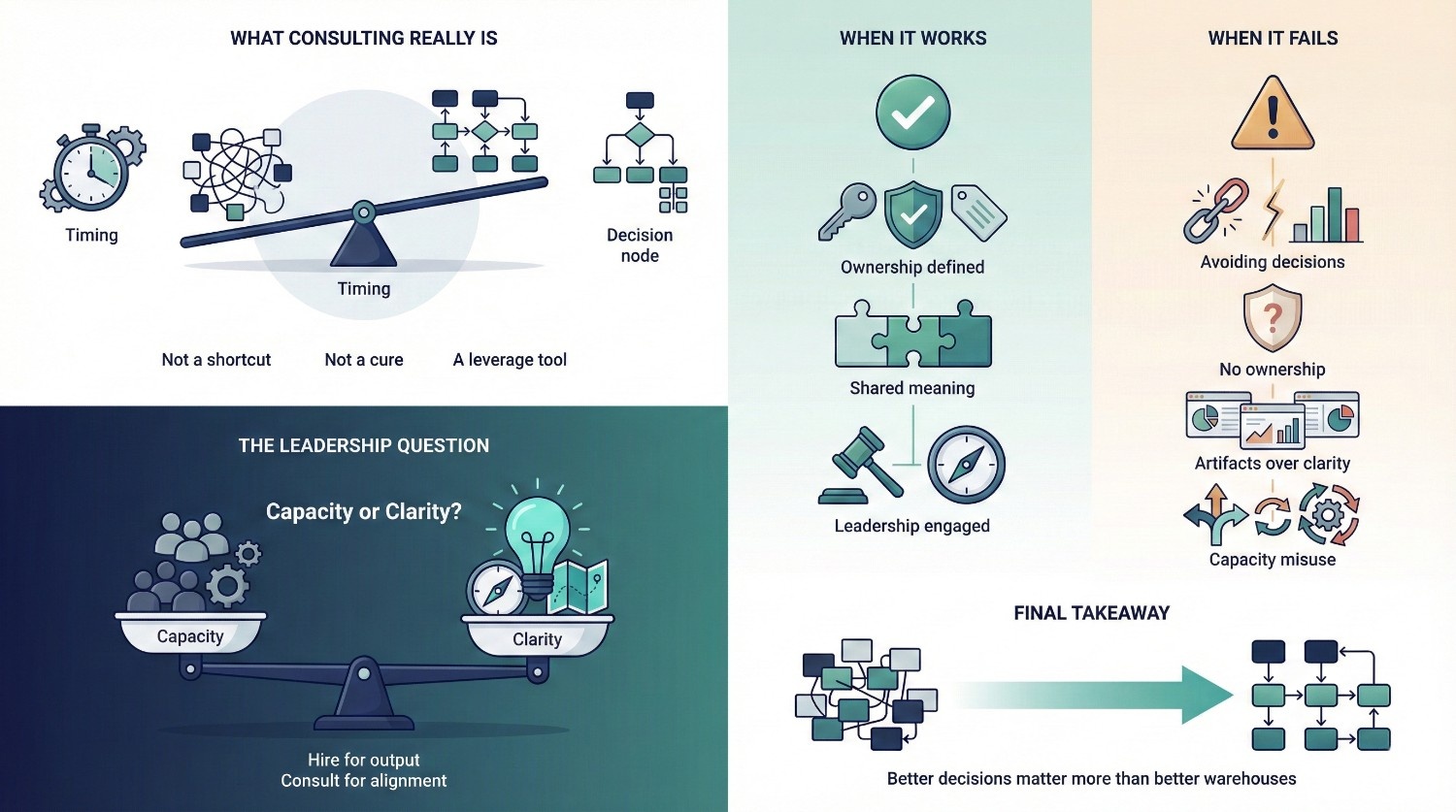
Data Warehouse Consulting is neither a cure all nor a shortcut. Used well, it creates leverage at moments when internal effort can no longer keep pace with organizational complexity. Used poorly, it becomes an expensive way to avoid hard decisions.
The difference is rarely the quality of the consultants. It’s why they were hired. Consulting is most effective when used as a timing tool. It creates leverage at specific inflection points, not as a permanent operating model or a default response to discomfort.
When Data Warehouse Consulting Works Best
Data Warehouse Consulting delivers its highest value when:
- The core problems are organizational, not technical
- Teams are blocked by ownership gaps, not skill gaps
- Semantics are disputed and need to be made explicit
- Leadership is willing to engage in decision-making
- The organization is ready to align around shared definitions
In these situations, consulting introduces structure, clarity, alignment and momentum that internal teams struggle to create alone.
When Data Warehouse Consulting Fails
Consulting predictably fails when it is:
- Used to avoid uncomfortable decisions
- Expected to “fix” data without assigning ownership
- Treated as capacity instead of leverage
- Asked to deliver artifacts instead of clarity
In these cases, consultants can build impressive systems that the organization never truly absorbs. The result looks like progress, but feels like disappointment.
The Real Test for Leaders
Capacity problems scale with hiring. Clarity problems scale with leadership. Confusing the two leads organizations to buy help for the wrong constraint. Before hiring Data Warehouse Consulting, leaders should ask:
“Is our biggest constraint capacity or clarity?”
If the answer is capacity, invest internally. Hire, train, and simplify. If the answer is clarity about meaning, ownership, and decision making, then consulting can be the right tool at the right time.
Final Takeaway
Hire Data Warehouse Consulting when clarity is your bottleneck, not when output is.
When used intentionally, it sharpens decisions, stabilizes trust, and helps organizations grow into their data systems. When used by default, it only makes confusion more efficient.
The most valuable outcome of consulting is not a better warehouse. It is an organization that knows how to decide together when the numbers matter.
Frequently Asked Questions (FAQ)
You likely need Data Warehouse Consulting when your primary problems are no longer technical. If teams argue over metric definitions, no one can clearly explain where “truth” lives, migrations stall despite strong engineers, or trust is the core complaint, internal effort has likely stopped scaling.
More engineers increase output, but do not create clarity. If ownership, semantics, and decision rights are unclear, additional capacity often accelerates confusion rather than resolving it.
More engineers increase output, but do not create clarity. If ownership, semantics, and decision rights are unclear, additional capacity often accelerates confusion rather than resolving it.
No. Size matters less than complexity. Mid-sized organizations often need consulting sooner because they scale data faster than they scale governance and decision-making structures.
It’s usually too early if the following conditions apply:
- You have few data sources
- One team owns definitions and reporting
- Problems are clearly technical, such as performance issues, broken pipelines, or cost tuning.
In these cases, internal hiring or upskilling delivers higher ROI.
At minimum, it should deliver:
- Explicit, agreed-upon metric definitions
- Clear ownership of core data and metrics
- Published decision and change rules
- A path for internal teams to fully own the system
If these outcomes aren’t part of the engagement, disappointment is likely.
Because they optimize for delivery rather than absorption. Pipelines and dashboards can be shipped without changing how decisions are made, who owns the numbers, or how trust is built.
Consultants can help design the conditions for trust, but they cannot own it. Trust requires leadership backing, explicit ownership, stable semantics, and clear communication, none of which can be outsourced.
Using it to avoid making decisions. When consulting is treated as a substitute for ownership instead of a tool to clarify it, failure is almost guaranteed.
Long enough to establish clarity and transfer ownership, but not so long that dependency forms. Successful engagements are time-bound and focused on making internal teams confident decision-makers.
Ask one question: “Is our biggest constraint capacity or clarity?” If it’s capacity, hire internally.
If it’s clarity, Data Warehouse Consulting can create leverage if leadership is ready to engage.