
Table of Contents
Introduction
At some point in every data integration consulting engagement, usually before it starts, sometimes midway through, and almost always afterward, someone in leadership asks the same question:
“What are we getting for this money?”
It’s a fair question. A necessary question. And one that most organizations struggle to answer clearly.
Not because the value isn’t there. But because integration ROI doesn’t fit neatly into the models that leadership is used to seeing.
Why Integration ROI Is Hard to Pin Down
Marketing ROI is often more direct to model than integration ROI, though attribution still varies by channel, lifecycle, and sales cycle length. Product ROI is measurable, launch a feature, track adoption, calculate revenue impact.
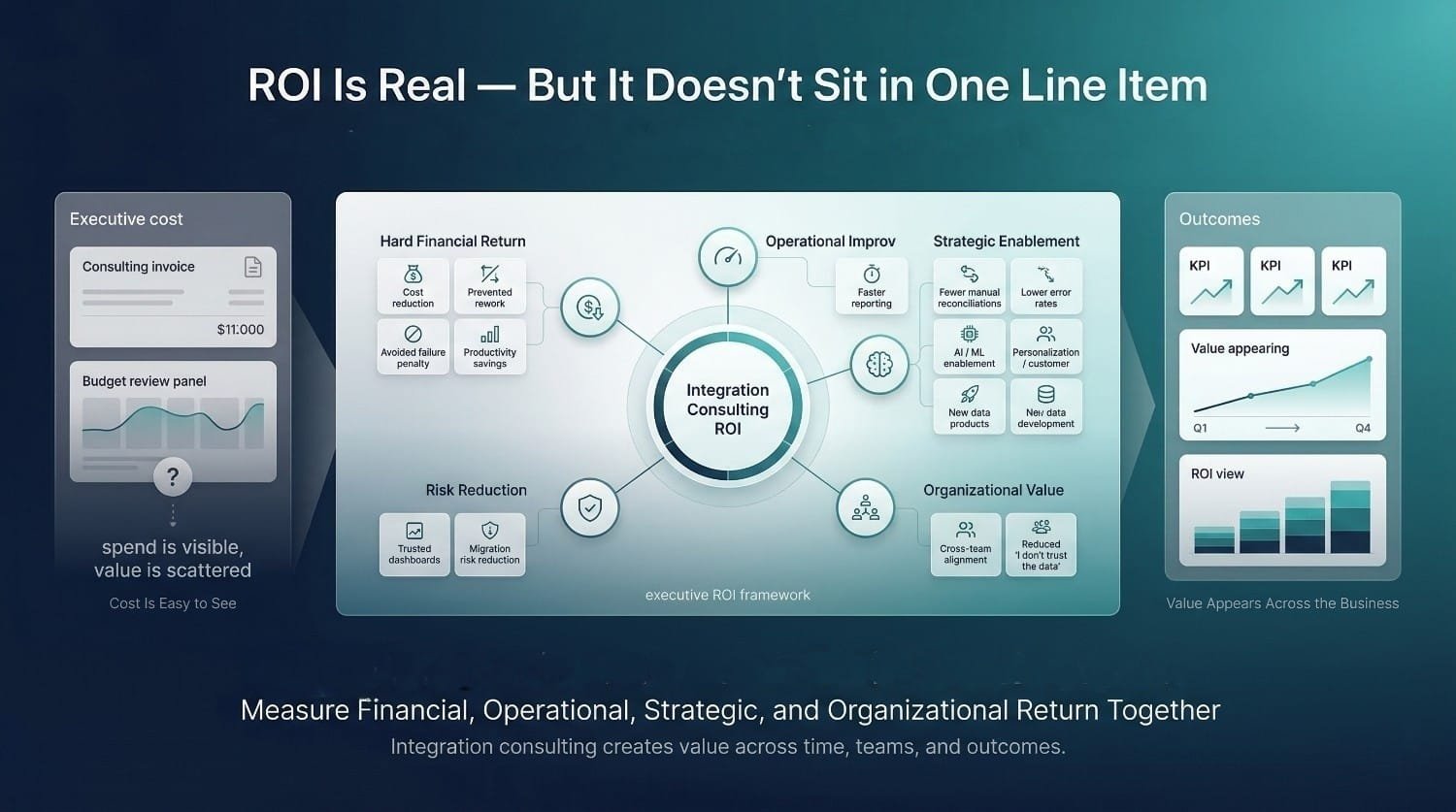
Data integration consulting ROI is different. The value often appears across multiple line items and stakeholders rather than a single owner:
- Prevented costs, the migration failure that didn’t happen, the compliance violation that was avoided, the rework cycle that was never needed
- Distributed benefits, faster reporting for finance, better personalization for marketing, cleaner training data for the AI team, more reliable dashboards for leadership. No single team “owns” the full ROI.
- Indirect impact, integration doesn’t generate revenue directly. It enables the initiatives that generate revenue. The value is real but one step removed from the P&L.
- Time-shifted returns, the investment happens in Q1. The full returns materialize in Q3 and Q4. By then, nobody’s connecting the dots back to the integration work.
This measurement challenge creates a dangerous dynamic.
The Cost of Not Measuring
When organizations can’t quantify integration ROI, predictable things happen:
Integration Gets Treated as a Cost Center
- Leadership sees the consulting invoice but can’t see the value it created
- The engagement gets categorized alongside infrastructure expenses, necessary but not strategic
- Future investment requests are harder to justify because there’s no demonstrated return from previous ones
Budgets Get Cut Prematurely
- The integration initiative is delivering value, but nobody’s measuring it
- A budget review happens. The CFO asks which line items can be reduced.
- Integration consulting, with no documented ROI, is an easy target
- The engagement gets cut. The partially built foundation starts to degrade. Months later, the same problems often return.
The Same Mistakes Get Repeated
- Without ROI measurement, there’s no organizational memory of what worked
- The next integration initiative starts from scratch, same discovery, same mistakes, same stalled outcomes
- The cycle of invest → can’t prove value → cut budget → problems return → invest again becomes permanent
The Thesis
The ROI of data integration consulting is absolutely measurable, it just requires knowing what to measure, when to measure it, and how to connect integration outcomes to business impact.
The problem isn’t that integration value is unmeasurable. The problem is that most organizations are looking for ROI in the wrong places, at the wrong times, using the wrong metrics.
Integration ROI isn’t a single number. It’s usually a multi-dimensional picture that spans:
- Hard financial returns, reduced costs, avoided waste, recovered productivity
- Operational improvements, faster processes, fewer errors, less manual work
- Strategic enablement, analytics, AI, personalization, and compliance initiatives that couldn’t have happened without integrated data
- Risk reduction, failed projects prevented, compliance violations avoided, trust preserved
- Organizational value, culture shift from “I don’t trust the data” to data-driven decision-making
Each of these dimensions to a practical degree using a mix of financial metrics and well chosen proxies. Each contributes to the total ROI picture. And together, they make a compelling case that data integration consulting isn’t a cost, it’s one of the highest-leverage investments a data organization can make.
What You'll Walk Away With
By the end of this post, you’ll have:
- A practical framework for measuring integration consulting ROI across multiple dimensions, financial, operational, strategic, and organizational
- Specific metrics and formulas you can apply to your own organization, not theoretical models, but calculations you can run with real numbers
- Guidance on when to measure, because ROI shows up at different times for different value dimensions
- A communication strategy for presenting integration ROI to leadership, in language that resonates with CFOs, CEOs, and boards
- The confidence to make the case for data integration consulting as a strategic investment, not just a line item to be defended
Let’s build the framework.
Why Measuring Integration Consulting ROI Is Difficult (But Not Impossible)
Before building the measurement framework, let’s be honest about why this is hard. Not to make excuses, but because understanding the measurement challenges is essential to designing metrics that actually work.
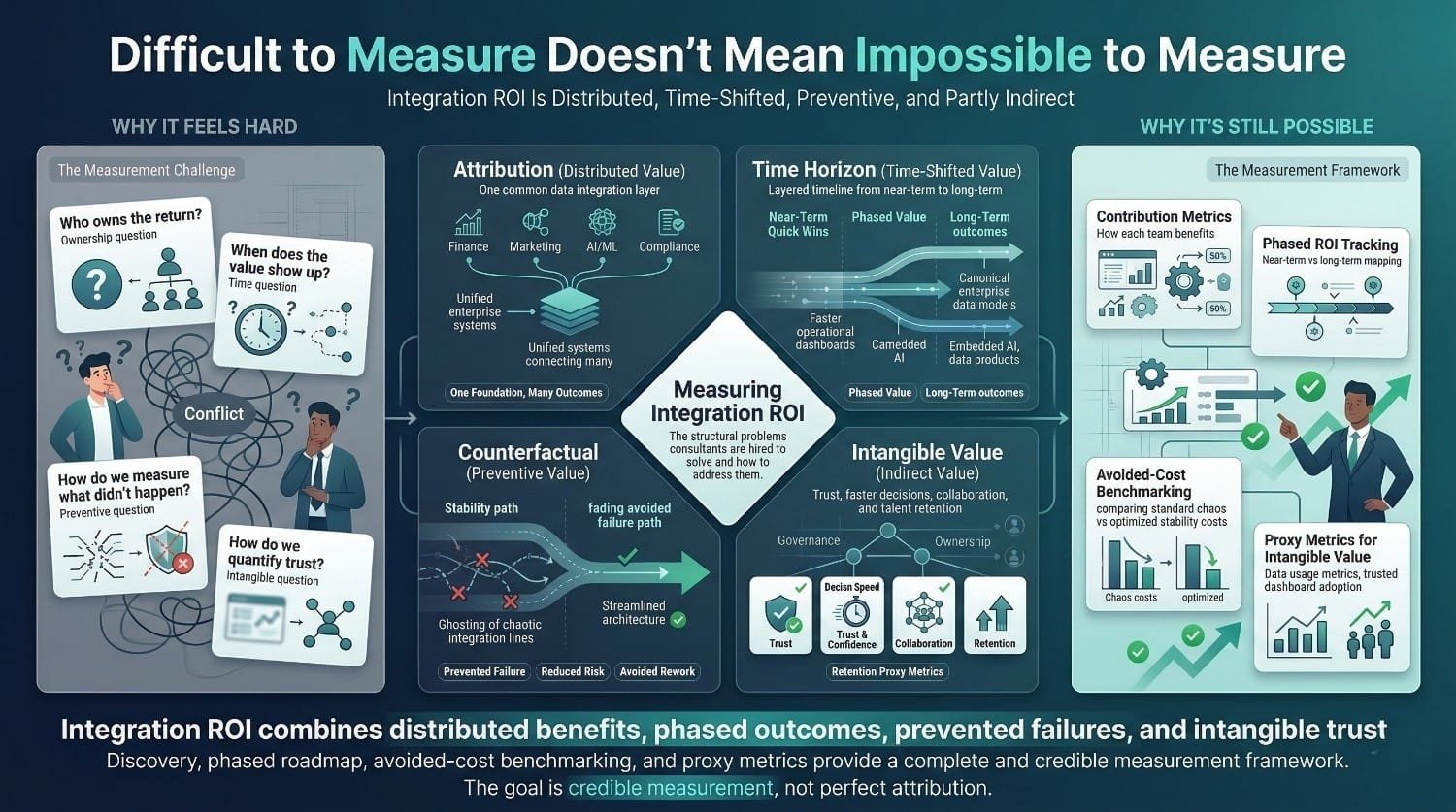
There are four core problems. Each one is real. None of them are unsolvable.
The Attribution Problem
The Challenge
Data integration consulting improves the foundation. But foundations are invisible. What people see, and what leadership measures, are the things built on top of that foundation.
Consider what happens after a successful integration engagement:
- Finance closes the books 3 days faster, is that an integration win or a finance win?
- The AI team’s churn model is 22% more accurate, is that a data science achievement or an integration achievement?
- Marketing’s personalization engine increases conversion by 15%, is that marketing ROI or integration ROI?
- The compliance team passes an audit without findings, is that a governance success or a consulting success?
The honest answer to all of these is both. Integration made each of them possible. But the visible credit goes to the team that delivered the final output, not the team that built the data foundation underneath it.
Why This Makes ROI Hard
- Multiple teams and projects benefit from the same integration work
- No single initiative “owns” the full return
- The people who experience the benefit often don’t know integration was involved
- Standard ROI models expect a clean line from investment to return, integration creates a web, not a line
The Analogy
Measuring the ROI of data integration consulting is like measuring the ROI of a building’s foundation. Nobody buys a building because of its foundation. But without the foundation, nothing above it stands.
The foundation doesn’t get credit for the visible outcomes. But without it, many outcomes do not hold up in scale, auditability, or reliability.
How to Solve It
Don’t try to claim 100% attribution for downstream outcomes. Instead, establish contribution metrics, documented evidence that integration was a necessary enabler for specific business results. We’ll build this into the framework in later sections.
The Time Horizon Problem
The Challenge
Integration ROI doesn’t arrive all at once. Different types of value materialize on different timelines.
Near term returns (weeks to months):
- Reduced manual data preparation time
- Faster data delivery to the warehouse
- Eliminated spreadsheet-based workarounds
- Fewer pipeline failures and faster recovery times
Medium-term returns (3–12 months):
- Improved reporting accuracy and consistency
- Analytics initiatives unblocked and delivering insights
- Analyst productivity recovered from data janitor work
- Stakeholder trust in data increasing
Long-term returns (1–3 years):
- Better strategic decisions based on trusted, unified data
- Technical debt significantly reduced
- Architecture is positioned to handle material growth with fewer redesign cycles, depending on workload patterns and governance maturity
- AI/ML initiatives producing reliable results
- Organizational culture shifted toward data-driven decision-making
Why This Makes ROI Hard
- Leadership typically wants ROI demonstrated within the first quarter of an engagement
- The most valuable returns, strategic enablement, cultural change, avoided rebuilds, take 12+ months to fully materialize
- Short-term ROI calculations capture the quick wins but miss the compounding value
- Budget reviews happen on annual cycles, but integration ROI compounds over multi-year horizons
How to Solve It
Measure ROI in phases, immediate, medium-term, and long-term, with different metrics appropriate to each horizon. Set expectations upfront that the full ROI picture emerges over time, while demonstrating quick wins early to build confidence. We’ll build this timeline into the framework.
The Counterfactual Problem
The Challenge
Some of the highest-value outcomes of data integration consulting are things that didn’t happen:
- The cloud migration that didn’t fail because architecture was designed correctly from the start
- The compliance violation that didn’t occur because governance and lineage were implemented before the audit
- The integration project that didn’t stall for the third time because consulting addressed the root causes that previous attempts missed
- The six months of rework that didn’t happen because the data model was designed right the first time
The executive trust erosion that didn’t occur because dashboards showed accurate numbers from day one
Why This Makes ROI Hard
It’s genuinely difficult to prove the value of something that was prevented.
- You can’t measure revenue from a crisis that didn’t happen
- You can’t quantify the cost of a project failure that was avoided
- You can’t show a before-and-after for a problem that never materialized
- Leadership is naturally skeptical of claims like “we saved you $500K by preventing a failure you never saw”
How to Solve It
Use benchmarking and industry data to estimate counterfactual costs. If 85% of big data projects fail (Gartner), and your consulting-guided project succeeded, the counterfactual cost is estimable. If the average failed migration costs $X in rework and delays, and yours didn’t fail, the avoided cost is calculable.
It’s not perfect attribution. But it’s reasonable estimation, and it’s far better than ignoring prevented costs entirely.
The Intangible Value Problem
The Challenge
Some of the most impactful outcomes of data integration consulting are hard to quantify directly:
- Data trust, the shift from “I don’t trust the data” to leadership confidently citing dashboards in board meetings
- Cross-team collaboration, departments that used to guard their data now sharing willingly because there’s a governed, unified model
- Decision speed, questions that used to take days of manual data assembly now answered in minutes
- Organizational data literacy, teams understanding where data comes from, what it means, and how to use it correctly
Talent retention, data professionals staying because they’re doing meaningful work instead of maintaining broken infrastructure
Why This Makes ROI Hard
- These benefits are real and significant, often the most significant long-term outcomes
- But they don’t translate directly into dollar amounts
- CFOs are understandably skeptical of “trust improved” as an ROI metric
- Purely financial ROI calculations exclude these benefits entirely, creating an incomplete and misleading picture
How to Solve It
Do not force intangible value into a single financial formula, but do connect it to operational proxies and, where possible, downstream cost or revenue sensitivity. Instead, measure it with proxy metrics that leadership can understand and track:
- Data trust → adoption rates (percentage of decisions referencing integrated data)
- Decision speed → time-to-insight (hours from question to answer, before vs. after)
- Collaboration → cross-departmental data usage (number of teams actively querying unified datasets)
- Talent retention → attrition rates in data roles, before and after the engagement
These aren’t dollar amounts. But they’re measurable, trackable, and meaningful, and they complete the ROI picture that financial metrics alone can’t capture.
Why Organizations Still Must Measure It
Despite these challenges, not measuring integration ROI is worse than measuring it imperfectly.
Accountability for Investment Decisions
Leadership allocated significant budget to this engagement. They deserve, and will demand, evidence that the investment produced results. Having an imperfect measurement framework is infinitely better than having no answer at all.
Justifying Future Integration Spending
Integration isn’t a one-time investment. New sources, new requirements, new regulations, and business growth all create ongoing integration needs. Without documented ROI from previous engagements, every future budget request starts from zero, fighting for justification instead of building on proven returns.
Identifying What's Working and What Isn't
ROI measurement isn’t just for leadership reporting. It’s for learning. Which aspects of the engagement delivered the most value? Where were the returns lower than expected? What should be adjusted for the next phase? Without measurement, you can’t optimize.
Building the Case for Ongoing Data Investment
The organizations that invest consistently in data infrastructure, integration, governance, quality, outperform those that invest sporadically. But consistent investment requires consistent evidence of return. ROI measurement creates the feedback loop that sustains ongoing investment.
The Bottom Line
Imperfect measurement of real value is always better than precise measurement of nothing.
The measurement challenges are real. But they’re not reasons to skip measurement, they’re reasons to build a framework that accounts for them. That’s exactly what we’ll do in the next sections.
Setting the Foundation: Define Success Before You Start
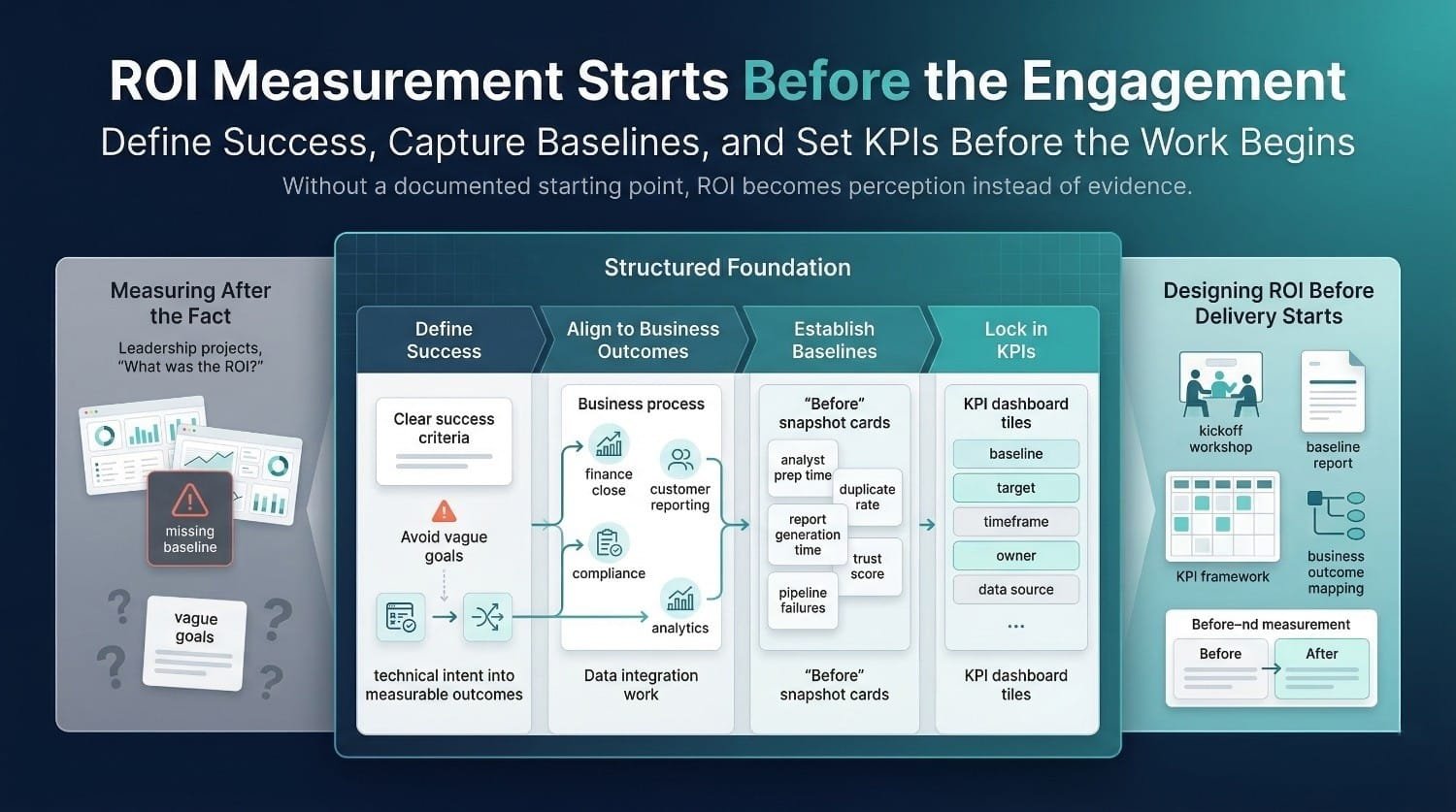
Most ROI measurement failures trace back to the same root cause: success and baselines were not defined before the engagement began.
This section fixes that. Before a single pipeline is built or a single architecture diagram is drawn, these four steps need to happen, or your ROI measurement will always be guesswork.
The Biggest Mistake: Measuring ROI After the Fact
The Pattern
- Organization engages data integration consulting
- The engagement often runs for several months, depending on scope, data landscape complexity, and compliance requirements
- The work is delivered, architecture, pipelines, governance, documentation
- Leadership asks: “What was the ROI?”
- The data team scrambles to find metrics that show value
- Nobody documented the starting point, so there’s nothing to compare against
- The ROI conversation becomes a debate about perception instead of a discussion grounded in evidence
Why This Happens
- The team was focused on delivery, not measurement
- Success criteria felt obvious, “make the data better”, so nobody formalized them
- Baselining the current state felt like extra work that delayed the “real” work
- Leadership assumed ROI would be self-evident after the project shipped
Why It Destroys ROI Measurement
Without a documented starting point, you cannot measure improvement credibly. You can only make claims.
- “Reporting is faster now” → How much faster? Compared to what?
- “Data quality improved” → From what baseline? By what percentage?
- “Teams trust the data more” → Based on what evidence? How did you measure trust before?
Claims without baselines aren’t ROI, they are anecdotes, and anecdotes rarely hold up under CFO level scrutiny.
The Fix
Define success criteria and establish baselines before the engagement starts. Not during. Not after. Before.
This should be a formal deliverable of the engagement’s kickoff, agreed upon by the consulting team, the internal data team, and the business stakeholders who will ultimately judge whether the investment paid off.
Aligning Integration Goals with Business Outcomes
The Problem with Vague Goals
Most integration initiatives start with goals like:
- “Improve our data”
- “Integrate our systems”
- “Build a single source of truth”
- “Modernize our data infrastructure”
These aren’t goals. They’re directions. You can’t measure ROI against a direction because you can never determine whether you’ve arrived.
What Business-Aligned Goals Look Like
Every data integration consulting engagement should map to specific, measurable business outcomes, not technical activities.
Vague goal → Business-aligned goal:
- “Improve our data” → “Reduce customer record duplication from 35% to under 3%, enabling accurate customer count reporting across all departments”
- “Integrate our systems” → “Create a unified financial view across NetSuite, Salesforce, and our billing platform to reduce monthly close time from 15 days to 5 days”
- “Build a single source of truth” → “Deliver a governed customer data model that supports a 10% improvement in cross-sell conversion by enabling personalization based on unified purchase and engagement history”
“Modernize our data infrastructure” → “Achieve SOX compliance for consolidated financial data by Q3, with full lineage tracking from source to regulatory report”
How to Get There
For every integration initiative, answer three questions:
- What business decision or process will this integration improve? Not “what data will move”, what will change for the business.
- How will we measure that improvement? A specific metric with a current value and a target value.
- By when should the improvement be measurable? A realistic timeframe tied to business cycles, not just project milestones.
If you can’t answer all three, the goal is likely not defined clearly enough to measure ROI against.
Establishing a Baseline
Why Baselines Are Critical
A baseline is the documented current state, the “before” snapshot that every “after” measurement is compared against. Without it, ROI is speculation.
With baseline: “Analyst time spent on data preparation decreased from 62% to 18%, a 71% reduction.”
Without baseline: “We think analysts spend less time on data prep now.”
One is evidence. The other is a feeling. Leadership funds evidence.
Quantitative Baselines to Document
Before the engagement begins, measure and record:
Time metrics:
- Hours per week analysts spend on manual data cleaning and reconciliation
- Time to generate standard reports (monthly close, quarterly board deck, customer analytics)
- Time to onboard a new data source into the existing architecture
- Time to resolve a data-related support ticket or inquiry
Quality metrics:
- Duplicate record rate across key entities (customers, products, transactions)
- Data error rate, percentage of records with known quality issues
- Pipeline failure rate, number of failures per week or month
- Schema drift incidents, unplanned changes that break downstream systems
Cost metrics:
- Engineering hours spent maintaining existing pipelines vs. building new capabilities
- Annual spend on tools and infrastructure supporting the current integration state
- Cost of manual workarounds, spreadsheets, CSV exports, email-based data sharing
Volume metrics:
- Number of data sources currently integrated
- Number of active pipelines
- Total data volume being moved and processed
Qualitative Baselines to Document
Quantitative metrics tell part of the story. Qualitative baselines tell the rest:
- Stakeholder trust survey, a simple 1–5 rating from key stakeholders: “How confident are you in the accuracy and reliability of the data you use for decisions?” Conducted before the engagement, repeated after.
- Data dispute frequency, how often do departments escalate conflicting numbers? Track the count and severity for 30–60 days before the engagement.
- Decision-making patterns, are executives referencing dashboards in meetings, or are they relying on gut instinct and spreadsheets? Document the observed pattern.
Team satisfaction, are data engineers and analysts frustrated with the current state? A brief survey captures sentiment that turnover data alone won’t show.
How to Capture Baselines Efficiently
This doesn’t need to be a month-long research project. A focused baselining effort typically takes 1–2 weeks:
- Pull quantitative metrics from existing monitoring tools, project management systems, and time tracking
- Run a short stakeholder survey, 5 questions, 5-point scale, distributed to 15–20 key stakeholders
- Interview 3–5 team leads for qualitative context
- Document everything in a shared baseline report that becomes the official reference point
The consulting team should help with this, in fact, baselining should be a standard deliverable in the discovery phase of any data integration consulting engagement.
Defining KPIs for the Engagement
How Many KPIs
Aim for 5–10 measurable KPIs that span multiple value dimensions. Fewer than 5 may not capture the full picture. More than 10 often creates measurement overhead that is difficult to sustain.
KPI Categories
Spread your KPIs across these five categories to ensure comprehensive coverage:
Efficiency KPIs, Are we doing things faster?
- Time to generate monthly financial reports
- Hours per week spent on manual data preparation
- Time to onboard a new data source
Quality KPIs, Is the data better?
- Duplicate record rate across key entities
- Pipeline failure rate per month
- Data accuracy score (percentage of records passing validation rules)
Speed KPIs, Is data arriving faster?
- Data freshness, latency between source event and warehouse availability
- Time from data request to data delivery
- Query performance on integrated datasets
Cost KPIs, Are we spending less on waste?
- Engineering hours on maintenance vs. new development
- Cost of manual workarounds eliminated
- Total integration infrastructure spend relative to data volume
Business Impact KPIs, Is the business performing better?
- Revenue attributed to initiatives enabled by integrated data
- Compliance audit outcomes (findings reduced or eliminated)
- Stakeholder adoption rate of integrated data products
- Decision-making speed for data-dependent questions
Making KPIs Actionable
For a mid-market company engaging data integration consulting to unify customer data across CRM, billing, and product systems:
- Duplicate customer record rate: Baseline 34% → Target under 3% → 6 months → Owned by data engineering lead
- Monthly close time: Baseline 14 days → Target 5 days → 9 months → Owned by finance controller
- Analyst data prep time: Baseline 58% of working hours → Target under 20% → 6 months → Owned by analytics manager
- Pipeline failures per month: Baseline 11 → Target under 2 → 4 months → Owned by data engineering lead
- Stakeholder data trust score: Baseline 2.1/5.0 → Target 4.0/5.0 → 12 months → Owned by data product manager
- Cross-sell conversion rate: Baseline 4.2% → Target 6.0% → 12 months → Owned by marketing director
- Time to answer ad hoc data questions: Baseline 3–5 days → Target under 4 hours → 6 months → Owned by analytics manager
Notice how this set spans efficiency, quality, speed, cost, and business impact. No single category dominates. The full picture emerges from the combination.
Example KPI Set
The organizations that invest consistently in data infrastructure, integration, governance, quality, outperform those that invest sporadically. But consistent investment requires consistent evidence of return. ROI measurement creates the feedback loop that sustains ongoing investment.
The Non-Negotiable Rule
If a KPI isn’t defined before the engagement starts, it should not be heavily weighted in the ROI calculation afterward.
Retroactive KPIs, metrics identified after the work is done to make the results look good, aren’t credible. They’re cherry-picked. Leadership knows the difference.
Define the KPIs upfront. Measure them honestly. Report the results, including the ones that fell short. That’s how you build credibility for this engagement and every future investment in data integration consulting.
The ROI Measurement Framework
This is the framework that makes data integration consulting ROI measurable, communicable, and defensible.
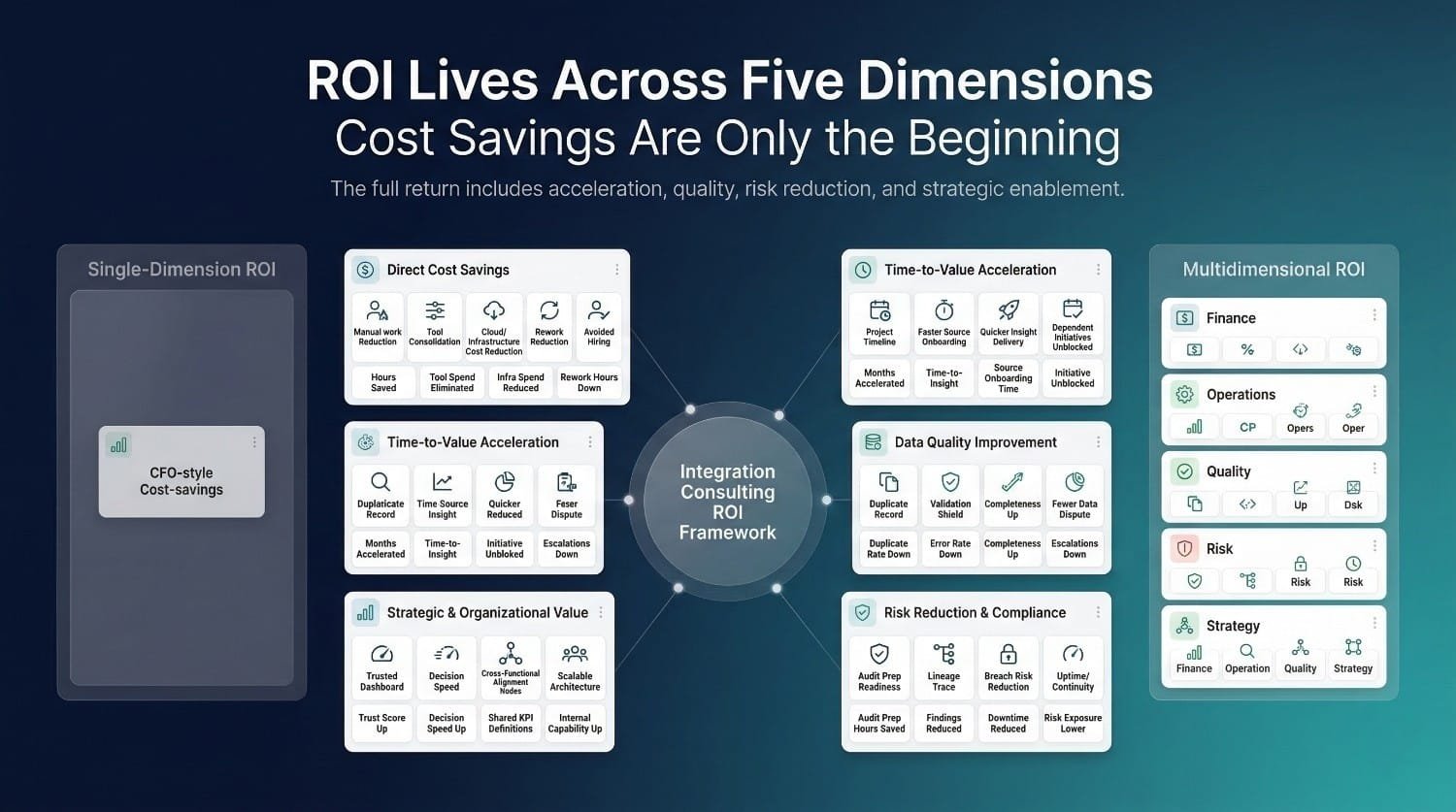
Most organizations make the mistake of looking for ROI in a single dimension, usually cost savings. That captures maybe 20% of the value. The other 80% lives in acceleration, quality, risk reduction, and strategic enablement.
This framework covers all five.
Dimension 1, Direct Cost Savings
The most tangible, easiest-to-communicate dimension. This is where you start when talking to the CFO.
Reduction in Manual Data Work
The hours your team currently spends on manual extraction, transformation, reconciliation, and reporting, that either get automated or eliminated through proper integration.
How to calculate:
(Hours saved per week × Fully loaded hourly cost) × 52 weeks = Annual savings
Example: 3 analysts each save 12 hours/week on manual data prep. Fully loaded cost is $75/hour.
(36 hours × $75) × 52 = $140,400/year
This is often one of the largest and fastest appearing cost savings from a data integration consulting engagement, especially in analytics heavy organizations.
Elimination of Redundant Tools and Licenses
Successful integration often reveals, and enables the retirement of, overlapping tools, middleware, custom scripts, and duplicate platforms that exist because data wasn’t unified.
How to calculate:
Annual cost of eliminated tools and infrastructure.
Example: Two overlapping ETL tools ($45K/year each) and a legacy middleware platform ($30K/year) are retired after consolidation.
$45K + $45K + $30K = $120,000/year
Reduced Data Infrastructure Costs
Better architecture often means more efficient use of cloud compute, storage, and processing, eliminating redundant data copies, optimizing query patterns, and right-sizing infrastructure.
How to calculate:
Monthly infrastructure spend (before) − Monthly infrastructure spend (after) × 12
Example: Warehouse compute costs drop from $18K/month to $11K/month after architecture optimization.
($18K − $11K) × 12 = $84,000/year
Reduced Rework and Error Correction
Every hour spent fixing broken pipelines, correcting bad data, and re-running failed processes is an hour that proper integration eliminates.
How to calculate:
(Average monthly rework hours × hourly cost) before − (Average monthly rework hours × hourly cost) after × 12
Example: Team spent 60 hours/month on rework at $85/hour. After consulting, rework drops to 10 hours/month.
(60 − 10) × $85 × 12 = $51,000/year
Avoided Hiring
When integration is done well, you may avoid hiring additional engineers or architects that would otherwise have been required to manage a fragmented environment.
How to calculate:
Number of FTEs avoided × Fully loaded annual cost per FTE
Example: The engagement eliminated the need for 1 additional senior data engineer ($165K fully loaded).
$165,000/year avoided
How to Track This Dimension
- Compare time logs and resource allocation before and after the engagement
- Pull infrastructure and tooling invoices on a quarterly basis
- Use project management data to quantify rework reduction
- Track headcount plans, what was budgeted vs. what was actually needed
Dimension 2, Time-to-Value Acceleration
This dimension captures the value of getting results sooner. It’s less intuitive than cost savings but often higher in total impact, because delayed business value compounds.
Faster Project Delivery
How much sooner did the integration deliver usable results compared to a documented internal estimate or prior similar project?
How to calculate:
(Estimated internal timeline − Actual timeline with consulting) × Business value per month of delay
Example: Internal estimate was 14 months based on prior delivery velocity. With consulting, the project was delivered in 7 months. The analytics initiative this unblocked generates $50K/month in identified savings.
(14 − 7) × $50K = $350,000 in accelerated value
This is often one of the largest and fastest appearing cost savings from a data integration consulting engagement, especially in analytics heavy organizations.
Reduced Time-to-Insight
How quickly can analysts and business users access integrated, trustworthy data, from question to answer?
How to calculate:
Average time-to-insight (before) vs. (after)
Example: Two overlapping ETL tools ($45K/year each) and a legacy middleware platform ($30K/year) are retired after consolidation.
Example: Before integration, answering a cross-system customer question took 3–5 business days of manual assembly. After, it takes under 2 hours.
This doesn’t have a clean dollar amount, but it directly enables faster decision-making, which the strategic dimension captures.
Track it as: Average hours from data request to delivered insight, measured monthly.
Faster Onboarding of New Data Sources
A well-architected integration environment makes adding new sources dramatically faster.
How to calculate:
Average onboarding time (before) vs. (after)
Example: Before consulting, adding a new data source took 6–8 weeks of custom development. After, it takes 3–5 days using the architecture and patterns established during the engagement.
Track it as: Days to integrate a new source, measured for each new addition post-engagement.
Accelerated Dependent Initiatives
Faster integration often unblocks other high-value projects that were waiting on data.
How to calculate:
Estimated revenue or cost impact of dependent initiatives × Months of acceleration
Example: The AI-powered churn prediction model was blocked by data readiness. Integration consulting unblocked it 4 months ahead of schedule. The model is projected to save $200K/year in reduced churn.
4 months × ($200K ÷ 12) = $66,667 in accelerated value
How to Track This Dimension
- Compare planned vs. actual project timelines and document the delta
- Survey business users on time-to-insight before and after, a simple quarterly pulse
- Track new source onboarding times as a recurring operational metric
- Maintain a dependency map showing which initiatives were unblocked by integration
Dimension 3, Data Quality Improvement
Quality is the dimension that connects most directly to data trust, the intangible factor with the most outsized long-term impact.
Duplicate Record Reduction
How to calculate:
(Duplicate count before − Duplicate count after) ÷ Total records × 100 = Percentage reduction
Example: 340,000 customer records. 119,000 duplicates identified (35%). After entity resolution, 6,800 remain (2%).
Duplicate rate reduced from 35% to 2%, a 33 percentage point reduction and approximately a 94% relative reduction in duplicates.
Data Error Rate Reduction
How to calculate:
Errors per 10,000 records (before) vs. (after)
Example: Data profiling found 847 errors per 10,000 records before the engagement. After quality remediation and governance implementation, the rate dropped to 23 per 10,000.
97.3% reduction in error rate
Data Completeness Improvement
How to calculate:
Percentage of records with all required fields populated (before) vs. (after)
Example: Customer address completeness was 64% before the engagement. After standardization and enrichment, it’s 96%.
32 percentage point improvement in completeness
Reduction in Data Disputes
How to calculate:
Number of data escalations or dispute tickets per quarter (before) vs. (after)
Example: Before the engagement, the data team received an average of 14 escalations per quarter about conflicting metrics. After governance and shared definitions were implemented, escalations dropped to 2 per quarter.
86% reduction in data disputes
Business Impact of Improved Quality
Better data quality doesn’t just look good in a profiling report, it drives measurable downstream improvements.
Track these proxy metrics:
- Forecast accuracy improvement (finance)
- Campaign targeting precision (marketing)
- Customer satisfaction scores tied to data-driven personalization
- AI/ML model accuracy improvement attributable to cleaner training data
How to Track This Dimension
- Run data profiling reports at regular intervals, monthly or quarterly
- Use automated quality monitoring tools like Great Expectations, Monte Carlo, or Soda
- Track data dispute tickets through your existing ticketing system
- Survey business users quarterly on data trust and usability with a simple 1–5 scale
Dimension 4, Risk Reduction and Compliance
This dimension captures the value of things that didn’t go wrong, the hardest to measure but often the most financially significant.
Compliance Audit Readiness
How to calculate:
Hours spent on audit preparation (before) vs. (after)
Example: The finance team previously spent 320 hours per audit cycle assembling data, tracing lineage manually, and filling documentation gaps. After integration consulting implemented governance and lineage tracking, preparation dropped to 45 hours.
275 hours saved × $95/hour = $26,125 per audit cycle
Audit Findings Reduction
How to calculate:
Number and severity of data-related findings (before) vs. (after)
Example: Previous SOX audit surfaced 7 data-related findings, 2 classified as significant deficiencies. Post-integration audit surfaced 1 minor observation.
Quantify the cost of remediating findings, each significant deficiency typically costs $50K–$200K in remediation effort, external auditor scrutiny, and management attention.
Avoided Penalties and Fines
How to calculate:
Potential fine amount × Probability of violation (before) − Potential fine
amount × Probability of violation (after)
This requires estimation, but the estimates are defensible using regulatory penalty schedules and your organization’s pre-engagement risk assessment.
Example: GDPR fine exposure for a data subject access request failure. Maximum statutory penalty under GDPR can reach €20M or 4% of global revenue. Use internally assessed probability ranges before and after the engagement, documented by compliance and security teams, rather than single point estimates.
Even conservative estimates produce significant risk-adjusted savings.
Data Breach Risk Reduction
How to calculate:
Estimated breach cost × Risk reduction percentage
Use industry benchmarks, IBM’s annual Cost of a Data Breach report provides average costs by industry and region. If data integration consulting improved access controls, data classification, and lineage tracking, estimate the risk reduction with your security team.
Business Continuity Improvement
How to calculate:
Downtime hours (before) vs. (after) × Revenue impact per hour of downtime
Example: Critical pipeline failures caused an average of 14 hours of data unavailability per quarter. After architecture improvements, downtime dropped to under 1 hour per quarter.
13 hours recovered × $5,000 revenue impact per hour × 4 quarters = $260,000/year
How to Track This Dimension
- Partner with compliance and legal teams to quantify audit preparation effort and findings
- Track audit results year-over-year with specific attention to data-related findings
- Conduct annual risk assessments with security and compliance, document the before and after
- Monitor pipeline uptime and data availability SLAs
Dimension 5, Strategic and Organizational Value
This is the dimension that doesn’t fit into spreadsheets, but often has the highest long-term impact on organizational performance.
Data Trust and Adoption
The shift from “I don’t trust the data” to leadership confidently citing dashboards in board meetings.
How to measure:
- BI platform adoption rates, daily/weekly active users, before and after
- Dashboard usage metrics, views, queries, exports
- Stakeholder trust survey, the same 1–5 scale used in baselining, repeated quarterly
- Qualitative indicator: are executives referencing data in decision meetings?
Decision-Making Speed
How to measure:
- Survey executives quarterly: “How quickly can you get the data you need to make a decision?”, before vs. after
- Track time from question to answer for common business inquiries
- Track the frequency of documented decision delays attributed to unavailable or unreliable data in leadership meetings
Cross-Functional Alignment
How to measure:
- Number of formally agreed-upon shared KPI definitions, zero before, documented count after
- Reduction in cross-departmental data escalations
- Stakeholder satisfaction surveys specifically measuring inter-team data collaboration
- Existence and adoption of a published business glossary
Internal Capability Uplift
How to measure:
- Reduction in external consulting dependency post-engagement, measured by tasks completed internally that previously required outside help
- Team skill assessments, formal or informal evaluation of integration competencies before and after
- Number of new data sources onboarded by the internal team without consulting assistance
- Quality of documentation and runbooks produced by the internal team
Scalability and Future-Readiness
How to measure:
- Time and cost to onboard new data sources, trending over time
- Architecture flexibility, can the current architecture support 2–3x growth without redesign?
- Number of new business initiatives supported by the integration architecture without requiring additional consulting
Employee Satisfaction and Retention
How to measure:
- Team satisfaction surveys, specifically targeting data engineering and analytics roles
- Retention rates in data roles, before and after the engagement
- Qualitative feedback on work quality, are engineers building new things or maintaining broken things?
- Recruitment ease, is the data infrastructure now an asset in hiring conversations rather than a warning?
How to Track This Dimension
- Conduct quarterly stakeholder surveys with consistent questions for trending
- Pull BI platform analytics for adoption and usage metrics
- Monitor team composition, retention, and satisfaction through HR data and direct feedback
- Maintain an annual architecture fitness assessment
The Five Dimensions, Summary
For quick reference, here’s the complete framework at a glance:
Dimension 1, Direct Cost Savings: Reduced manual work, eliminated tools, lower infrastructure costs, less rework, avoided hiring.
Dimension 2, Time-to-Value Acceleration: Faster project delivery, reduced time-to-insight, faster source onboarding, unblocked dependent initiatives.
Dimension 3, Data Quality Improvement: Fewer duplicates, lower error rates, better completeness, fewer data disputes, improved downstream outcomes.
Dimension 4, Risk Reduction and Compliance: Audit readiness, fewer findings, avoided penalties, reduced breach risk, improved business continuity.
Dimension 5, Strategic and Organizational Value: Data trust, decision speed, cross-functional alignment, capability uplift, scalability, talent retention.
No single dimension tells the full story. Together, they create a comprehensive and defensible multidimensional ROI picture that captures both immediate financial returns and longer term strategic value.
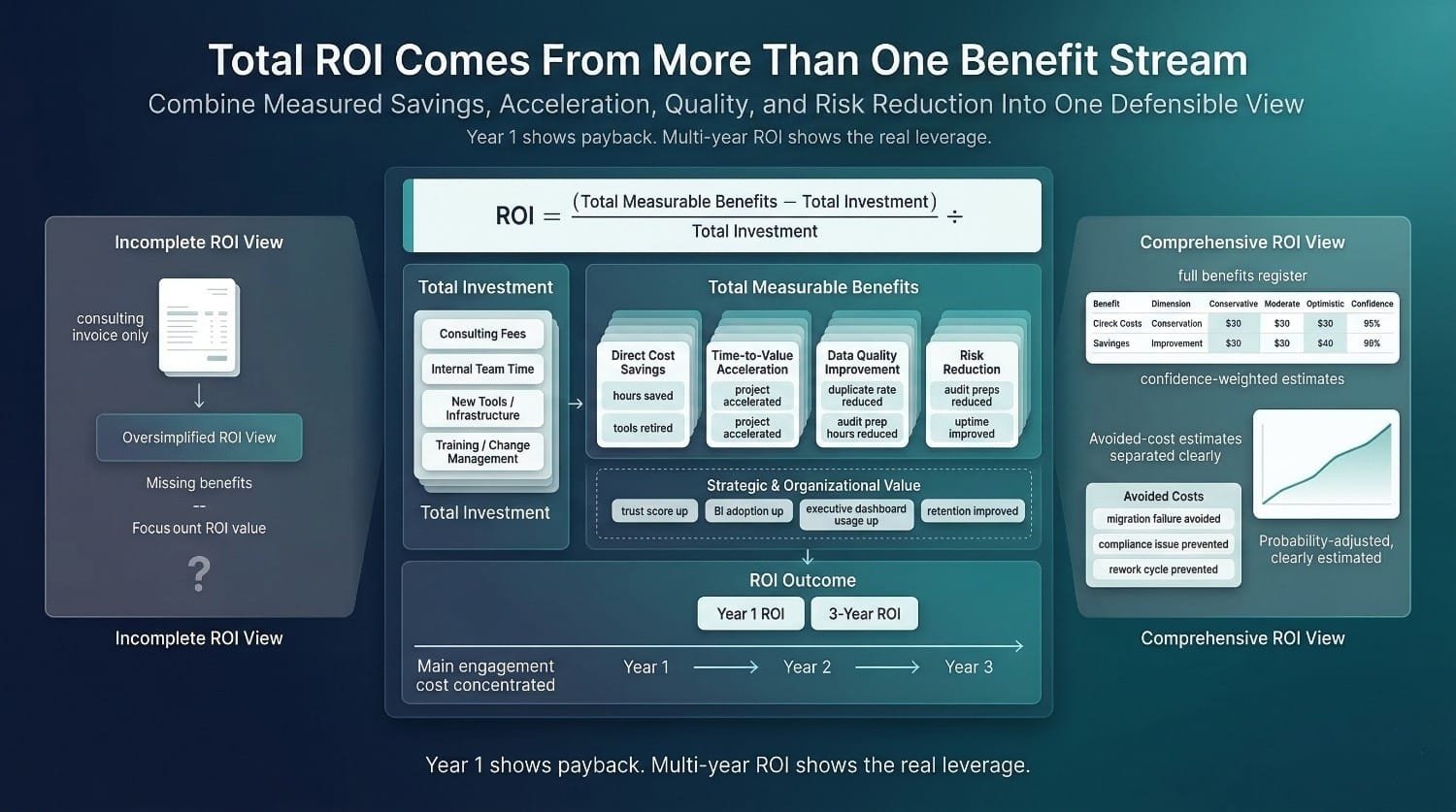
Calculating Total ROI: Putting It All Together
The five dimensions give you what to measure. This section gives you the how, the actual mechanics of turning those measurements into a defensible ROI number that leadership can evaluate, compare, and act on.
The Basic ROI Formula
The formula itself is simple:
ROI = (Total Measurable Benefits minus Total Cost of Engagement) divided by Total Cost of Engagement multiplied by 100 percent
The complexity isn’t in the formula. It’s in making sure both sides of the equation are honest and complete.
What to Include in Total Cost
Don’t just count the consulting invoice. Count everything the engagement required:
Consulting fees, the obvious one. The contract value of the engagement including any change orders.
Internal team time, your engineers, analysts, and stakeholders spent time working alongside the consultants. That’s real cost. Calculate it as hours contributed × fully loaded hourly rate.
New tools and infrastructure, if the consulting engagement recommended and you purchased a new iPaaS platform, data quality tool, or governance platform, include the incremental first year cost attributable to the initiative. These were part of the investment, even though they weren’t on the consulting invoice.
Change management and training, workshops, training sessions, communication efforts, and the stakeholder time invested in adoption. If it wouldn’t have happened without the consulting engagement, it’s part of the cost.
Example total cost calculation:
A mid-sized company’s engagement:
- Consulting fees: $300,000
- Internal team time (estimated 1,200 hours at $85/hour average): $102,000
- New iPaaS platform (Year 1): $75,000
- Training and change management: $25,000
- Total cost: $502,000
Using only the $300K consulting fee in the denominator would overstate the ROI. Using the full $502K gives leadership an honest picture.
That said, there’s a judgment call here. Some organizations exclude tool costs because those tools deliver value beyond the consulting engagement. Others exclude internal team time because those employees would have been paid regardless, although finance teams often treat opportunity cost as real when comparing investment alternatives. Be transparent about what you include and why, and be consistent across calculations.
Building a Comprehensive Benefits Register
The benefits register is where all five dimensions come together into a single, organized accounting of value delivered.
How to Build It
For every benefit identified across the five ROI dimensions, document:
The benefit, a clear, specific description of what improved.
The dimension, which of the five value categories it falls under.
The measurement, the actual metric, with before and after values.
Three estimates, because precision varies by benefit type:
- Conservative, the floor. Only includes value you can prove with hard data. This is the number you defend to skeptics.
- Moderate, the realistic middle. Includes reasonable estimates where direct measurement isn’t perfect but the logic is sound.
- Optimistic, the ceiling. Includes the full potential value, including downstream impacts that are harder to attribute directly.
Confidence level, your honest assessment of how reliable the estimate is. High confidence for directly measured savings. Medium for reasonable estimates. Low for extrapolations and projections.
Example Benefits Register
Benefit: Reduced analyst data preparation time
- Dimension: Direct Cost Savings
- Measurement: 36 hours/week saved across 3 analysts at $75/hour
- Conservative: $112,000/year (accounting for only 80% of measured savings to be safe)
- Moderate: $140,400/year (full measured value)
- Optimistic: $168,000/year (including productivity gains from analysts doing higher-value work)
- Confidence: High, measured directly through time tracking
Benefit: Analytics initiative launched 4 months early
- Dimension: Time-to-Value Acceleration
- Measurement: Customer analytics platform generating $50K/month in identified savings
- Conservative: $100,000 (2 months of accelerated value, heavily discounted)
- Moderate: $200,000 (4 months of accelerated value)
- Optimistic: $300,000 (including secondary initiatives unblocked)
- Confidence: Medium, timeline acceleration is documented, value per month is estimated
Benefit: Reduced compliance audit preparation
- Dimension: Risk Reduction
- Measurement: 275 hours saved per audit cycle
- Conservative: $20,000/year
- Moderate: $26,125/year
- Optimistic: $35,000/year (including reduced external auditor fees from cleaner documentation)
- Confidence: High, hours directly measurable through time tracking
Benefit: Duplicate record reduction from 35% to 2%
- Dimension: Data Quality
- Measurement: 112,200 duplicate records resolved
- Conservative: $40,000/year (reduced rework and customer service errors)
- Moderate: $80,000/year (including improved campaign targeting and personalization)
- Optimistic: $120,000/year (including improved customer lifetime value from better experience)
- Confidence: Medium, quality metrics measured directly, business impact estimated
Using a Weighted Approach
For the final ROI calculation, use the confidence-weighted moderate estimate as your primary number:
- High confidence benefits, use the moderate estimate at full value provided the measurement method remained consistent before and after
- Medium confidence benefits, apply a discount factor such as 75 percent to reflect estimation uncertainty
- Low confidence benefits, apply a deeper discount such as 50 percent or less depending on attribution strength
This approach is conservative enough to be credible and comprehensive enough to capture real value. When presenting to leadership, show all three scenarios, conservative, moderate, and optimistic, so they can see the range.
Accounting for Costs Avoided
This is the counterfactual value, the cost of bad outcomes that didn’t happen because the consulting engagement prevented them.
Why This Matters
Some of the highest-value outcomes of data integration consulting are preventive. Excluding them from the ROI calculation systematically undervalues the investment.
How to Estimate
Avoided cost equals Cost of the negative outcome multiplied by the difference in probability of occurrence before and after consulting
Example 1: Migration failure avoided
Your organization was planning a cloud migration. Without consulting, the estimated probability of a significant stall or failure (based on industry data and your own history) was 40%.
- Estimated cost of a materially failed or stalled migration, including rework, extended timeline, and productivity loss, for example $600,000 based on internal or industry benchmarks
- Probability without consulting: 40%
- Probability with consulting: 5%
- Avoided cost: $600,000 × (40% − 5%) = $210,000
Example 2: Compliance violation prevented
Pre-engagement, the compliance team estimated a 15% probability of a data-related regulatory finding in the next audit cycle.
- Estimated remediation cost of a significant finding: $150,000
- Probability without consulting: 15%
- Probability with consulting: 2%
- Avoided cost: $150,000 × (15% − 2%) = $19,500
Example 3: Third integration project failure prevented
The organization had two prior failed integration attempts. Without consulting, the estimated probability of a third failure was high, say 60% based on the pattern.
- Estimated cost of another failure (wasted budget, delayed initiatives, team attrition): $400,000
- Probability without consulting: 60%
- Probability with consulting: 10%
Avoided cost: $400,000 × (60% − 10%) = $200,000
Where to Get the Estimates
- Industry benchmarks, Gartner, IBM, Forrester publish failure rates, breach costs, and compliance penalty data
- Internal history, your own track record of past integration attempts, audit findings, and project failures
- Expert judgment, your compliance team, your security team, and your engineering leads can estimate probabilities based on their domain knowledge
Consulting team input, experienced consultants have seen enough projects to provide calibrated probability estimates
The Credibility Rule
Always present avoided costs separately from directly measured benefits and clearly label them as probability adjusted estimates.
Don’t mix them into the same total without labeling them. Leadership should see a clear distinction between “value we measured” and “value we estimate was prevented.” Both are real. Both are important. But they carry different confidence levels and should be presented accordingly.
Time-Adjusted ROI
Why Year 1 Understates the Real Return
Most organizations calculate ROI based on Year 1 benefits vs. total engagement cost. This can understate the return when integration benefits persist and compound over multiple years.
Year 1 captures the immediate wins, manual work reduction, tool consolidation, initial quality improvement.
Year 2 captures the secondary effects, analytics initiatives delivering full-year results, governance preventing new quality issues, architecture supporting new sources without rework.
Year 3 captures the compounding value, AI/ML models trained on clean data producing measurable business impact, the architecture supporting 2–3x growth, organizational culture fully shifted toward data-driven decision-making.
The 3-Year ROI Horizon
For strategic data integration consulting investments, a three year horizon is often a reasonable planning frame, subject to the organization’s budgeting model and strategy cycle:
Year 1:
- Direct cost savings begin (but may not reach full run-rate until mid-year)
- Time-to-value acceleration captured
- Initial quality improvements measured
- Consulting costs fully incurred
Year 2:
- Cost savings at full annual run-rate
- Dependent initiatives delivering measurable returns
- Quality improvements compounding (fewer errors means less rework means more capacity for new work)
- Risk reduction benefits accumulating
- No additional consulting costs (unless ongoing advisory was engaged)
Year 3:
- All annual savings continue
- New initiatives enabled by the architecture deliver additional returns
- Scalability benefits realized as growth occurs without re-architecture
- Organizational capability fully transferred, team operating independently
- Strategic value (trust, adoption, decision speed) at full maturity
Discounted Cash Flow for Long-Term Benefits
For a rigorous financial presentation, apply a discount rate to future benefits to account for the time value of money:
Present Value = Future Benefit ÷ (1 + discount rate)^year
Using an illustrative discount rate such as 10 percent, consistent with the organization’s weighted average cost of capital:
- Year 1 benefit of $530K → Present value: $530K
- Year 2 benefit of $480K → Present value: $480K ÷ 1.10 = $436K
- Year 3 benefit of $520K → Present value: $520K ÷ 1.21 = $430K
This approach is especially useful when presenting to a CFO or finance committee that evaluates all investments on a net present value basis.
Sample ROI Calculation Walkthrough
Let’s put the entire framework together with a realistic scenario.
The Scenario
A mid-sized B2B company (300 employees, $60M revenue) engages data integration consulting to unify customer and financial data across Salesforce, NetSuite, a product database, and HubSpot. The goal is a governed customer 360 and reliable financial reporting.
Total Investment
- Consulting engagement (16 weeks): $300,000
- Internal team time (800 hours at $90/hour): $72,000
- New data quality monitoring tool: $24,000/year
- Training and change management: $18,000
- Total Year 1 investment: $414,000
Year 1 Benefits
Dimension 1, Direct Cost Savings:
- Manual data preparation reduction equivalent to approximately 2.5 FTE capacity reallocated to higher value work, estimated at $95,000 based on fully loaded cost assumptions
- Retired legacy ETL tool and middleware: $55,000
- Reduced pipeline maintenance (rework down 70%): $38,000
- Subtotal: $188,000
Dimension 2, Time-to-Value Acceleration:
- Customer analytics platform launched 4 months early, generating $50K/month in identified cross-sell revenue: $200,000
- New source onboarding reduced from 6 weeks to 5 days, enabling two additional integrations in Year 1 that would have slipped to Year 2: value captured in quality and cost savings above
- Subtotal: $200,000
Dimension 3, Data Quality Improvement:
- Duplicate customer records reduced from 32% to 2.5%, improving campaign targeting and reducing customer service errors: $65,000
- Data disputes between departments dropped 85%, recovered leadership time and reduced friction: $15,000
- Subtotal: $80,000
Dimension 4, Risk Reduction:
- Compliance audit preparation reduced by 260 hours: $24,700
- Estimated avoided compliance finding (probability-weighted): $19,500
- Improved pipeline uptime (data availability SLA from 91% to 99.5%): $55,000
- Subtotal: $99,200
Dimension 5, Strategic and Organizational Value:
- Stakeholder data trust score improved from 2.1 to 3.8 (out of 5.0)
- BI platform daily active users increased 140%
- Executive decision meetings now reference dashboards in 85% of sessions (up from 20%)
- One senior data engineer retention saved (was actively interviewing due to frustration with broken infrastructure)
- Subtotal: Documented through surveys and adoption metrics, not included in financial calculation
Year 1 ROI Calculation
Financially quantified benefits: $188,000 + $200,000 + $80,000 + $99,200 = $567,200
Total investment: $414,000
Year 1 ROI = ($567,200 − $414,000) ÷ $414,000 × 100% = 37%
A 37% return in Year 1, with the strategic dimension not even included in the financial calculation.
Year 3 Cumulative View
Year 2 benefits (conservative, assuming no new initiatives, just continuing returns):
- Annual cost savings continue: $188,000
- Analytics platform full-year impact: $600,000
- Quality and risk benefits continue: $179,200
- Year 2 incremental tool cost: $24,000
- Year 2 net benefits: $943,200
Year 3 benefits (conservative, adding one new initiative enabled by the architecture):
- Continuing annual benefits: $967,200
- New AI-driven customer retention initiative (enabled by clean, unified data): $150,000
- Architecture supports 40% data volume growth without additional infrastructure: $45,000 in avoided scaling costs
- Year 3 net benefits: $1,162,200
3-Year Cumulative:
- Total benefits: $567,200 + $943,200 + $1,162,200 = $2,672,600
- Total investment (Year 1 engagement + 3 years of tool costs): $414,000 + $48,000 = $462,000
3-Year ROI = ($2,672,600 − $462,000) ÷ $462,000 × 100% = 479%
What This Tells Leadership
- Year 1 ROI of 37%, the engagement paid for itself and then some in the first year alone
- 3-year ROI of 479%, the compounding value of a sound data foundation dramatically outpaces the initial investment
- And the strategic dimension, trust, adoption, decision speed, talent retention, isn’t even included in these numbers
This is why data integration consulting, when well executed and measured rigorously, is often a high return investment within the data portfolio.
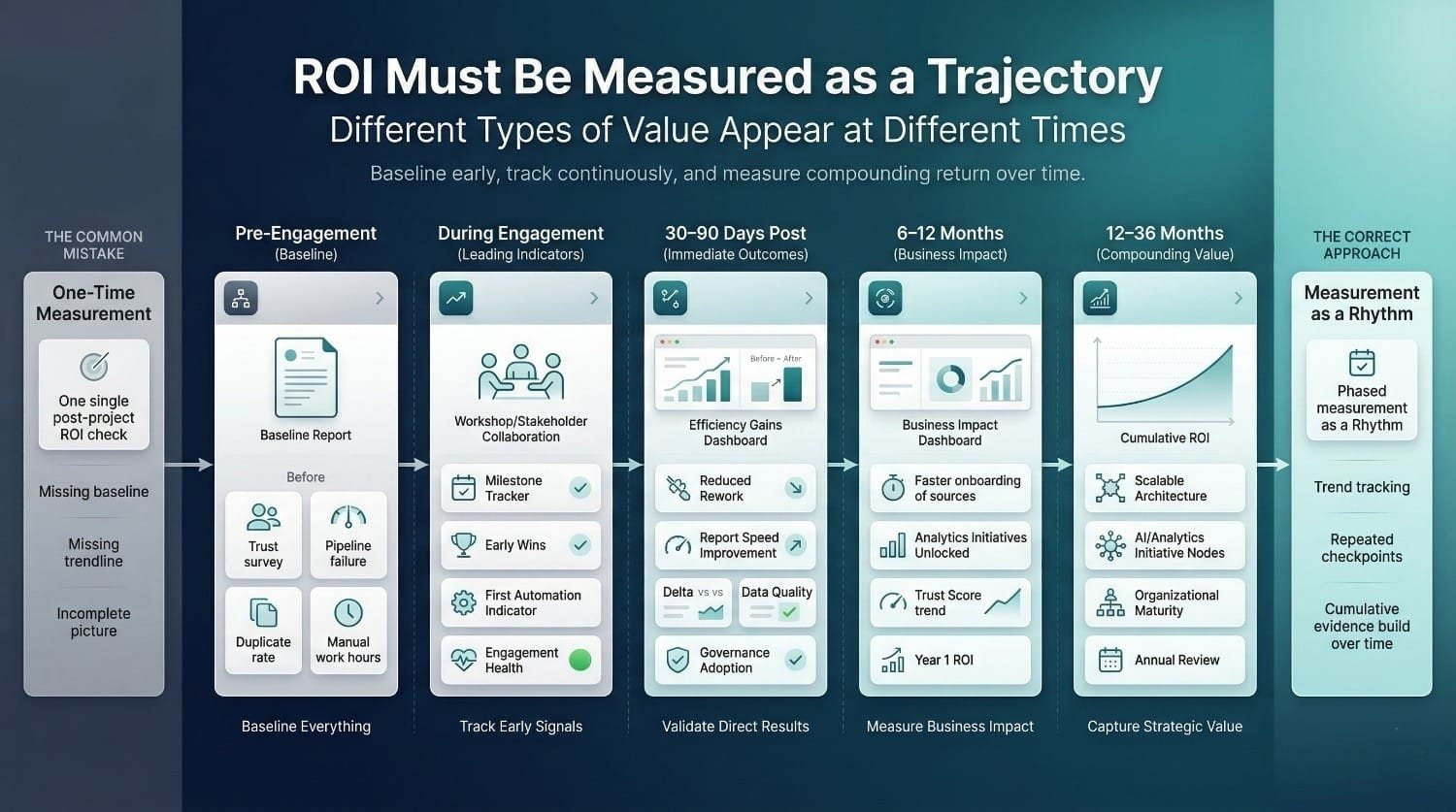
When to Measure
Knowing what to measure is half the challenge. Knowing when to measure is the other half.
Measure too early and you’ll miss the compounding value. Measure too late and you’ll lose the baseline. Measure only once and you’ll capture a snapshot instead of a trajectory.
ROI measurement isn’t a single event. It’s a rhythm, timed to capture different types of value as they materialize.
Pre-Engagement (Baseline)
When: 2–4 weeks before the consulting engagement begins
Purpose: Establish the “before picture” that every future measurement compares against.
This is the most important measurement window, and the one most organizations skip. Everything that follows depends on having an honest, documented starting point.
What to Capture
Quantitative baselines across all five dimensions:
- Hours per week spent on manual data preparation and reconciliation
- Average time to generate key reports (monthly close, board deck, customer analytics)
- Pipeline failure rate per month
- Duplicate record rate across key entities
- Data error rate per 10,000 records
- Infrastructure spend, compute, storage, tooling
- Engineering time split between maintenance and new development
- Average time to onboard a new data source
- Compliance audit preparation hours
- Number of data-related audit findings from the most recent cycle
Qualitative baselines:
- Stakeholder data trust survey, a simple 1–5 scale distributed to 15–20 key decision-makers
- Data dispute frequency, how often do teams escalate conflicting numbers
- Decision-making patterns, are leaders referencing data or relying on instinct
- Data team satisfaction, brief pulse survey on infrastructure frustration and work quality
Who Owns This
The data integration consulting team should help capture baselines as part of their discovery phase. But the internal data team owns the data, because they’ll need to run the same measurements at every future checkpoint.
The Non-Negotiable
If a metric isn’t baselined before the engagement starts, it is difficult to use it credibly in the ROI calculation afterward.
Document everything. Store it somewhere accessible. You’ll reference it repeatedly over the next 12–36 months.
During the Engagement (Leading Indicators)
When: Continuously throughout the engagement, reviewed at weekly and monthly checkpoints
Purpose: Track early signals that predict long-term ROI, and identify course corrections before they become expensive.
What to Track
Early wins that demonstrate momentum:
- First manual process automated, and the hours it’s already saving
- First data quality improvement measured, duplicates resolved, error rates dropping
- First pipeline migrated from manual/legacy to the new architecture
- First stakeholder reaction to improved data, the moment someone says “these numbers actually match”
Engagement health indicators:
- Are milestones being hit on schedule?
- Are stakeholders showing up to workshops and reviews, or disengaging?
- Are internal team members actively participating, or passively watching?
- Are blockers being resolved quickly, or accumulating?
- Is scope stable, or creeping without formal change management?
Leading indicators of long-term ROI:
- Stakeholder engagement levels during the engagement predict adoption after it. If leadership isn’t engaged during design, they won’t trust the output.
- Speed of cross-departmental agreement on shared definitions predicts governance adoption. If teams are aligning quickly, governance will stick. If every definition is a battle, post-engagement sustainability is at risk.
- Reduction in data-related escalations during the engagement signals that quality and trust are already improving.
- Internal team confidence, are your engineers feeling capable of maintaining what’s being built, or overwhelmed by its complexity?
Why This Matters for ROI
Leading indicators may not appear directly in the final ROI calculation. But they tell you whether the ROI you’re expecting is likely to materialize, or whether intervention is needed now to protect the investment.
A data integration consulting engagement that’s hitting milestones, engaging stakeholders, and producing early wins is more likely to deliver strong ROI, assuming adoption continues. One that’s missing deadlines, losing stakeholder attention, and producing no visible improvements needs immediate course correction, before the ROI window closes.
Immediately Post-Engagement (30–90 Days)
When: Starting the day the consulting engagement formally ends, measured at 30, 60, and 90 days.
Purpose: Capture the direct, tangible outcomes that are immediately measurable, and validate that what was built is actually being used.
What to Measure
Direct efficiency gains:
- Hours saved per week on manual data tasks, re-measure using the same methodology as the baseline
- Pipeline failure rate, is it down? By how much?
- Report generation time, is it faster? Measure the same reports baselined pre-engagement
- Rework hours, how much time is the team still spending on error correction?
Quality improvements:
- Run the same data profiling reports used in the baseline, duplicates, error rates, completeness
- Compare current quality scores against pre-engagement baselines
- Document any quality issues that surfaced post-launch and how they were resolved
Governance and process adoption:
- Are data ownership roles active, are stewards actually performing stewardship?
- Are golden record rules being followed, or being bypassed?
- Is documentation being maintained, or already stale?
- Is the governance framework operational, or already gathering dust?
Stakeholder sentiment:
- Re-run the data trust survey, same questions, same audience as the baseline
- Capture specific feedback on what’s improved and what hasn’t
- Document any departments or users still relying on old processes, this signals adoption gaps that need addressing
The Critical Check
The 30 to 90 day window is often where you discover whether the engagement delivered sustainable value or just only short term improvement. If governance is already slipping, adoption is low, or the internal team is struggling to maintain what was built, the long-term ROI is at risk.
Address issues in this window, as they are typically less costly to correct early than after patterns solidify.
Medium-Term (6–12 Months)
When: Formal measurement at 6 months and 12 months post-engagement.
Purpose: Capture the downstream business impacts that take time to materialize, and confirm that the integration foundation is delivering on its strategic promise.
What to Measure
Business impact of integrated data:
- Are analytics initiatives that were blocked now producing results? What results?
- Has reporting accuracy and consistency improved in ways stakeholders notice and value?
- Are cross-sell, upsell, or personalization initiatives leveraging the unified data? With what measurable impact?
- Has forecast accuracy improved? By how much?
Operational maturity:
- Is the team onboarding new data sources faster than before? Measure average onboarding time.
- Are pipeline failures continuing to decline, or have they plateaued or increased?
- Is the architecture handling growth without strain, or are performance issues emerging?
- Has maintenance burden decreased, is the engineering team spending more time on new capabilities vs. firefighting?
Quality trends:
- Run data profiling again, are quality scores holding steady, improving, or degrading?
- Are data disputes still rare, or creeping back?
- Is the governance framework still active, or has it atrophied?
Compliance and risk:
- If an audit has occurred in this window, what were the results compared to pre-engagement?
- Has audit preparation time remained reduced?
- Are lineage and access controls still being maintained?
Financial tracking:
- Sum up actual cost savings realized to date, compare against the benefits register projections
- Track tool and infrastructure spend, has it decreased as projected?
- Calculate Year 1 ROI using actual measured data, not estimates
Why This Window Matters Most
The 6–12 month window is where the moderate-confidence benefits in your register either materialize or don’t. It’s where time-to-value acceleration shows its full impact. And it’s where you get the first credible data point on whether the 3-year ROI projection is tracking.
This is the measurement that justifies, or challenges, the next phase of integration investment.
Long-Term (12–36 Months)
When: Annual measurement at 12, 24, and 36 months post-engagement
Purpose: Capture the compounding strategic value, calculate cumulative ROI, and assess whether the integration foundation is delivering lasting organizational change.
What to Measure
Scalability realized:
- How many new data sources have been added since the engagement? How long did each take?
- Has the architecture supported business growth (new products, new geographies, acquisitions) without requiring redesign?
- What new initiatives has the integration foundation enabled that weren’t part of the original scope?
Strategic enablement:
- Are AI/ML initiatives running on the integrated data? What business value are they producing?
- Has the organization launched data products (internal or external) that depend on the integration architecture?
- Has the data infrastructure become a competitive advantage, or is it still just keeping the lights on?
Organizational data maturity:
- Stakeholder trust survey, is trust continuing to improve, holding steady, or declining?
- BI adoption, are more teams and users engaging with integrated data over time?
- Decision-making culture, has the organization genuinely shifted from gut-driven to data-driven?
- Data literacy, do business users understand where data comes from and what it means?
Team capability:
- Is the internal team operating independently, handling integration tasks that previously required consulting?
- Has the team grown in skill and confidence, or are they still dependent on external support?
- Are runbooks and documentation still being maintained and used?
Cumulative financial ROI:
- Sum all measured benefits across all five dimensions for each year
- Calculate the 3-year cumulative ROI using actual data
- Compare against the original projections, where did reality exceed or fall short of estimates?
Industry benchmarking:
- How does your data maturity compare to industry peers?
- Are your integration costs, quality scores, and time-to-insight metrics competitive?
- Frameworks such as CMMI Data Management Maturity and other industry data maturity models can provide structured comparison points
The Ultimate Test
At the 36-month mark, ask one question:
“Is our data infrastructure enabling the business to move faster, decide better, and operate more efficiently than it could 3 years ago, and can we prove it?”
If the answer is yes, backed by measured data across all five dimensions, the data integration consulting investment has likely delivered its full return. If the answer is mixed, the measurement data tells you exactly where the gaps are and what to address next.
The Complete ROI Measurement Timeline
Pre-engagement: Baseline everything. No exceptions.
During engagement: Track leading indicators weekly. Course-correct early.
30–90 days post: Measure direct outcomes. Validate adoption. Fix gaps quickly.
6–12 months post: Capture business impact. Calculate Year 1 ROI with real data.
12–36 months post: Measure compounding value. Calculate cumulative ROI. Assess lasting organizational change.
Each window builds on the previous one. Skip any of them and the ROI picture is incomplete. Follow all of them and you’ll have the most comprehensive, defensible integration ROI measurement in your organization’s history.
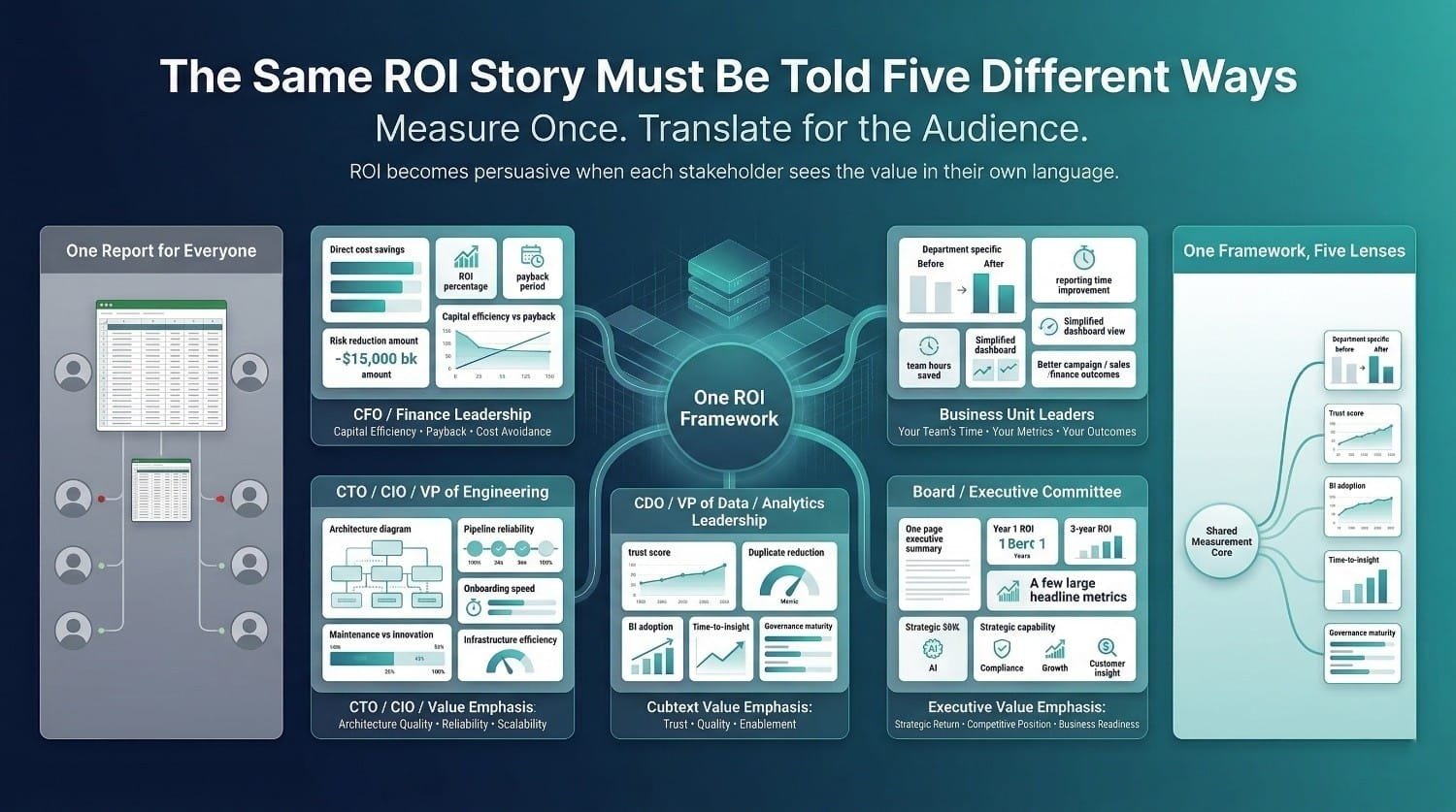
How to Communicate ROI to Different Stakeholders
You’ve measured the ROI. Now you have to communicate it, and the same numbers, presented the same way, will resonate with one audience and fall flat with another.
A CFO wants payback periods. A CTO wants architectural metrics. A business unit leader wants to know why their reports are faster. The board wants a paragraph, not a spreadsheet.
Presenting the right value to the right audience in the right language is as important as measuring it in the first place. A technically rigorous ROI analysis that is not understood by stakeholders delivers limited value.
To the CFO / Finance Leadership
What They Care About
The CFO’s question is always the same: “Was this a good use of capital, and should we invest more?”
They don’t care about data quality scores. They don’t care about pipeline reliability. They care about money, saved, avoided, earned, or accelerated.
How to Present
Lead with the financial summary. Don’t build up to it. Start with it.
“The 414K dollar integration investment delivered 567K dollars in measurable financial returns in Year 1, a 37 percent ROI. The three year projected return is 2.67M dollars, representing a 479 percent cumulative ROI based on stated assumptions.”
Then break it down by category:
- Direct cost savings: $188K/year in labor, tools, and infrastructure
- Revenue acceleration: $200K from launching the analytics initiative 4 months early
- Quality-driven savings: $80K/year in reduced rework and customer-facing errors
- Risk reduction: $99K in avoided compliance costs and improved uptime
Frame in terms they use every day:
- Payback period, how many months until the investment was fully recovered
- Cost of inaction, what would the next 3 years cost if the integration problems continued unchecked
- Comparison to alternatives, the consulting engagement vs. the cost of a failed internal attempt (using your own history or industry benchmarks)
Use the language of investment rather than technical implementation details. No mention of canonical data models, entity resolution, or governance frameworks. Instead: capital efficiency, cost avoidance, accelerated revenue capture, and risk mitigation.
What to Avoid
Don’t present intangible benefits as financial returns. The CFO will discount your entire analysis if you try to put a dollar sign on “improved data trust.” Keep the financial section rigorous and present strategic value separately as supporting context.
To the CTO / CIO / VP of Engineering
What They Care About
The technical leadership question: “Did this make our architecture better and our team more capable?”
They’ve lived with the technical debt, the fragile pipelines, and the late-night pages. They want to know the integration consulting delivered a foundation that’s sound, scalable, and maintainable, not just functional today.
How to Present
Lead with architectural improvement:
“We went from 47 point-to-point connections with no documentation to a hub-and-spoke architecture with full lineage tracking, automated monitoring, and documented runbooks for every pipeline.”
Then show the operational metrics:
- Pipeline failure rate: from 11/month to under 2/month
- Mean time to recovery: from 4.5 hours to 22 minutes
- New source onboarding: from 6–8 weeks to 3–5 days
- Engineering time on maintenance vs. new development: from 70/30 to 25/75
- Infrastructure cost per GB processed: 40% reduction through architecture optimization
Highlight capability and sustainability:
- Technical debt quantified and addressed, not just patched
- Team can now handle integration tasks that previously required external support
- Architecture has been validated through testing and capacity planning to support projected growth multiples without major redesign
- Documentation and runbooks are complete and actively maintained
Address what matters to them personally:
- Their team is no longer firefighting, they’re building
- On-call burden has decreased measurably
- The architecture reflects industry best practices and is defensible in technical design reviews.
- New hires can onboard to the integration layer in days, not months
What to Avoid
Don’t over-index on financial ROI with this audience. They understand the cost justification, but what they really want to know is whether the technical foundation is solid. If the architecture is right, they’ll help you make the financial case to everyone else.
To the CDO / VP of Data / Analytics Leadership
What They Care About
The data leadership question: “Can we now trust the data sufficiently to build advanced analytics and AI capabilities on top of it with predictable outcomes?”
They’ve been trying to deliver analytics, build models, and create data products, but the foundation kept undermining them. They want to know the foundation is finally trustworthy.
How to Present
Lead with data quality and trust:
“Duplicate customer records dropped from 34% to under 3%. The stakeholder data trust score improved from 2.1 to 3.8 out of 5. For the first time, all three departments report the same customer count.”
Then show the analytics enablement:
- BI platform daily active users: up 140%
- Time from data request to delivered insight: from 3–5 days to under 4 hours
- Analytics initiatives unblocked: customer 360, churn prediction, personalization engine
- AI/ML team now spends 30% of time on data prep, down from 80%
Show governance maturity:
- Shared business glossary published with agreed-upon definitions for all key metrics
- Data ownership model operational with active stewards in every domain
- Lineage tracking covering source through transformation to consumption
- Data quality monitoring automated with alerting and escalation procedures
Connect to their roadmap:
- What can they now build that they couldn’t before?
- What initiatives move from “blocked by data” to “ready to start”?
- How does the foundation support their 12–18 month analytics strategy?
What to Avoid
Don’t present this as a one-time achievement. Data leaders know that quality and governance degrade without ongoing attention. Show them the measurement rhythm and the sustainability plan, not just the current snapshot.
To Business Unit Leaders
What They Care About
The business leader’s question: “How does this help my team do our jobs better?”
They don’t care about integration architecture. They care about their reports, their customers, their numbers, and their time.
How to Present
Lead with their specific pain point, resolved:
For the VP of Sales:
“Your team was spending 6 hours per week manually reconciling pipeline data between Salesforce and the forecasting tool. That reconciliation is now automated. And the customer data powering your territory assignments is accurate for the first time, no more misattributed accounts.”
For the CFO’s finance team:
“Monthly close went from 14 days to 5. The revenue numbers in the dashboard now match the numbers in NetSuite, exactly. Your team recovered 320 hours per audit cycle in preparation time.”
For the VP of Marketing:
“You now have a unified customer profile across CRM, e-commerce, and engagement data. Campaign targeting accuracy improved by 23%. The cross-sell model your team requested is live and producing results.”
Use before-and-after comparisons on metrics they already track. Don’t introduce new metrics, show improvement on the ones they already care about.
Show time recovered. Every business leader understands the value of their team getting hours back. “Your analysts spend 18% of their time on data prep instead of 62%” is a powerful statement to someone managing a team budget.
What to Avoid
Don’t present the technical framework. Don’t mention data modeling, governance, or architecture. Translate everything into their language, their metrics, their outcomes. If you lead with technical terminology such as pipeline in a presentation to a business unit leader, you risk losing their attention.
To the Board / Executive Committee
What They Care About
The board’s question: “Is this company making smart investments in its data capabilities, and are we positioned competitively?”
They want the highest-altitude view, investment, return, strategic positioning, and risk management. In the fewest possible words.
How to Present
One paragraph. Then one page. Then supporting detail if asked.
The paragraph:
“We invested $414K in a data integration initiative to unify our customer and financial data across four core systems. The engagement delivered 567K dollars in measurable Year 1 returns, a 37 percent ROI, with three year projected returns of 2.67M dollars based on stated assumptions. Beyond financial returns, the initiative eliminated conflicting reporting across departments, reduced compliance preparation time by 80%, and created the data foundation for our AI and personalization roadmap. The investment has been fully recovered and is now generating ongoing annual returns.”
The one-page summary should include:
- Total investment and total return, Year 1 and 3-year
- Three or four headline metrics that capture the impact (one per value dimension)
- Strategic capabilities gained, what the organization can now do that it couldn’t before
- Competitive context, how this positions the company relative to peers and market expectations
- Connection to enterprise strategy, how integrated data supports digital transformation, customer experience, regulatory readiness, or whatever the board’s current strategic priorities are
If the board asks for detail, have the full five-dimension ROI analysis ready. But don’t present it unprompted. Boards want confidence and clarity, not exhaustive spreadsheets.
What to Avoid
Don’t present more than one page unless asked. Don’t use technical language. Don’t present conservative, moderate, and optimistic scenarios, pick the moderate number and stand behind it. Don’t caveat excessively, the board wants to see confident, evidence-based results, not a defensive hedge.
Do not present data integration consulting ROI primarily as a technology story. Present it as a business investment story grounded in measurable outcomes.
The Communication Principle
Same ROI. Different lens. Every audience gets the version that answers their specific question in their specific language.
The CFO gets the financial case. The CTO gets the technical transformation. The CDO gets the data quality and enablement story. Business leaders get their department’s specific improvements. The board gets the strategic summary.
One measurement framework. Five presentations. Each one compelling because it speaks directly to what that audience cares about most.
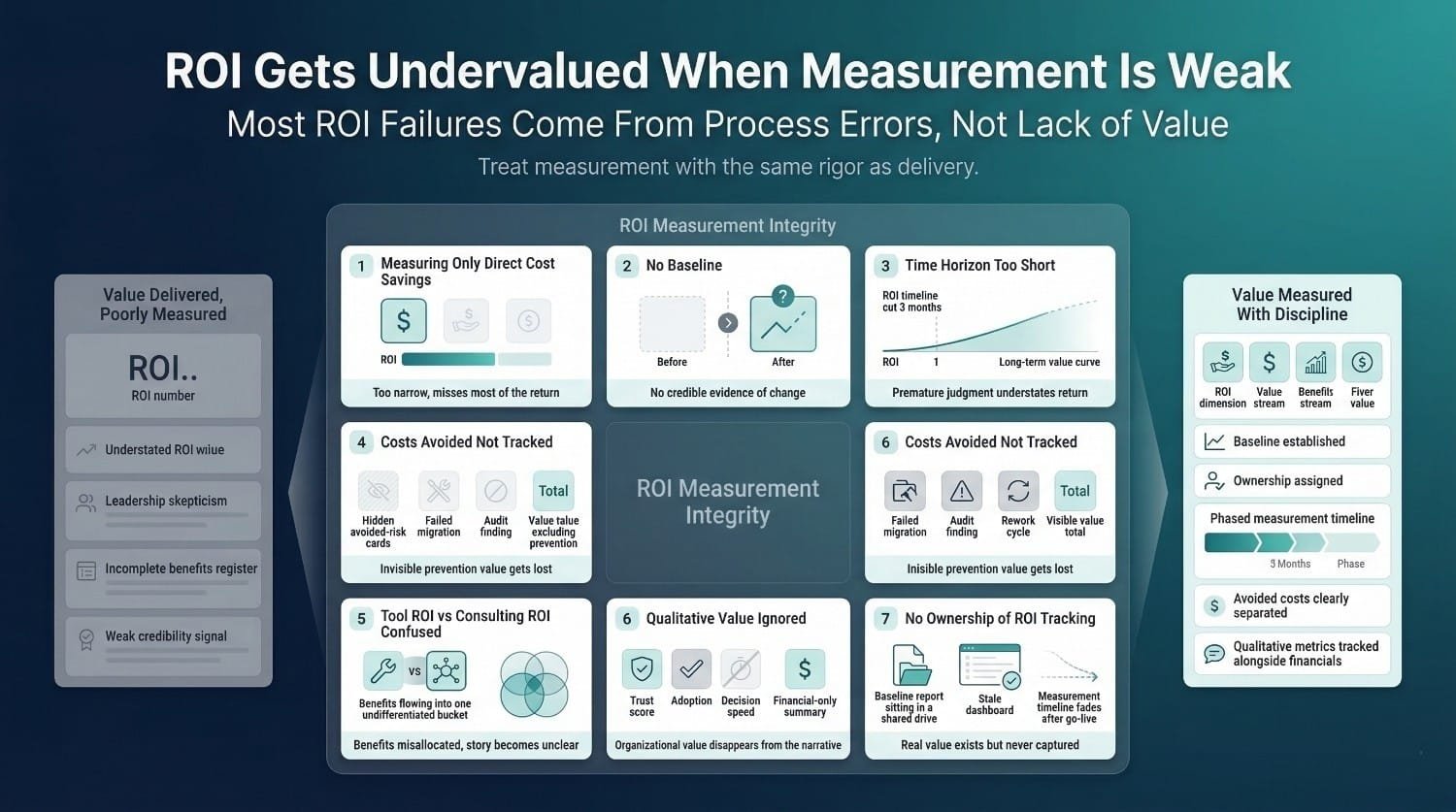
Common Pitfalls in Measuring Integration Consulting ROI
The measurement framework works, but only if you avoid the mistakes that undermine it. These seven pitfalls are common, predictable, and entirely preventable.
Measuring Only Direct Cost Savings
This is the most frequent mistake. It’s also the most damaging to the perceived value of data integration consulting.
When ROI is calculated solely on cost savings such as labor reduction, tool consolidation, and infrastructure optimization, the number is real but incomplete. In many organizations this captures only a portion of the total value delivered.
The other 70–80%, accelerated initiatives, quality improvements, risk reduction, strategic enablement, goes unmeasured and therefore unrecognized. Leadership sees a modest return when the actual return is substantial.
The fix: Use all five dimensions from the framework. Even if some dimensions produce estimates rather than exact figures, a comprehensive picture with clearly labeled confidence levels is infinitely more accurate than a precise calculation that ignores most of the value.
Not Establishing a Baseline
This one is fatal to credible ROI measurement, and it’s almost always caused by eagerness to start the “real work.”
Without documented baselines, every post-engagement improvement is anecdotal. “Reports are faster” isn’t ROI. “Monthly close decreased from 14 days to 5 days” is ROI. The difference is the baseline.
Retroactive baselining, trying to reconstruct what things looked like before the engagement, is unreliable. People’s memories are inaccurate. Historical data is incomplete. The resulting “baseline” is shaped by the desire to show improvement rather than by actual measurement.
The fix: Treat baselining as a non-negotiable deliverable of the engagement kickoff. Two weeks of focused measurement before work begins. If the consulting team pushes back on this, or if your internal team sees it as unnecessary overhead, push harder. Every dollar of ROI you’ll
Using Too Short a Time Horizon
A leadership team that evaluates data integration consulting ROI at the 3-month mark is looking at a construction project and judging it by the foundation pour. The foundation is essential but it’s not the building.
At 3 months, you’ll see some direct cost savings and early quality improvements. You won’t see the analytics initiative that launches in month 6. You won’t see the compliance audit that passes cleanly in month 9. You won’t see the AI model that produces results in month 14. And you definitely won’t see the cumulative 3-year return that makes the investment look obvious in retrospect.
Premature ROI judgment leads to premature budget cuts, which leads to abandoned integration initiatives, which leads to the same problems returning 12 months later.
The fix: Set expectations upfront that Year 1 ROI will be meaningful but partial, and that the full return materializes over 2–3 years. Present the 3-year projection at the start of the engagement so leadership evaluates against the right horizon. Then deliver interim measurements at 90 days, 6 months, and 12 months to show the trajectory, building confidence that the long-term projection is credible.
Failing to Track Costs Avoided
Avoided costs are invisible by design. The migration that didn’t fail doesn’t generate an incident report. The compliance penalty that wasn’t levied doesn’t appear on a P&L. The third failed integration attempt that didn’t happen doesn’t consume any budget.
Because these non-events leave no trace, they’re systematically excluded from ROI calculations, even though they’re often the largest value component. A single avoided migration failure can represent hundreds of thousands of dollars in prevented waste, depending on scope and organizational complexity. A single avoided compliance finding can prevent $50K–$200K in remediation. These are real numbers that real organizations have experienced.
The fix: Build cost avoidance into the benefits register from day one. Use the probability-weighted estimation method: cost of negative outcome × probability without consulting − probability with consulting. Label these estimates clearly as avoided costs with their confidence level. Present them separately from measured savings so leadership can evaluate them on their own merits. They may not withstand the same level of scrutiny as directly measured savings but ignoring them entirely understates the ROI by a significant margin.
Conflating Tool ROI with Consulting ROI
When a data integration consulting engagement includes iPaaS selection and implementation, which it often does, the ROI of the tool and the ROI of the consulting get mixed together. This creates problems in both directions.
If the combined ROI is attributed entirely to consulting, the consulting investment looks disproportionately valuable, and the tool investment looks invisible. If attributed entirely to the tool, consulting looks like it delivered no value, when in reality, the tool only works because consulting designed the architecture, data model, and governance framework it operates within.
The fix: Separate the contributions explicitly. The tool provides ongoing operational value, connectivity, automation, monitoring, infrastructure. Consulting provided the strategy, architecture, governance, and organizational alignment that made the tool effective. When presenting ROI, allocate benefits to the appropriate source. Operational efficiency gains from automated pipelines? That’s tool value. The fact that those pipelines move the right data, in the right structure, with the right quality? That’s consulting value.
Ignoring Qualitative and Organizational Metrics
CFOs are skeptical of “soft” metrics. That skepticism is reasonable, vague claims about “improved culture” don’t belong in a financial analysis.
But dismissing qualitative metrics entirely means ignoring some of the most consequential outcomes of the engagement. The shift from low trust in data to data informed decision making is difficult to quantify but can be strategically significant. Analyst retention improving because infrastructure friction is reduced can prevent substantial replacement and onboarding costs per departure, which vary by role and geography. Executive decision speed improving from days to hours isn’t soft, it’s competitive advantage.
The mistake isn’t including these metrics. The mistake is either ignoring them or presenting them as financial returns when they’re not.
The fix: Present qualitative and organizational metrics in their own section, clearly labeled, tracked with surveys and proxy metrics, and positioned as strategic value that complements the financial analysis. Don’t convert “trust score improved from 2.1 to 3.8” into a dollar amount. Present it as what it is, measurable evidence that the organization’s relationship with its data has fundamentally changed. The right audience will understand its significance without a fabricated price tag.
Not Assigning Ownership of ROI Tracking
This is the pitfall that kills measurement through neglect rather than error.
The engagement ends. The consulting team leaves. The internal team is focused on operating and maintaining what was built. Nobody is specifically accountable for continuing to measure ROI. The baseline data sits in a shared drive. The survey never gets re-run. The quality profiling reports stop being generated. By the time leadership asks for the 12-month ROI assessment, nobody has the data to produce one.
The ROI was real. It just wasn’t captured, because nobody owned the capturing.
The fix: Assign a specific individual, not a team, an individual, to own the ROI measurement process. This person is responsible for running the scheduled measurements (quarterly surveys, monthly quality profiles, semi-annual financial assessments), maintaining the benefits register with actual data, and producing the ROI reports at each milestone. Put it in their objectives. Make it part of their performance evaluation. If ROI measurement is everyone’s job, it’s nobody’s job, and it won’t happen.
The Common Thread
Every one of these pitfalls has the same root cause: measurement wasn’t treated as seriously as delivery.
The engagement gets meticulous attention, discovery, architecture, implementation, testing, validation. The ROI measurement gets a vague plan and good intentions.
Flip that. Treat ROI measurement with the same rigor as the integration itself. Define it upfront. Baseline before you start. Track at every milestone. Assign ownership. Report across all five dimensions. Use the right time horizon.
The value of data integration consulting is real. Making it visible, credibly, comprehensively, and consistently, is what ensures the investment is recognized, sustained, and repeated.
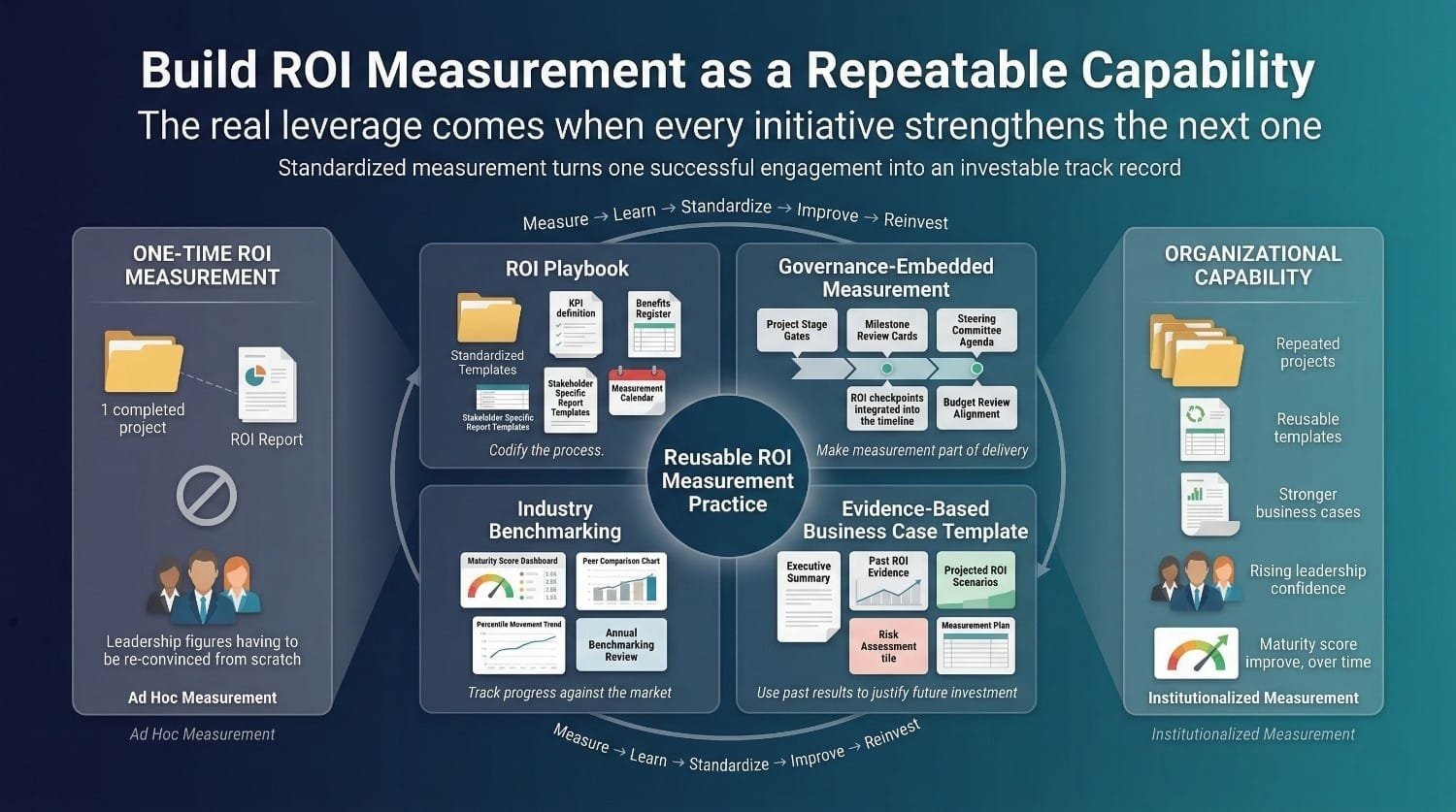
Building a Reusable ROI Measurement Practice
Measuring ROI once is valuable. Building a repeatable practice that measures ROI consistently across every integration initiative, that’s transformational.
The organizations that sustain investment in data integration aren’t the ones that got lucky with one project. They’re the ones that proved the return every time, building an evidence base so compelling that future investment decisions become straightforward.
Here’s how to build that practice.
Creating an Integration ROI Playbook
Don’t let everything you’ve learned from this engagement live in one person’s head or one project’s folder. Codify it into a reusable playbook that any future initiative can follow.
What the Playbook Should Contain
The measurement framework, the five dimensions of value, adapted to your organization’s specific context. Which metrics matter most for your business? Which dimensions have the richest data sources? Where do your stakeholders focus their attention?
Baseline templates, standardized checklists and data collection templates so every future initiative captures the same “before” metrics. Include the quantitative metrics (time, cost, quality, volume) and the qualitative survey instruments (trust, satisfaction, decision speed). If the same template is used every time, results become comparable across initiatives.
KPI definition templates, a standard format for defining engagement KPIs: the metric, the baseline, the target, the timeframe, the owner, and the data source. Pre-populated with the KPIs that proved most useful in past engagements, with room to add initiative-specific metrics.
Benefits register template, the three-scenario (conservative, moderate, optimistic) format with confidence levels. Pre-populated with common benefit categories so teams don’t have to reinvent the structure each time.
ROI report templates, standardized formats for each stakeholder audience. The CFO version, the CTO version, the business unit version, and the board summary. Pre-structured so the team only needs to fill in the numbers, not design the presentation from scratch.
Measurement calendar, the standard timeline (baseline, during, 30–90 days, 6–12 months, 12–36 months) with specific activities at each checkpoint. Treat it as a project plan for measurement itself.
Why This Matters
The first ROI measurement is the hardest because everything is being created from scratch. The playbook ensures the second one is dramatically easier, and the tenth one is routine. Over time, the measurement practice becomes as natural as the integration work itself.
Integrating ROI Tracking into Project Governance
ROI measurement shouldn’t be a separate workstream that runs alongside the project. It should be embedded in the project’s governance structure, so measurement happens automatically as part of how the initiative is managed.
How to Embed It
Make baselining a gate a formal gate in project governance so integration initiatives do not move past planning without documented baselines. If you don’t have a “before” picture, you don’t start building. This sounds rigid, but it takes 1–2 weeks and prevents the single most common measurement failure.
Include ROI metrics in milestone reviews. Every project milestone review, whether it’s a sprint demo, a phase gate, or a steering committee update, should include a section on ROI tracking. Not a full analysis, just a status check: Are we capturing the data we need? Are early indicators trending in the right direction? Are there risks to the expected return?
Add ROI checkpoints to steering committee agendas. At minimum, the steering committee should see ROI data at the engagement midpoint, at go-live, at the 6-month mark, and at the 12-month mark. This keeps leadership engaged with the value story throughout, not just at the end when they’re asked to approve the next investment.
Tie ROI reporting to budget cycles. If your organization runs annual or quarterly budget reviews, align ROI reporting to those cycles. The integration ROI report should land on the CFO’s desk at the same time as every other investment performance review, not as a special request, but as standard operating procedure.
The Cultural Shift
When ROI measurement is embedded in governance, it stops being something the team does reluctantly after the project and becomes something the organization expects as part of every initiative. That shift, from afterthought to standard practice, is what sustains long-term investment in data integration consulting and data infrastructure broadly.
Building a Business Case Template for Future Investments
Every measured ROI feeds the next business case. Over time, you build an evidence base that makes future investment decisions faster and more confident.
How Past ROI Data Strengthens Future Business Cases
Pattern recognition. After multiple measured engagements, patterns may emerge. You may observe consistent ranges of Year 1 and multi year ROI in your organization, calibrated to your industry and delivery model. That’s not a projection, it’s a track record.
Credibility with leadership. The first business case for data integration consulting is often the hardest because it relies primarily on projections rather than internal evidence. You’re asking leadership to trust projections. The second business case comes with evidence: “Our last engagement projected 37% Year 1 ROI and delivered 42%. Here’s why the next one will deliver similar or greater value.” That’s a fundamentally different conversation.
Risk calibration. Past measurements reveal where estimates were accurate and where they weren’t. Maybe direct cost savings consistently exceeded projections while time-to-value acceleration was overestimated. That calibration makes future projections more accurate and more credible.
The Business Case Template
Build a reusable template that includes:
Executive summary, one paragraph framing the investment, the expected return, and the strategic rationale.
Evidence from past engagements, measured ROI from previous consulting investments, with specific outcomes cited. This is the credibility section.
Proposed initiative, what will be done, why, and for whom. Business outcomes, not technical activities.
Projected ROI, using the five-dimension framework, with conservative, moderate, and optimistic scenarios. Calibrated against the accuracy of past projections.
Risk assessment, what could reduce the return, and how those risks will be mitigated.
Measurement plan, how ROI will be tracked, by whom, and on what timeline. This demonstrates accountability before the first dollar is spent.
When this template is populated with real data from real engagements, it becomes one of the most powerful tools in the data leader’s arsenal for securing investment.
Benchmarking Against Industry Standards
Internal ROI measurement indicates whether your investment delivered value. External benchmarking provides context on whether your integration maturity is competitive and where additional investment may have the highest impact.
Available Benchmarking Frameworks
Gartner Data and Analytics Maturity Model, assesses organizational maturity across data management, analytics capability, and governance, and can be used to position your organization relative to industry peers and identify high impact investment areas.
Forrester Data Management Maturity Assessment, focuses on data quality, integration, governance, and organizational readiness. Provides a structured comparison against industry averages.
CMMI Data Management Maturity Model, a more granular framework that evaluates specific practices across data governance, data quality, data operations, and platform architecture. Useful for identifying precise capability gaps.
Stanford Data Maturity Model, a simpler framework focused on data awareness, data practice, and data governance maturity. Good for organizations earlier in their data journey.
How to Use Benchmarking
Identify capability gaps. If your integration architecture scores well but your governance maturity lags industry averages, you know where the next investment should focus.
Justify investment to leadership. Benchmarking data provides external validation. If your organization’s data maturity is in the bottom quartile for your industry, that’s a compelling argument for investment, independent of any specific ROI calculation.
Track progress over time. Run the same benchmarking assessment annually. Improvement in maturity scores, especially when correlated with measured ROI from integration investments, tells a powerful story about the organization’s data trajectory.
Set realistic targets. Benchmarking shows what’s achievable. If top-quartile organizations in your industry report data completeness above 95% and you are at 72%, you have an externally benchmarked reference point to guide improvement targets.
The Connection to ROI
Benchmarking and ROI measurement reinforce each other. ROI tells you whether specific investments paid off. Benchmarking tells you whether the cumulative effect of those investments is moving your organization toward competitive parity or advantage.
Together, they create a complete picture: “Our last three data integration consulting engagements delivered an average 45% Year 1 ROI, and our overall data maturity has moved from the 30th percentile to the 65th percentile in our industry over 3 years.”
That’s not just an ROI story. It is a transformation narrative supported by measurable evidence.
The Outcome
When these four practices are in place, a reusable playbook, governance-embedded measurement, an evidence-based business case template, and ongoing benchmarking, ROI measurement shifts from a compliance exercise to a strategic capability that strengthens competitive positioning.
You know what works. You can prove it. You can project future returns with calibrated confidence. And you can secure investment faster because leadership trusts the process.
That’s the difference between an organization that invests in data integration reactively, scrambling for justification every time, and one that invests proactively, with a track record that speaks for itself.
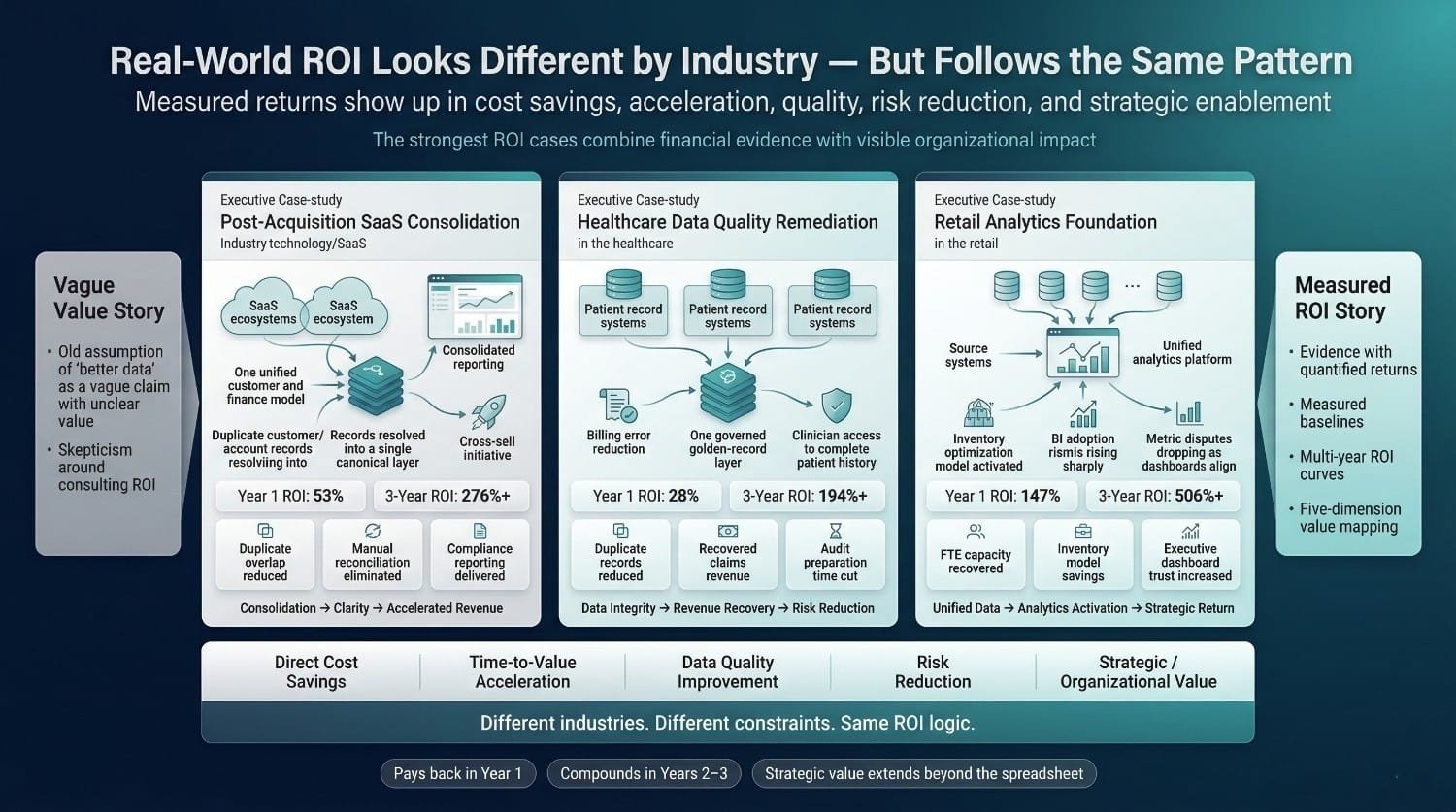
Real-World Scenarios
The framework is built. The formulas are defined. Now let’s see how it plays out in practice.
These three scenarios illustrate how organizations across different industries measured the ROI of data integration consulting, using the five-dimension framework, with real baselines, real costs, and real outcomes. The details are illustrative, but the patternsand measurement approaches reflect common outcomes observed in comparable engagements.
Scenario A: Post-Acquisition Data Consolidation
The Situation
A mid-sized B2B SaaS company ($80M ARR, 400 employees) acquired a smaller competitor ($25M ARR, 150 employees). Post-close, the combined organization had two of everything, two CRMs, two billing platforms, two product databases, and two customer success tools. Finance was manually reconciling revenue across both systems. Sales couldn’t see a unified pipeline. Customer success had no way to identify overlapping accounts.
Six months post-close, the CFO flagged a regulatory risk: consolidated financial reporting was required by the next audit cycle, and no plan existed to deliver it.
The Investment
Consulting engagement: $400,000 over 6 months, discovery, canonical data model, entity resolution, governance framework, iPaaS selection and implementation guidance, testing, and knowledge transfer.
Internal team time: $85,000 (950 hours across engineering, finance, and customer success)
New tooling (iPaaS + data quality monitoring): $65,000 Year 1
Total Year 1 investment: $550,000
Measured Outcomes by Dimension
Dimension 1, Direct Cost Savings:
- Redundant tooling eliminated (duplicate CRM, overlapping analytics platform, legacy middleware): $200,000/year
- Manual reconciliation work eliminated (finance team): $72,000/year (1,200 hours at $60/hour)
- Infrastructure consolidation (two data warehouses merged to one): $48,000/year
Dimension 2, Time-to-Value Acceleration:
- Unified customer view delivered in month 5, estimated 4 months faster than an internal-only attempt
- Cross-sell initiative launched on unified data in month 7, generating a 12% increase in cross-sell revenue: $312,000 in Year 1
Dimension 3, Data Quality Improvement:
- Duplicate customer records across both systems: reduced from 42% overlap to under 3%
- Billing errors caused by mismatched account data: reduced 78%, recovering an estimated $85,000/year in previously disputed invoices
Dimension 4, Risk Reduction:
- Consolidated financial reporting delivered before the audit deadline
- The compliance team estimated potential penalty exposure of up to $500,000, which was mitigated through remediation before the audit cycle.
- Probability-weighted avoided cost (compliance team estimated 25% probability of violation without consulting): $125,000
Dimension 5, Strategic and Organizational Value:
- Stakeholder trust score: improved from 1.9 to 4.1 (out of 5.0)
- Sales team fully adopted the unified pipeline view within 60 days of launch
- Customer success team reduced account research time by 65%
- Cultural integration between the two companies accelerated, shared data became a unifying force rather than a source of friction
ROI Calculation
Year 1 quantified benefits: $200K + $72K + $48K + $312K + $85K + $125K = $842,000
Year 1 ROI: ($842K − $550K) ÷ $550K = 53%
3-Year cumulative benefits (conservative): $842K + $720K + $750K = $2.31M
3-Year ROI: ($2.31M − $615K total cost including ongoing tooling) ÷ $615K = 276%
When the time-to-value acceleration of the cross-sell initiative is projected across three full years, the cumulative ROI exceeds 400%.
Scenario B: Data Quality Remediation for a Healthcare Provider
The Situation
A regional healthcare network (3,000 employees, 500,000+ patients) operated three separate EHR systems inherited from previous expansions. Patient records were fragmented, the same patient often existed as separate records in multiple systems with inconsistent demographics, medical histories, and insurance information.
The consequences were serious. Billing errors from mismatched patient data were costing hundreds of thousands annually in rejected and underpaid claims. Clinicians couldn’t see complete patient histories. And a recent audit had flagged data integrity concerns that needed remediation before the next review cycle.
The Investment
Consulting engagement: $250,000 over 4 months, patient data profiling, entity resolution design, golden record logic, governance framework, and compliance architecture.
Internal team time: $60,000 (700 hours across data engineering, clinical informatics, and compliance)
New tooling (MDM and quality monitoring): $45,000 Year 1
Total Year 1 investment: $355,000
Measured Outcomes by Dimension
Dimension 1, Direct Cost Savings:
- Billing team manual reconciliation reduced by 55%: $95,000/year in recovered staff time
- IT support tickets related to patient data discrepancies reduced 70%: $28,000/year
Dimension 2, Time-to-Value Acceleration:
- Patient record lookup time for front-desk staff reduced from average 4.5 minutes to 45 seconds per encounter
- Clinical staff access to complete patient history: immediate vs. previously requiring cross-system manual search averaging 12 minutes
Dimension 3, Data Quality Improvement:
- Duplicate patient records: reduced from 38% to under 4%
- Billing errors attributable to bad data: reduced 60%
- Recovered revenue from corrected claims and reduced denials: $300,000/year
- Patient demographic completeness: improved from 71% to 97%
Dimension 4, Risk Reduction:
- Audit preparation time reduced by 70%, from 450 hours to 135 hours per cycle: $29,925/year
- Previous audit findings related to data integrity: fully remediated before next cycle
- Patient safety risk from fragmented records: significantly reduced (not financially quantified but documented as critical clinical outcome)
Dimension 5, Strategic and Organizational Value:
- Clinical staff satisfaction with data systems: improved from 2.3 to 4.0 (out of 5.0)
- Foundation in place for future EHR consolidation, reducing what would have been a 24-month project to an estimated 12 months
- Compliance team confidence in audit readiness: transformed from “significant concern” to “well-prepared”
ROI Calculation
Year 1 quantified benefits: $95K + $28K + $300K + $29.9K = $452,900
Year 1 ROI: ($452.9K − $355K) ÷ $355K = 28%
Modest in Year 1, but the recovered claims revenue alone makes the investment self-funding.
3-Year cumulative benefits (conservative): $452.9K + $423K + $435K = $1.31M
3-Year ROI: ($1.31M − $445K total cost including ongoing tooling) ÷ $445K = 194%
When the accelerated EHR consolidation savings are included (estimated $400K–$600K in reduced project scope), the 3-year ROI exceeds 350%.
And the patient safety improvement, while not included in the financial calculation, was cited by the CMO as the single most important outcome.
Scenario C: Analytics Foundation for a Retail Chain
The Situation
A national retailer ($800M revenue, 50+ stores, e-commerce platform) had 20+ data sources and no unified analytics capability. Marketing, finance, and operations each maintained their own reporting processes, pulling from different systems, using different definitions, producing different numbers.
The data team (6 people) spent 70% of their time on data preparation and firefighting. Strategic analytics was effectively impossible. An inventory optimization initiative had been stalled for 8 months because the data wasn’t ready. Leadership had lost confidence in data-driven decision-making.
The Investment
Consulting engagement: $500,000 over 9 months, full assessment, architecture design, canonical data model, governance framework, data quality remediation, iPaaS and warehouse implementation guidance, testing, and knowledge transfer.
Internal team time: $135,000 (1,500 hours across data engineering, analytics, and business stakeholders)
New tooling (iPaaS, data quality platform, BI platform upgrade): $120,000 Year 1
Total Year 1 investment: $755,000
Measured Outcomes by Dimension
Dimension 1, Direct Cost Savings:
- Data team capacity freed by 40%, redirected from data prep to high-value analytics: equivalent of 2.4 FTEs recovered at $130K fully loaded = $312,000/year in redirected capacity
- Retired 3 redundant reporting tools and 2 legacy data stores: $87,000/year
- Reduced cloud infrastructure waste through architecture optimization: $65,000/year
Dimension 2, Time-to-Value Acceleration:
- Inventory optimization model launched 6 months ahead of the revised internal timeline
- Model contributed $1.2M in cost savings in its first year through improved stock allocation, reduced overstock, and fewer stockouts
- Time-to-report for standard business reviews: from 3 weeks of manual assembly to 2 days of automated generation
Dimension 3, Data Quality Improvement:
- Customer record deduplication: 28% duplicates reduced to under 2%
- Product data standardization across e-commerce and POS: 94% consistency (up from 61%)
- Metric disputes between departments: from 8–10 per quarter to fewer than 1
Dimension 4, Risk Reduction:
- Complete audit trail for revenue reporting, previously nonexistent
- Data lineage from source to executive dashboard, fully documented
- Reduced risk of material financial misstatement: estimated $200K in avoided audit remediation costs
Dimension 5, Strategic and Organizational Value:
- Stakeholder data trust score: from 1.8 to 4.2 (out of 5.0)
- BI platform daily active users: increased 220%
- Executive team now references dashboards in 90% of strategic decisions (up from under 15%)
- Two additional analytics initiatives (customer lifetime value model and demand forecasting) launched in Year 1, both building on the integration foundation
- Zero attrition in data team over 12 months post-engagement (vs. 2 departures in the 12 months prior)
ROI Calculation
Year 1 quantified benefits: $312K + $87K + $65K + $1.2M + $200K = $1.864M
Year 1 ROI: ($1.864M − $755K) ÷ $755K = 147%
3-Year cumulative benefits (conservative, assuming inventory model continues, two new analytics initiatives contribute an additional $400K/year starting Year 2): $1.864M + $2.064M + $2.1M = $6.028M
3-Year ROI: ($6.028M − $995K total cost including ongoing tooling) ÷ $995K = 506%
The CFO described the integration engagement as one of the highest returning infrastructure investments in the company’s recent history. The data team, previously seen as a cost center, was reclassified as a strategic function reporting to the COO.
What All Three Scenarios Demonstrate
ROI is measurable. Every scenario produced concrete, defensible financial returns, not vague claims about “better data.”
Year 1 returns cover the investment. In every case, the engagement paid for itself within the first year, even using conservative estimates.
The real returns compound in Years 2 and 3. The foundation built by data integration consulting enables initiatives that weren’t even planned during the original engagement. That compounding effect is what drives 3-year ROI into the 300–500%+ range.
Strategic value matters even when it’s not in the calculation. Patient safety. Cultural transformation. Talent retention. Executive confidence. These outcomes don’t appear in the financial ROI, but they’re often what leadership remembers most.
The five-dimension framework captures the full picture. No single dimension tells the story. Together, they make a case that’s comprehensive, credible, and compelling.
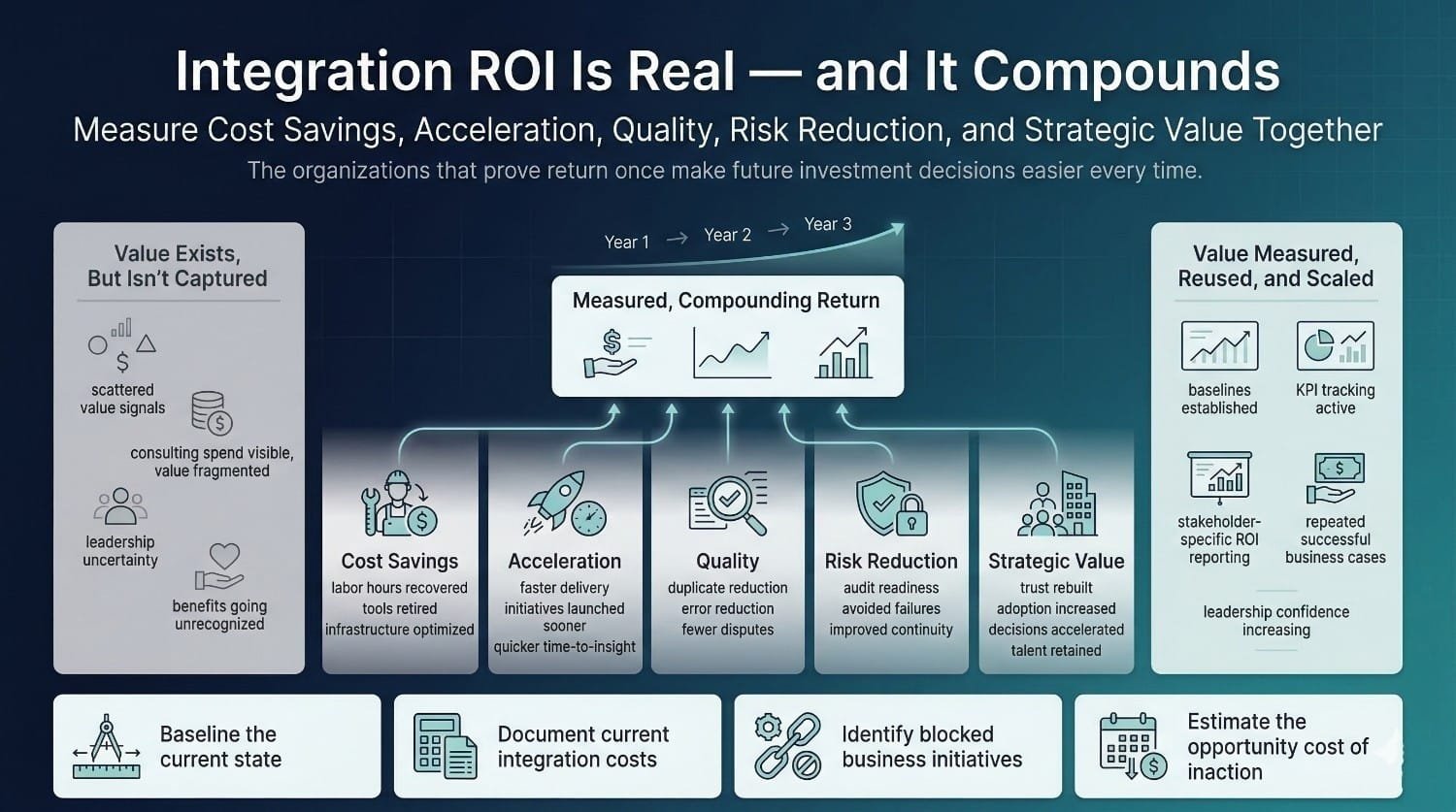
Final Thoughts
Data integration consulting ROI is not mysterious, unmeasurable, or purely theoretical. It’s concrete, multi-dimensional, and, when measured properly, consistently demonstrates that integration consulting is one of the highest-returning investments in the data portfolio.
The problem was never that the value wasn’t there. The problem was that most organizations didn’t have a framework for capturing it.
Now you do.
The Framework, One Last Time
A single metric can’t capture integration ROI. Five dimensions can.
Dimension 1, Direct Cost Savings. The hours recovered, the tools retired, the infrastructure optimized, the rework eliminated. The numbers the CFO sees first and remembers longest.
Dimension 2, Time-to-Value Acceleration. The months saved. The initiatives unblocked. The revenue and cost savings that started flowing sooner because the data foundation was built right the first time instead of rebuilt three times.
Dimension 3, Data Quality Improvement. The duplicates resolved. The errors eliminated. The disputes that stopped happening. The downstream improvements in every system and decision that depends on trustworthy data.
Dimension 4, Risk Reduction and Compliance. The audit that passed cleanly. The penalty that wasn’t levied. The migration that didn’t fail. The value of things that didn’t go wrong, often the largest component, and the most systematically overlooked.
Dimension 5, Strategic and Organizational Value. The trust rebuilt. The adoption achieved. The decisions accelerated. The talent retained. The culture shifted from “I don’t trust the data” to “let me check the dashboard.” The hardest to quantify and often the most consequential.
Together, these five dimensions tell the complete story, not just what the engagement cost and saved, but what it enabled, prevented, and transformed.
The Key Enablers
The framework only works if four conditions are met:
Define success upfront. Measurable business outcomes, not vague aspirations. If you can’t articulate what “done” looks like in specific, trackable terms before the engagement starts, you’ll never prove it was achieved afterward.
Baseline everything. The “before” picture is the foundation of every ROI calculation. No baseline, no credible measurement. Two weeks of focused baselining before the engagement begins is the single highest-ROI investment in the entire measurement process.
Measure across the right time horizon. Year 1 captures the quick wins. Years 2 and 3 capture the compounding value. A 3-month evaluation window will always understate the return. A 3-year window reveals the true picture.
Communicate in the language each stakeholder understands. The CFO gets the financial case. The CTO gets the architectural transformation. Business leaders get their department’s specific improvements. The board gets the strategic summary. Same ROI, different lens, every audience convinced.
The Compounding Effect
Organizations that measure integration ROI rigorously don’t just justify one engagement. They build a compounding advantage:
- Each measured engagement strengthens the business case for the next one
- Leadership trust in data investment grows with every documented return
- Future projections become more accurate as historical data accumulates
- The organization shifts from reactive, justification-heavy data spending to proactive, evidence-based data investment
This is the difference between organizations that struggle to fund every data initiative and those where leadership actively asks “what should we invest in next?”, because the track record speaks for itself.
The Final Truth
Data integration consulting is not a cost. It’s an investment with measurable, compounding returns, when done right and when measured properly.
The scenarios in this post showed Year 1 returns of 28% to 147% and 3-year cumulative returns exceeding 350–500%. These aren’t exceptional outcomes. They’re typical of well-executed, properly measured data integration consulting engagements.
The only organizations that don’t see these returns are the ones that don’t measure them, and therefore can’t prove what they already know to be true.
Don’t be that organization.
What to Do Next
Start Building Your ROI Measurement Practice Today
You don’t need to wait for the next consulting engagement to begin measuring. Start now:
- Baseline your current state, time spent on manual data work, quality scores, pipeline reliability, stakeholder trust
- Document your existing integration costs, tooling, infrastructure, team time on maintenance
- Identify the business initiatives that are blocked or slowed by data integration gaps
- Estimate the value of those initiatives, even roughly, to understand the opportunity cost of inaction
These four steps take a week or less and give you the foundation for a compelling business case, whether you’re justifying a new engagement, evaluating a current one, or building the case for ongoing investment.
Explore the Full Series
This post is part of an ongoing series on building smarter data integration strategies. Previous posts provide deeper context on the topics referenced throughout this framework:
- The Difference Between Data Movement and Data Integration, the foundational distinction that shapes every integration decision
- Why Data Integration Projects Fail Even When Connectors Work, the hidden failure modes that proper consulting prevents
- When Do You Actually Need Data Integration Consulting?, the inflection points that signal it’s time for outside expertise
- Data Integration Consulting vs iPaaS Tools, understanding what each solves and how they work together
Subscribe to get the next post delivered directly.
Reach Out
If you’re evaluating a data integration consulting investment and want help estimating the potential ROI, or if you’ve completed an engagement and need help measuring what it delivered, start the conversation. A scoped ROI assessment can give you the numbers you need to make the case with confidence.
The value is there. The framework to measure it is here. The only remaining question is whether you’ll capture it, or let it go unrecognized.
Frequently Asked Questions (FAQs)
Yes. The challenge isn’t that integration ROI is unmeasurable, it’s that most organizations look for it in the wrong places using the wrong metrics. A single financial calculation will always understate the return because integration value spans multiple dimensions: direct cost savings, time-to-value acceleration, data quality improvement, risk reduction, and strategic organizational value. When you measure across all five dimensions with proper baselines, the ROI is measurable across multiple dimensions and can be compelling, with documented cases showing 30 to 50 percent in Year 1 and materially higher cumulative returns over multiple years depending on scope and baseline conditions.
It varies by scope and complexity, but well executed engagements with proper measurement have been shown to deliver Year 1 ROI in the range of 25 to 150 percent and multi year cumulative ROI in the 200 to 500 percent range, depending on starting conditions and industry context. The wide range reflects differences in starting conditions. Organizations with severe data quality problems, significant manual workarounds, or high compliance exposure tend to see higher returns because the baseline is worse, meaning more value to recover. Organizations with moderate challenges see meaningful but more modest returns in Year 1, with compounding value in Years 2 and 3 as the foundation enables new initiatives.
Four specific challenges make it harder than, say, measuring the ROI of a marketing campaign. First, the attribution problem, integration improves the foundation, but the visible results show up in other teams’ initiatives (faster analytics, better AI models, smoother operations). Second, the time horizon problem, some benefits appear immediately while others take 12–36 months to fully materialize. Third, the counterfactual problem, how do you measure the cost of a migration failure that didn’t happen or a compliance penalty that was avoided? Fourth, the intangible value problem, data trust, decision speed, and organizational alignment are real and significant but resist clean dollar amounts. These challenges are manageable with a structured measurement framework. They just require a framework designed to account for them.
Direct cost savings, reduced manual work, eliminated redundant tools, lower infrastructure costs, less rework, avoided hiring. The most tangible and easiest to communicate.
Time-to-value acceleration, faster project delivery, reduced time-to-insight, faster source onboarding, dependent initiatives unblocked sooner. Often the highest single-value component.
Data quality improvement, fewer duplicates, lower error rates, better completeness, fewer cross-departmental data disputes. Directly connected to data trust.
Risk reduction and compliance, faster audit preparation, fewer findings, avoided penalties, reduced breach risk, improved business continuity. The hardest to measure but often the largest prevented cost.
Strategic and organizational value, increased data trust and adoption, faster decision-making, cross-functional alignment, internal capability uplift, scalability, and talent retention. The longest to materialize and the most consequential long-term.
Establish a baseline. Every credible ROI measurement depends on having a documented “before” picture that you can compare against the “after.” Without baselines, every improvement claim is anecdotal. With baselines, it’s evidence. This means measuring your current state, time spent on manual data tasks, pipeline failure rates, duplicate record percentages, report generation times, stakeholder trust scores, before the consulting engagement begins. It takes 1–2 weeks and is the single highest-value step in the entire measurement process.
ROI measurement isn’t a one-time event. It follows a rhythm. Baseline everything before the engagement starts. Track leading indicators during the engagement to confirm the project is on track. Measure direct outcomes at 30–90 days post-engagement, time saved, errors reduced, pipelines automated. Capture downstream business impacts at 6–12 months, analytics results, reporting improvements, compliance outcomes. Assess compounding strategic value at 12–36 months, scalability, new capabilities enabled, organizational data maturity. Each window captures different types of value. Skipping any of them leaves the picture incomplete.
Use probability-weighted cost avoidance. Estimate the cost of the negative outcome that was prevented, then multiply by the difference in probability with and without consulting. For example, if a failed migration would have cost $600K and the probability of failure without consulting was 40% vs. 5% with consulting, the avoided cost is $600K × 35% = $210K. These estimates should come from industry benchmarks (Gartner, IBM, Forrester publish failure rates and breach costs), your own historical data, and expert judgment from your compliance, security, and engineering teams. Always present avoided costs separately from directly measured savings so leadership can evaluate them on their own terms.
When a data integration consulting engagement includes iPaaS selection and implementation, be explicit about which benefits came from which investment. The tool provides ongoing operational value, connectivity, automation, monitoring, managed infrastructure. Consulting provided the strategy, architecture, data model, governance framework, and organizational alignment that made the tool effective. Operational efficiency gains from automated pipelines are tool value. The fact that those pipelines move the right data, in the right structure, with the right quality, governed by the right rules, that’s consulting value. Allocate benefits to the appropriate source and present them clearly.
That’s normal and expected for strategic integration investments. Year 1 captures the immediate wins, manual work reduction, tool consolidation, initial quality improvement. But the consulting costs are fully incurred in Year 1 while the benefits compound over Years 2 and 3. The analytics initiatives enabled by the integration deliver full-year impact in Year 2. The architecture supports growth without rework. AI/ML models trained on clean data produce measurable results. Governance prevents quality degradation that would have required re-investment. A 25 to 30 percent Year 1 ROI that grows materially over three years can represent a strong investment relative to many infrastructure initiatives. Set expectations upfront that the full picture emerges over a multi-year horizon.
Different stakeholders need different presentations of the same data. For the CFO, lead with hard financial returns, cost savings, payback period, 3-year cumulative return, cost of inaction comparison. For the CTO, emphasize architectural improvements, reduced technical debt, pipeline reliability, and team capability uplift. For the CDO or VP of Data, focus on quality metrics, time-to-insight, BI adoption, and analytics enablement. For business unit leaders, translate everything into their specific outcomes, faster reports, better customer insights, recovered team capacity. For the board, provide a one-paragraph summary with total investment, total return, and strategic capabilities gained. Same ROI, different lens, each audience addressed in the language they think in.
A specific individual, not a team. When ROI measurement is everyone’s responsibility, it becomes nobody’s responsibility and doesn’t happen. Assign one person, typically a data product manager, analytics lead, or program manager, to own the entire measurement process. They’re responsible for capturing baselines, running scheduled measurements, maintaining the benefits register, and producing ROI reports at each milestone. This ownership should be documented in their objectives and reviewed as part of their performance evaluation. The investment in assigning clear ownership is modest compared to the risk of lacking credible ROI data when leadership requests it.
Every measured engagement strengthens the next business case. After two or three engagements with documented ROI, you have a track record, not just projections. You can say “Our previous engagement projected 37% Year 1 ROI and delivered 42%. Based on similar scope and complexity, the next engagement is projected to deliver comparable returns.” That’s a fundamentally different conversation than asking leadership to trust projections with no historical evidence. Build a reusable business case template that includes evidence from past engagements, projected ROI calibrated against past accuracy, and a measurement plan that demonstrates accountability before the first dollar is spent.
Yes, though the depth of measurement should scale with the investment. A $50K scoped assessment doesn’t need a 20-metric, 3-year measurement program. But it does need a clear objective, a baseline for the metrics it aims to improve, and a post-engagement check on whether those metrics moved. Even a lightweight measurement, “We invested $50K in an assessment that identified $180K in annual waste and produced a roadmap that prevented us from purchasing a $200K tool we didn’t need”, is valuable. It builds the evidence base, demonstrates accountability, and makes the next investment easier to justify.
This post is part of an ongoing series on data integration strategy. Previous posts include “The Difference Between Data Movement and Data Integration” covering the foundational concepts, “Why Data Integration Projects Fail Even When Connectors Work” exploring hidden failure modes beyond connectivity, “When Do You Actually Need Data Integration Consulting?” providing a framework for recognizing critical inflection points, and “Data Integration Consulting vs iPaaS Tools” examining how tools and consulting complement each other. Subscribe to get the next post in the series delivered directly.