
Table of Contents
Introduction
When CTOs decide to bring in cloud data migration consultants, there is often an unspoken expectation:
“We’ll bring in experts, and the risk will go down.”
It sounds reasonable. Consultants have done this before. They bring patterns, tooling, and hard-earned lessons. Surely their involvement reduces uncertainty.
And yet, many cloud data migration efforts still struggle or fail even after consultants are hired.
Not because the consultants were incompetent.
Not because the tools were wrong.
Not because the architecture was flawed.
The failure often comes from something more subtle—and more predictable.
Why Most Consulting Failures Aren’t About Incompetence
In postmortems, consulting partners are sometimes blamed indirectly:
- “They didn’t understand our business.”
- “They over-engineered things.”
- “They delivered what we asked for, but not what we needed.”
In reality, many consultants do exactly what they are engaged to do. They follow the scope,execute the plan and deliver artifacts as contracted.
The problem is not execution quality.
It is an expectation mismatch.
CTOs sometimes assume consultants will:
- Resolve ambiguity that hasn’t been owned internally —or surface it and propose options.”
- Make hard business decisions on their behalf (rather than facilitating decision-making and documenting trade-offs).
- Absorb political risk tied to metrics and definitions (instead of enabling alignment on definitions and escalation paths).
- Deliver trust, not just infrastructure (even though trust ultimately requires internal ownership and adoption).
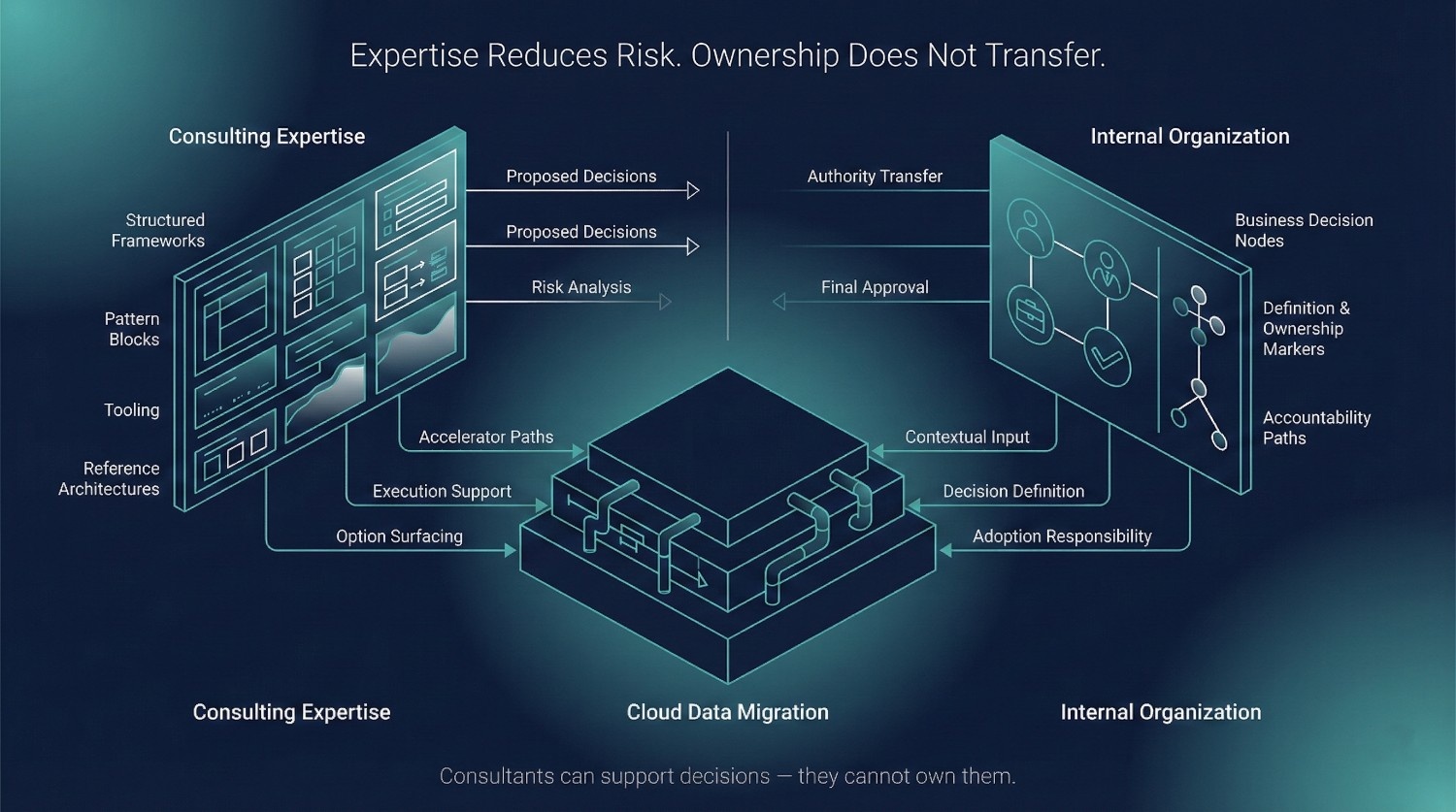
Consultants cannot legitimately replace internal ownership of decisions, incentives, and definitions—but they can facilitate alignment, surface risk, and provide decision frameworks.
The Real Problem
Cloud data migration is as much a leadership and operating-model problem as it is a technical one — which is why CTOs must rethink how they approach migration risk.
When consultants are brought in without clear boundaries:
- Ownership becomes fuzzy
- Decision rights are implied, not explicit
- Accountability drifts between internal teams and external partners
CTOs may believe risk has been “handed off” than is realistically transferable.
Consultants believe they are “supporting execution.”
In that gap, migrations often stall.
Decisions get deferred.
Ambiguity can get encoded into pipelines (schemas, transformations, and metric logic).
Trust issues surface without an owner to resolve them.
By the time problems are visible, everyone may be technically doing their job locally—while accountability for end-to-end outcomes remains unclear.
What This Article Will Cover
This article is not about whether consultants are good or bad in general. It is about how CTOs misframe their role—and why that misframing quietly undermines migrations.
Specifically, we’ll explore:
- What CTOs assume consultants will do
And which of those assumptions are structurally unrealistic or non-transferable. - Why those assumptions break migrations
Even when the consultants are skilled and experienced. - How to hire consultants without outsourcing accountability
So external expertise reduces execution risk without increasing organizational risk.
Hiring cloud data migration consultants can be a powerful accelerator when used appropriately.
But only when CTOs are clear about what can be delegated—and what cannot.
Mistake #1: Treating Consultants as a Silver Bullet
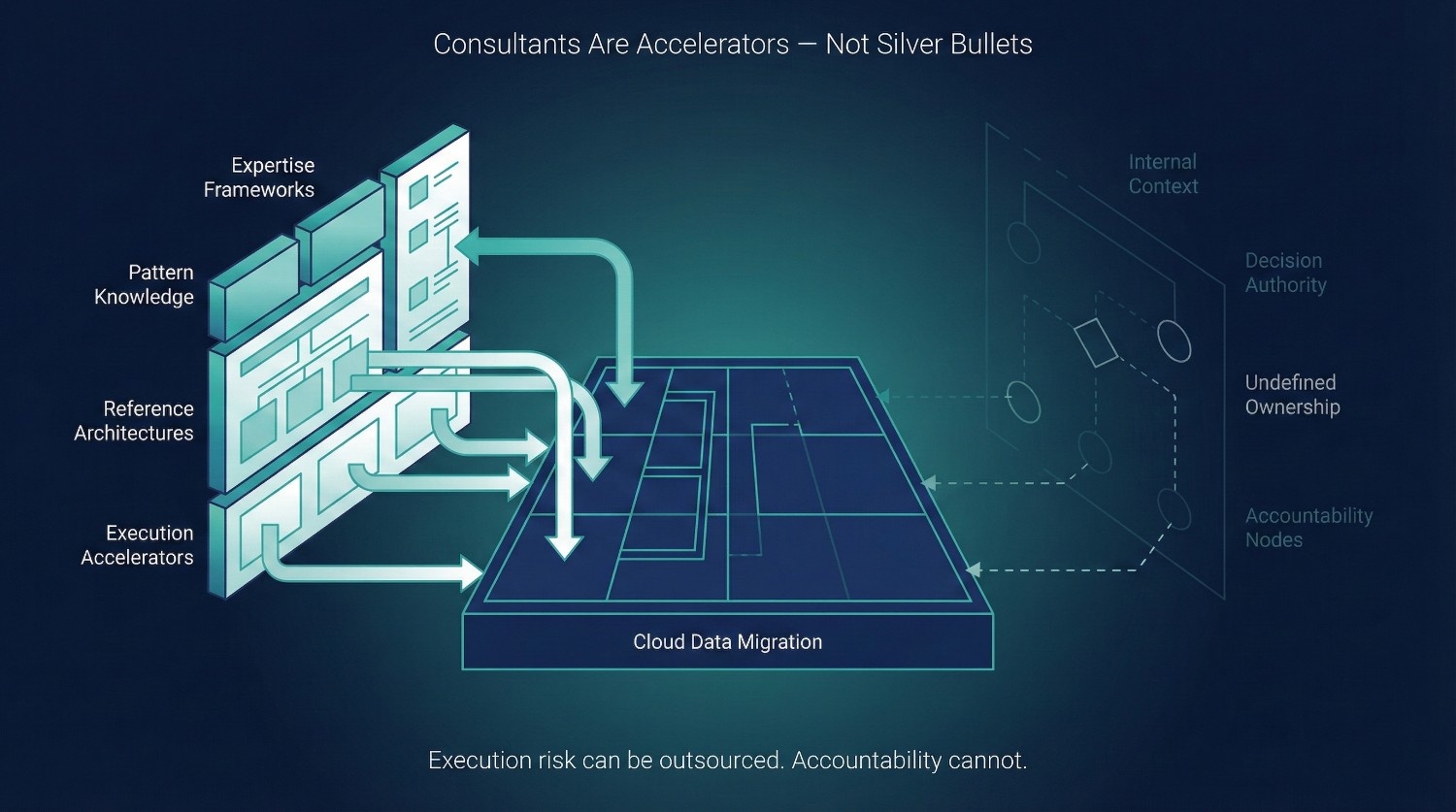
One of the most common—and most damaging—mistakes CTOs make is assuming that hiring experienced cloud data migration consultants automatically and materially reduces overall migration risk.
The logic sounds convincing:
- They’ve done this many times before.
- They know the pitfalls.
- They have proven frameworks.
What gets overlooked is a critical distinction.
Pattern expertise is not the same as organizational or contextual understanding.
Enterprise migration frameworks consistently emphasize that external partners reduce execution risk, not decision or adoption risk. Oracle, Microsoft, and AWS migration playbooks all stress that governance, ownership, and change management must remain internal responsibilities—partners accelerate delivery, but they do not replace accountability.
“They’ve Done This Before” ≠ “They Know Your Business”
Consultants bring experience with:
- Common migration failure modes
- Proven architectural patterns
- Tooling choices that scale
- Validation and cutover strategies
What they do not bring by default is:
- Deep knowledge of your revenue model
- Historical quirks in your data
- Political sensitivities around metrics
- The unwritten rules teams rely on
Cloud data migration is rarely just about moving data. Large-scale enterprise vendors increasingly frame migrations as semantic transformations, not infrastructure moves. Snowflake and Databricks both emphasize that trust collapses not when pipelines fail, but when definitions change without alignment—even if the data is technically correct.
When CTOs assume prior experience substitutes for business context, consultants are set up to make technically sound decisions that create organizational friction.
Pattern Expertise vs. Contextual Understanding
Pattern expertise answers questions like:
- How should we structure pipelines?
- Where should validation live?
- How do we design for scale and reliability?
Contextual understanding answers different questions:
- Which numbers are politically sensitive?
- Which definitions cannot change without fallout?
- Which teams must agree before anything ships?
- What historical assumptions are embedded in “how things work”?
Consultants are typically strong at the first set.
Only the organization can legitimately and sustainably own the second.
When this distinction is blurred, migrations drift into dangerous territory.
Why Migrations Fail When Consultants Are Expected to Do the Impossible
Problems arise when consultants are implicitly expected to own or resolve responsibilities that cannot be outsourced.
Resolving Political Decisions
Consultants cannot legitimately decide unilaterally:
- Which revenue number is “official”
- Which definition wins when teams disagree
- Which historical data should be reinterpreted
These decisions affect incentives, performance, and credibility. They require internal authority.
When consultants are asked to “just pick one,” the organization may accept the result temporarily—but trust fractures later.
Owning Metric Definitions
Consultants can document definitions.
They can propose cleaner models.
They can highlight inconsistencies.
They cannot own the consequences of those definitions.
If a metric change affects targets, compensation, or executive reporting, the decision must come from leadership—not an external partner.
When consultants appear to “own” definitions, accountability quietly evaporates.
Mediating Internal Conflicts
Consultants are often placed in the role of informal neutral arbiter:
- Between finance and sales
- Between product and operations
- Between legacy and modern teams
But consultants have no real enforcement power. They can facilitate discussion, not resolve it.
When CTOs expect consultants to mediate unresolved internal conflict, those conflicts simply get postponed—and encoded into architecture instead.
Consultants are accelerators, not substitutes for leadership, authority, or ownership..
They reduce execution risk when leadership owns decisions and context — the operating model outlined throughout a CTO’s guide to data migration consulting.
They increase organizational risk when they are treated as a silver bullet for ambiguity, politics, or accountability.
Mistake #2: Hiring for Tools Instead of Outcomes
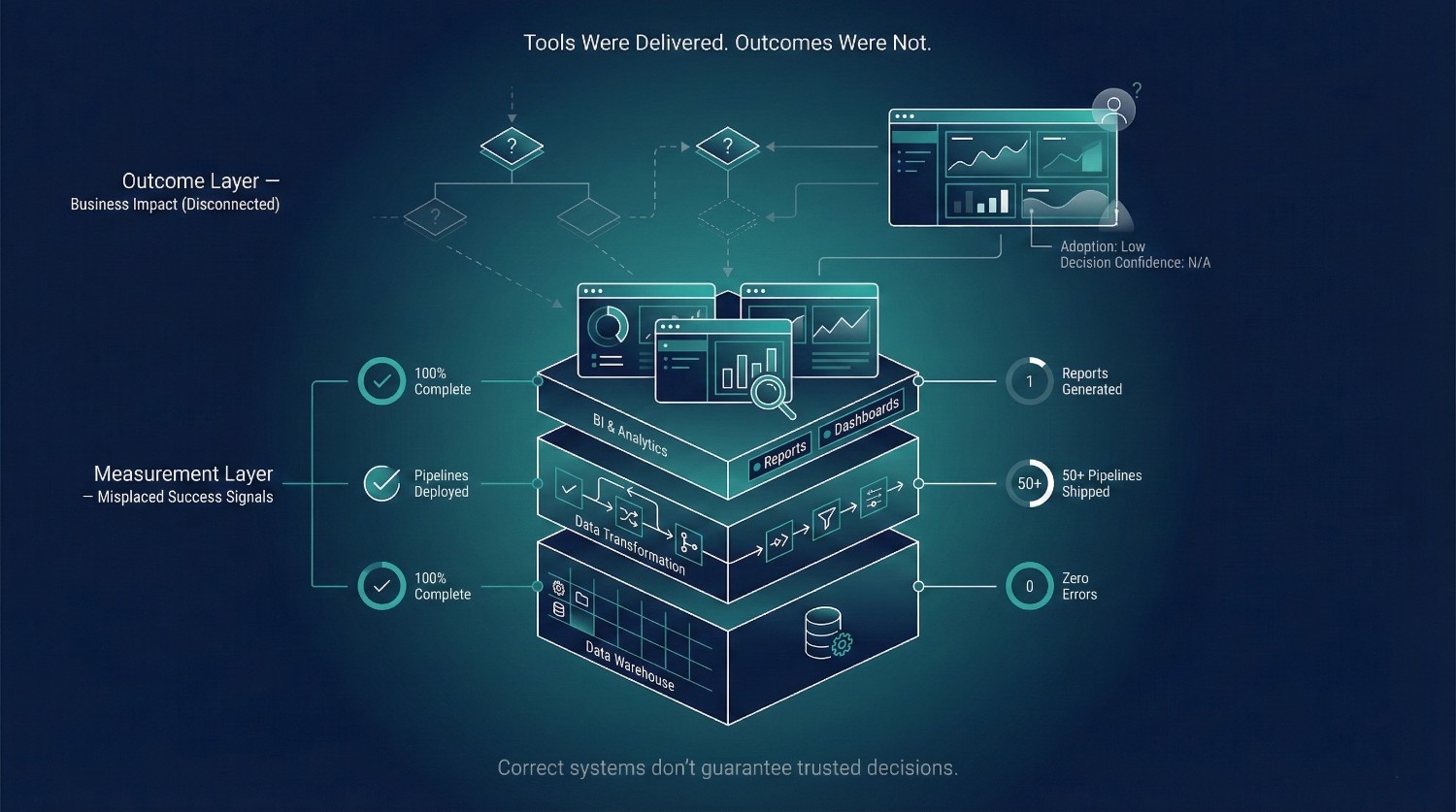
Another common failure pattern appears early in the hiring process—often before a consultant is even selected.CTOs often optimize for tool expertise, not migration outcomes.
Resume-Driven Hiring
Consulting shortlists are frequently built around resumes that emphasize tools:
- Snowflake experts with deep warehouse tuning experience
- dbt specialists who can model quickly and cleanly
- BigQuery veterans who understand cost and performance trade-offs
None of this is bad on its own.
It is also not sufficient.
Tool mastery answers the question “Can they build this?”
Migration success depends on “Will this actually be used and trusted?”
Those are very different capabilities.
Tool Mastery vs. Migration Success
Strong tool specialists are excellent at:
- Designing pipelines
- Writing transformations
- Optimizing performance
- Implementing best practices
Cloud data migration often struggles or fails when these skills are applied in isolation from business outcomes.
Multiple industry postmortems show that analytics platforms fail to deliver value not because of performance or scale limits, but because business teams do not adopt or trust the outputs. Tool proficiency is necessary—but insufficient—without outcome ownership and adoption planning.
Migration success requires additional competencies:
- Understanding which data changes are politically sensitive
- Knowing when technical “correctness” harms adoption
- Sequencing delivery to build confidence, not just completeness
- Framing progress in business terms, not technical milestones
A consultant can be world-class in Snowflake or dbt and still participate in a migration that business teams quietly abandon.
Why Migrations Collapse Under Tool-First Hiring
When hiring prioritizes tools over outcomes, success is measured incorrectly.
Common warning signs include:
- Progress measured in pipelines shipped
Dozens of tables are migrated, but no one agrees which ones matter. - Validation framed as a technical checklist
Numbers match “within tolerance,” yet business teams don’t trust them. - Dashboards exist, but decisions don’t change
Adoption is assumed instead of verified. - Migration declared complete while shadow analytics grows
Spreadsheets and side reports multiply instead of disappearing.
In these scenarios, the consultants did exactly what they were hired for:
- They built the system
- They followed best practices
- They delivered on scope
What failed was the shared definition of success.
The Core Misalignment
Hiring for tools assumes:
- If the platform is correct, the business will follow
Successful migration requires:
- If the business doesn’t trust it, correctness is irrelevant
When consultants are evaluated on technical output rather than business outcomes—usage, confidence, and decision impact—the migration optimizes for the wrong finish line.
Tools matter.
But cloud data migration is not a tooling project.
CTOs who hire for outcomes—trust, adoption, clarity, and decision support—use tools as means, not goals. Those who hire primarily for resumes often end up with a technically impressive platform that the business quietly works around.
Mistake #3: Delegating Decision Authority Without Real Power
One of the most damaging dynamics in consultant-led cloud data migration is subtle and rarely intentional:
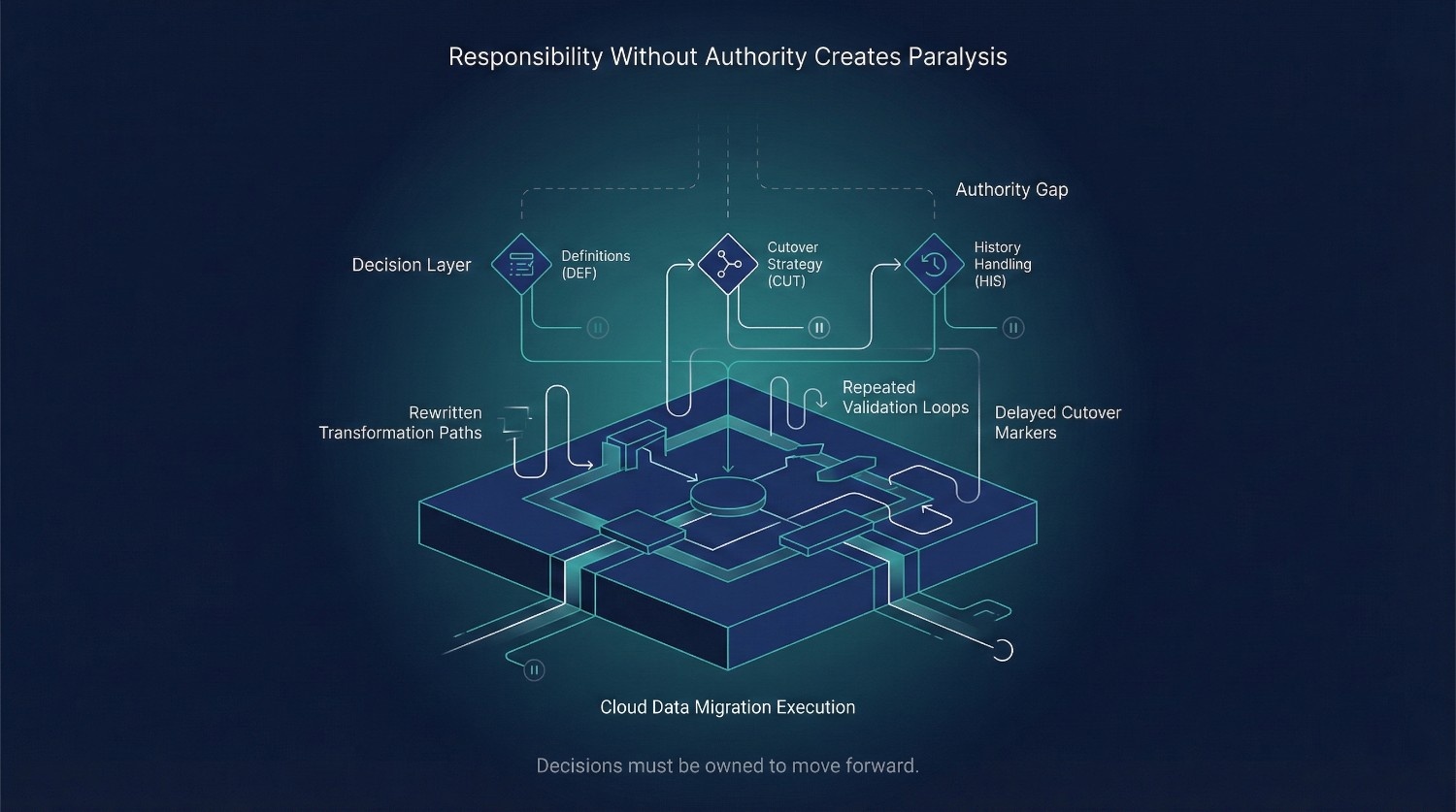
Consultants are asked to “decide” operationally without being given real authority.
On paper, this looks efficient.
In practice, it creates paralysis.
Consultants Asked to “Decide” Without Mandate
CTOs often delegate decisions implicitly:
- “You’ve seen this before—what’s the best approach?”
- “Can you standardize this for us?”
- “Just pick the cleanest option.”
What consultants hear is permission.
What the organization has actually given them is responsibility without power.
Consultants can recommend.
They can document trade-offs.
They can implement a choice.
They cannot absorb the consequences of that choice.
Decisions Consultants Cannot Make
Some decisions look technical but are fundamentally organizational. Consultants should never be expected to own or arbitrate them independently.
Examples include:
- Revenue definitions
Whether revenue is recognized, billed, booked, or collected—and when—affects forecasting, compensation, and board reporting. - Customer truth sources
Choosing which system is authoritative when CRM, billing, and product disagree reshapes ownership and accountability. - Historical correction rules
Deciding whether to “fix” past data or preserve historical inaccuracies changes how the organization interprets its own performance.
These are not design choices.
They are leadership decisions with political impact.
When consultants are forced to make them, the organization may temporarily move forward—but trust erodes later when stakeholders realize no one internally agreed to the outcome.
The Predictable Result
When decision authority is delegated without mandate, migrations fall into a familiar loop:
- Endless clarification cycles
Consultants ask for confirmation. Stakeholders disagree. No one is empowered to decide. - Rewritten logic
Transformations are adjusted repeatedly to accommodate unresolved objections. - Delayed cutovers
Leadership hesitates to commit because decisions feel provisional and reversible.
From the outside, it looks like slow execution.
In reality, it is decision avoidance encoded into process.
Consultants can execute decisions.
They cannot legitimize them.
CTOs who want migrations to move must do one of two things:
- Retain decision authority explicitly, or
- Assign it clearly to someone with real mandate
Anything in between guarantees delay.
Mistake #4: Expecting Consultants to Fix Messy Data
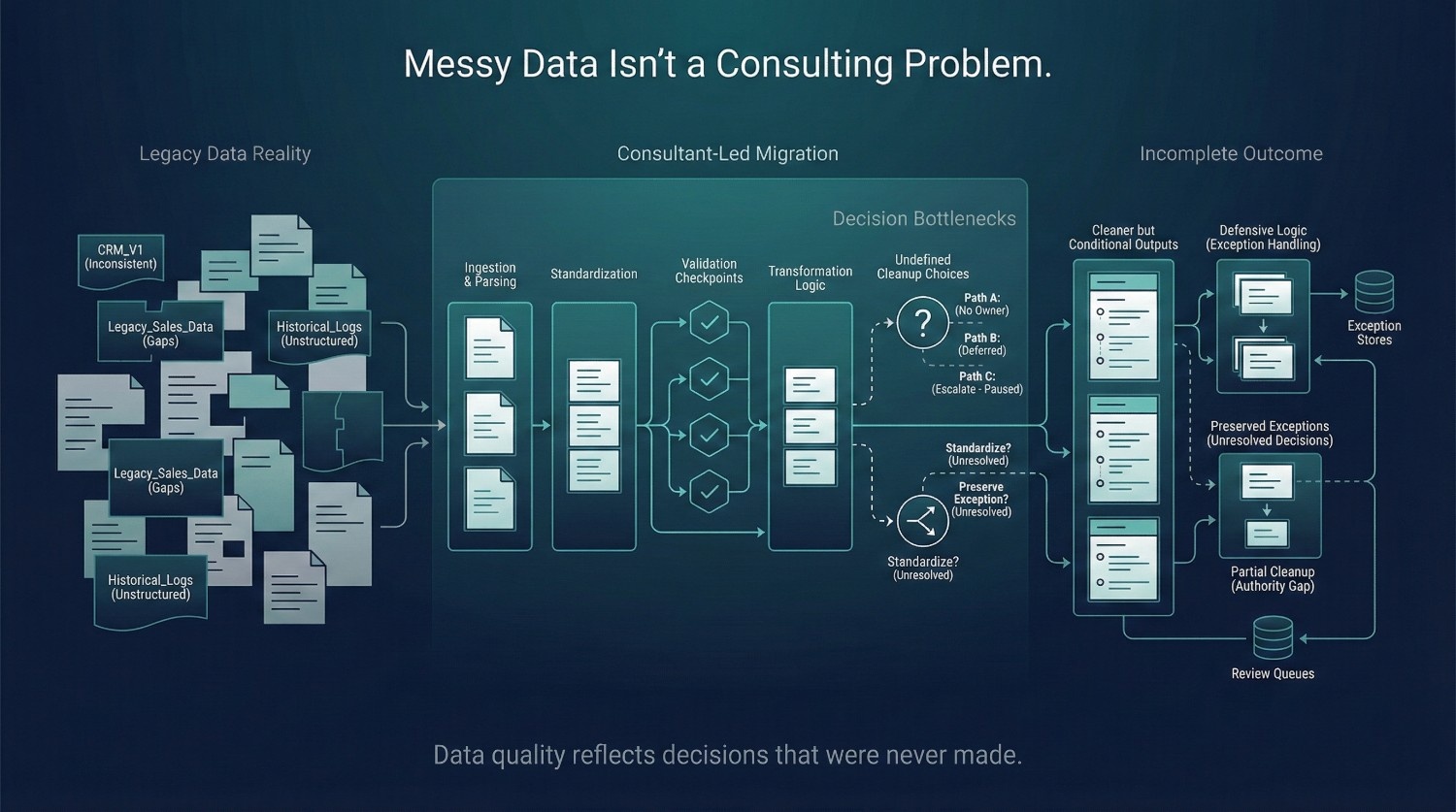
In mature organizations, data quality often reflects incentive structures: speed over correctness, local optimization over global consistency, and short-term delivery over long-term trust. Migration exposes these trade-offs—it does not create them.
There is a persistent fantasy in cloud data migration projects:
“Once the consultants come in, they’ll clean the data as part of the migration.”
This belief is understandable—and deeply flawed.
The Fantasy: “They’ll Clean It During Migration”
CTOs often assume that:
- Legacy inconsistencies will be corrected as tables are rebuilt
- Historical issues will be normalized automatically
- Edge cases will disappear once pipelines are modern
What actually happens is very different.
Consultants can clean what is defined.
They cannot clean what the organization has never agreed on.
Messy data is usually not a purely technical accident. It is the visible outcome of years of unresolved decisions.
Why Data Quality Reflects Organizational Behavior
Data becomes messy when:
- No one owns definitions long-term
- Exceptions are allowed without governance
- Speed is rewarded more than correctness
- “We’ll fix it later” becomes normal
These are behavioral patterns, not engineering gaps.
A consultant can refactor schemas, enforce constraints, and remove invalid records—but they cannot decide:
- Which nulls are acceptable
- Which historical values should change
- Which inconsistencies matter to the business
- Which edge cases must remain
Without those answers, “cleanup” becomes guesswork.
What Consultants Can Actually Do
Consultants are effective at:
- Surfacing data quality issues clearly
Making inconsistencies visible, measurable, and undeniable. - Explaining trade-offs
Showing what improves if data is cleaned—and what breaks if it is. - Proposing cleanup strategies
Phased fixes, guardrails, and forward-looking constraints.
What they cannot do is own the consequences of cleanup decisions.
What Happens When Cleanup Has No Owner
When no internal owner is assigned to data quality decisions, migrations degrade predictably:
- Cleanup is partial and inconsistent
- Logic becomes defensive and conditional
- Exceptions are encoded instead of resolved
- Trust erodes because numbers behave unpredictably
Eventually, consultants are blamed for “not fixing the data,” even though no one empowered them to decide what “fixed” actually means.
Messy data cannot be meaningfully outsourced away.
Cloud data migration exposes data quality problems—but solving them requires organizational ownership, not external labor.
Consultants can accelerate progress once decisions are made.
They cannot replace the decisions themselves.
Mistake #5: Underestimating Internal Resistance
One of the most predictable ways consultant-led migrations fail has nothing to do with technical delivery.It happens when CTOs underestimate how the business will react to outsiders changing the system they rely on.
Business Teams Often See Consultants as Outsiders
From the business perspective, consultants are not neutral helpers. They are:
- People who don’t carry the consequences of missed targets
- People who won’t be in the room when numbers are questioned
- People who leave after the project ends
Even when consultants are competent and well-intentioned, business teams often see them as temporary disruptors, not long-term partners.
This perception matters—because trust is relational, not contractual.
The Fear Beneath the Resistance
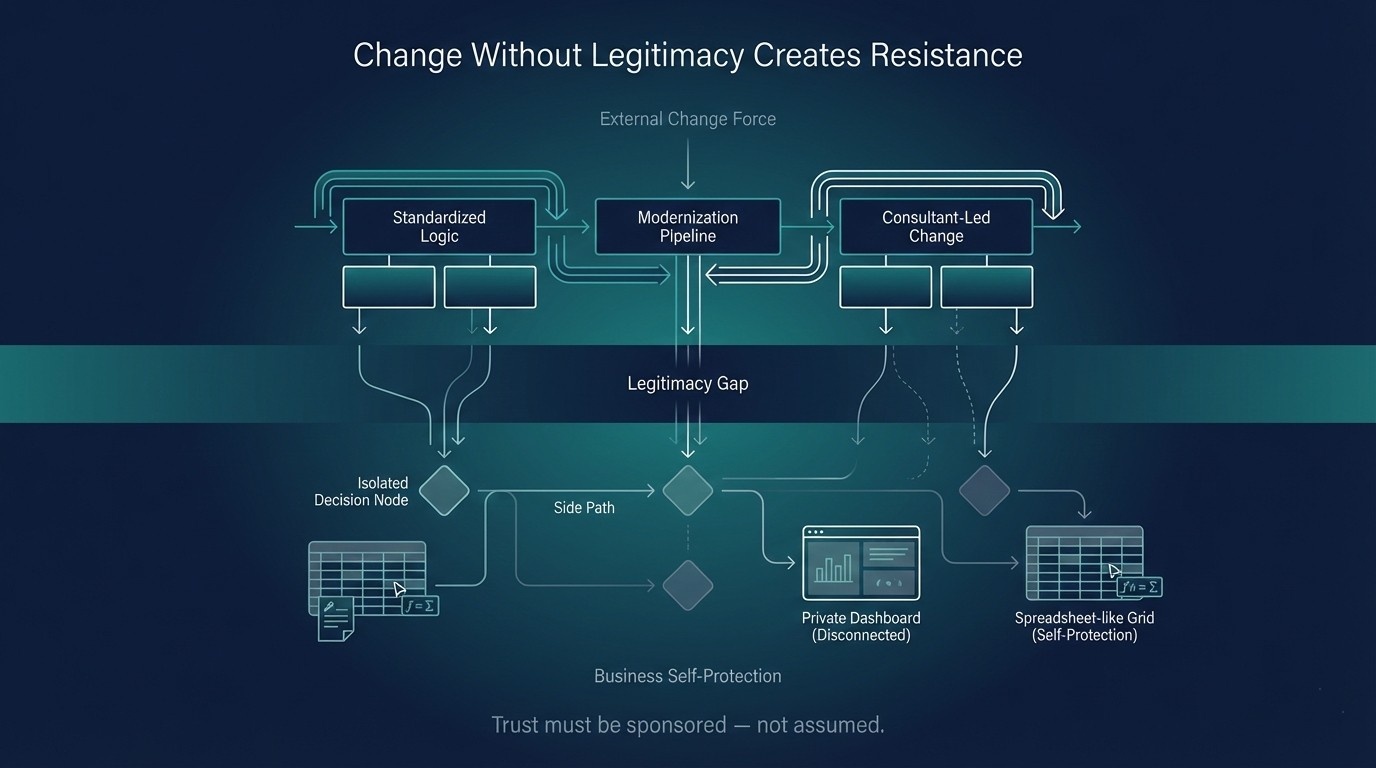
Resistance is rarely about technology. It is about loss.
Business teams fear losing:
- Control
Informal adjustments, manual overrides, and local fixes disappear under standardized systems. - Familiar numbers
Metrics that people learned to explain and defend are replaced by ones that behave differently. - Flexibility
Exceptions that used to be handled quietly now require process, justification, or escalation.
From the business side, this does not feel like modernization. It feels like a constraint imposed by people who won’t absorb the fallout.
Why Consultant-Led Change Fails Without Leadership Backing
Consultants cannot overcome this resistance without explicit leadership backing.
They lack:
- Organizational authority
- Political cover
- Credibility to say “this is the new way”
When leadership stays distant, several things happen quickly:
- Business teams disengage rather than confront
- Validation becomes performative, not collaborative
- Feedback is withheld instead of surfaced
- Adoption stalls quietly
Consultants can explain what changed.
Only leadership can legitimize why the change is happening—and why it is non-negotiable.
From a leadership perspective, resistance is a signal—not a defect. It often indicates that the migration is touching real power structures: forecasting, accountability, performance measurement, and narrative control. Consultants surface this tension; only leadership can resolve it.
Without visible leadership backing:
- Resistance hardens instead of softening
- Consultants become easy scapegoats
- The migration slows without anyone explicitly blocking it
Consultants can implement chang.They cannot authorize it or absorb its long-term consequences.
When CTOs underestimate internal resistance, they unintentionally set consultants up to fail—and business teams up to protect themselves.
Mistake #6: No Single Internal Owner for the Migration
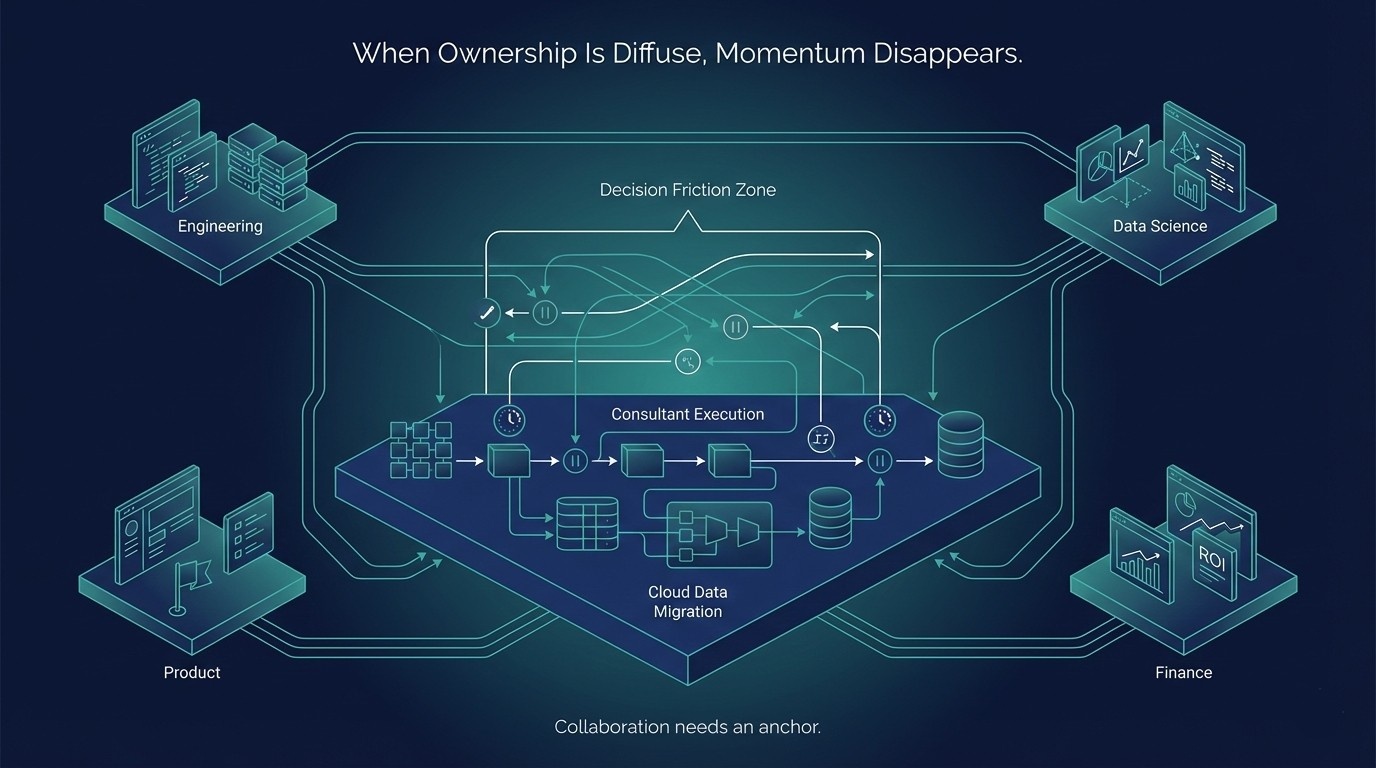
One of the most reliable ways to drain momentum from a consultant-led cloud data migration is failing to name one clearly accountable internal owner.
When ownership is diffuse, execution may continue—but direction disappears.
Consultants Reporting to Everyone (and No One)
Without a single owner, migrations often slow in predictable ways:
- Decisions get deferred because consensus is required
- Consultants wait for alignment that may never fully arrive
- Engineers often hedge by building flexibility instead of clarity
- Cutovers slip because no one wants to take responsibility
Progress becomes fragile. Every step forward risks reopening old debates.
What looks like “complex stakeholder management” is frequently just missing ownership.
How Diffuse Accountability Kills Momentum
Nulls, duplicates, and overrides are blocked or flagged.
Business impact:
- Edge cases stop appearing
- Exceptions require new processes
- Flexibility is replaced with friction
Each decision improves the technical system.
Each one also removes a coping mechanism the business relied on.These coping mechanisms were never ideal—but they were stabilizing. Removing them without replacement creates exposure before confidence is rebuilt.
Why CTOs Must Name One Accountable Owner
Successful migrations almost always have a clearly named internal owner who:
- Has authority to resolve cross-team conflicts
- Can prioritize migration work over competing initiatives
- Is accountable for outcomes, not just deliverables
- Serves as the single point of escalation for consultants
This role does not replace collaboration.
It anchors it.
With a clear owner:
- Consultants know who can decide
- Teams know where to escalate
- Validation leads to closure, not discussion
- Momentum compounds instead of stalling
Without one, even excellent consultants are often forced into a reactive role—executing tasks without the power to move the migration forward.
In mature organizations, this role often maps to a product owner or executive sponsor for data, with explicit mandate over scope trade-offs, cutover readiness, and acceptance criteria. Without this role, migrations default to consensus-driven governance—which scales discussion, not decisions..
Consultants can support execution.
They cannot substitute for ownership.
When CTOs fail to name a single accountable owner, cloud data migration becomes a coordination problem no one is empowered to solve.
Mistake #7: Treating Migration as a Project, Not a Program
Enterprise cloud vendors consistently frame data migration as a multi-phase operating transformation, not a delivery event. Oracle, Microsoft, and AWS migration frameworks all emphasize that success requires an explicit transition from “build” to “run,” including ownership, governance, and adoption models that persist long after initial delivery.
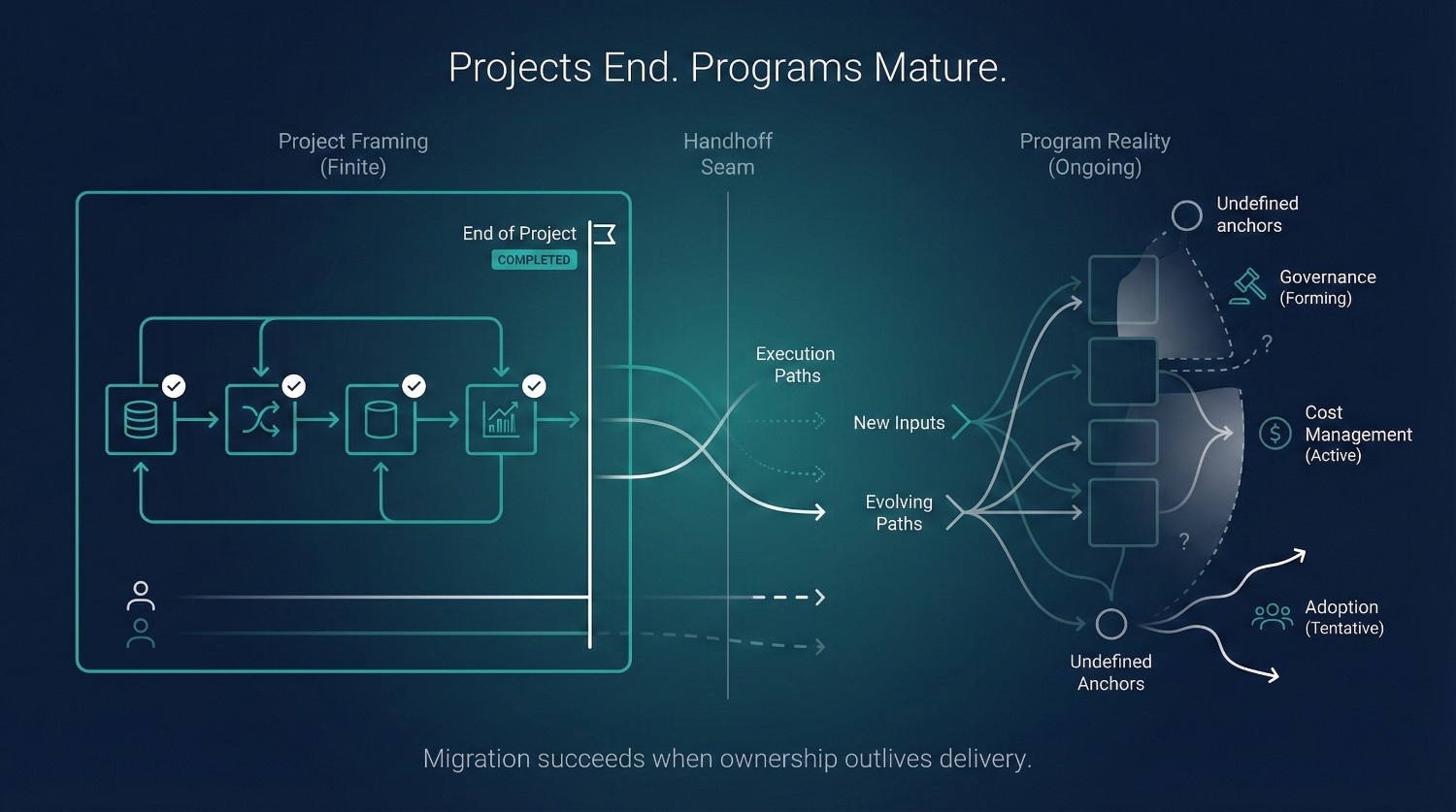
One of the most subtle—but costly—mistakes CTOs often make is framing cloud data migration as a finite project rather than an ongoing program.
Projects end.
Programs mature.
Confusing the two sets the organization up for disappointment the moment consultants roll off.
Fixed Timelines vs. Evolving Reality
Projects assume:
- Requirements can be fully defined upfront
- Scope can be locked
- Success can be declared on a date
Cloud data migration rarely behaves this way.
As data moves:
- Definitions surface that were never agreed on
- Usage patterns change
- New stakeholders appear
- Hidden dependencies emerge
A fixed timeline collides with an evolving understanding of the business. When dates matter more than readiness, teams optimize for completion—not usability.
The migration may “finish,” but the work is not done.
“Phase 1 Complete” Doesn’t Mean Usable
Many migrations celebrate milestones like:
- “All pipelines migrated”
- “Core tables landed”
- “Dashboards rebuilt”
These are engineering achievements. They are not, by themselves, business outcomes.
What often follows:
- Reports exist, but aren’t trusted
- Metrics are available, but not adopted
- Definitions are documented, but not internalized
- Decisions still rely on legacy numbers
From the business perspective, nothing feels finished.
Declaring phases complete before adoption creates a credibility gap:
“If this is done, why can’t we rely on it yet?”
That gap erodes confidence in both the platform and the leadership sponsoring it.
Consultants Leave, Complexity Remains
When migration is treated as a project, consultants are expected to:
- Build the system
- Hand it over
- Exit cleanly
But complexity does not exit with them.
What remains:
- Ongoing definition debates
- New data sources to integrate
- Cost and performance tuning
- Governance and ownership questions
- Adoption work that was deferred
If the organization has not transitioned from delivery mode to operating mode, the platform often stagnates—or regresses.
Teams are left maintaining a system they didn’t fully internalize.
Cloud data migration succeeds when it is treated as a program of change, not a box to check.
Projects deliver artifacts.
Programs build capability.
CTOs who understand this plan for:
- Ownership beyond consultants
- Governance that outlives delivery
- Adoption as ongoing work
- Trust as something that compounds over time
When migration is framed correctly, consultants accelerate progress instead of becoming a temporary bridge to nowhere.
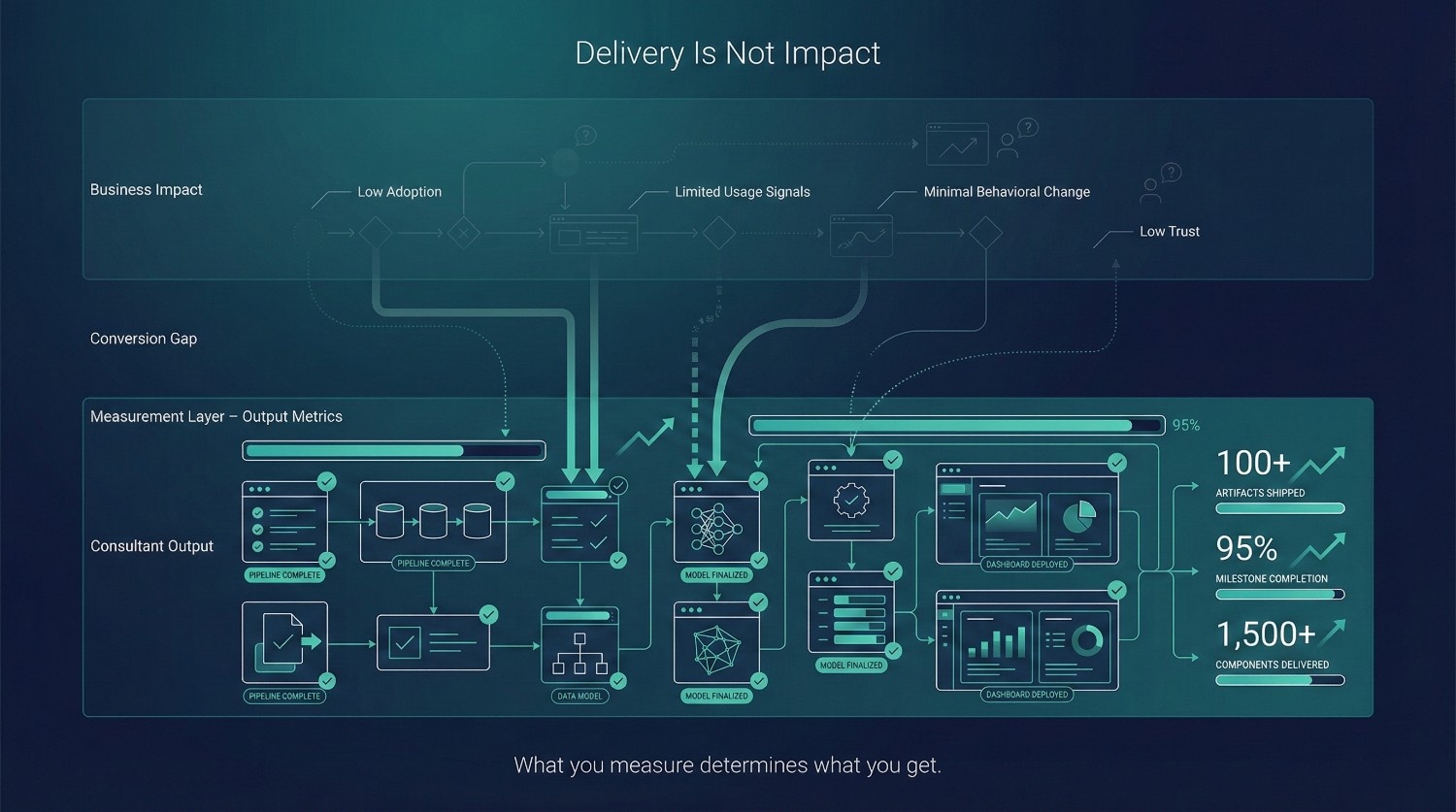
Mistake #8: Measuring Consultant Success by Output, Not Impact
One of the most frequent reasons CTOs feel disappointed after a consultant-led cloud data migration is that everything promised was delivered—and yet the business outcome is underwhelming.The disconnect lies in how success was measured.
Output Looks Like Progress
Consultants are often evaluated on tangible deliverables:
- Pipelines delivered on schedule
- Models built according to specification
- Dashboards shipped and accessible
These outputs are easy to track, easy to invoice for, and easy to declare “done.”
From a project management perspective, the engagement looks successful.
Impact Tells a Different Story
Impact is harder to measure—and often ignored.
Industry research on analytics initiatives repeatedly shows that technical completion does not correlate with business value. Platforms fail not when pipelines break, but when users quietly stop trusting or using them—often without raising explicit objections.
The real questions are uncomfortable:
- Are the numbers trusted?
Do business teams rely on them without cross-checking? - Are the dashboards used?
Or are they opened once and then replaced by spreadsheets? - Are decisions faster?
Are fewer meetings spent reconciling data, and more spent acting on it?
If the answer to these questions is unclear—or negative—the migration likely did not succeed in the ways that matter.
Why This Misalignment Happens
Consultants tend to deliver what they are measured on.
When success is defined as:
- Number of tables migrated
- Percentage of pipelines completed
- Dashboards matching legacy output
Consultants optimize for throughput, not adoption.
They move fast, ship broadly, and check boxes.
What they are not incentivized to do:
- Slow down to resolve trust issues
- Spend time aligning definitions with business teams
- Push back on premature completion
- Optimize for long-term usability over short-term delivery
That work feels “out of scope”—because it frequently is.
What CTOs Should Measure Instead
If consultants are involved in cloud data migration, success should be measured by business impact, not just technical output.
Examples include:
- Reduction in manual reconciliation work
- Percentage of teams using the new platform as their primary source
- Time saved in recurring reporting cycles
- Fewer disputes over metric definitions
- Executive confidence in numbers during reviews
These indicators matter because they change executive behavior. When leaders stop asking, “Do these numbers reconcile?” and start asking, “What should we do next?”, the migration has crossed from technical success into business value.
Consultants can build what is asked for contractually.
They cannot create impact unless impact is explicitly expected and measured.
CTOs who measure output get delivery.
CTOs who measure impact get transformation.
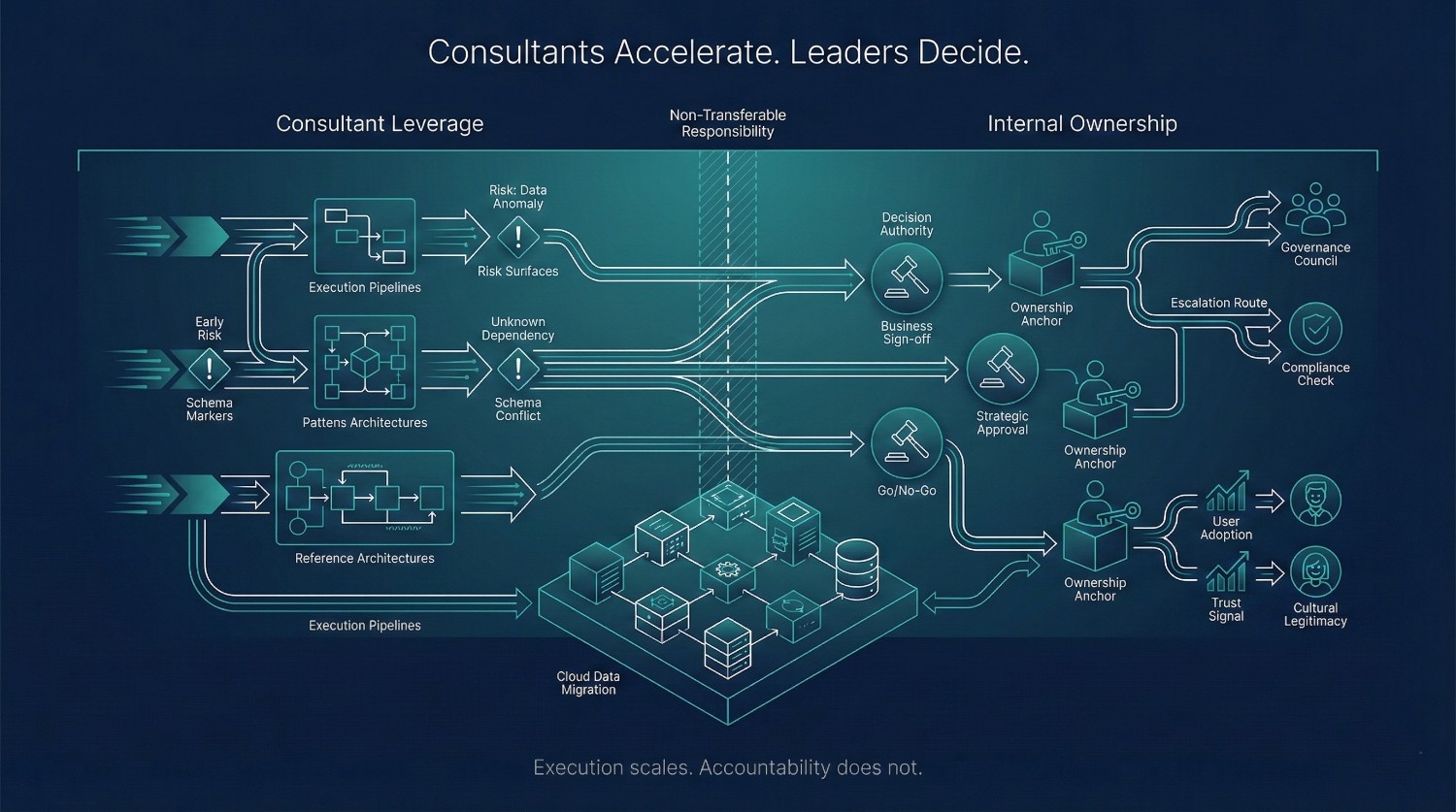
What Consultants Can (and Cannot) Do
Cloud data migration consultants are neither magic solutions nor disposable labor when used correctly. Their value is real—but bounded.
Migrations often struggle or fail when CTOs misunderstand where consultants add leverage and where leadership cannot be substituted.
What Consultants Do Well
When used correctly, consultants are powerful accelerators.
They excel at:
- Accelerating execution
They shorten delivery timelines by applying proven migration patterns, avoiding common implementation mistakes, and keeping work moving when internal teams are capacity-constrained. - Providing pattern recognition
Having seen many migrations, they recognize warning signs early—schema drift, validation overload, dual-run sprawl—and can flag them before they become systemic problems. - Reducing unknown unknowns
Consultants surface risks internal teams may not anticipate, especially around scale limits, cost behavior, tooling edge cases, and cutover sequencing. - Bringing external credibility
Their experience can validate internal recommendations and help leadership commit to decisions that might otherwise stall.
These strengths make consultants valuable execution partners, not owners of outcomes.
What Consultants Cannot Replace
There are responsibilities that cannot be outsourced—no matter how skilled the consultants are.
They cannot replace:
- Leadership decisions
Choices about metric definitions, trade-offs, cutover timing, and acceptable risk must be made by internal leadership with authority. - Cultural change
Trust, adoption, and behavior shifts require sustained internal leadership. Consultants can support change—but cannot legitimize it. - Accountability
Someone inside the organization must own success or failure. Consultants can deliver work, but they cannot carry responsibility once the engagement ends. - Business ownership
Only internal teams can own the meaning of data, the consequences of change, and the long-term stewardship of metrics.
When consultants are pushed into these roles, migrations slow, trust erodes, and responsibility becomes unclear.
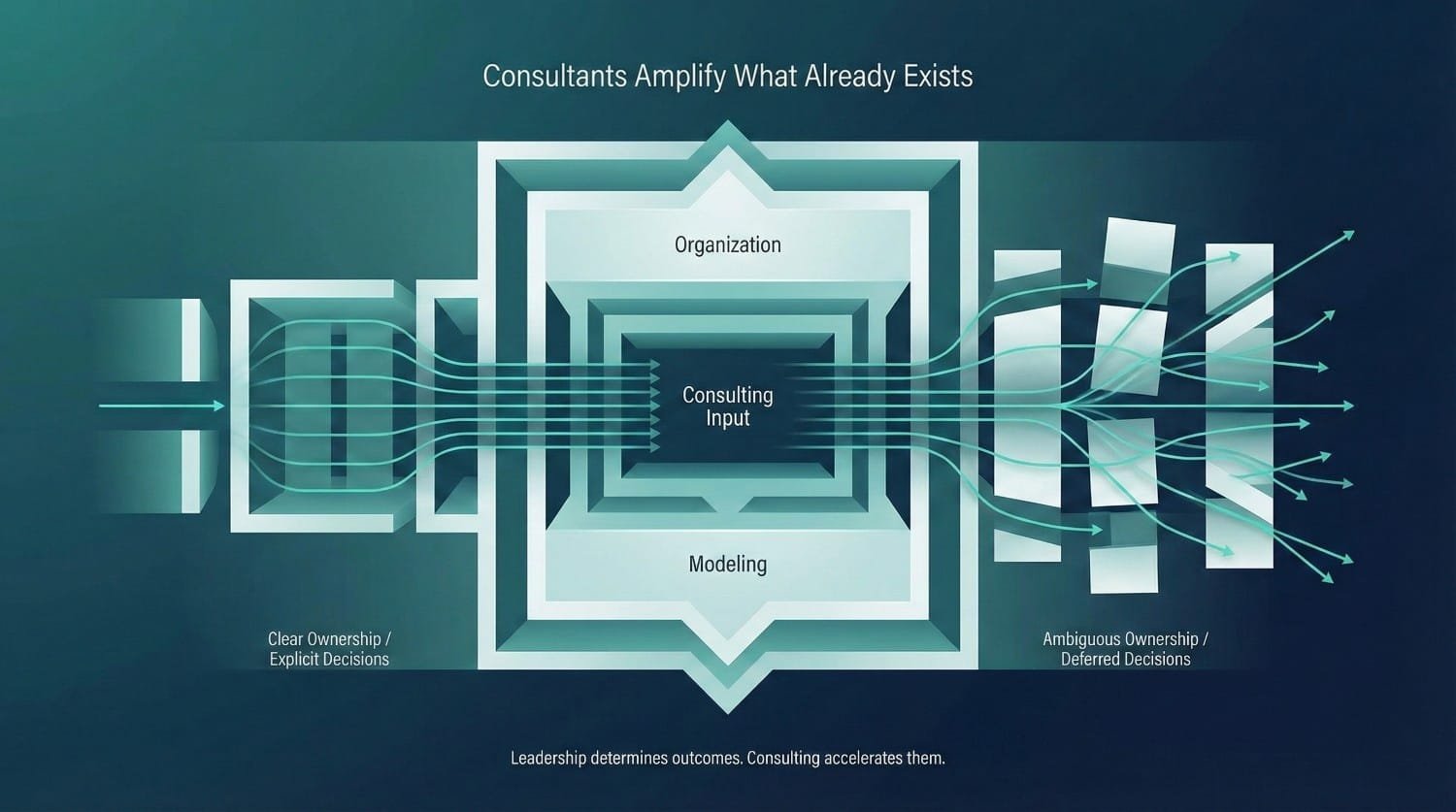
Consultants tend to amplify what already exists.
If leadership is clear, they accelerate progress.
If ownership is vague, they magnify confusion.
CTOs who understand this use consultants as force multipliers—not as substitutes for leadership, accountability, or business ownership.
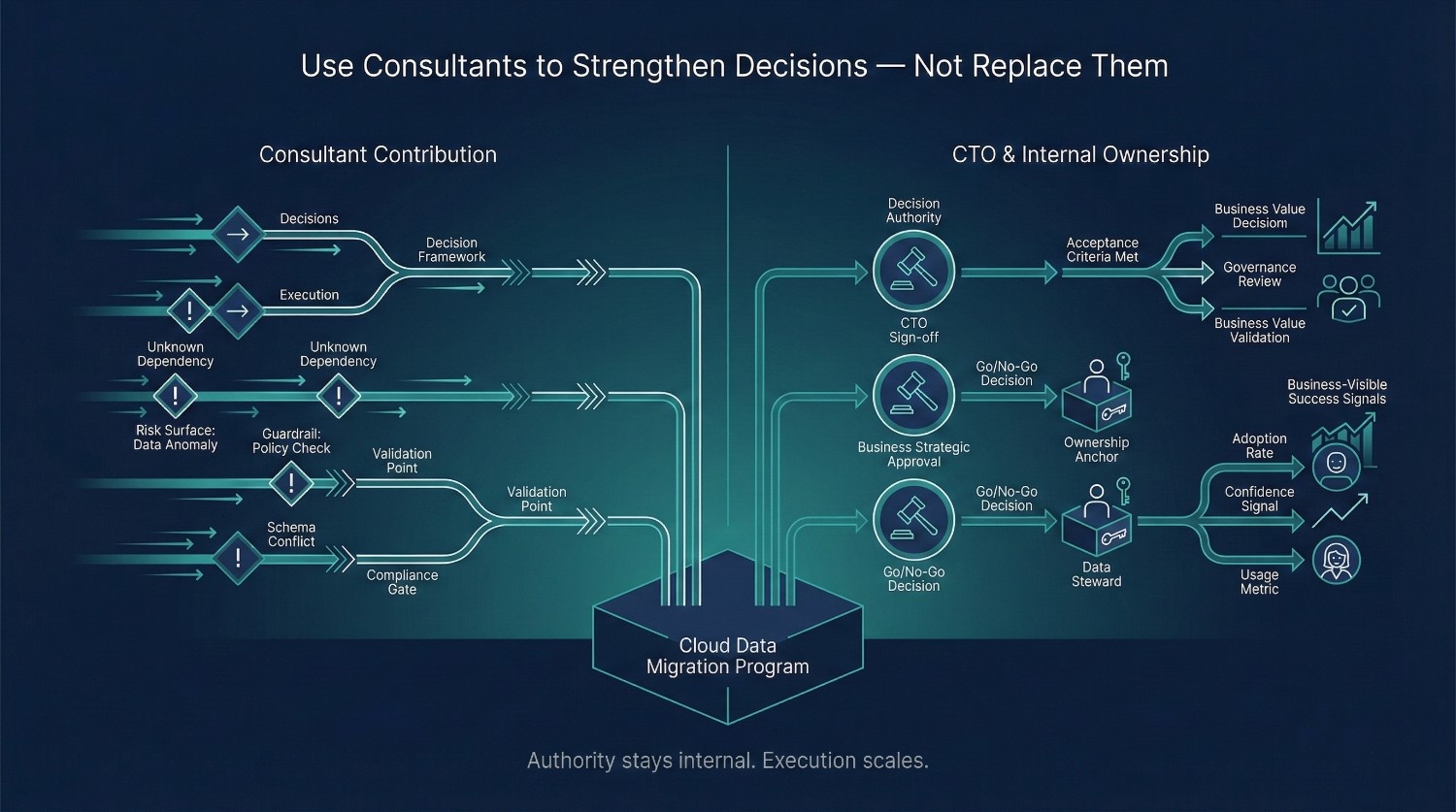
How CTOs Should Actually Use Migration Consultants
The most successful cloud data migrations don’t “hand off” responsibility to consultants. They partner with them deliberately.
CTOs who get value from consultants are explicit about what is being delegated—and what is not, a distinction at the heart of data migration consulting vs in-house execution.
Use Consultants to Strengthen the Migration
Consultants create the most leverage when they are used to:
- Structure decisions
Frame options clearly, document trade-offs, and surface where a decision is required—rather than quietly encoding assumptions into pipelines. - Expose risk early
Identify schema ambiguity, data quality issues, cost traps, and organizational bottlenecks before they become late-stage surprises. - Design migration guardrails
Define validation boundaries, dual-run exit criteria, rollback paths, and cutover checkpoints that make progress safe and intentional.
In this role, consultants don’t replace leadership judgment—they make it easier to exercise.
Keep Ownership Where It Belongs
To avoid the failure patterns described earlier, CTOs must retain ownership of what cannot be delegated.
Specifically:
- Keep ownership internal
One clearly named internal owner must be accountable for outcomes, not just delivery. - Keep decisions explicit
Metric definitions, sources of truth, and acceptance criteria should be decided openly and recorded—not implied through implementation. - Keep success metrics business-visible
Adoption, trust, decision speed, and incident reduction should matter as much as pipeline completion.
When these conditions are met, consultants become accelerators rather than shields.
Data migration consulting works best as a partnership, not a handoff.
Consultants bring structure, experience, and execution capacity.
CTOs bring authority, context, and accountability.
When those roles are clear, cloud data migration stops being a risky outsourcing exercise—and becomes a disciplined, collaborative transformation that actually delivers value.
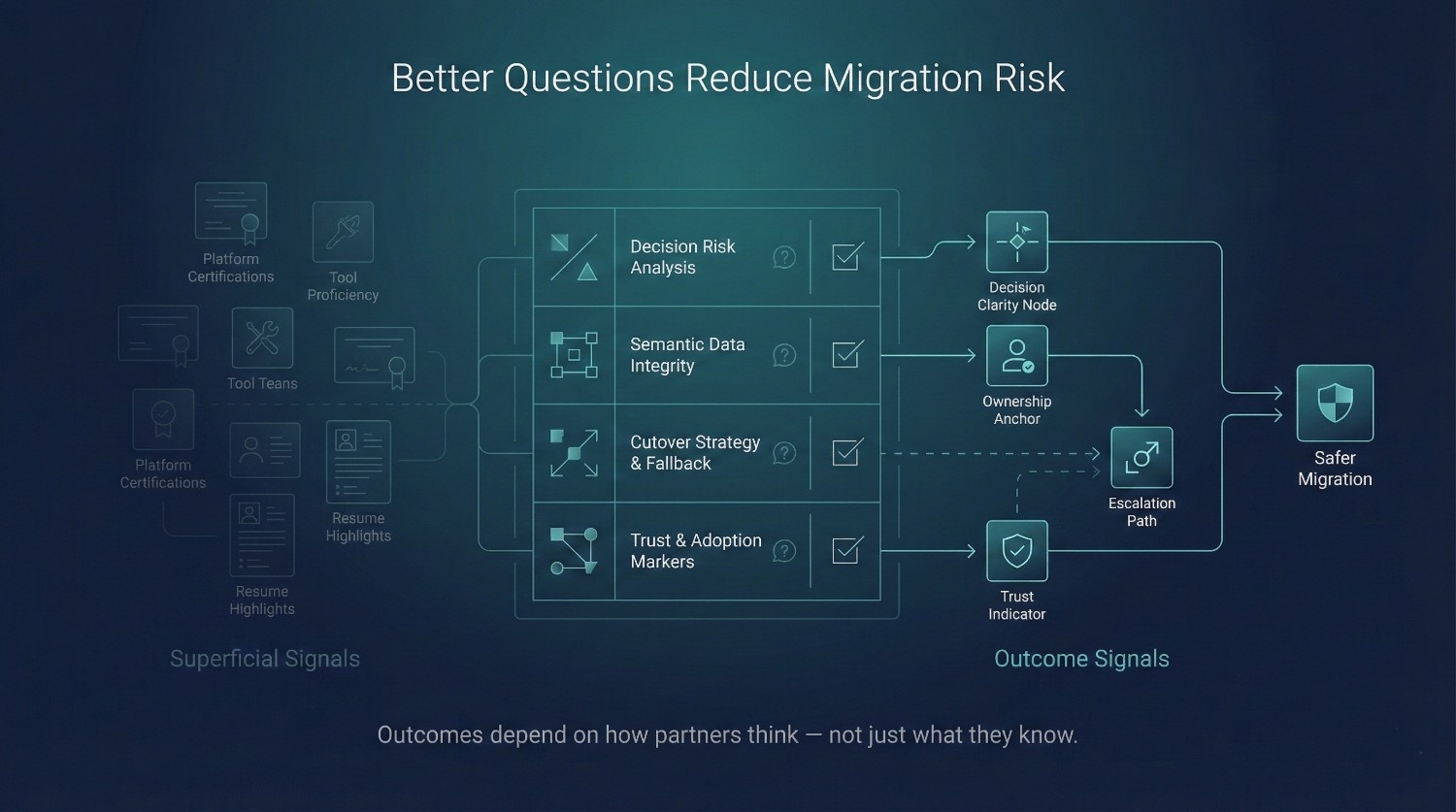
A Better Hiring Checklist for CTOs
The quality of a cloud data migration engagement is often determined before the first line of code is written—by the questions CTOs ask during hiring.
A strong checklist shifts the conversation away from tools and resumes and toward how consultants think, communicate, and manage risk.
Below are questions that reveal whether a consulting partner understands migration as an organizational problem—not just a technical one.
How Do You Surface Decision Risk?
What you’re listening for:
- How consultants identify decisions that cannot be deferred
- Whether they explicitly flag “this requires leadership input”
- How they prevent ambiguity from being encoded into pipelines
Strong answers describe:
- Decision logs
- Explicit escalation points
- Clear separation between recommendations and decisions
Weak answers focus on “best practices” without addressing ownership.
How Do You Handle Metric Ambiguity?
What you’re listening for:
- How they deal with conflicting definitions
- Whether they push for explicit alignment before building
- How they communicate trade-offs to business stakeholders
Strong answers explain:
- Freezing definitions early
- Versioning or renaming metrics when meaning changes
- Involving business owners in validation
Weak answers suggest they’ll “clean it up later” or “make it match legacy.”
How Do You Prevent Permanent Dual-Runs?
What you’re listening for:
- How they define exit criteria upfront
- Whether cutover is treated as a leadership decision
- How they time-box validation without eroding confidence
Strong answers mention:
- Predefined cutover windows
- Acceptance thresholds
- Explicit ownership of the go-live decision
Weak answers frame dual-runs as open-ended safety nets.
How Do You Measure Business Trust?
What you’re listening for:
- Whether they talk about adoption, not just correctness
- How they detect disengagement early
- Whether trust is treated as something observable
Strong answers reference:
- Usage patterns
- Reduction in manual reconciliation
- Fewer metric disputes
- Executive confidence in reporting
Weak answers equate trust with “numbers matching.”
A consultant who answers these questions well is not promising zero risk.
They are showing that they understand where risk actually lives—and how to manage it without hiding behind tools or process.
For CTOs, this checklist helps separate consultants who deliver artifacts from those who help deliver outcomes.
Final Thoughts
Cloud data migration consultants do not change the fundamental dynamics of an organization.
They amplify them.
Consultants Reflect the Organization They Work Within
Consultants adapt to the environment they are placed in. Consultants do not introduce dysfunction into migrations; they surface it faster. Strong operating models become visible sooner. Weak ones fail sooner. In that sense, consultants are not the cause of outcomes—they are accelerants.
In organizations with:
- Clear ownership
- Explicit decision-making
- Visible leadership support
Consultants move fast, surface issues early, and help deliver durable outcomes.
In organizations with:
- Ambiguous ownership
- Deferred decisions
- Avoidance of accountability
Consultants inadvertently magnify those weaknesses. Ambiguity becomes architecture. Delay becomes process. Risk becomes invisible until it is too late.
The same consultants can succeed or fail largely depending entirely on the leadership context.
Strong Leadership Produces Strong Outcomes
When CTOs:
- Own decisions instead of deferring them
- Define success in business terms
- Stay engaged beyond delivery milestones
Consultants become powerful force multipliers. They accelerate execution without absorbing responsibility that does not belong to them.
Migration feels disciplined rather than chaotic. Progress compounds instead of resetting.
Weak Ownership Amplifies Failure
When leadership treats consultants as risk shields:
- Decisions stall
- Trust erodes
- Accountability diffuses
- Outcomes disappoint
The failure is often attributed to consulting quality—but the root cause is misplaced ownership
The CTO’s Real Job
The CTO’s role in cloud data migration is not to avoid responsibility by outsourcing it.
It is to focus responsibility where it belongs.
When leadership is clear, consultants help migrations succeed.
When leadership is absent, consultants can unintentionally make the failure more efficient.
That distinction determines whether cloud data migration becomes a strategic win—or another expensive lesson.
Frequently Asked Questions (FAQ)
Not automatically. Consultants reduce execution risk, not decision risk. Risk only decreases when leadership retains ownership of decisions, definitions, and outcomes. Without that, consultants often amplify existing organizational issues.
Because most failures are not technical. They come from unclear ownership, unresolved metric definitions, internal resistance, and deferred leadership decisions—none of which consultants can legitimately own or fix on their own.
That hiring consultants transfers responsibility. It doesn’t. Consultants can advise, build, and warn—but accountability always remains internal. Treating consultants as a shield from difficult decisions is a common failure pattern.
No. Consultants can surface ambiguity, document trade-offs, and recommend options—but final decisions about revenue, customer truth, and historical corrections must be made by internal leadership with authority.
Only partially. Consultants can surface data quality issues and propose cleanup strategies, but messy data reflects long-standing organizational behavior. Without an internal owner to make decisions, cleanup becomes inconsistent and trust suffers.
Because consultants are seen as outsiders who don’t absorb the consequences of change. Without visible leadership backing, business teams protect themselves by disengaging, delaying adoption, or maintaining shadow analytics.
One clearly named internal owner with end-to-end accountability. When consultants report to multiple teams, decisions stall, priorities conflict, and momentum collapses.
Because projects end, but data platforms don’t. When consultants leave after “Phase 1,” unresolved definitions, adoption gaps, and governance issues remain. Migration must be treated as a program, not a delivery milestone.
Not by pipelines delivered or dashboards shipped. Success should be measured by:
- Business adoption
- Reduced reconciliation effort
- Faster decision-making
- Fewer metric disputes
- Increased executive confidence in data
Consultants should:
- Structure decisions
- Expose risk early
- Design guardrails
- Accelerate execution
They should not be expected to own leadership decisions, cultural change, or accountability.
Consultants amplify leadership—they don’t replace it. Strong leadership produces strong outcomes. Weak ownership produces amplified failure. The CTO’s job is not to outsource responsibility, but to focus it clearly and visibly.