

A CTO's Guide to Data Migration Consulting and When to Hire

Usman AshrafAug 5, 2026
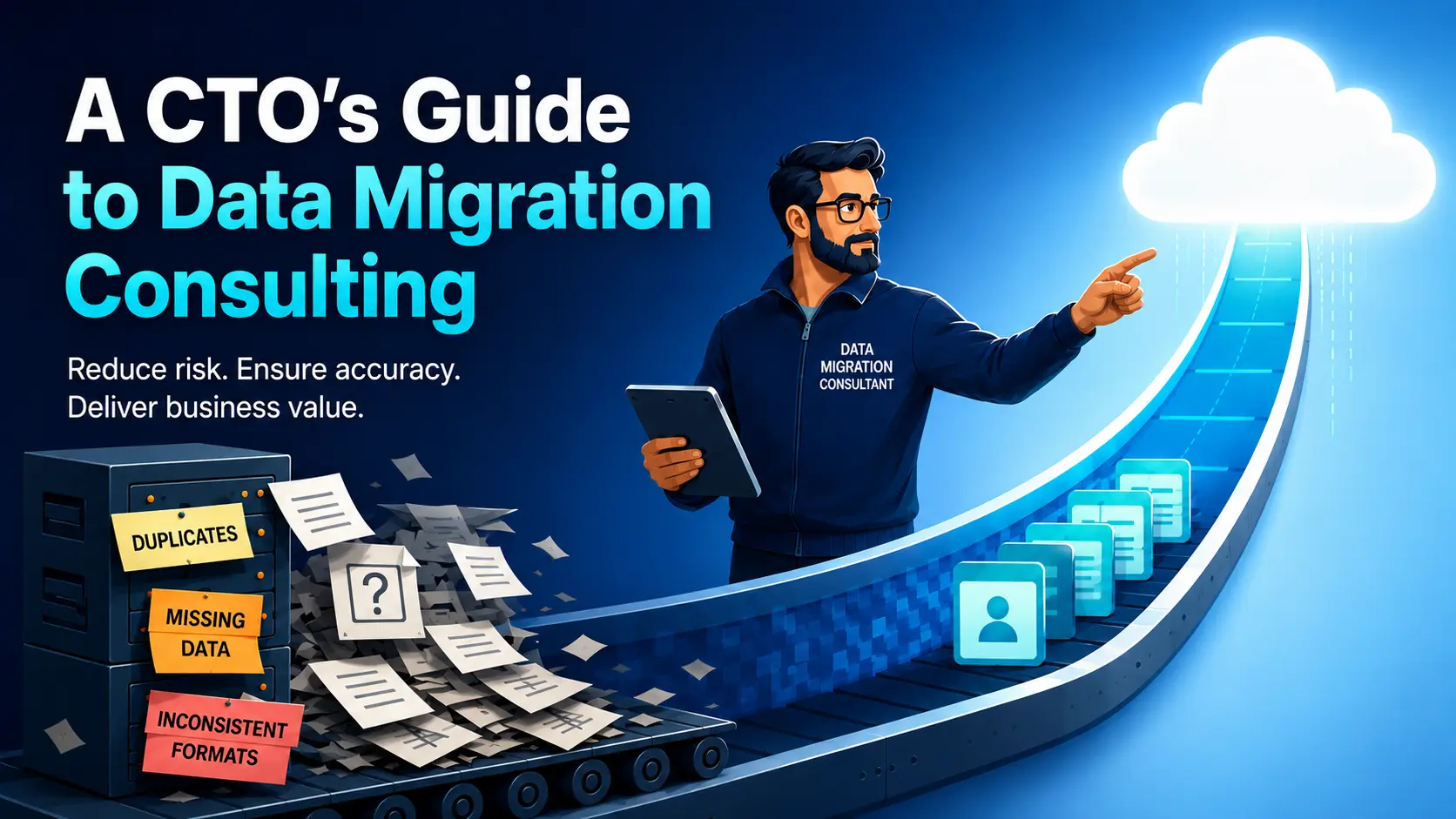
CTO overseeing data migration consulting as inconsistent legacy data moves through a structured pipeline into a cloud platform.

Introduction

Most data migrations go over budget, miss deadlines, or do both. An Oracle white paper puts the failure rate for projects involving data migration above 80%. Similarly, NetApp found that only 16% of projects finish on time and under budget

Moving data between systems sounds like a weekend of scripts, and most teams discover halfway through that they’re running a business project disguised as an engineering one. All these reasons created a market for data migration consulting. 

This guide explains what data migration consulting covers and where DIY migrations go wrong. It then walks through what consultants do at each stage, when to bring one in, and how to choose between firms.

What is Data Migration Consulting?

Data migration consulting provides expert assistance for transferring data from one system to another. Common scenarios include: 

  • migrating an old database to the cloud
  • replacing an ERP or CRM system
  • merging records from two companies after an acquisition. 

Successful data migration means every record is transferred accurately and on time, without disrupting daily operations.

Data copying is just a small part of the overall process. A consultant helps determine which data should be moved and how it fits into the new system. These consultants also design the checks needed to ensure that the transfer was successful. The majority of the work involves planning, cleaning records, testing, and coordinating with different departments to agree on how the new system should function.

The expertise of a consultant is what you are paying for. Someone with previous migration experience understands where potential issues may arise in your project. While the consultant focuses entirely on the migration, your team can continue to keep the rest of the business running smoothly. 

There’s no need to develop tools during the project because the consultant already has mapping and validation tools in place. This leads to fewer errors and a shorter timeline for the migration.
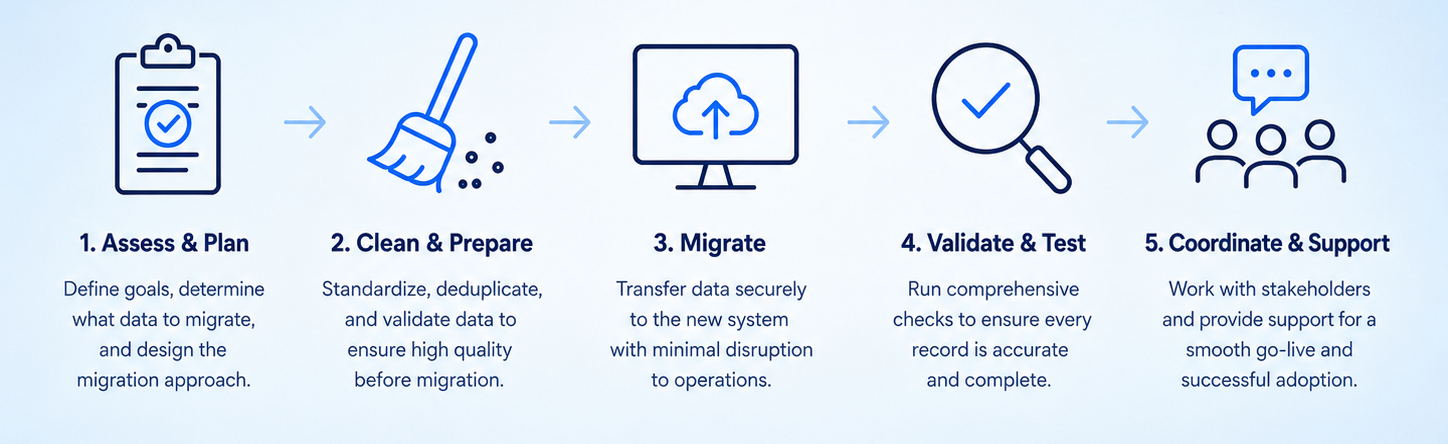
Five-step data migration consulting process covering planning, data preparation, migration, validation, and post-launch support.

Why Do Migrations Fail Without Expert Guidance?

The IBM Institute for Business Value found that over a quarter of organizations lose more than $5 million a year to poor data quality. A migration, in essence, surfaces the quality problems your legacy system tolerated for years.

You find the duplicate customers, the orphaned records, and the fields somebody repurposed for something else. The target system rejects or mishandles data that the legacy system accepted.

Flexera's 2026 State of the Cloud Report ranks understanding application dependencies as the biggest barrier to cloud migration. Cost comes second. Teams underestimate how many reports, integrations, and scheduled jobs depend on the data they plan to migrate.

DIY migrations fail in five predictable ways:

  1. Skip Data Profiling:
    Teams skip data profiling, so data issues appear during migration and delay the cutover.
  2. Assumption-Based Field Mapping:
    Field mappings rely on assumptions instead of documentation. For example, cust_status = 3 may no longer mean what everyone thinks.
  3. Big-Bang Cutover Without a Rollback Plan:
    Everything moves in one big-bang cutover with no rollback plan. If something breaks, recovery becomes a crisis.
  4. Incomplete Validation:
    Validation only checks row counts, missing errors in balances, dates, and relationships.
  5. Lack of Business Sign-Off Ownership:
    No one owns business sign-off, so users keep finding data issues long after the migration is declared complete.

Data migration consulting catches these in profiling and testing, before cutover. Our guide on why cloud data migrations fail goes deeper into this topic.

What Do Data Migration Consultants Do Across the Lifecycle?

Good migration consultants run the same phases on every project. They spend most of the time on profiling, mapping, and testing, so nothing surprises you on cutover weekend.

Step 1: Discovery and Assessment

Consultants create an inventory of every source system and profiles the data within each one. They measure volume, catalog quality problems, trace which systems and reports read the data, and record the security and compliance rules that apply.

This phase produces three documents:

  • A source inventory
  • A data quality report
  • A dependency map of the systems and reports that use the data

You can use these documents to price and schedule the project. Skip discovery, and you meet the same quality problems during execution, where every fix costs more and moves the date.

Step 2: Strategy and Planning

Based on the assessment, the consultant picks a migration pattern. The pattern can be big-bang, phased, or a parallel run (where both systems are live simultaneously).

The plan they write locks down five decisions:

  • The scope-split between move, archive, and delete
  • The load sequence
  • The cutover date
  • The rollback plan
  • The sign-off owner for each stage

A phased migration costs more planning hours and removes most of the risk. Big-bang runs faster and cheaper on a smaller project, provided you can lose a weekend to downtime. In most cases, you can expect a recommendation for the simplest pattern your downtime tolerance allows.

Step 3: Data Mapping and Transformation Design

Next, the consultant maps each source field to its corresponding destination field. They define the transformation rules, assign an owner for each mapping, and record the decisions in a mapping specification so the decisions remain traceable.

Mapping can reveal conflicting business definitions. If three systems store different customer addresses, someone has to decide which value serves as the authoritative record. The consultant documents the reasoning behind the choice so that future teams can understand the rationale.

A data migration consultancy facilitates these discussions with both business and technical stakeholders. The mapping specification serves as a reference for ETL development, testing, and future audits.
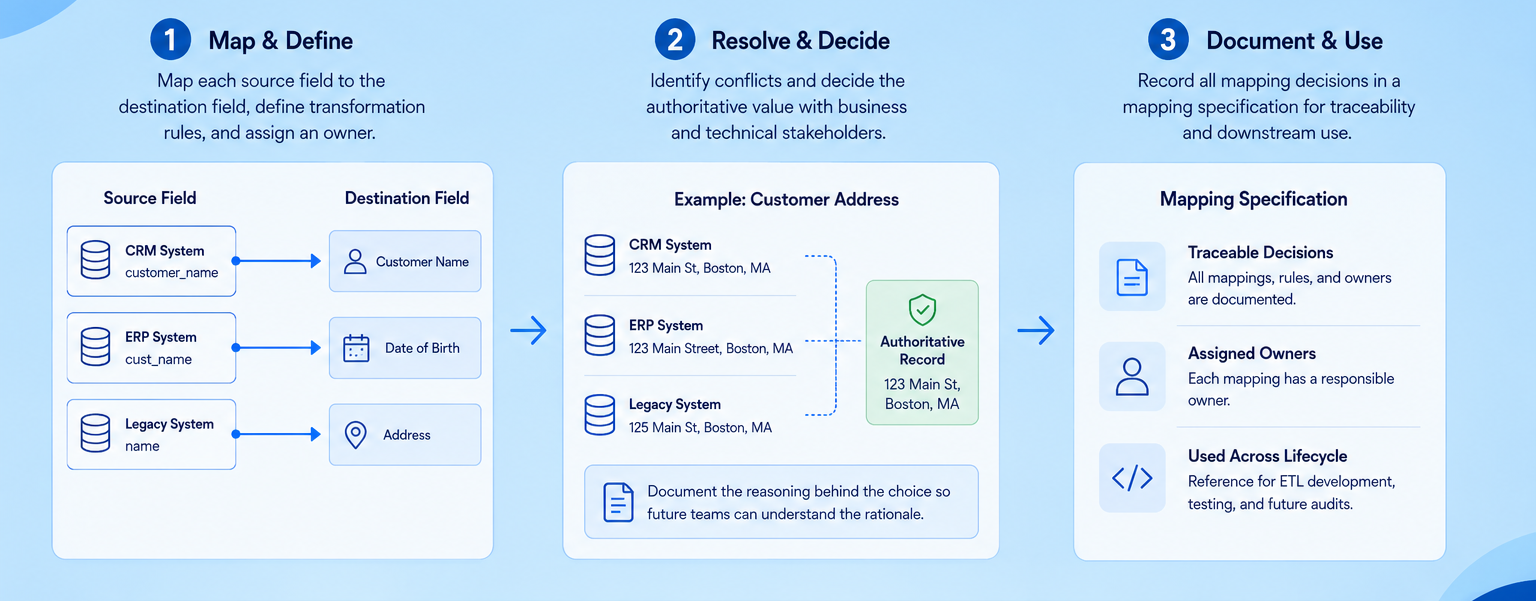
Three-step data mapping process covering field mapping, conflict resolution, and documented specifications for migration.

Step 4: Build the ETL or ELT Pipelines

A quality consultant builds the ETL or ELT pipelines from the approved mapping specifications. Most teams use tools like dbt, Airbyte, and Fivetran, and write custom code for systems those tools don’t support. 

The consultant designs the pipelines so a failed job can restart without duplicating records. Mapping errors are much easier and cheaper to fix during development, so they verify each transformation as they implement it.

They also design the data warehouse at this stage if a warehouse is the destination. The smallest warehouse size that can handle the workload and enable auto-suspend so idle warehouses shut down automatically is preferred. Clustering keys are also applied ((only to large tables that frequently need similar filtering in queries) at this stage. 

Step 5: Validation and Testing

Validation covers more than matching row counts. The consultant compares financial totals, verifies checksums on individual records, and assesses the percentage of empty fields in each column for both the source and target data. They also confirm that every child record in the target still references an existing parent.

Real business users conduct the acceptance testing themselves. They need to be able to close a financial period, access customer history, and complete any other workflows that the business relies on.

The consultant rehearses the entire cutover before the real one, performing each step within the scheduled maintenance window. A rehearsal that runs past the allotted time shows the plan needs work while there is still time to fix it.

Step 6: Governance, Security, and Compliance

A migration creates security risks that don’t exist in day-to-day operations. For example, extracts remain in staging storage after loading completes, teams share credentials, and sensitive records may cross boundaries between systems.

The consultant encrypts data while it moves between systems and while it sits in storage. They restrict staging access to authorized personnel and mask personal data in every environment outside production.

Throughout the migration, they document the origin of every data field and the changes it undergoes. They also keep audit records, because your team will need those records to demonstrate compliance with regulations, like GDPR and HIPAA, once the migration is complete.

Step 7: Cutover and Post-Migration Support

The consultant executes the cutover from a detailed runbook. The runbook outlines minute-by-minute tasks, clear go/no-go checkpoints, and a tested rollback procedure.

After go-live, they provide hypercare support. During the first few weeks of operation, they monitor the data pipelines, resolve production issues, and tune workloads.

Business stakeholders approve the migration before your team decommissions the legacy system. Your team takes over operations before the engagement ends and manages the new environment independently.
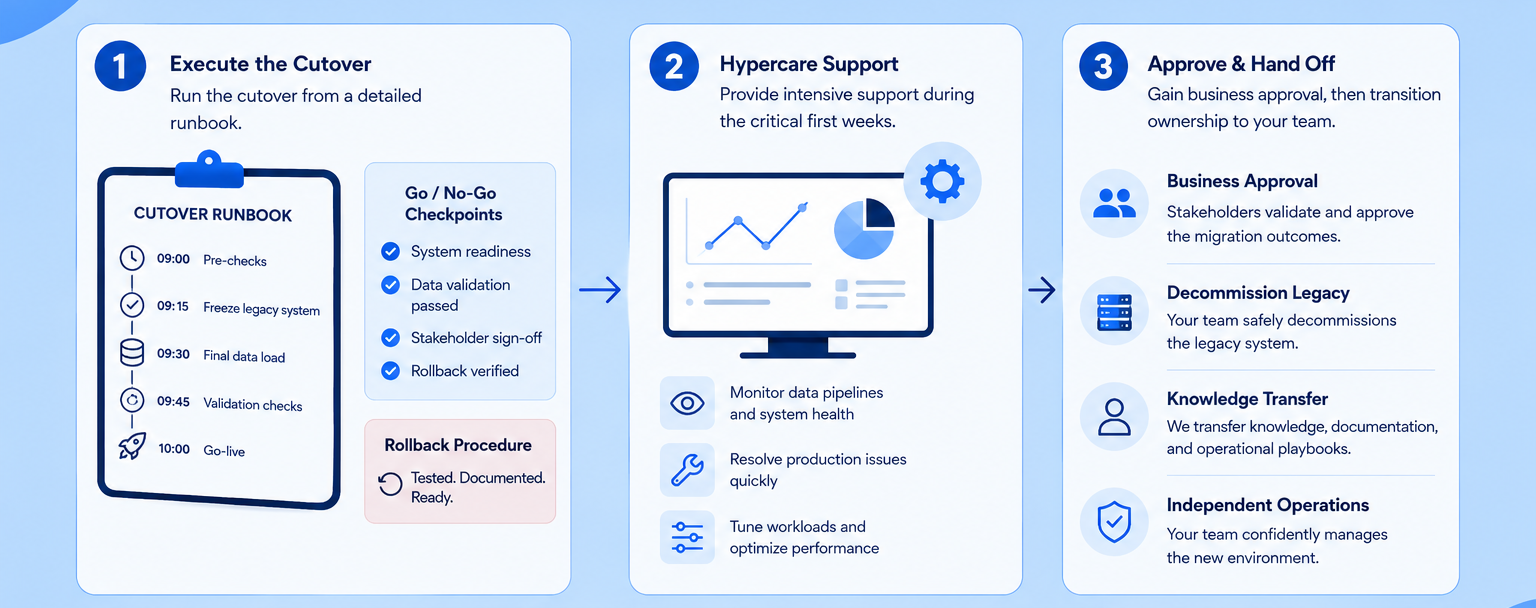
Three-step data migration cutover process covering runbook execution, hypercare support, approval, and operational handoff.

DIY Data Migration vs. Data Migration Consulting Services

Should every migration involve a data migration consultancy? No. A single small database with no compliance constraints and a tolerant downtime window is a fine internal project. The comparison below shows where the line usually sits.

FACTOR

DIY MIGRATION

DATA MIGRATION CONSULTING SERVICES

Upfront Cost

Lower (internal salaries)

Higher (fees typically $20k to $500k+ by scope)

Real Cost After Overruns

64% exceed the forecast budget

Fixed or milestone-based, scoped after assessment

Timeline

Competes with your roadmap; slips are common

Dedicated team; timeline contractually anchored

Data Quality Handling

Discovered mid-project

Profiled and remediated before the move

Testing Depth

Row counts, spot checks

Reconciliation, UAT, mock cutovers

Rollback Plan

Rarely rehearsed

Rehearsed as part of the runbook

Compliance Exposure

Depends on internal expertise

Auditable lineage, masking, access controls

Knowledge Afterward

Stays in-house by default

Requires deliberate knowledge transfer (put it in the contract)

Best For

Small, low-risk, single-system moves

Regulated data, multiple sources, hard deadlines, M&A

The honest breakeven is complexity, not company size. A 30-person fintech moving regulated transaction data needs data migration consulting more than a 500-person retailer moving a marketing database.

When Should You Hire a Data Migration Consultant?

Engage a data migration consultant during the evaluation of a new platform, ideally before signing the contract. Use their assessment to validate your choice of platform, determine the scope of the migration, and establish a timeline. Delaying this step until the project is behind schedule can turn a planned migration into a recovery effort.

Data migration consulting services are particularly valuable in the following situations:

  1. Consolidating Systems After a Merger or Acquisition: When dealing with multiple source systems, differing schemas, duplicate records, and conflicting business rules, migration becomes significantly more complex.
  2. Regulatory Requirements: It is essential to document compliance requirements, data residency rules, and retention policies before migration. This can help reduce the risk of compliance violations during and after the process.
  3. Replacing a Legacy System with Limited Documentation: Before designing the migration, review the source schema, business rules, and application dependencies. This thorough review can help identify hidden transformation requirements.
  4. Limited Downtime Tolerance: If the business has minimal tolerance for downtime, plan for a phased cutover or a near-zero-downtime migration. This strategy minimizes operational disruption but can increase implementation complexity.
  5. Capacity Constraints on Your Engineering Team: If your engineering team is already at capacity, assign a dedicated migration team. This allows for planning, testing, and validation to proceed without conflicting with daily delivery work.

By considering these factors, you can better ensure a successful data migration.

What Do You Need Before Engaging a Data Migration Consultancy?

You don't need to have every detail finalized before engaging a data migration consultant. It’s a part of his job to figure out the missing pieces. However, providing five key inputs can accelerate the discovery phase.

  • Named Business Owner: Assign one person to make data decisions and approve migration outcomes
  • Clear Business Objective: Define the main goal, such as cost reduction, platform replacement, acquisition support, or better performance
  • Access to Systems and SMEs: Provide source-system access, schema documentation, and time with subject matter experts
  • Documented Compliance Requirements: Share relevant regulations, data residency needs, and retention policies
  • Realistic Downtime Requirement: Set the maximum acceptable outage and account for the added work required for zero downtime
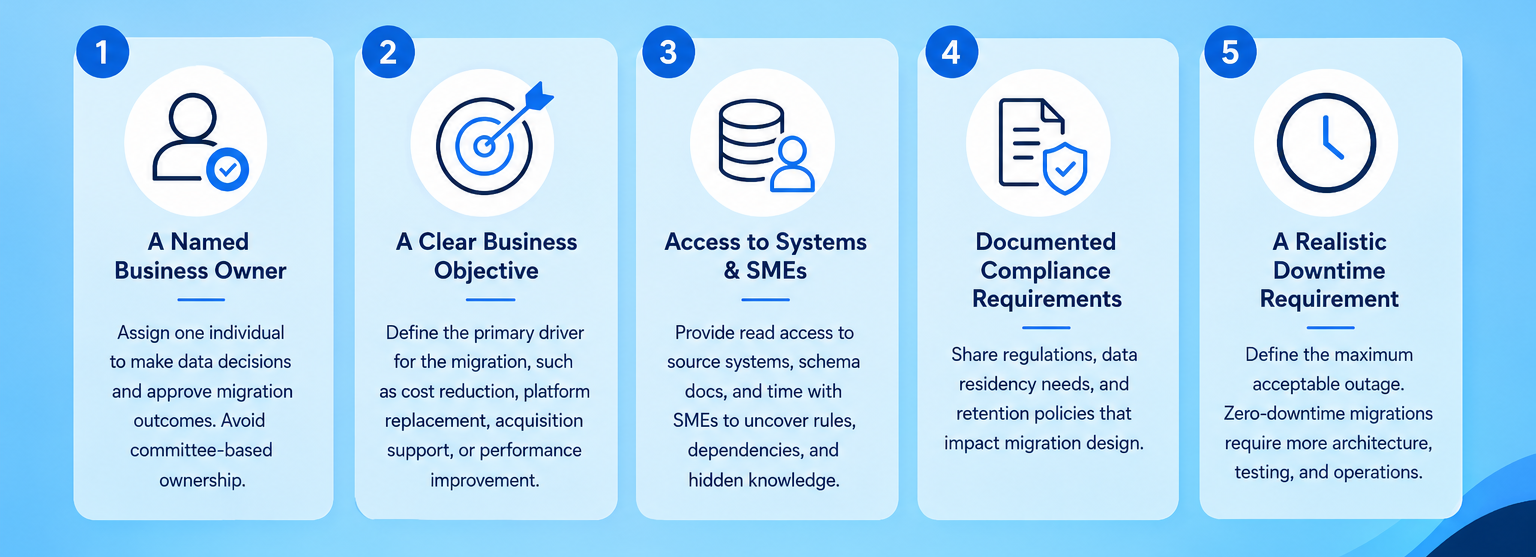
Five inputs for data migration consulting: a business owner, clear objective, system access, compliance needs, and downtime limits.

By providing these inputs early in the process, you can shorten the discovery phase and reduce assumptions. This enables consultants to scope the project based on known requirements, rather than including contingencies for uncertainty.

Best Practices for a Successful Migration Project

Whether you hire a consultant or manage the migration internally, these practices reduce project risk:

  1. Profile the source data before planning. Identify missing values, duplicate records, invalid formats, and orphaned records before estimating scope or timelines.
  2. Migrate only the required data. Archive obsolete records instead of migrating them. This reduces migration time, storage requirements, and validation effort.
  3. Freeze data mappings before execution. Finalize source-to-target mappings before migration begins. Limit mapping changes to critical issues to reduce rework and testing.
  4. Validate the migration with functional testing. Verify business-critical records, referential integrity, aggregates, and application workflows. Perform at least one full trial migration before production cutover.
  5. Keep the source system available after cutover. Retain the legacy system until business stakeholders complete validation and approve the migration. This provides a rollback option if critical issues emerge.
  6. Document mapping and transformation rules. Record field mappings, transformation logic, and migration decisions. This simplifies troubleshooting, audits, and future migrations.

Common Migration Challenges and How Consultants Solve Them

CHALLENGE

HOW A DATA MIGRATION CONSULTANCY HANDLES IT

Undocumented Legacy Schemas

Automated profiling plus interviews with long-tenured staff to reconstruct meaning before mapping

Dirty Source Data

Cleansing rules applied in the pipeline, with a defect log the business reviews and approves

Conflicting Records Across Systems

Survivorship rules agreed with stakeholders, documented in the mapping specification

Hard Cutover Deadlines

Phased migration with parallel running, so the deadline gates one slice, not everything

Hidden Downstream Dependencies

Dependency mapping during assessment where every report and job that reads the data gets an owner and a test

Regulatory Exposure in Transit

Encryption, masked non-production copies, role-based staging access, and documented lineage

Post-Cutover Performance Problems

Hypercare period with query tuning and warehouse right-sizing before handover

Checklist To Choose the Right Data Migration Consulting Services

Day rates for data migration consulting services tend to vary less than the outcomes of the projects. Use the following checklist when comparing these services:

  1. Platform Experience: Choose a consultant who has prior experience with your new platform. For instance, if you are migrating to Snowflake, inquire specifically about their Snowflake migration projects rather than just their general cloud experience. Familiarity with your specific platform helps prevent common mistakes.
  2. Initial Assessment: A reputable consultant will review your data before providing a comprehensive project quote.
  3. Testing Plan: Request sample reports that demonstrate how they test and verify the migration process.
  4. Rollback Plan: Inquire about their contingency plan in case the migration fails during the final switch.
  5. Qualified Team Members: Ensure you meet the actual consultant who will be working on your project, rather than just interacting with the sales team.
  6. Relevant Experience: Ask for references from projects that are similar in size, systems, or industry to yours.
  7. Team Training: Confirm that they will provide documentation, training, and a proper handover to your team.
  8. Post-Migration Support: Inquire about the duration of their support after the go-live date, how promptly they address issues, and the cost of any additional support.

Any data migration consultant worth considering will confidently answer these questions. Be cautious of those who avoid discussions about testing and rollback plans, as they may not deliver satisfactory results.

Where to Go From Here?

One pattern runs through the statistics in this guide. Migrations fail in the planning and testing phases, not in the data transfer. Whichever consultancy you hire, look for one that wants to profile your data before quoting. Similarly, they should treat testing as a third of the project rather than a formality.

We've done this kind of work for years at Data Prism. The projects include moving datasets into BigQuery and Snowflake for clients who needed the numbers to match on Monday morning. Our data migration services start with the assessment this guide describes. 

If you're weighing a migration and would like a second opinion on scope, risk, or platform choice, book a free consultation. You're welcome to bring your ugliest schema, because we've seen worse.

Book a Free 30-Minute Meeting

Discover how our services can support your goals — no strings attached. Schedule your free 30-minute consultation today and let's explore the possibilities.

Book a Free Call

Frequently Asked Questions

Data migration consultants assess source data, define source-to-target mappings, build migration pipelines, validate migrated data, and coordinate production cutovers. On larger projects, they also work with business stakeholders to resolve data definition conflicts and obtain business sign-off before go-live.

Data migration costs depend on the number of systems, data quality, and how much data needs to be cleaned or transformed. Simple migrations can cost tens of thousands of dollars, while complex projects can cost hundreds of thousands or more.

Project timelines depend on the size and complexity of the migration. Simple database migrations typically take 4 to 8 weeks, including testing. Data warehouse migrations involving multiple source systems often require 3 to 6 months. Enterprise ERP migrations and post-merger consolidations commonly take 6 to 18 months. Testing account for a significant portion of the project schedule.

A consultancy may not be necessary for small migrations involving a single, well-documented system when the data is not regulated, the business can tolerate downtime, and the internal team has completed similar migrations successfully. Even then, the project should include a documented migration and testing plan.

Data migration moves data from one system to another as part of a one-time project. Data integration continuously synchronizes data between systems while they remain operational. Many modernization projects require both migration and ongoing integration.

Validate the migration by comparing record counts, financial totals, checksums, and referential integrity between the source and target systems. Business users should also verify critical workflows before approving the migration. A completed data load alone does not confirm a successful migration.

Book Consultation