What Are the Benefits of Using Transient Tables in Snowflake?

Usman AshrafJul 18, 2025
What Are the Benefits of Using Transient Tables in Snowflake?

Introduction

If you’re working with short-lived datasets or intermediate results in Snowflake, transient tables might be your best ally. Unlike permanent tables, which are designed for long term data storage and come with time travel and fail-safe retention, transient tables are built to optimize cost for temporary use cases.

So, what exactly are transient tables? In Snowflake, they are a type of table that doesn’t
include a Fail-safe period, and their Time Travel retention is limited to just one day (or less, depending on settings). This means that once data is dropped or changed, recovery options are minimal but the cost savings are significant. You can dive deeper into the fundamentals of Snowflake’s Time Travel and retention policies in our detailed Time Travel guide.

When Should You Use Transient Tables?

Transient tables are ideal for workloads where data is temporary or intermediate, such as:

    • Staging tables used in ETL pipelines
    • Intermediate transformation results
    • Data snapshots for short-term analysis
    • Sandbox environments for testing logic

In each of these scenarios, storing data permanently offers no added benefit. By switching to transient tables, you avoid unnecessary charges for fail-safe and extended Time Travel retention.

If you're building data pipelines or workflows using our Data Engineering services, we often recommend transient tables for optimizing performance and cost.

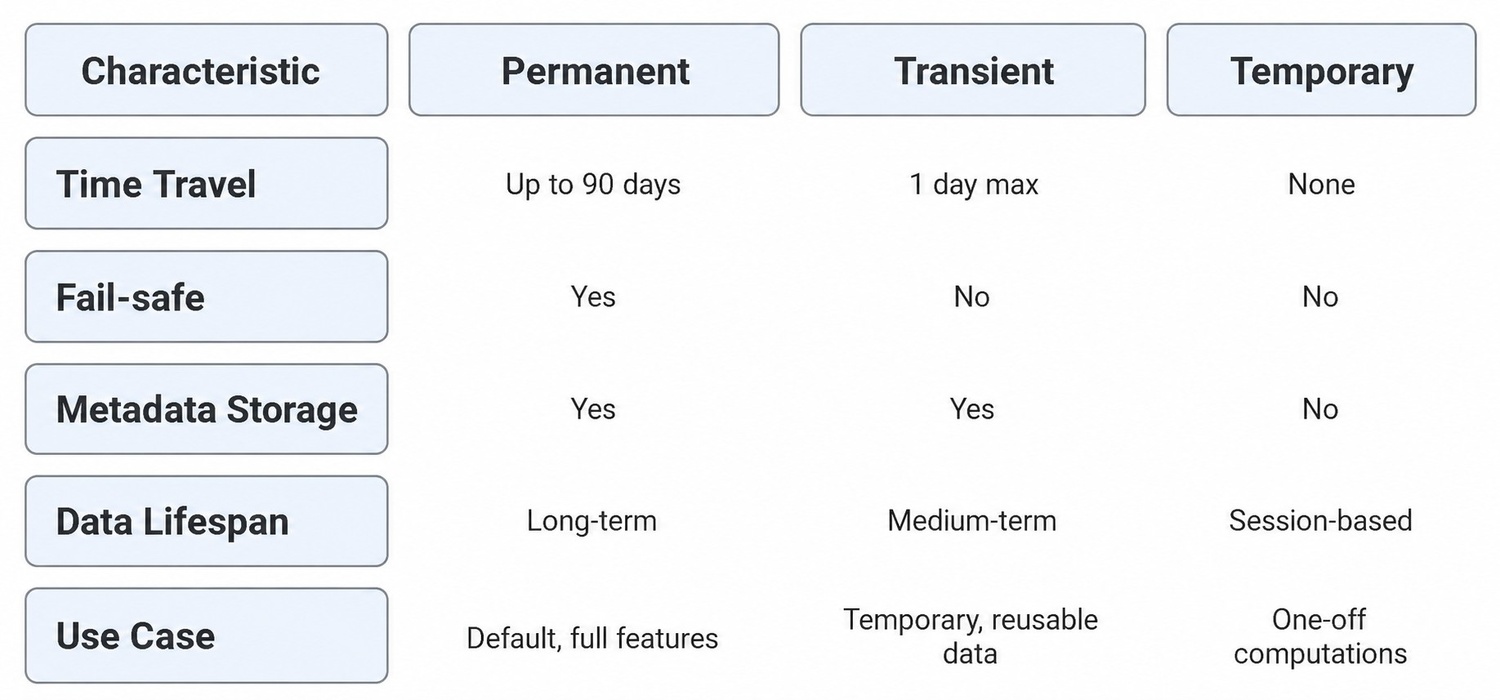
Transient vs. Temporary vs. Permanent: What's the Difference?
comparison-200kb-jpeg

Permanent Tables:

Default type with full features—Time Travel (up to 90 days), fail-safe, and metadata storage.

Transient Tables:

Time Travel support (1 day max), no fail-safe; best for temporary but reusable data.

Temporary Tables:

Session-based, drop automatically when the session ends; great for one-off computations.

Choosing between these options depends on your business use case and data lifecycle. Forexample, if you're managing one-time scraping tasks, our Web Scraping solutions often use temporary tables. For recurring transformations, transient tables strike the right balance between flexibility and savings.

Cost Benefits of Transient Tables

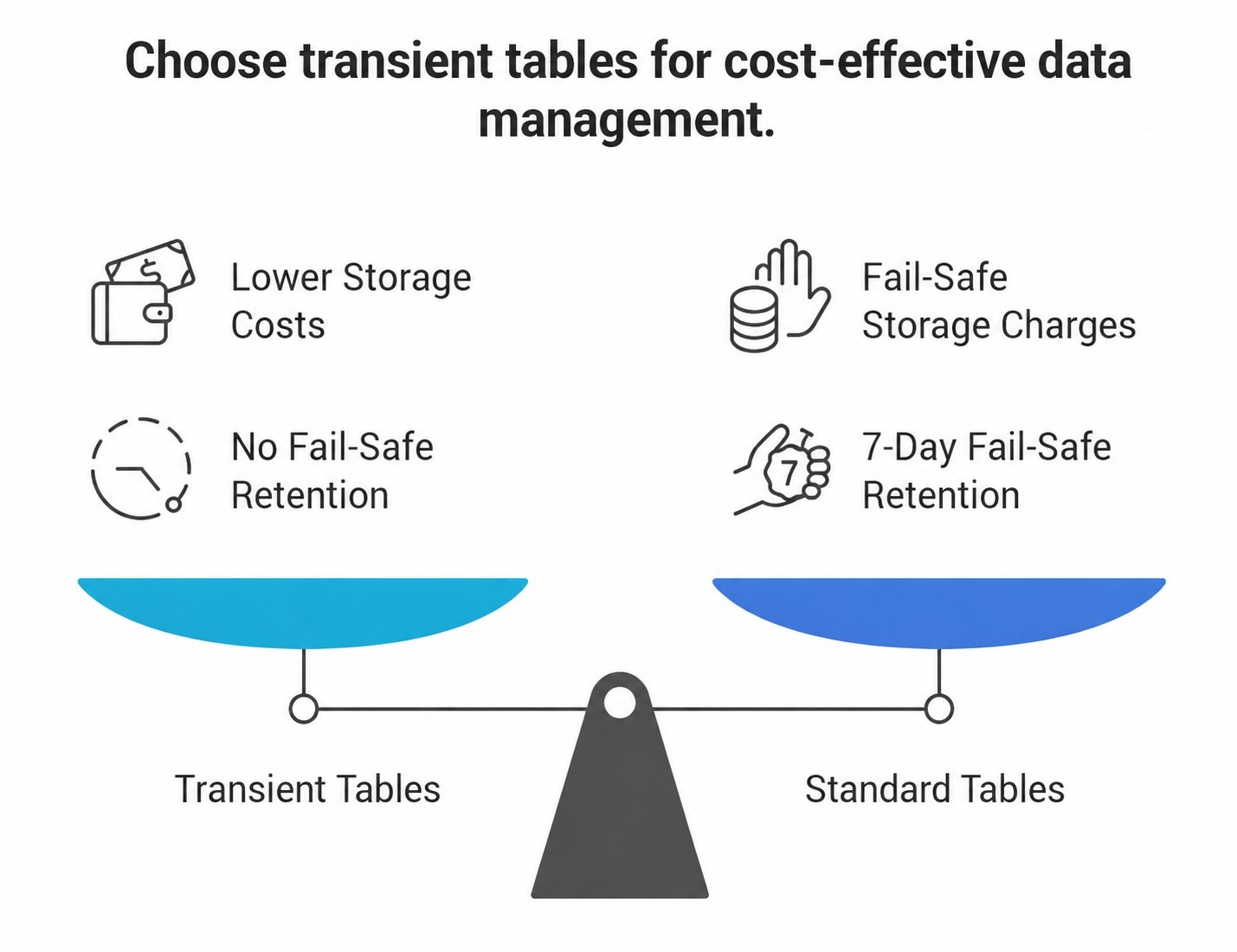
The main financial benefit comes from eliminating fail-safe storage charges. Snowflake
retains data in a fail-safe for 7 days after Time Travel expires, during which recovery is
possible but costly. Transient tables skip this altogether, allowing you to pay only for what you use.
benefits-jpeg

Plus, they reduce storage usage in environments like:

    • Development and QA, where datasets are refreshed often
    • Ad hoc analysis
    • Batch processing with no long-term storage needs

If you also want to take advantage of Snowflake’s cost-saving mechanisms, consider
combining transient tables with Zero-Copy Cloning to test and iterate faster.

Transient tables offer a smart, budget-friendly way to manage non-critical data in Snowflake. They're particularly effective in agile environments where speed, flexibility, and cost-efficiency are priorities. Just remember: if your data might need recovery beyond one day, transient might not be the safest choice.

Book a Free 30-Minute Meeting

Discover how our services can support your goals — no strings attached. Schedule your free 30-minute consultation today and let's explore the possibilities.

Book a Free Call

Frequently Asked Questions

Ideal for development, QA, ad hoc analysis, and batch processing where data doesn’t need long-term storage or recovery beyond a day.

Yes, they reduce storage costs by skipping fail-safe and extended Time Travel, offering savings for temporary and frequently refreshed data.

Transient tables store temporary data with limited Time Travel (1 day) and no fail-safe, ideal for short-lived or intermediate datasets.

Book Consultation